

Comparing Interior Quotations in Pimple Nilakh, Pune: A Scope and Payment Guide
To compare interior quotations in Pimple Nilakh, give each provider the same drawings, quantities and specification schedule. Add missing work, taxes and owner-supplied purchases to a comparison sheet before judging totals. Agree payment triggers and substitutions in writing. Check the final scope against the measured site rather than choosing solely from the initial quoted amount.
A worked comparison: the lower starting total may not stay lower
Consider two hypothetical proposals for the same brief. Proposal A starts at ₹8.4 lakh and omits ₹1.1 lakh of required work. Proposal B starts at ₹9.1 lakh and omits ₹0.4 lakh. Both adjusted totals are ₹9.5 lakh before any other unresolved items. These figures illustrate arithmetic, not Pimple Nilakh market pricing.
The adjustment only becomes meaningful after missing items are specified and priced consistently. Do not insert an arbitrary allowance simply to make the totals match. Mark an unresolved item as pending and obtain the provider’s written price.
- Use one room-wise BOQ.
- Record each inclusion, exclusion and provisional amount.
- Reconcile quantities and measurement units.
- Add only confirmed comparison adjustments.
- Compare responsibility, programme and service terms alongside cost.
Ask what evidence supports each agreed payment trigger. Follow the signed commercial terms and record changes rather than assuming a generic payment percentage applies to every project.
What should two interior quotations have in common before you compare them?
They need the same brief. Ask each designer to quote against identical rooms and deliverables: kitchen, wardrobes, TV or storage units, beds, study areas, false ceiling, electrical changes, painting, curtains, loose furniture and installation. If one proposal includes only fixed carpentry and another includes civil work or appliances, their totals cannot be compared fairly.
Record the property type and constraints at the top of the brief. A new apartment may need coordination for builder handover items, while an occupied resale home can involve dismantling, protection, debris removal and making-good work. A compact apartment also makes internal storage, door clearances and service access more consequential than attractive elevation drawings.
Comparable input
Use one room schedule, one drawing set, one finish expectation and one list of inclusions. Mark items that are undecided instead of allowing each bidder to assume differently.
Decision output
Compare the adjusted total, exclusions, lead time, supervision responsibility, warranty wording and payment exposure—not just the headline number.
Which BOQ gaps can make a low quotation expensive later?
A quotation should identify quantities, dimensions, unit rates or a clear lump-sum basis. “Modular kitchen” is not a sufficient line item. Look for carcass material, thickness, shutters, edge treatment, internal accessories, hardware series, countertop, backsplash, sink, waste connection and installation.
The same discipline applies to wardrobes and storage. Check whether the quote states the number of shutters, cabinet depth, lofts, internal shelves, drawers, hanging sections, handles, soft-close hardware and mirror or glass provisions. For a TV unit, clarify backing, cable access, drawers, wall preparation and electrical coordination.
| Quotation area | Specification to record | Acceptance check |
|---|---|---|
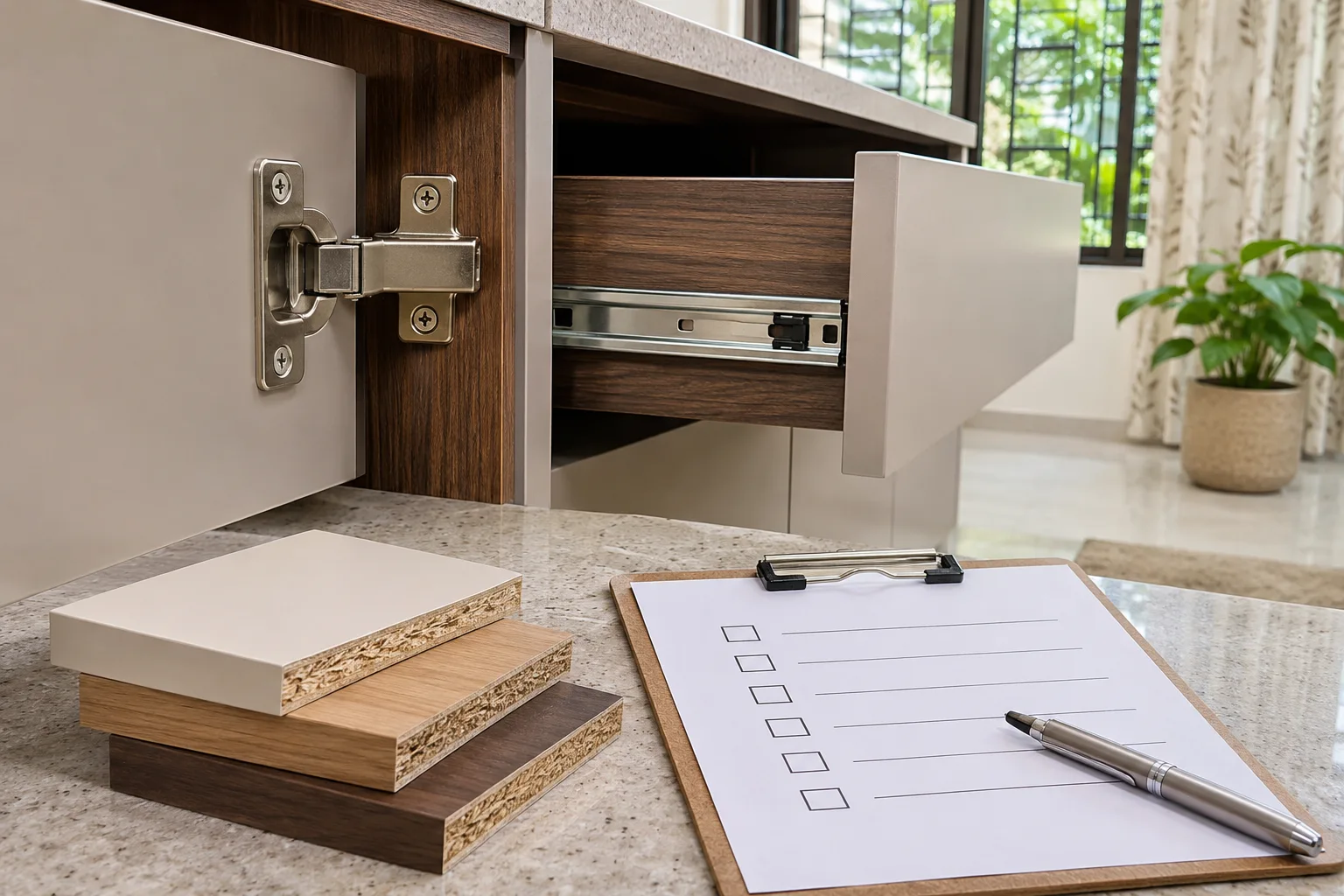
| Board and finish | Board type, thickness, grade, laminate or veneer, edge banding and exposed-side finish | Confirm sample, thickness and visible finish before production |
| Hardware | Hinges, channels, lifts, baskets, handles, brand or equivalent grade and load expectation | Operate every door and drawer; check alignment and soft-close action |
| Countertop and sink | Material, thickness, cut-outs, edge profile, sink model or allowance, sealing responsibility | Check level, joints, cut-out accuracy and water-tight sealing |
| Services | Electrical points, plumbing shifts, exhaust route, appliance connections and testing | Test circuits, switches, drainage and appliance clearances |
| Site work | Dismantling, protection, debris removal, transport, loading restrictions and touch-ups | Confirm the site is clean, protected items are undamaged and snags are closed |
Ask specifically about taxes, transport, lifting or handling, installation, measurement visits, design fees, sample development and any minimum order condition. Civil work exclusions deserve a separate line: wall repairs, waterproofing, plumbing relocation, masonry, flooring, gas-line work and electrical rewiring may sit outside an interiors package.

How should material grades and “equivalent” products be judged?
Material language must be specific enough to prevent substitution without approval. “Premium plywood” or “branded hardware” describes an intention, not a deliverable. Request the board category and thickness for each use, the surface finish, edge treatment and the environment in which it will be installed. Kitchen sink units, bathroom-adjacent storage and utility cabinets need more careful moisture planning than a dry bedroom wardrobe.
Brand names alone are not a quality specification. A quotation should state the proposed brand and series where relevant, or define an equivalent by measurable performance: board thickness, hardware load rating, finish type, warranty and compatible dimensions. If an equivalent is proposed because of availability, obtain written approval before procurement. A cheaper substitute can affect door weight, alignment, repairability or the appearance of adjoining pieces.
Recommended material schedule
- Item and location: for example, kitchen base units or bedroom loft shutters.
- Core material, thickness and finish: include visible edges and backs.
- Hardware: manufacturer, series or agreed performance level.
- Sample and approval reference: record the selected laminate, colour, handle and stone.
- Maintenance and warranty note: state what is covered and what is excluded.
Which payment milestones protect both the homeowner and the execution plan?
Payment should follow identifiable progress, not vague calendar dates. A sensible structure links each instalment to approved drawings, material procurement, factory completion, installation progress and handover. The exact percentages depend on the contract and project size; the principle is that a large advance should not be released before the scope and specifications are stable.
Before paying an advance, ask what it funds, which materials will be ordered, how cancellations are handled and whether taxes are included. Clarify the trigger for every invoice and the evidence required: approved shop drawings, delivery records, photographs, measurement sheets or a site inspection. Keep a retention or snag-resolution mechanism only if it is clearly written and acceptable to both parties.
- Design approval: drawings, room schedule, finishes and revision limits are signed off.
- Procurement: approved materials and hardware are documented; substitutions require consent.
- Installation stages: payments correspond to measurable room or package progress.
- Handover: testing, cleaning, warranty documents, keys and a closed snag list are completed.
Do not treat a payment calendar as permission for unlimited changes. A change order should show the requested change, revised quantity, cost or credit, tax impact, schedule effect and written approval before work proceeds.
Can digital checks reveal quotation differences before a meeting?
They can organise the comparison, but they do not replace a site measure, material sample or contract review. WallsToWonder’s tools can help make the first pass more systematic:
Interior design cost estimator
Use it to frame a budget discussion and identify how room count, scope and finish choices may influence the allowance. Treat the result as planning guidance, not a final quotation.
Quotation checker
Use it to surface missing descriptions, unclear exclusions and payment wording that deserve questions. Verify every flagged item against drawings and the designer’s written response.
What should you ask designers before releasing an advance?
Ask for the person responsible for measurement, design coordination, procurement, site supervision and final handover. One company may divide these roles; another may assign several to one coordinator. Neither arrangement is automatically better, but the responsibility must be visible.
Scope and coordination
- Which items are excluded, and who coordinates civil, electrical and plumbing work?
- What happens if the actual site dimension differs from the drawing?
- Are society permissions, protection, working hours and debris movement included?
Commercial control
- How are revisions, damages, delays and approved substitutions documented?
- When does the warranty begin, and who handles service requests?
- What documents accompany handover?
Useful warranty wording names the product or workmanship covered, duration, exclusions, response process and whether labour or replacement is included. “Warranty as per company policy” needs supporting terms before it can be evaluated.
Which red flags justify pausing the comparison?
A quotation deserves clarification when it has a single unexplained total, no dimensions, no material schedule, copied room descriptions, unusually broad “premium” language or a payment demand that is disconnected from progress. Be cautious when the proposal excludes measurement but promises a fixed outcome, or when the designer refuses to record an agreed substitution.
Another warning sign is a very low price created by omissions: no back panels, no transport, no installation, no site protection, no electrical finishing or no tax. A higher quote can also be weak if it hides quantities and gives no way to verify what has been purchased. Ask both sides to revise the document into the same comparison format.
Make your shortlist easier to audit
Use the WallsToWonder designer directory to explore designers and companies serving Pimple Nilakh and nearby Pune localities. Share the same brief with each shortlisted professional, then retain the approved BOQ, material schedule and milestone plan with the agreement.
Frequently asked questions from Pimple Nilakh homeowners
Should I choose the cheapest interior quotation?
No. First normalise scope, material grades, exclusions, taxes, hardware and payment triggers. Compare the adjusted proposals rather than the initial totals.
Is plywood always better than every other board?
Not automatically. Suitability depends on location, moisture exposure, thickness, edge treatment, finish and workmanship. Specify the application instead of relying on a generic label.
Can the designer change a brand after I approve the quotation?
Only under the agreed substitution process. Ask for written approval, equivalent specifications and any price or schedule adjustment before procurement or installation.
How much advance should I pay?
There is no universal safe percentage. Release funds against clearly defined milestones, approved documents and procurement evidence, with the commercial terms written into the contract.
What is the most useful document at handover?
Keep the final as-built scope, approved material and hardware schedule, invoices where applicable, warranty terms, care instructions, test records and a closed snag list.
Prepare your next review with WallsToWonder
Use the interior cost estimator to organise a preliminary scope and the quotation checker to identify questions for the provider. Confirm the results against the site and written documents. Explore the company directory and confirm service availability in Pimple Nilakh, Pune directly.
For a related practical checklist, read this guide to planning the actual room, site or handover before your next consultation.
Get a personalised estimate for your home
Choose your rooms, materials and preferences to understand a practical interior budget before you commit.