
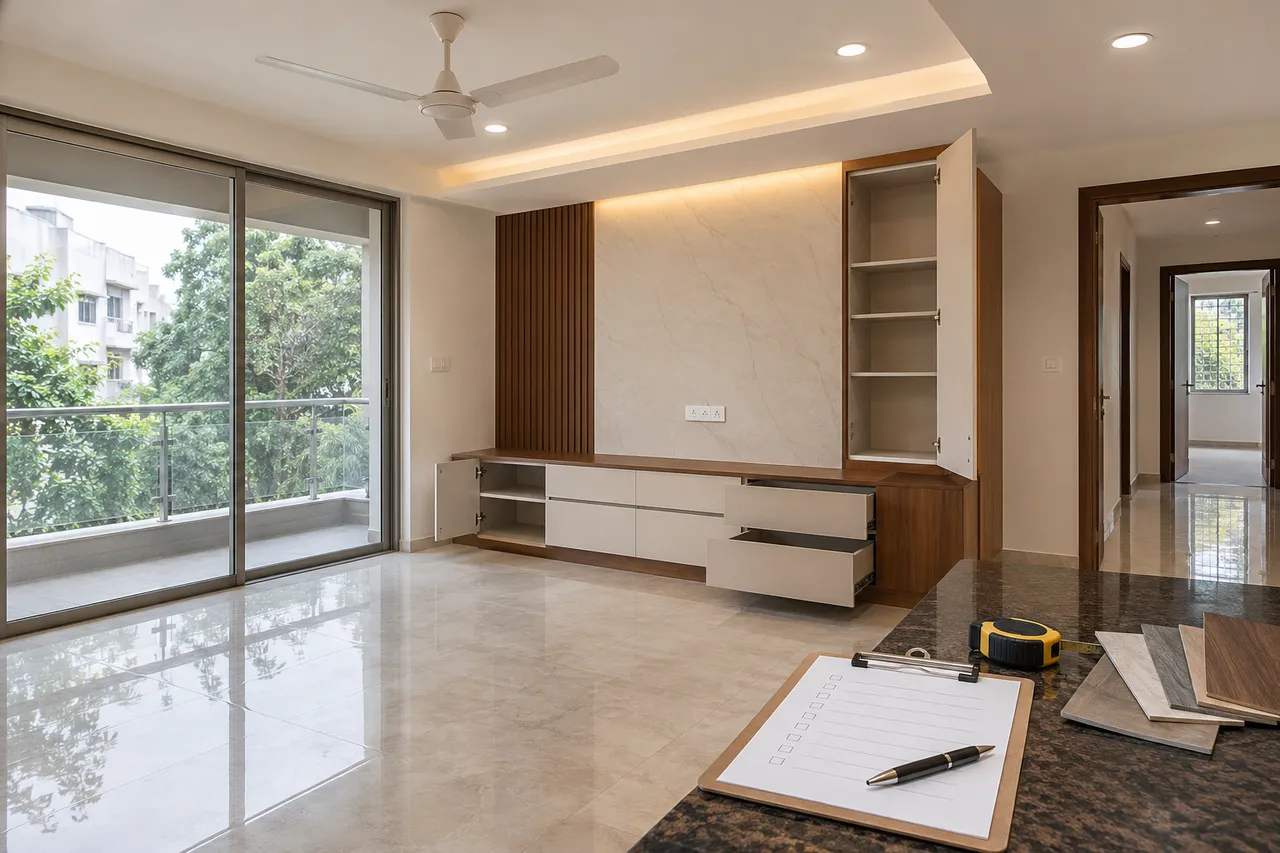
Prabhat Road Pune Interior Handover Checklist: Inspect Before Final Payment
For interior handover on Prabhat Road, compare installed work with approved drawings and record specific defects room by room. Operate accessible furniture normally and arrange service testing by qualified professionals. Collect care instructions, warranties and pending-work dates. Review completion and payment against the agreed contract rather than treating a visual walkthrough as technical certification.
Build a snag record that separates observation from technical testing
A homeowner can note a chipped panel, rubbing drawer or missing handle. Electrical verification, uncertain plumbing faults and equipment commissioning should be handled by appropriately qualified people. Ask for the relevant test or installation records within the agreed scope.
For each issue, record an identifier, room, component, observation, photograph, responsible party, target date and recheck result. A statement such as “electrical pending” is too broad to track. Describe the visible issue and assign the technical assessment to the responsible professional.
- Compare the latest approved scope.
- Record visible and operational issues.
- Arrange required specialist checks.
- Reinspect corrections before closing the record.
- Apply the agreed handover and payment terms.
Do not invent a retention percentage or assume you can alter payment terms unilaterally. If completion is disputed, record the issue and use the contract’s process. Keep service instructions and future maintenance access with the handover file.
What must be true before the final payment is released?
The performance objective is simple: every contracted item should be installed, usable, visually acceptable and documented. “Installed” is not enough. A drawer that opens but scrapes, a tap that works but leaves a damp joint, or a wardrobe shutter that closes only when lifted is not a completed handover.
Start with the latest approved quotation, drawings, finish schedule and change approvals. Mark each item as accepted, snagged, not applicable or pending due to another party. Do not rely on a verbal promise that a missing component will be supplied later.
Payment control: retain a clearly agreed amount until the snag list is closed, documents are received and all installed systems have been tested. The exact commercial arrangement depends on the contract; the principle is to connect payment to measurable completion.Which surfaces and moving parts reveal poor execution first?
Inspect in daylight and again with the room lighting switched on. Look along long cabinet edges, skirting lines, wall panelling and countertop joints. Small variations become more visible when adjacent lines meet at a corner. Check that shutters are level, reveals are consistent, and doors do not collide with handles, walls or neighbouring shutters.
Alignment and shutters
Open every cabinet and wardrobe shutter fully. Check hinge movement, soft-close action, gaps between shutters, edge-banding, drawer clearance and contact with internal shelves. Shutters should remain in position without drifting open or dropping.
Hardware and load behaviour
Test handles, channels, hinges, lift-up fittings, baskets and locks several times. Operate drawers with a normal load where practical. A smooth empty drawer can still bind when loaded, so the acceptance check should reflect intended use.
Finishes and edges
Check laminate joints, veneer direction, paint coverage, exposed screw heads, chipped corners and uneven polish. Inspect reflective finishes from different angles rather than judging one photograph or one light source.
Sealants and wet interfaces
Ask the installer to verify specified wet-area joints against the approved detail and the product instructions. Check for visible gaps, damage or poor finish, and record who maintains each joint. Do not assume the same sealant or joint detail is appropriate everywhere.

Have the kitchen, plumbing and appliances been coordinated as one system?
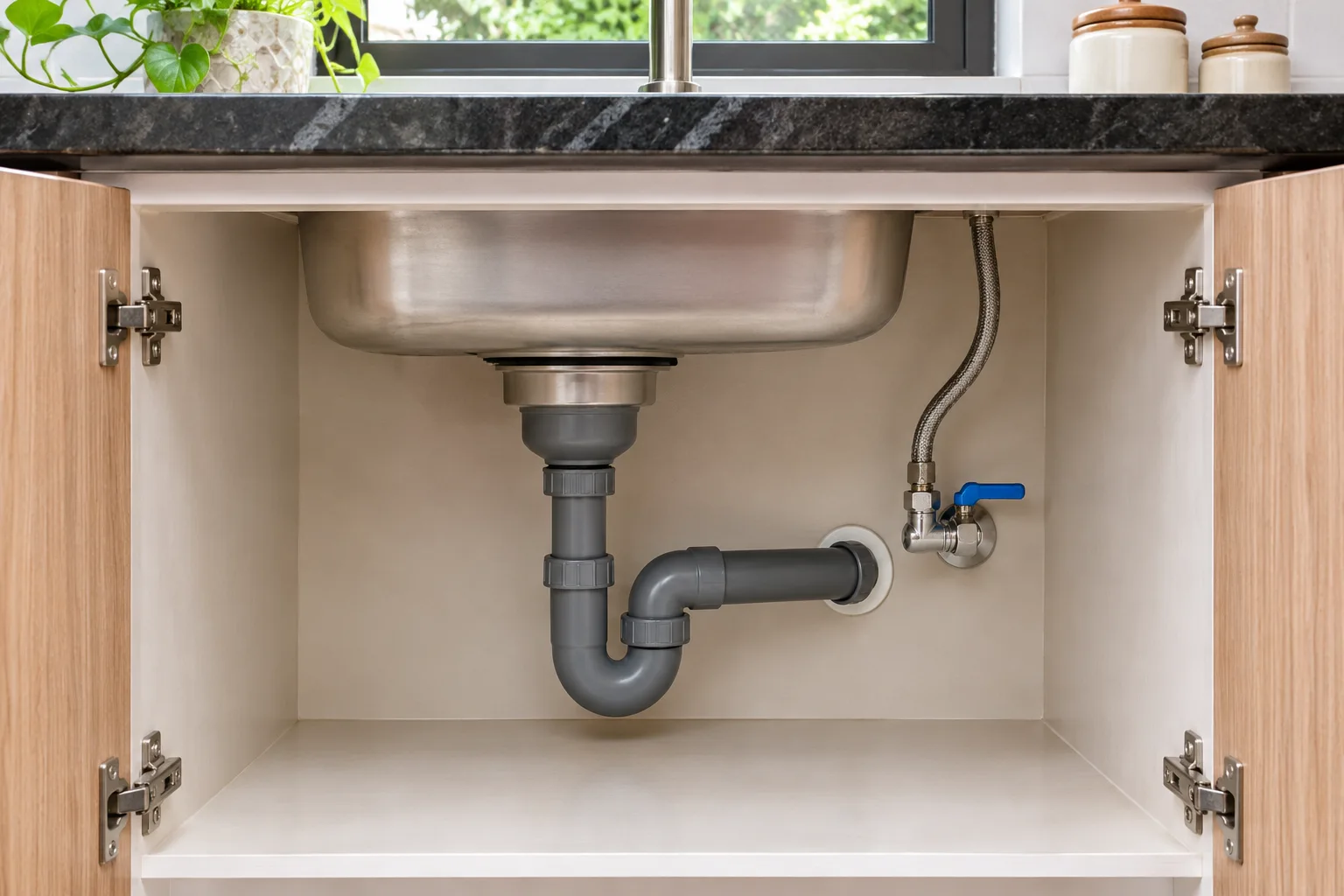
Review the kitchen as a coordinated installation. Ask the responsible installer to demonstrate sink operation, drainage and accessible connections, and to verify countertop installation against the approved design. Record moisture or visible defects below the sink without dismantling fittings yourself.
Place the specified appliances in their intended positions, even if some are being supplied separately. Confirm refrigerator, washing machine, dishwasher, hob, chimney, microwave and oven clearances against the actual models. Check ventilation routes, service access, door swing and plug locations. A cabinet that fits an appliance on paper may fail once the plug, hose, handle or ventilation gap is included.
For bathrooms and utility areas, operate every tap, flush, floor trap and shower diverter. Check hot and cold orientation where relevant, drainage speed, leakage around connections and access to isolation valves. Do not accept a wet-area inspection based only on a dry visual walkthrough.
What electrical checks are reasonable at handover?
Operate accessible lights and controls normally. Arrange socket, circuit, protection and load verification by a qualified electrician, and obtain the relevant records. Record visible damage or an unexplained fault without opening fittings or attempting electrical tests yourself.
The designer or contractor should provide the relevant electrical documentation and identify circuits clearly. Do not open distribution boards or alter wiring yourself. If there is tripping, exposed wiring, a missing cover, unexplained dead point or uncertainty about load compatibility, record it for correction by the responsible electrical professional.
Can the quotation prove what was actually delivered?
Quotation review is a handover task, not only an advance-payment task. Compare the final installation against the description, quantity, material thickness or grade where specified, hardware brand or equivalent clause, finish code and inclusions. Pay particular attention to vague phrases such as “premium hardware”, “standard accessories” or “complete electrical work”. These need a documented interpretation before acceptance.
| Quotation area | Acceptance question | Evidence to retain |
|---|---|---|
| Carpentry and modular units | Do quantities, dimensions, internal fittings and finish codes match the approved scope? | Final marked-up drawing, material schedule and photographs |
| Hardware | Are the installed hinges, channels, lifts, locks and handles the specified items or an approved substitute? | Product details, warranty terms and operating test |
| Electrical and lighting | Are fittings, points, controls and accessories complete and functioning? | Point list, circuit information and test record |
| Plumbing and appliances | Are connections, cut-outs, clearances and service access usable with the actual equipment? | Model details, installation notes and leak check |
| Exclusions and variations | Are owner-supplied items, civil repairs, society permissions and later work clearly separated? | Signed variation or exclusion note |
Which digital checks can reduce quotation and budget confusion?
Tools cannot replace a site inspection, but they can expose omissions before they become payment disputes. Use them to structure questions for the designer, not to treat an automated result as a final commercial decision.
Budget cross-check
The interior design cost estimator can help organise scope assumptions and identify categories that need clarification before comparing proposals.
Quotation interrogation
Use the quotation checker to flag unclear descriptions, missing quantities and comparison points. Confirm every flagged issue against your signed documents.
What should the room-wise snag record contain?
Walk the home in one direction and give every issue a location, description, responsible party and due date. Photograph the problem with enough surrounding context to identify it later. A room-wise record is more useful than a general note saying “finish pending”.
| Area | Acceptance checks | Common snag wording |
|---|---|---|
| Entrance and foyer | Door clearance, shoe storage, switch access, edge finish and wall damage | “Panel edge chipped near right jamb; repair and refinish.” |
| Living and dining | TV panel alignment, concealed wiring, lights, fan clearance, loose hardware and paint | “TV cable route not accessible; provide agreed access provision.” |
| Kitchen and utility | Shutters, drawers, sink seal, plumbing, appliance clearances, chimney route and sockets | “Leak visible below sink after five-minute flow test.” |
| Bedrooms and wardrobes | Shutter gaps, hanging space, drawer travel, loft access, switches and wall touch-ups | “Left wardrobe shutter rubs against adjacent shutter when opened.” |
| Bathrooms | Water flow, drainage, flush, silicone, accessories, mirror, ventilation and seepage signs | “Silicone discontinuous at vanity backsplash joint.” |
| Balcony or service zone | Drainage, washing-machine point, railing clearance, storage stability and external paint | “Water remains near drain after test; investigate slope.” |
Which handover documents should be in your file?
Request the final approved drawings, revised quotation, variation record, material and finish schedule, appliance installation information, electrical point or circuit details, plumbing access notes, cleaning and maintenance instructions, and a closed snag register. Collect invoices or product records where they are contractually relevant.
Warranties should identify the product, supplier or responsible party, coverage conditions and start date. Ask what voids the warranty: drilling into a panel, using a particular cleaning product, overloading a channel or failing to maintain a silicone joint can matter. Store digital scans with dated handover photographs.
What are the warning signs that payment should pause?
- The final amount differs from the approved scope without a written variation.
- Several shutters, drawers, sockets or plumbing points have not been tested.
- Water testing is refused or postponed without a clear reason.
- Substituted materials or hardware are described only as “equivalent” with no approval record.
- Warranty papers, drawings or product information are promised after payment with no handover date.
- Snags are recorded broadly, with no owner, closure method or target date.
Before paying an advance on a future project, ask how approvals, variations, site protection, testing, snag closure and documentation will be handled. Compare designers on the clarity of these systems, not only on render quality. WallsToWonder’s designer directory can support initial comparison, but scope and contract documents still need your own review.
How should the acceptance meeting be closed?
Conduct one joint walkthrough with the person authorised to agree corrections. Read each snag aloud, assign responsibility, and distinguish a cosmetic touch-up from a functional defect. After corrections, retest the affected item rather than accepting a photograph of the repair.
Keep the record usable after handover.Save the signed scope, final drawings, warranty details, test notes and dated snag photographs together. If you need a second local reference before your inspection, compare this guide with the Baner Pune handover checklist; use it for process comparison, not as a substitute for your own contract.
Frequently asked questions
Should I inspect before or after the final cleaning?
Do both where possible. Inspect dust-free surfaces for finish quality, then check concealed corners, channels and service areas before they are difficult to access.
Can minor paint touch-ups be accepted at handover?
Yes, if they are recorded with a defined area, correction method and closure date. Do not group functional defects with ordinary touch-ups.
What if an appliance has not arrived yet?
Verify the actual model or approved dimensions, clearances, power point, ventilation and service access. Record final appliance installation as a separate pending item.
Is a visual check enough for plumbing?
No. Run taps, flushes and drainage points, inspect joints and look for moisture below counters and vanities. Some leaks appear only during flow or filling.
How do I compare two interior designers for handover quality?
Ask both to show how they document scope, variations, material approvals, testing, snag closure and warranties. A clear acceptance process is a stronger comparison point than presentation images alone.
Prepare your next review with WallsToWonder
Use the interior cost estimator to organise a preliminary scope and the quotation checker to identify questions for the provider. Confirm the results against the site and written documents. Explore the company directory and confirm service availability in Prabhat Road, Pune directly.
For a related practical checklist, read this guide to planning the actual room, site or handover before your next consultation.
Turn this idea into a plan for your home
Visualise your space, understand the likely budget, or find a professional who can bring the idea to life.