
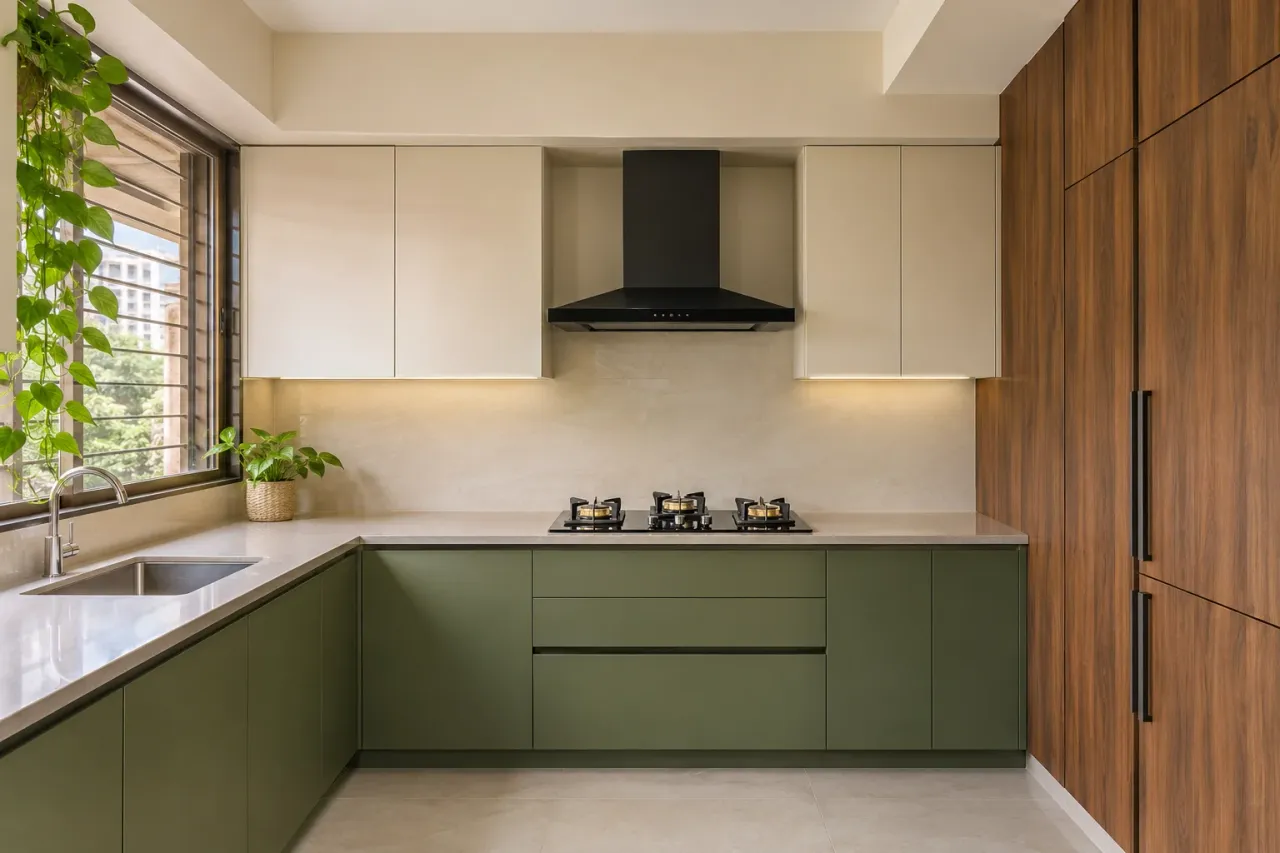
Olive Green and Walnut Kitchen Ideas for Indian Homes
Olive green and walnut kitchen: the practical answer
An olive green and walnut kitchen works best when one finish leads and the other supports it. Use olive on a main cabinet run, walnut-look accents on selected surfaces and a lighter worktop to balance the palette. Approve real samples under the kitchen’s daylight and task lighting.
Best suited to: Homeowners seeking a warm coloured kitchen while retaining practical storage and cleanable surfaces. In dark rooms, use deeper finishes selectively rather than covering every plane.
Decide which finish should dominate
Try olive lower cabinets with lighter upper cabinets and a walnut accent at a tall unit or open shelf. Alternatively, use a wood-led kitchen with olive on one contained run. A colour distribution plan is easier to assess than a sample board containing equal amounts of every finish.
Dark and sage greens appear in the international 1stDibs 2026 designer survey. This is a broad style signal, not evidence of Indian keyword volume or a requirement to replace sound cabinets.
Compare walnut appearance with actual material performance
Walnut is a colour and grain reference in many kitchen briefs; the specified surface may be veneer, laminate or another finish. Ask exactly what the cabinet front and edge are made from. Select the construction for the location, moisture exposure and maintenance needs rather than assuming the wood name describes the whole cabinet.
View a large enough sample to judge grain direction and repeated pattern. Very dark grain on every shutter can compete with olive and make a small kitchen busy. A plain cabinet finish beside a limited wood area often gives the eye a clearer resting place.
Let the worktop and backsplash simplify the room
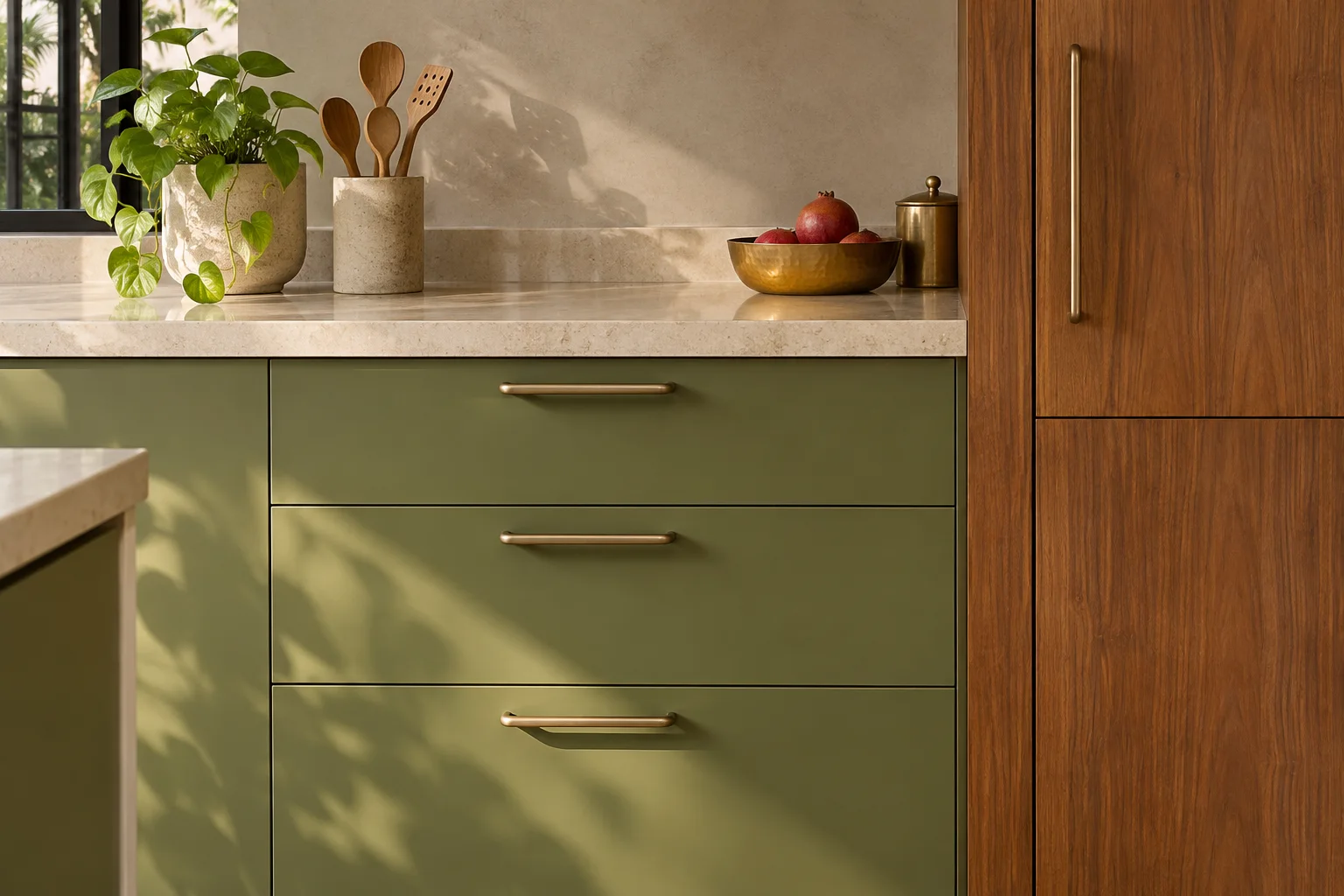
A light warm-grey or cream surface can provide visual relief, but assess stain care, joints and compatibility with the worktop supplier. If the cabinetry already has rich colour and grain, use a quiet backsplash rather than introducing several unrelated patterns.
Place worktop, wall tile and cabinet samples together vertically and horizontally. A warm cream can turn an olive sample visually muddy, while a cool white may make the same green appear sharper. Judge the combination in the kitchen rather than on a phone.
Test light, handles and cleaning together
Check the cabinet under both daylight and the planned task light. Evaluate finger marks and wipeability on the sample. Hardware should feel comfortable with wet hands and allow proper drawer operation; its metal colour is a later decision.
Keep the workflow, ventilation and storage plan ahead of the colour decision. The modular kitchen design guide helps with layout, while the cabinet-finish comparison helps frame material questions for your supplier.
Which option suits your space?
| Option | Useful for | Check before choosing |
|---|---|---|
| Olive lower cabinets | Colour without enclosing the whole room | How it looks against existing flooring |
| Walnut accent unit | A controlled wood feature | Grain scale and edge treatment |
| Light upper cabinets | A quieter upper wall | Colour relationship to ceiling and backsplash |
Before you approve the design
- Choose a dominant finish and a smaller accent area.
- Approve physical cabinet, tile and worktop samples together.
- Confirm cabinet construction and edge specification.
- Test handles and cleaning on actual samples.
Frequently asked questions
Does olive green suit a small kitchen?
It can, depending on daylight, contrast and how much area it covers. Keep other large surfaces calmer and test the green in the actual kitchen.
Do I need real walnut cabinets?
No. A suitable walnut-look surface may achieve the palette. Compare durability, appearance, repair options and cost for the specific product rather than the colour name.
Should the kitchen handles be brass?
Brass-coloured handles are one option, not a requirement. Choose a finish that relates to nearby fittings and meets your cleaning and durability expectations.
Turn this idea into a plan for your home
Visualise your space, understand the likely budget, or find a professional who can bring the idea to life.