
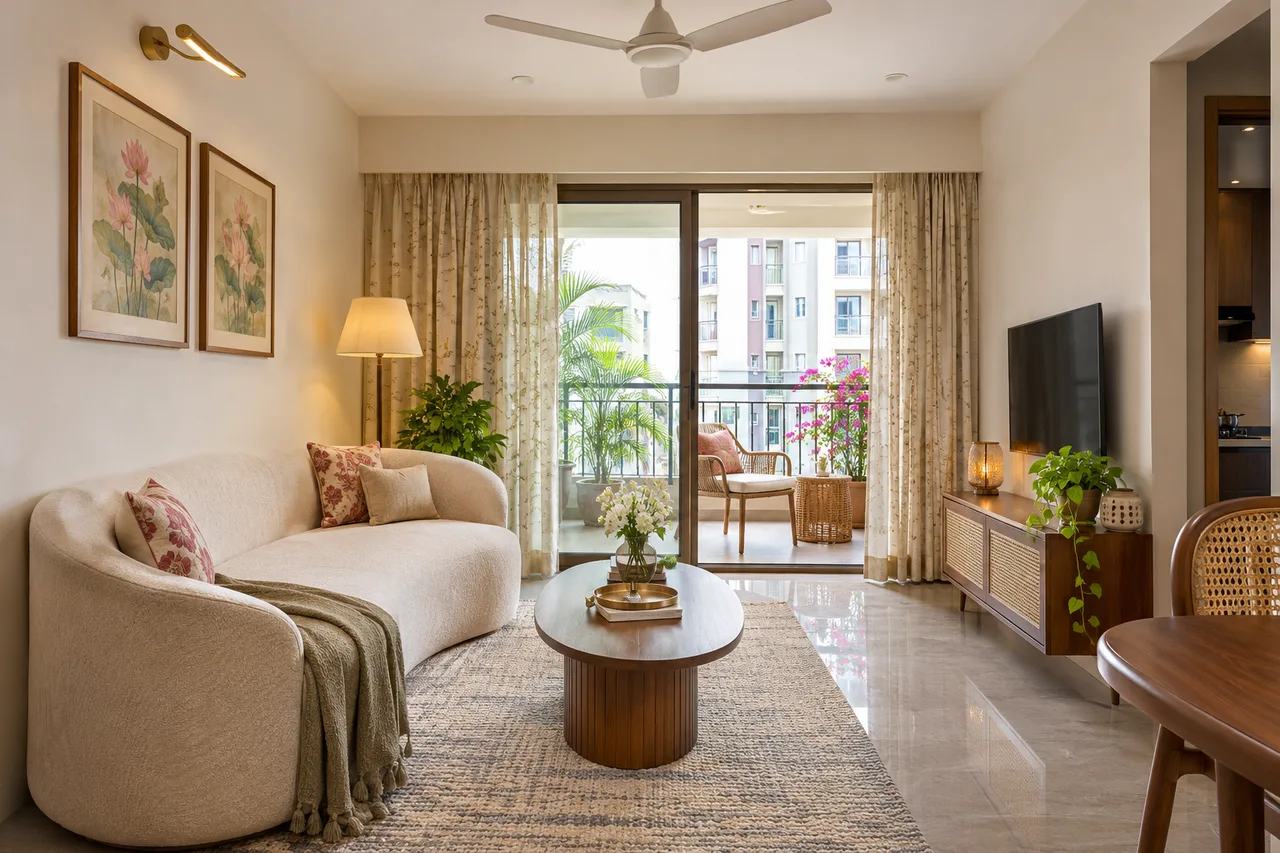
Curved Sofa Ideas for Small Living Rooms: Check Seating and Walking Space
A curved sofa can work in a small living room when its full footprint, usable seating and walking routes fit the actual room. Compare the maximum depth and seat positions, test television views, and mark the complete outline before buying. Choose the curve for your daily routine rather than assuming rounded furniture automatically saves space.
What to prepare
Bring a measured room sketch, photographs, a list of regular users, existing furniture dimensions and the exact sofa’s top-view drawing. Keep doors, balcony access, sockets and curtains visible on the plan.
Measure the complete shape, not just the width
Ask for overall width, maximum depth, height and a dimensioned top view of the exact configuration. A curved front and a curved back occupy different parts of the room. Measure the widest and deepest points, including arms and projecting feet. Do not estimate the footprint from a straight sofa with the same advertised width. Keep doors, skirting, curtains and any existing storage on the measured plan. A product can fit inside an empty rectangle while leaving an awkward strip behind it that cannot be used for movement or storage.
Count usable seats rather than accepting a seat label
Try the sofa with the people who normally use it. Check the usable width between arms, the depth at different positions and whether the curve turns occupants toward one another. A generous-looking curved silhouette can provide less useful sitting space than expected once arms, cushions and angled positions are included. Compare sitting upright, reading and watching television. If someone wants to stretch out, test that separately. There is no dependable way to turn external width into a universal comfortable seat count.
Map the walking route before placing a coffee table
Draw the route from the entrance to the balcony, kitchen and other frequently used doors. Place the sofa without narrowing that route into a leftover gap. Then add the coffee table and any occupied occasional chair. Walk through carrying a bag or a tray, and check the needs of the actual household, including mobility aids where relevant. A rounded edge may change the way a piece looks, but it does not guarantee enough clear passage. Ask for the remaining dimensions on the plan.
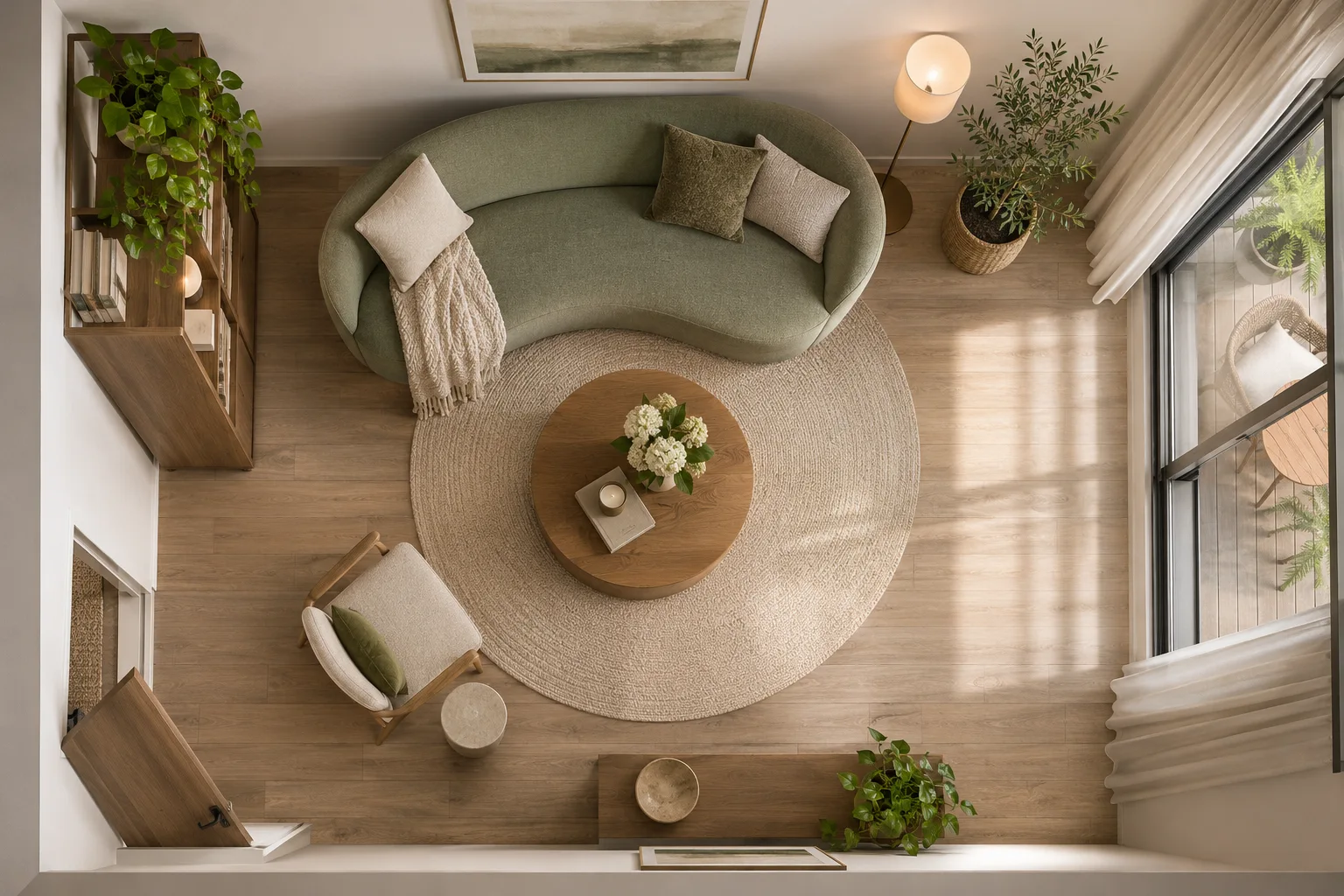
Test a gently curved option before a deep crescent
A restrained curve may offer the appearance you want with fewer layout compromises than a pronounced crescent. Compare both against the same room and seating brief. Do not assume that the strongest curve is the most suitable statement piece. If placing the sofa away from the wall creates unusable space behind it, consider a different shape or position. A straight sofa with a curved chair or rounded table may provide a better balance of usable seating and the visual direction you like.
Check television sightlines from every regular position
Sit in each intended place and assess the actual screen location. A curved sofa can support conversation while making end seats face away from the television. Choose according to the room’s main activity instead of assuming one arrangement serves all uses equally. Check daylight reflections and evening lighting as part of the trial. Do not select a television size or height from the sofa’s advertised seating capacity. Use a room-specific viewing test and compare alternatives before ordering fixed wall panelling.
Choose a table for reach as well as shape
A round or oval table can relate visually to a curved sofa, but the useful decision is whether people can reach it and move past it. Test the closest and farthest seats. An undersized central table may leave the ends without a practical surface; an oversized one can block standing up. A small side table may solve a specific reach problem. Do not add several loose pieces until they collectively consume the clear route you wanted to preserve.
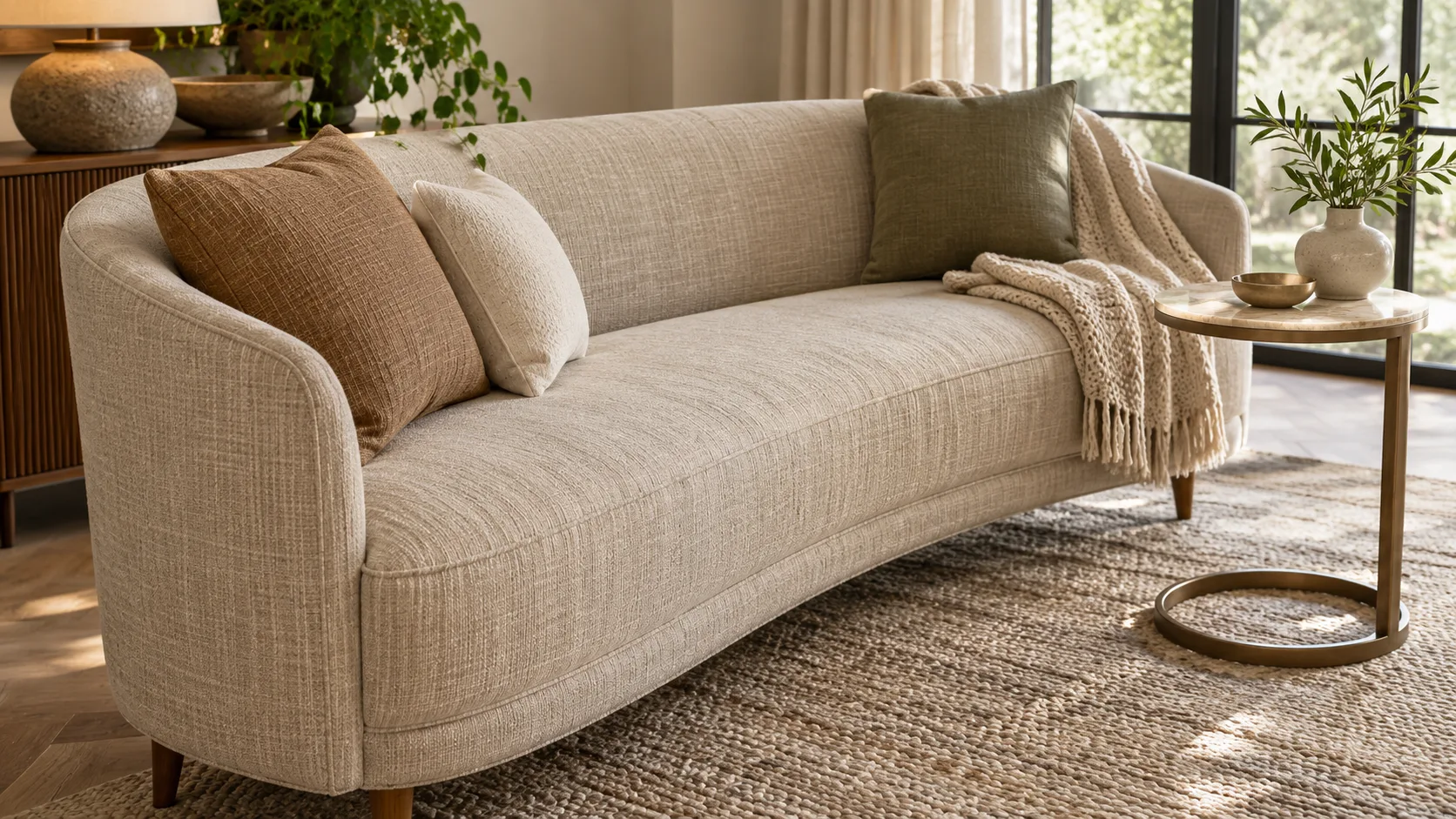
Review fabric, construction and maintenance
Request the exact upholstery specification, care instructions, cushion construction and warranty information. A textured showroom sample does not establish stain resistance or suitability for every household. Check whether covers are removable and whether replacement or cleaning support is available for that product. Inspect seams around the curve and ask how cushions stay in position. Choose the finish with everyday use in mind, including pets or children where relevant, without accepting unsupported promises that a material is maintenance-free.
Confirm delivery and assembly before paying
Measure the route from unloading to the room, including lift openings, stair turns, landings and the entrance. Ask for packed dimensions and the largest indivisible component. A sofa that fits the room may still fail the route in. Have the retailer confirm delivery feasibility rather than assuming removable legs solve every obstacle. Clarify who assembles modules, whether pieces connect, and what happens if delivery cannot be completed. Get access restrictions and the full delivery scope into the order.
Compare complete layouts before choosing custom work
Compare a curved sofa, a compact straight sofa with a loose chair, and a suitable modular option using the same required seating. Include tables, lighting and any storage each option displaces. Custom upholstery or joinery may offer a particular shape but needs approved dimensions, construction details and written commercial terms. Do not commission a bespoke curve merely because the first showroom model was too large. Resolve the household’s required seating and movement before paying for a special silhouette.
Rehearse the room with a full-size footprint
Use floor-compatible temporary markers or paper to show the complete outline. Recreate the deepest points and the table rather than marking only the front edge. Open nearby doors and drawers, pull out occasional seating and walk the normal route. This checks layout, not cushion comfort, so combine it with an in-person seat test where possible. Photograph the trial with measurements for the supplier. If it works only when other furniture is removed, decide whether that change is acceptable before ordering.
Compare the options
| Option | Useful when | Check first |
|---|---|---|
| Gently curved sofa | A softer silhouette fits the measured plan | Maximum depth and end-seat orientation |
| Straight sofa and loose chair | Flexible seating is the priority | Both pieces occupied and tables included |
| Curved modular arrangement | The selected modules suit the routine | Exact assembled dimensions and connections |
A worked layout test
For an illustrative comparison, two sofas may both be 2,200 mm wide while one has a maximum depth of 950 mm and another reaches 1,250 mm. The second occupies an additional 300 mm at its deepest point. That is not a recommended sofa size or clearance: use the selected product’s full drawing. Put both outlines on the same room plan, add the occupied seating and table, then compare the route. Do not assume the shallow ends compensate for a deep centre.
Budget and quotation checks
Compare the sofa, upholstery upgrades, delivery, assembly, old-furniture removal and any necessary replacement tables as one total. Separate optional styling from the furniture required for the layout to work. Ask about cancellation, returns, repair support and custom-order conditions before purchase. There is no useful universal price for a curved sofa without its construction, dimensions and service scope. Obtain itemised current quotations instead of comparing a basic display price with a fully delivered custom product.
Planning sequence
Measure first, shortlist exact models, trial the footprint, test the seat and confirm delivery access. Approve any custom drawing only after those checks. Get the supplier’s production and delivery dates in writing and arrange removal of the existing furniture around a confirmed plan. At delivery, inspect the accepted configuration, upholstery and assembly before arranging the rest of the room.
Plan with WallsToWonder
Explore the appearance using Design My Room, then validate dimensions with the retailer and your measured plan. For a wider refresh, the interior cost planning tool can organise the scope. Read our living-room planning ideas alongside the seating test.
Frequently asked questions
Does a curved sofa save space?
Not automatically. Compare the complete footprint, required seating and remaining movement space with alternatives.
Is it suitable for a narrow room?
Only when the exact depth and layout work. A restrained curve or straight sofa may be a more practical choice.
How much walking clearance is needed?
Show the remaining dimensions on the plan and test them against the users, route, doors and occupied furniture. Avoid relying on a single generic gap.
Can it stand against a wall?
Check the back profile and supplier guidance. Some curves leave an unused wedge or need a different placement.
Is a round table essential?
No. Choose the table from reach, standing-up movement and circulation, then consider its visual relationship to the sofa.
Can I buy it without sitting on it?
A footprint test checks layout but not comfort. Test the actual product where possible and review purchase and return terms carefully.
What should be checked at delivery?
Inspect the correct configuration, fabric, seams, modules, assembly and agreed accessories with the supplier. Retain care and service information.
Further product-planning reference
Dunelm’s furniture-delivery measuring guide illustrates why furniture and access-route measurements should be checked separately. Use the actual supplier’s dimensions and delivery conditions for your order.
Turn this idea into a plan for your home
Visualise your space, understand the likely budget, or find a professional who can bring the idea to life.