
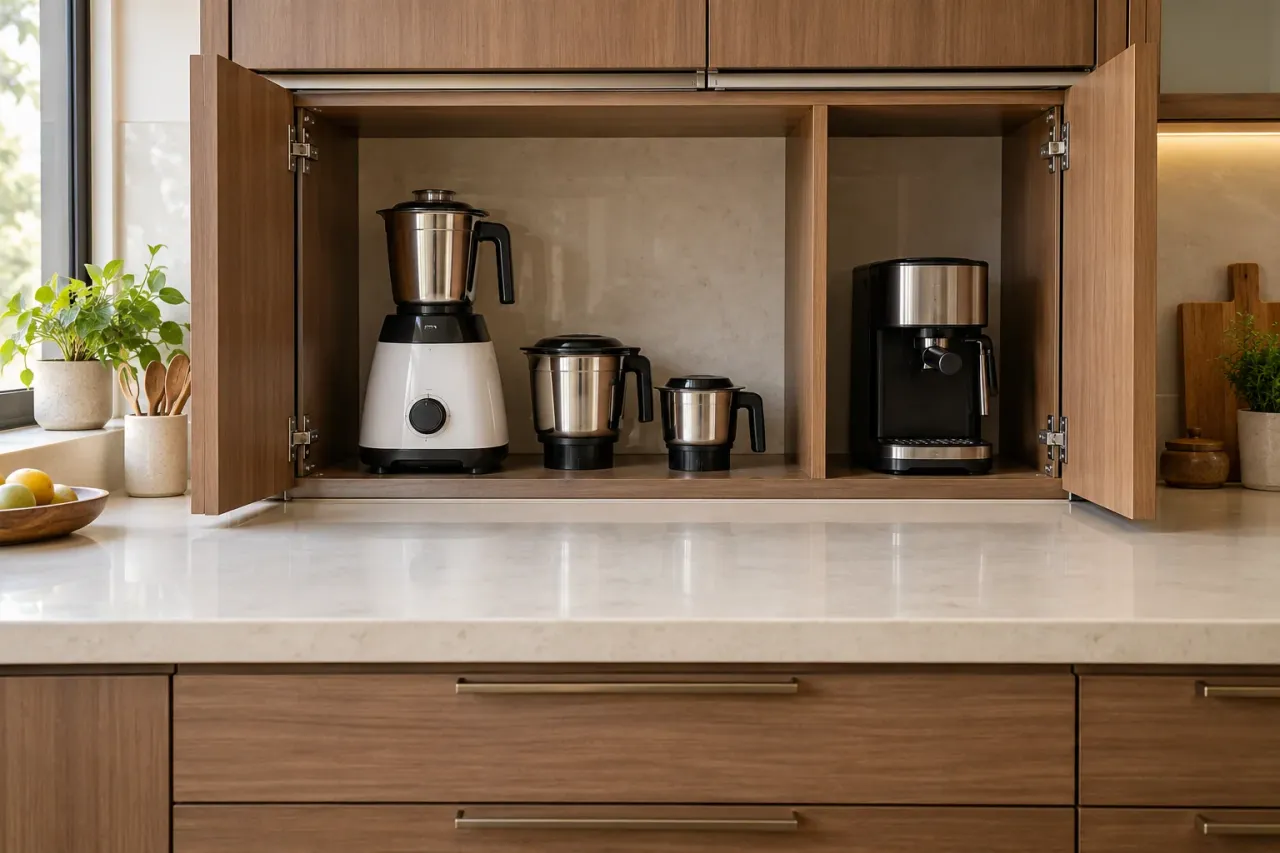
Kitchen Appliance Garage Ideas to Hide Mixer, Toaster and Coffee Clutter
Images in this article are AI-generated design concepts for inspiration, not photographs of completed projects. Confirm dimensions, materials and installation details for your home.
A kitchen appliance garage is a cabinet or enclosed bay that stores small appliances close to the worktop. It can hide a mixer-grinder, toaster and coffee accessories when you finish using them. The useful version is planned around your actual appliances, not just an attractive shutter.
These kitchen appliance garage ideas focus on Indian cooking routines: mixer jars, chutney attachments, charging cables, daily tea preparation and the need for a clear working counter. Start by listing what you use every day and what can live elsewhere.
Measure the appliances before designing the cabinet
Record each appliance's width, depth and height, including handles and the space needed to remove a lid or water tank. Check the manufacturer's installation and operating instructions. Storage dimensions are different from the clearances required while an appliance is running.
- Measure the mixer-grinder with the tallest jar attached and separately for storage.
- Check whether a coffee machine's reservoir lifts up, slides back or pulls sideways.
- Include cord bends and plugs in the depth calculation.
- List jars, blades, filters and trays that need their own compartments.
- Leave a convenient landing area where an appliance can be moved for use.
For heat- or steam-producing appliances, use an open counter with the required clearances unless the manufacturer explicitly permits another arrangement. Do not run appliances behind closed shutters. Have a qualified electrician plan accessible outlets, loads and protection for the equipment you intend to use.
1. A countertop bay beside the preparation area
Put frequently used equipment close enough to the prep zone that taking it out feels effortless. A mixer hidden at the far end of the kitchen may end up permanently on the main counter. Keep the bay away from direct hob heat and sink splashes, while preserving the worktop you need for food preparation.
Consider an easy-to-wipe interior surface and removable trays for loose accessories. Decide how you will clean the back corners and reach the outlets before approving the cabinet depth.
2. Pocket doors for an unobstructed opening
Pocket doors retract beside the storage bay, leaving the front accessible. They can be useful where swinging doors would interrupt work, but the mechanism occupies cabinet space. Ask the supplier for the actual hardware specification and the clear opening after installation.
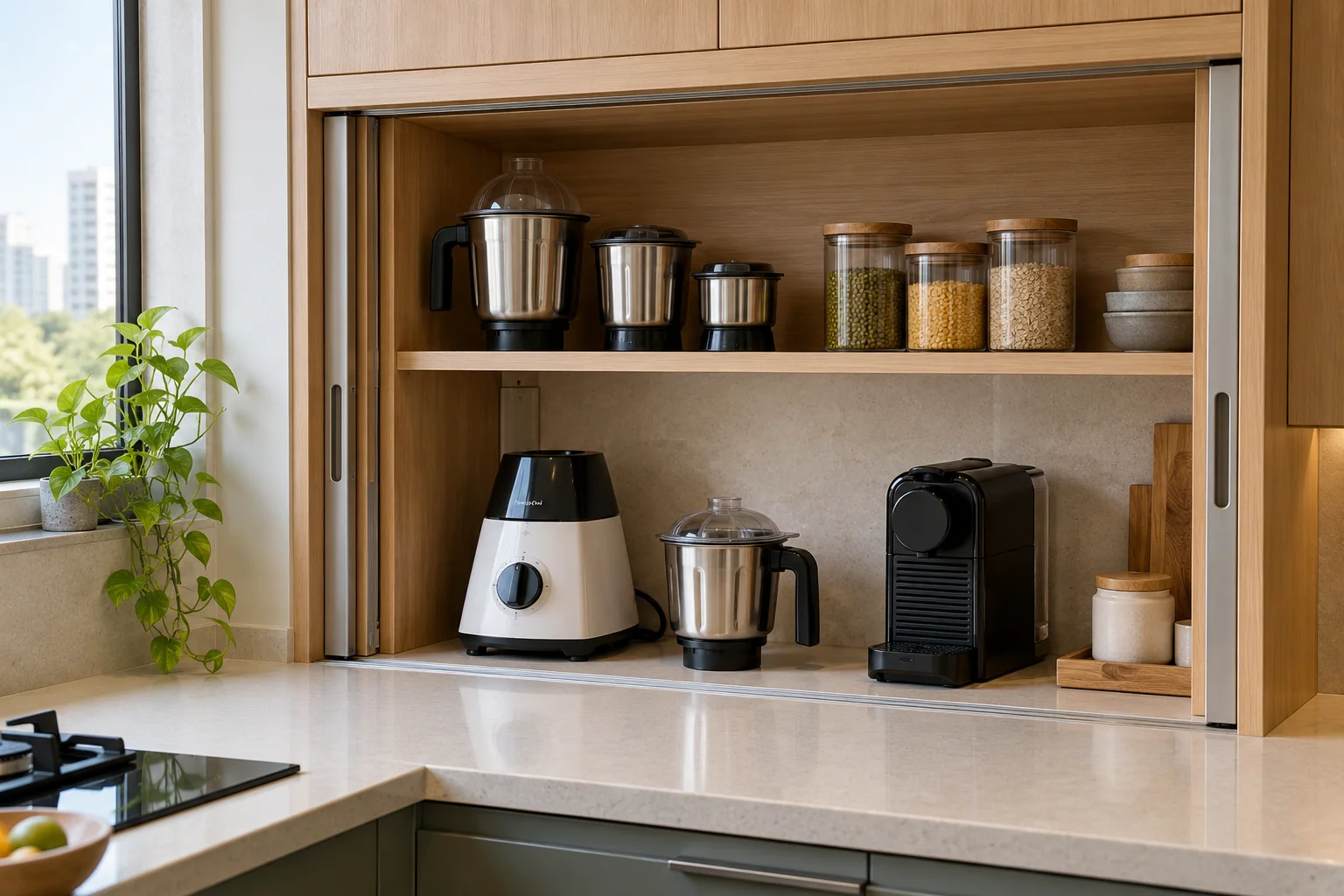
Blum's pocket-system overview illustrates this general door approach. A product mechanism does not determine appliance safety or guarantee compatibility with every cabinet size. Have the fabricator specify a complete supported system.
3. Lift-up or hinged doors for simpler layouts
A lift-up front can avoid side projection but needs suitable overhead space and hardware. Check whether it conflicts with upper cabinets, a ceiling feature or the user's reach. A conventional hinged pair may be easier to understand and maintain if there is enough space to leave the doors fully open.
| Door approach | Potential advantage | Check before choosing |
|---|---|---|
| Pocket doors | Front stays accessible when open | Space consumed by side pockets and hardware service access |
| Lift-up front | No side-swing across the counter | Overhead clearance, reach and support mechanism |
| Hinged shutters | Familiar operation | Door projection and neighbouring work zones |
| Tambour shutter | No conventional swinging leaf | Usable depth, track cleaning and repair access |
4. Give mixer jars and coffee accessories their own drawers
The cabinet becomes less useful when every jar is stacked around the mixer base. A drawer below can hold dry jars upright, with divisions that stop them knocking together. Keep sharp attachments in suitable protected storage and follow the appliance maker's cleaning and drying instructions before putting parts away.
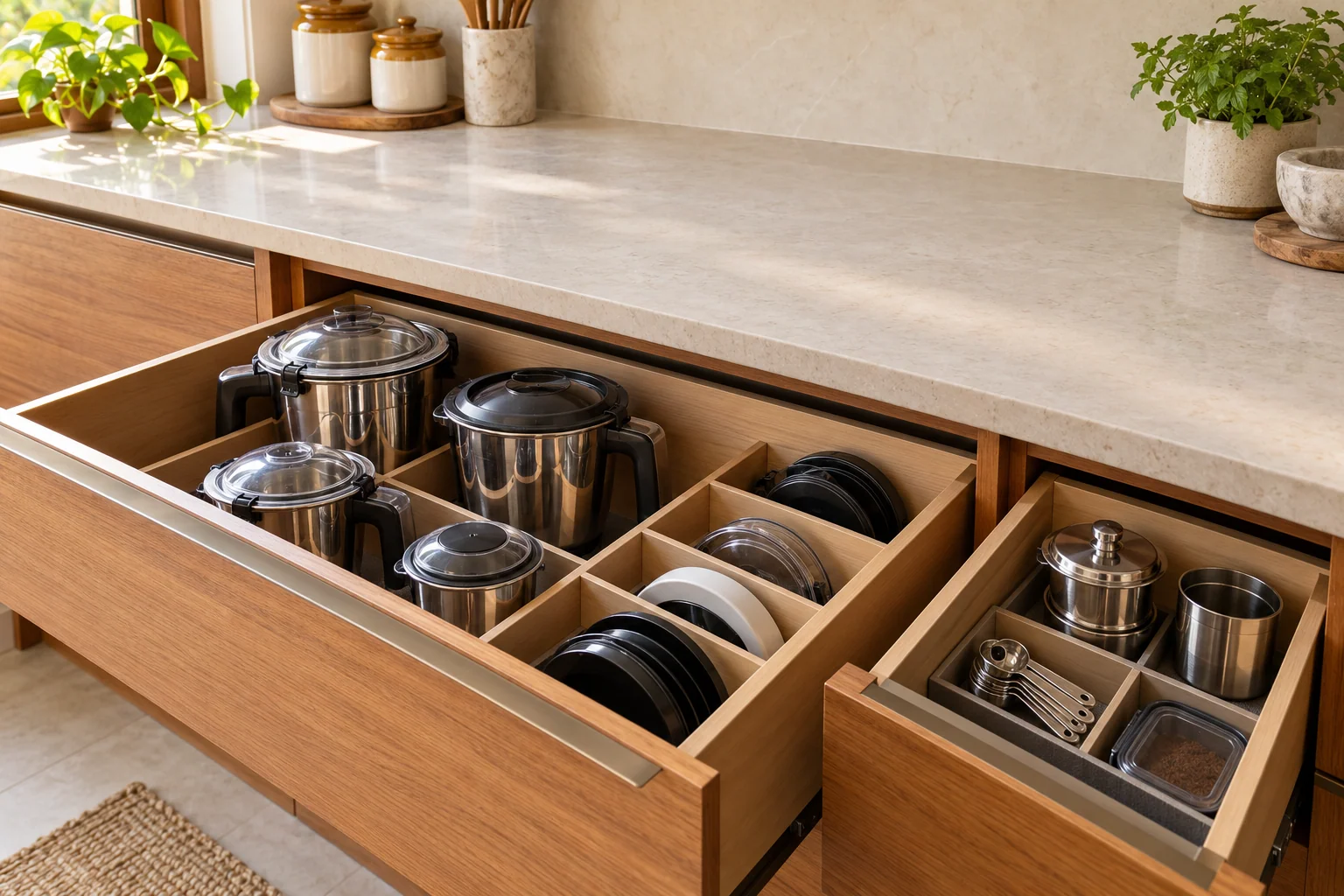
Check drawer loading with the hardware supplier. Heavy equipment needs rated supports and a layout that avoids awkward lifting. If a pull-out platform is proposed, have its load, stability and intended use assessed rather than assuming an ordinary drawer slide is suitable for a running appliance.
Make the storage routine easy enough to repeat
Try the sequence before final fabrication: open the door, take out the appliance, place it safely, use it, clean it and return it. If a door blocks the landing area or the cord cannot reach an appropriate outlet, revise the design. A cabinet that takes too much effort to use tends to stay open or unused.
For the broader layout, see the modular kitchen design guide. If new cabinetry changes the services plan, also review kitchen exhaust planning rather than treating storage as an isolated feature.
Frequently asked questions
Can I use a toaster inside an appliance garage?
Do not assume so. Follow the specific manufacturer's instructions and required clearances. Move heat-producing appliances to a suitable open counter unless an expressly permitted installation has been designed for them.
Can I add an appliance garage to an existing kitchen?
Sometimes. Check the worktop depth, available landing area, upper-cabinet position, outlets and remaining prep space. A freestanding storage solution may be more practical than changing otherwise sound cabinetry.
Does it need expensive pocket-door hardware?
No. Choose the door after testing the routine and available clearances. A well-positioned hinged cabinet can be useful when its open doors do not interrupt the work area.
What to include in your cabinet brief
Provide the appliance list, measured dimensions, manufacturer requirements, accessory inventory, selected hardware and electrical plan. Request a drawing of the bay fully open and closed. The goal is a clear counter supported by accessible storage.
Turn this idea into a plan for your home
Visualise your space, understand the likely budget, or find a professional who can bring the idea to life.