
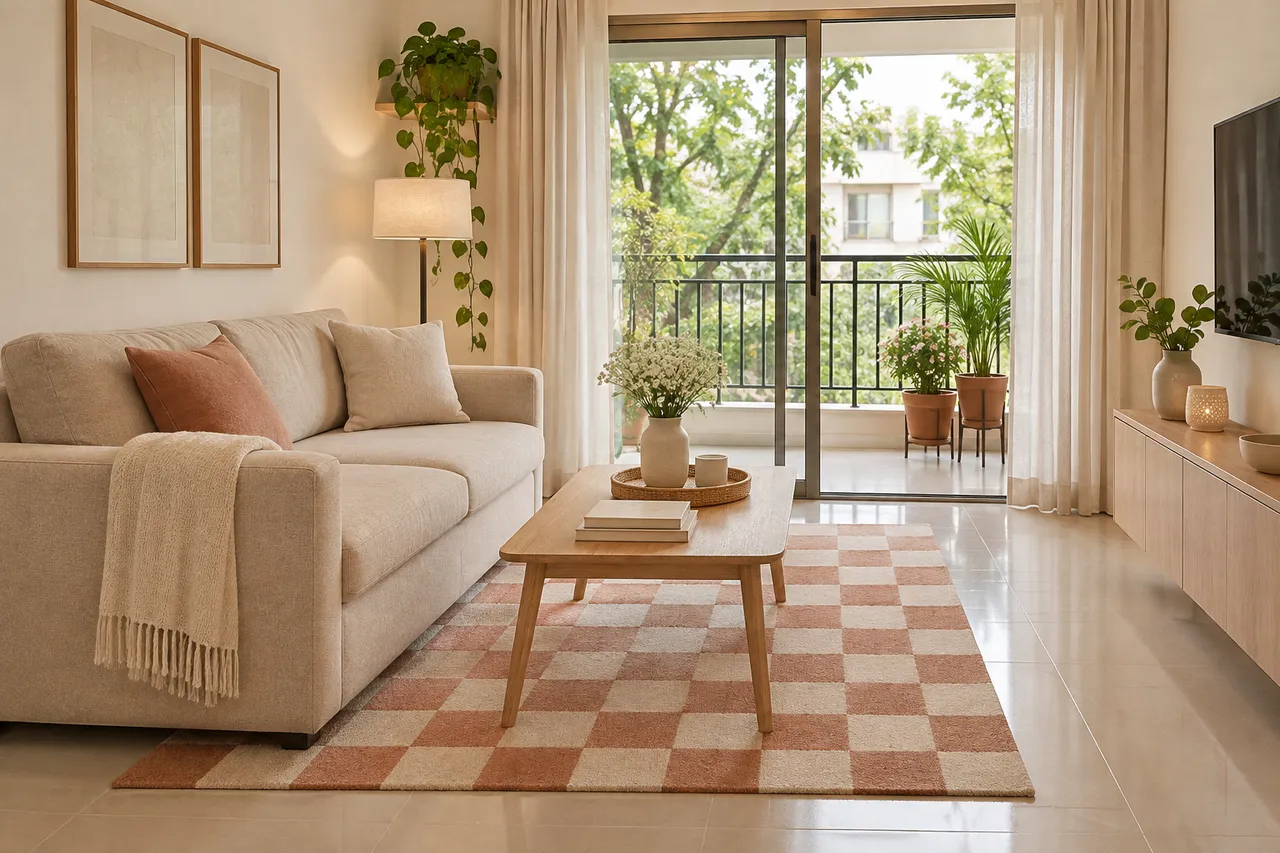
Checkerboard Rug Ideas for an Existing Living Room
Introduce a checkerboard rug by testing its footprint, pattern scale and care requirements against your existing sofa and floor. Keep the rest of the room simple during the trial. The useful choice is a rug that lies appropriately, supports furniture placement and leaves everyday routes workable—not simply the strongest pattern in a photograph.
What to prepare
Room and furniture measurements, removable tape for marking the outline, rug samples or product details, photographs of retained upholstery and the manufacturer’s care and installation information.
Start with the furniture you are keeping
Measure the sofa, chairs, coffee table and the clear space between them. Note door swings and access to the balcony or storage. Decide whether the rug will define one seating group or sit beneath a smaller part of it. Draw the proposed position on a simple plan.
Avoid ordering from room area alone. Two living rooms of similar size can need different rug arrangements because the furniture and routes differ. Mark the outline on the floor and walk through it with seats occupied before deciding that a particular size is suitable.
Compare the check size at room scale
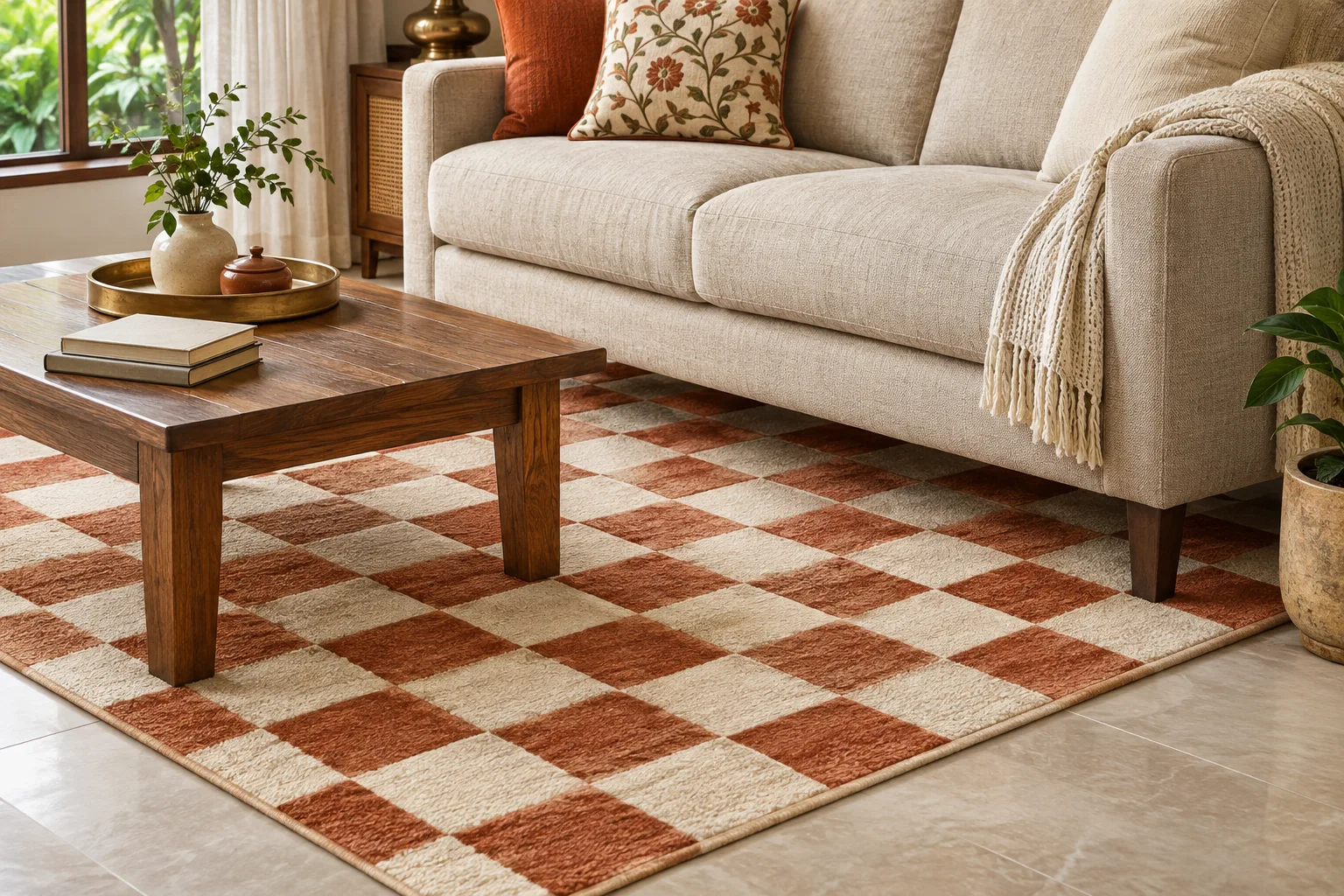
A small online image compresses the pattern. Ask for the actual check dimensions and compare them with the table and sofa. Use a paper or digital mock-up to discuss the pattern scale, while recognising that it will not reproduce the product’s texture or exact colour.
Try looking from the doorway and from the sofa. A bold grid may be enjoyable as the main feature, while a lower-contrast check can sit more quietly with existing furniture. Neither is automatically better for a small room; the surrounding patterns and your preference matter.
Choose contrast around the retained floor
Compare the light and dark squares against the actual floor and upholstery. Cream and muted terracotta, beige and brown, or softer tonal variations offer different effects. Product names such as ivory or walnut do not establish an exact match. Obtain a physical sample or a clear return policy where sampling is unavailable.
Check the combination in daylight and under the room’s lamps. Include the curtain and one representative cushion in the sample group. If several existing textiles are patterned, start by removing optional layers rather than assuming the rug must compete with all of them.
Review the complete rug construction
Ask about the actual fibre, pile, backing, edge finish and cleaning method. A flat appearance in a photograph does not tell you how the product will behave on your floor. Check whether an underlay is recommended and whether it is compatible with both the rug and the floor finish.
Do not select purely on colour if the household needs easy maintenance. Consider pets, children, frequent dining nearby and the ability to move furniture for cleaning. Obtain relevant product guidance instead of assuming one material is universally stain-proof or suitable for every household.
Test doors, chairs and moving furniture
Check every door that passes over or near the rug. Pull out the chair, use the storage and move through the room carrying ordinary items. Include the full thickness of the rug and recommended underlay in the discussion. The outline trial establishes area, not clearance above the floor.
For a room shared with work or dining, check rolling chairs or frequently moved seating separately. A living-room styling choice may not suit those tasks. Ask the supplier about intended use and compare another placement if the rug interferes with operation.
Keep the edges and cleaning practical
At installation, check the product in the intended position and follow the supplier’s guidance for settling, underlay and edge condition. Do not ignore a persistent curl or unstable edge because it appears outside the main photograph. Discuss concerns with the supplier before accepting the arrangement.
Plan how the rug and the floor beneath it will be cleaned. Keep care instructions with the purchase details. Avoid improvised cleaning chemicals or aggressive spot treatment that may affect the rug or floor; use the maker’s recommended procedure and a suitable service when needed.
Style one pattern, then add slowly
Begin with the rug, retained seating and the useful coffee-table items. A plain throw or a cushion repeating one rug tone may be enough. Add other patterns only after seeing the full room in ordinary use. A checkerboard does not require checkerboard accessories elsewhere.
Photograph the room with everyday items present. If the grid feels too dominant, compare a lower-contrast option rather than changing all the furniture to support it. The rug should be a chosen layer in your room, not a reason for an unplanned complete makeover.
Make the order easy to verify
Keep the exact dimensions, colour reference, construction, care instructions and underlay decision together. Confirm delivery, return conditions and any size tolerance with the supplier. Ask how the rug will be checked on arrival and what to do if the supplied item differs.
If the room is still changing, postpone the rug until the major seating footprint is settled. It is easier to choose the pattern around known furniture than to discover that a new chair or table changes the working layout after the return window has closed.
Compare the practical options
| Option | What to check |
|---|---|
| Low-contrast checks | Quieter starting point beside patterned furniture |
| Strong contrast | Use as the main visual feature |
| Different rug shape or no rug | Compare when access or care makes the grid impractical |
Build a useful budget
Budget for the rug, compatible underlay if needed, delivery and the cleaning method you expect to use. Check custom-size charges and return conditions before treating two prices as equivalent. Retain existing plain cushions for the first trial rather than adding a complete accessory set. Obtain current product prices; this guide does not claim a universal cost for checkerboard rugs.
Planning time and supplier schedule
Allow an hour for measuring, taping the outline and comparing two pattern scales. Revisit the layout during a normal evening when the room is occupied. Delivery and any product-settling guidance depend on the supplier and construction, so confirm them before arranging furniture around a promised date.
Frequently asked questions
Will a checkerboard rug suit a small living room?
It can, provided the footprint, contrast and pattern scale work with your furniture. Test the outline and compare samples in the actual room.
Does every rug need the same underlay?
No. Check guidance for the specific rug and floor finish. Compatibility matters as well as grip and thickness.
Should I buy matching checkerboard accessories?
They are optional. Start with the rug and retained furniture; too many repeating patterns may make the composition harder to judge.
Plan the next step with WallsToWonder
Read How Much Clearance Space Do You Actually Need Around Furniture? for the related planning checks. Explore the overall look with Design My Room, keeping your retained furniture and measured requirements in the brief. Use physical samples and product information for final choices.
Turn this idea into a plan for your home
Visualise your space, understand the likely budget, or find a professional who can bring the idea to life.