
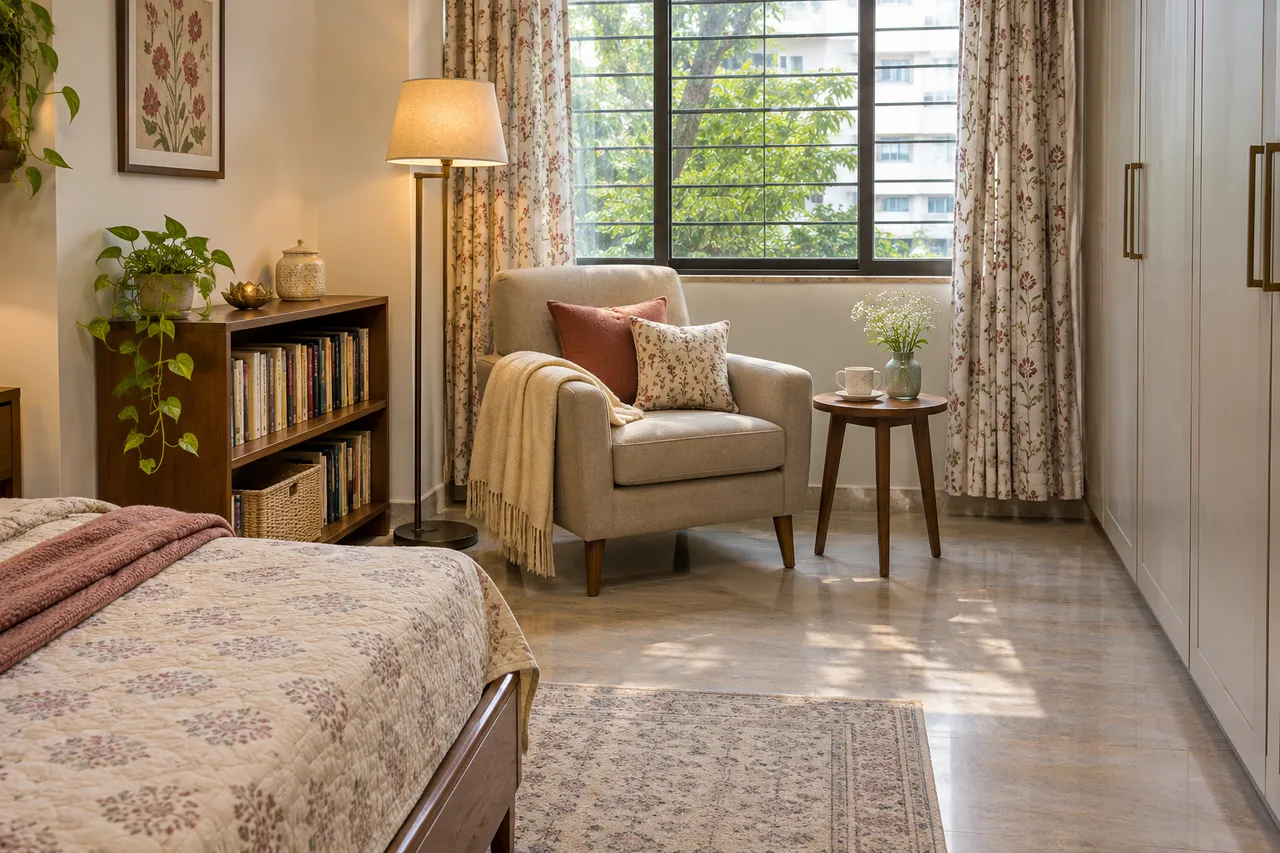
Bedroom Reading Corner Ideas Beyond a Window Seat
A bedroom reading corner needs a chair you can use comfortably, a place for a book and lighting suited to the task. Test the arrangement without blocking the bed, wardrobe or window. A freestanding chair can create the corner without a built-in window seat, provided the occupied footprint and daily routes work.
What to prepare
Tape measure, removable floor outline, an existing chair for the first trial, a book, a small stable table or suitable substitute, and product information for the chair and lighting you may buy.
Choose the routine before the furniture
Decide when and how you expect to use the corner. Reading for a short break, spending a longer evening with a book and sharing the room while another person rests are different situations. Write the main requirement before choosing a chair from a photograph.
Try the intended location at that time of day. Observe light, noise, privacy and the relationship with the bed. You may find that a quieter position away from the window suits the routine better than the visually obvious corner. A reading area does not have to face glass to be useful.
Measure the chair while it is occupied
Mark the chair’s actual footprint and allow for sitting down, standing up and using any moving parts. A recliner or swivel chair needs a different review from a fixed occasional chair. Obtain full product dimensions rather than just width and height.
Place another person in the room and walk to the wardrobe, bed and door. Check the route with wardrobe doors or drawers open. A chair that fits into an empty corner may still make the bedroom inconvenient once normal tasks and occupied space are included.
Try comfort before matching the style
Use an existing chair for the first layout trial, then compare candidate products where possible. Assess the seat, back, arm position and ease of getting up for the people who will use it. A room image cannot establish individual comfort.
Bring the type of book or device you normally read and consider where your hands and elbows rest. Check whether the chair requires an additional cushion or footrest, and include their footprint and care in the purchase decision. Do not add them purely because a styled reference includes them.
Give the book and drink a stable landing place
Choose a side surface that can be reached without an awkward stretch. Test it with the chair occupied and the objects you actually use. A small stable table may work better than a decorative stool if the stool’s top or base is unsuitable for that task.
Keep the surface restrained so there is room to set down a book. If you use a drink, consider the actual finish and care requirements. Confirm that the table does not narrow the route or conflict with a curtain, drawer or chair movement.
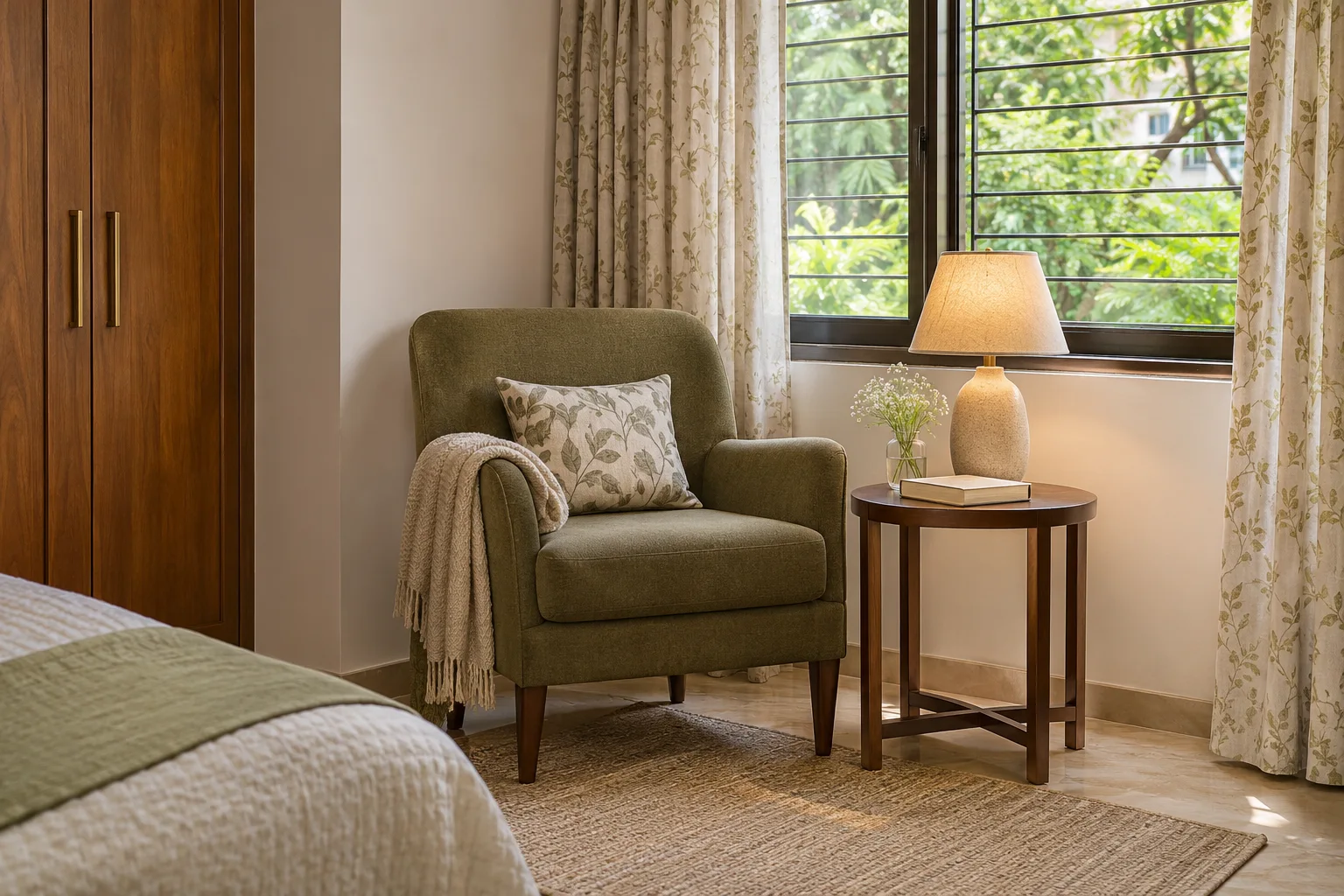
Position lighting around the task
Check the reading position with daylight and during the evening. Look for shadows on the page and glare from the lamp or nearby mirror. A shaded floor lamp, suitable table lamp or professionally coordinated fixed fitting may each be worth considering.
Review product information for the actual output, controls and intended use. A warm-looking light is not automatically sufficient for reading. Keep bases stable and cables away from walking routes. For new wiring or fixed fittings, ask a suitable professional to review the installation rather than extending a cable across the bedroom.
Keep curtains and window use independent
Open and close the curtain, operate the window and access any nearby controls. Furniture should not make ordinary maintenance or ventilation awkward. Check the interaction with the actual fabric and chair, especially where the curtain hangs close to a lamp.
Do not assume a window-side position is comfortable throughout the day. Sun, glare and privacy vary with the room. Compare a second chair angle or location before purchasing a new treatment to solve a problem created by the initial furniture placement.
Store a small current reading collection
A low bookcase, an existing drawer or a basket suitable for the objects can hold the books currently in use. Measure the actual book sizes before ordering shelves. Keep heavy storage and wall-fixed units within appropriate product and installation guidance.
Avoid turning the corner into an overflow library if space is limited. A small rotating selection may keep the area easier to use and clean. Retain access to the bed and wardrobe, and consider whether the existing room storage can hold the less frequently used books elsewhere.
Let the corner belong to the bedroom
Compare the chair fabric with retained bedding, curtains and flooring. One related tone or texture can connect the pieces without requiring a matching set. Use physical samples where possible and check cleaning instructions before buying upholstery.
Review the arrangement after several ordinary uses. Remove an accessory if it interferes with sitting or cleaning. If the chair remains unused, reconsider the routine and location before adding more furniture. A successful reading corner is one you reach for naturally, even when the bed is unmade and the room is not staged.
Compare the practical options
| Option | What to check |
|---|---|
| Existing chair plus lamp | Low-commitment test of the routine |
| New fixed reading chair | Check comfort, occupied space and care |
| Different location | Compare when window access or routes are compromised |
Build a useful budget
Price the chair, any table, lighting, delivery, assembly and electrical work if required separately. Begin with an existing chair to test the layout before committing to a coordinated set. Keep a budget allowance for the actual task rather than filling the corner with accessories. Compare product specifications and comfort alongside the total price.
Planning time and supplier schedule
Allow 45–60 minutes for a layout trial and repeat it during an ordinary evening reading session. Sampling and furniture delivery depend on the selected products. Confirm any electrical installation and supplier schedule separately; a simple movable setup may need much less work than fixed joinery or lighting.
Frequently asked questions
Do I need a built-in window seat?
No. A freestanding chair can work if comfort, occupied space, lighting and room access are suitable.
Is a warm lamp enough for reading?
Not necessarily. Review the actual output, position, glare and controls for the task rather than choosing by light colour alone.
What if the corner blocks the wardrobe?
Change the furniture size or location, or omit the corner. Regular access should be tested with the wardrobe open and the chair occupied.
Plan the next step with WallsToWonder
Read 3 Small-Room Layout Tests Before Buying Furniture for the related planning checks. Explore the overall look with Design My Room, keeping your retained furniture and measured requirements in the brief. Use physical samples and product information for final choices.
Turn this idea into a plan for your home
Visualise your space, understand the likely budget, or find a professional who can bring the idea to life.