
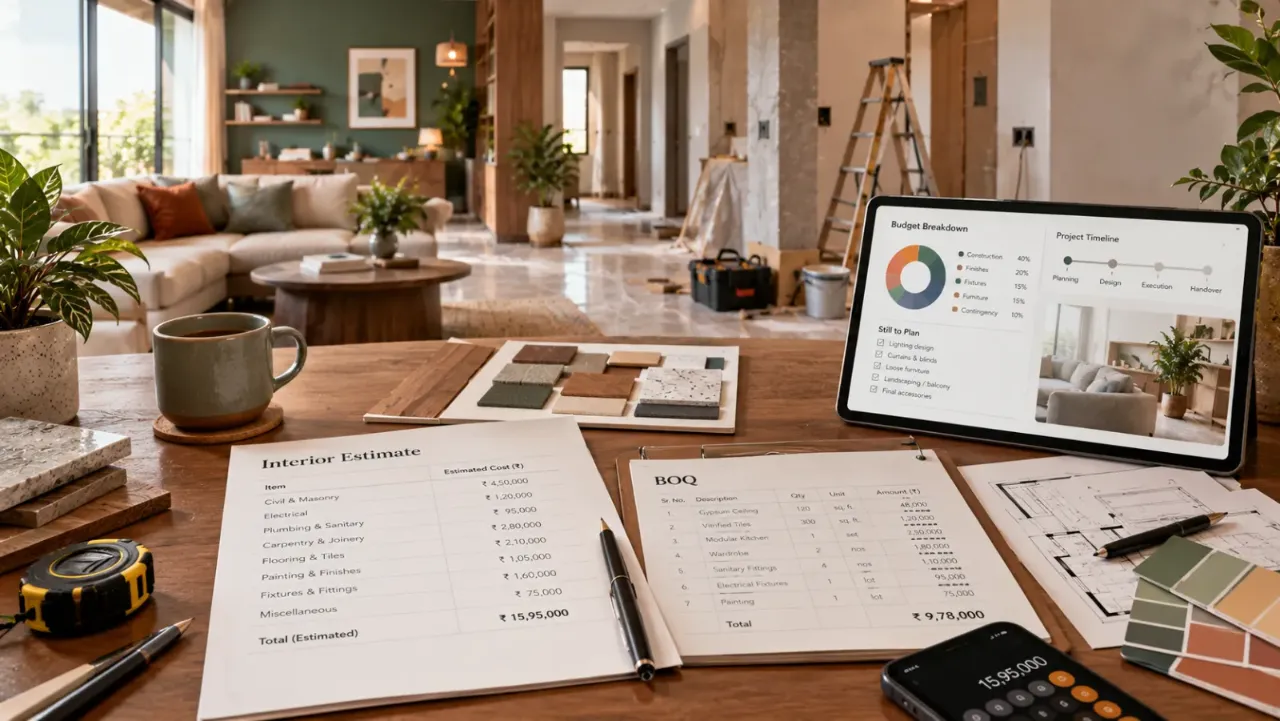
Your Home Isn’t Finished Yet: The Hidden Costs to Budget
You have approved the design. The carpentry is done. The lights are installed. The walls are painted. The wardrobes are ready. And then you realise something: you still need curtains, a mattress, pest control and a dozen smaller things nobody remembered to put into the first budget.
The Interior Quote Is Not the Same as the Move-In Budget
This is the first thing homeowners need to separate.
Your interior budget might include items such as:
- Wardrobes
- Modular kitchen
- TV unit
- False ceiling
- Electrical work
- Wall finishes
- Fixed furniture
- Selected decorative elements
But the home may still need:
- Curtains
- Curtain hardware
- Mattresses
- Pillows and protectors
- Pest control
- Loose furniture
- Rugs
- Mirrors
- Accessories
- Cleaning
- Small electrical purchases
- Move-in essentials
None of these makes your interior quote wrong. They simply belong to a different part of the spending plan.
The mistake is treating the two budgets as though they are the same.
Think in Three Budgets, Not One
1. Fixed Interiors
The built-in work attached to the home: kitchen, wardrobes, TV units, ceilings, wall treatments and similar items.
2. Loose Furnishing
Items added after or alongside the interior work, such as curtains, mattresses, rugs, mirrors and movable furniture.
3. Move-In Services
Practical services and final purchases such as pest control, deep cleaning, installation and last-minute essentials.
Once you separate these categories, the “mystery expenses” become much easier to predict.
1. Curtains Are Not Just Fabric
Curtains are often treated as a finishing touch.
They are actually several purchases bundled together.
You may need:
- Curtain fabric
- Lining or blackout lining
- Rods or tracks
- Brackets
- Finials or end components
- Stitching
- Installation
- Blinds for selected windows
- Specialised hardware for large openings
A beautiful curtain quotation can therefore be very different from the price of the fabric you first saw.
And the number of windows adds up quickly.
Three bedrooms, a living room, a balcony door and a study can turn “we'll buy curtains later” into a substantial final expense.
2. Curtain Hardware Can Be the Forgotten Line Item
Even when curtains are included in an overall furnishing budget, hardware is sometimes treated separately.
That's worth checking before you approve anything.
Ask whether the quotation includes the actual mechanism you want.
Rod or track + brackets + stitching + curtain + installation
For large windows or full-height curtains, the hardware can also affect how smoothly the curtain operates and how the final installation looks.
3. Blackout Curtains Can Change the Budget
A bedroom curtain and a bedroom blackout solution are not necessarily the same thing.
You may want a decorative outer curtain combined with a blackout layer.
That means more fabric, more stitching and potentially more hardware.
This is particularly relevant in bedrooms, children's rooms and rooms that receive strong morning or afternoon sunlight.
So decide early whether you want:
- Decorative curtains
- Light filtering
- Full blackout
- Curtains plus blinds
- A combination
The choice affects both cost and detailing.
4. The Mattress Is One of the Most Important “Invisible” Costs
A newly designed bedroom can look complete while the most important piece of furniture is still missing.
The mattress.
It often gets pushed to the end because it does not appear in the interior design render.
But a bed is not actually ready for use without one.
And mattresses are not something you should necessarily choose based only on appearance or price.
You need to think about:
- Size
- Firmness
- Sleeping preferences
- Thickness
- Bed-frame compatibility
- Ventilation
- Warranty and care
- Whether two people sharing the bed have different preferences
A beautiful bedroom with the wrong mattress is still a poorly planned bedroom.
5. Don't Forget Mattress Protectors and Bedding
Even after buying the mattress, there are usually more bedroom purchases.
You may still need:
- Mattress protector
- Pillows
- Pillow protectors
- Sheets
- Duvet or comforter
- Blankets
- Cushions
These may not feel like interior-design expenses.
But they are real move-in expenses.
And because they are usually purchased near the end, they often come out of the same shrinking pool of money.
6. Pest Control Is Another “Before Move-In” Expense
Pest control is easy to forget because it is not visible.
You don't see a pest-control service in a 3D design.
But an empty or newly renovated home can be the ideal moment to schedule treatment.
Why?
Because once wardrobes are filled, beds are installed and boxes arrive, accessing corners, cavities and service areas becomes harder.
A pre-move-in treatment can therefore be easier to coordinate than trying to deal with a problem after the home is fully occupied.
The exact treatment required depends on the property, local pest issues, construction stage and the provider's assessment.
7. Renovation Dust Can Trigger Another Expense
Even when the interior work looks finished, the home may still need a serious cleaning.
Construction dust can settle on:
- Wardrobes
- Shelves
- Window tracks
- Fans
- Light fixtures
- Flooring
- Kitchen interiors
- Bathroom fittings
A normal daily clean is not necessarily the same as a post-construction deep clean.
So add cleaning to the move-in plan rather than assuming the contractor's final sweep means the house is ready for occupation.
8. The “Small” Hardware Adds Up
There is a category of expenses that is individually small but collectively annoying.
Things like:
- Curtain rods
- Bathroom accessories
- Towel hooks
- Clothes hooks
- Door stoppers
- Extension boards
- Cable management pieces
- Small shelves
- Organisers
- Drawer dividers
- Dustbins
None of these looks like a major budget item.
Together, they can become one.
This is why a home can feel surprisingly expensive in the final month even when the major construction bills are already under control.
9. Lighting Can Have a Second Budget
You may have electrical work and built-in lighting included in the interior quote.
But what about decorative or movable lights?
You may still decide to buy:
- Bedside lamps
- Floor lamps
- Table lamps
- Pendant fixtures
- Decorative wall lights
- Under-cabinet lighting
- Smart lighting accessories
The distinction between electrical provision and light fixtures should be clear in your quotation.
Otherwise, you may think lighting is “done” when only part of it is.
10. Mirrors Are Often Bought Separately
A mirror can seem like a tiny purchase. Until you need several.
Bedroom dressing mirrors, bathroom mirrors, entryway mirrors, decorative mirrors and wardrobe mirrors can all sit in different parts of the budget.
And mirrors may involve more than the glass itself.
Depending on the design, you may also be paying for:
- Frame
- Backing
- Edge finishing
- Lighting
- Hardware
- Transportation
- Installation
Again, it is not one huge surprise. It is the accumulation of things you thought were “small”.
11. The Kitchen Has Its Own Hidden Shopping List
A kitchen can be completely installed and still not be ready for your actual life.
You may need:
- Containers
- Organisers
- Dustbins
- Mats
- Appliance stands
- Cookware
- Serving items
- Storage accessories
- Cleaning products
Some of these are basic household purchases rather than design expenses.
But from a cash-flow perspective, they arrive at exactly the same time as your interior bills.
That is why the final move-in budget matters.
12. Bathrooms Need More Than Tiles and Fittings
The same thing happens in bathrooms.
You may have completed the tiles, vanity, mirrors and sanitaryware.
But you may still need:
- Shower curtains where applicable
- Bath mats
- Storage accessories
- Towel sets
- Organisers
- Soap dispensers
- Cleaning tools
- Laundry baskets
The room can be visually finished and still operationally incomplete.
Good planning looks beyond the photograph.
13. Balcony and Outdoor Spaces Add Their Own Costs
Balconies are another place where the interior quote may not tell the complete story.
You may eventually want:
- Outdoor seating
- Planters
- Stands
- Cushions
- Outdoor lights
- Blinds or shades
- Storage
None may have been part of the original interior package.
So the beautiful balcony in the design concept can have a second-stage furnishing budget attached to it.
14. Appliances Can Distort Your “Interior Budget”
This is one of the biggest traps.
Homeowners often say:
But are the appliances included?
What about the refrigerator? Washing machine? Microwave? Dishwasher? Air conditioners? Water purifier?
If these are coming from the same overall pool of money, they need to be accounted for.
A house does not care whether an expense was classified as “interior” or “appliance”. Your bank account certainly does.
15. Don't Forget Installation Charges
Sometimes the product is budgeted but the service is not.
For example:
- You may buy a light but still need installation.
- You may buy curtains but still need curtain tracks installed.
- You may buy a mattress but later realise the bed storage mechanism needs assembly.
- You may buy a mirror that needs wall mounting.
Always ask what is included.
16. Moving In Can Create Another Round of Expenses
Moving day itself can come with extra costs.
Depending on the situation, you may need:
- Movers
- Transport
- Packing material
- Appliance handling
- Furniture assembly
- Temporary storage
- Loading or unloading
- Final cleaning
Again, these are not interior-design expenses.
But they are part of the cost of actually occupying the home.
17. Why These Costs Feel So Unexpected
They feel unexpected because the human brain remembers the big number.
Suppose the interior quotation is approved.
You feel like the major spending decision is complete.
Then the smaller purchases begin.
Curtains. Mattress. Cleaning. Pest control. Lights. Mirrors. Accessories.
And each one seems manageable.
Until several of them arrive in the same month.
The problem is therefore less about any one hidden cost and more about timing.
18. Create a “Not in the Interior Quote” List
This is one of the simplest ways to prevent budget shock.
The moment you approve the interior scope, create a second list.
Curtains + Mattress + Pest Control + Appliances + Loose Furniture + Mirrors + Cleaning + Accessories + Moving + Installation
Then put a realistic working budget beside each category.
It does not have to be exact.
The point is to make invisible spending visible.
19. Budget by Room, Not Just by Project
A whole-home budget can hide where the money is going.
Instead, think room by room.
Bedroom
Bed + mattress + curtains + lighting + bedding + accessories
Living Room
Sofa + curtains + lights + rug + centre table + loose furniture
Kitchen
Built-ins + appliances + organisers + cookware + accessories
Bathrooms
Fixed fittings + mirrors + accessories + bath textiles
Whole Home
Pest control + cleaning + moving + installation + final purchases
This makes it much easier to spot gaps before they become urgent.
20. The Last 10% Can Feel the Most Expensive
There is a strange pattern in home projects.
The first big spends feel deliberate.
The last spends feel endless.
By the time the main interior work is complete, you may already feel that the budget has been “used up”.
But the home still needs to become functional.
That is why the final stretch can feel disproportionately expensive.
The answer is not necessarily to buy everything at once.
It is to decide what is essential for move-in and what can wait.
What Should You Buy Before Move-In?
Must Have
Mattress, essential curtains, pest control, basic lighting, cleaning and necessary appliances.
Can Follow
Decorative mirrors, rugs, cushions, styling accessories, artwork and non-essential furniture upgrades.
This simple distinction can protect you from spending heavily just because an unfinished room feels emotionally uncomfortable.
A home does not need to be fully styled on day one.
It needs to be usable.
What to Ask Your Interior Designer or Contractor
Before you finalise the contract, ask a very simple question:
Not just:
The second question tells you what you are buying. The first tells you what you may still have to spend.
Ask specifically about:
- Curtains
- Curtain hardware
- Mattresses
- Loose furniture
- Appliances
- Decorative lighting
- Mirrors
- Accessories
- Cleaning
- Pest control
- Installation charges
- Transportation
- Final finishing work
You will be surprised how much clearer your final budget becomes.
The Bottom Line
A home can be interior-complete without being move-in complete.
Curtains, mattresses and pest control are three of the easiest costs to forget because they often sit outside the main interior package.
But they are exactly the kinds of expenses that appear when your budget is already under pressure.
So don't build your budget around one number.
Build it around the complete journey:
The goal is not to predict every rupee months in advance.
It is to make sure the last few weeks do not surprise you with expenses you could have seen coming.
Plan the Budget Before the Shopping Starts
A visual room concept can help you identify what the space actually needs before you start buying everything around it. You can use Walls to Wonder's Design My Room tool to explore the room and think through furniture, finishes and layout decisions.
You can also use Walls to Wonder's Interior Cost Estimate tool to build a more structured view of the project budget.
And when you are ready to take the design forward, explore professionals through the Walls to Wonder designer directory.
Final Thought
The budget that matters is not the number that gets you to a finished interior.
It is the number that gets you to a home you can actually live in.
Plan for the curtains.
Buy the mattress you will sleep on.
Schedule the pest control.
And leave enough room in the budget for the little things that make the big things usable.
Because “almost finished” is often where the spending surprises begin.
Frequently Asked Questions
Are curtains usually included in an interior design quotation?
It depends on the scope. Some interior packages include soft furnishings, while others focus mainly on fixed interiors. Always check whether curtain fabric, lining, hardware, stitching and installation are included separately.
Is a mattress part of interior design?
Usually, a mattress is treated as a loose furnishing or personal purchase rather than a fixed interior item. It should therefore be budgeted separately unless specifically included.
Should pest control be done before moving into a new or renovated home?
It can be useful to plan pest control before the home is fully occupied, particularly because access to certain areas becomes more difficult after furniture and belongings are installed. The appropriate treatment depends on the property and local conditions.
How much extra budget should I keep beyond my interior quotation?
There is no single percentage that works for every home because the scope varies widely. A better approach is to create a separate list of excluded items and estimate them individually.
What hidden costs do homeowners forget most often?
Curtains, mattresses, pest control, loose furniture, appliances, mirrors, cleaning, lighting fixtures, installation and moving-related expenses are commonly overlooked when homeowners focus only on the main interior quotation.
Should appliances be included in the interior budget?
They can be, but they should be clearly separated from fixed interior work so you understand exactly how much of the total budget is going toward appliances.
Is post-construction cleaning different from normal cleaning?
Yes. Construction and renovation can leave dust and residue in places that normal household cleaning does not address, so a dedicated final cleaning allowance can be useful before moving in.
What should I ask before accepting an interior quotation?
Ask both what is included and what is excluded. Pay particular attention to loose furniture, curtains, appliances, lighting fixtures, mirrors, accessories, installation, cleaning, pest control and transportation
Get a personalised estimate for your home
Choose your rooms, materials and preferences to understand a practical interior budget before you commit.