
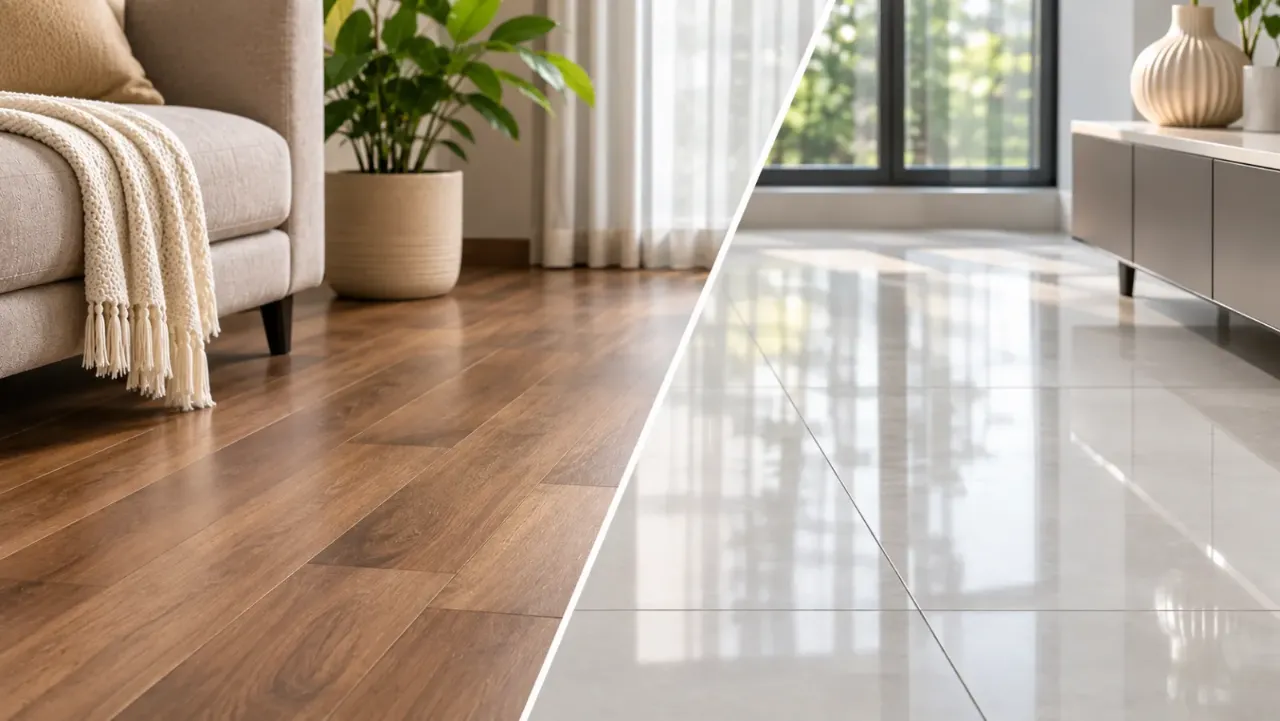
Wooden Flooring vs Vitrified Tiles in India: What Lasts
Choosing a floor is one of the more permanent decisions in a home. Furniture can be replaced, wall colours can be changed and décor can be updated, but flooring is harder and more expensive to redo. That is why the choice between wooden flooring and vitrified tiles deserves more than a comparison of showroom samples.
Wooden flooring creates a warm, comfortable look. Vitrified tiles offer a hard surface that is generally easier to clean and more tolerant of everyday moisture. Both can work well, but they do not age in the same way.
The bigger question is not simply which one lasts longer. It is what kind of wooden flooring you are comparing, how the floor will be used, how well it is installed and how much maintenance you are prepared to do.
Here is what homeowners in India should consider before making the decision.
1. First, understand what “wooden flooring” means
Wooden flooring is not one single material. The term is often used for products with very different constructions and lifespans.
Solid hardwood flooring
Solid hardwood is made from natural wood planks. Depending on the species, thickness and finish, it can be sanded and refinished several times over its life.
Its biggest advantage is repairability: surface wear does not always mean the entire floor needs replacing. However, solid wood responds to changes in humidity. It can expand, contract, cup or develop gaps if the installation and indoor conditions are not properly managed.
Engineered wood flooring
Engineered wood has a real-wood surface layer bonded to a layered core, commonly plywood or another engineered substrate. Its construction is designed to improve dimensional stability compared with a solid plank.
It still contains natural wood and is not waterproof. The thickness of the top wood layer determines whether, and how many times, the floor can be refinished. Ask the supplier for the actual wear-layer thickness rather than relying only on the term “engineered”.
Laminate flooring
Laminate flooring is not a solid wood floor. It usually has a decorative image layer over a fibreboard core, protected by a wear layer.
It can reproduce the appearance of wood at a lower initial cost, but deep scratches, chipped edges and swelling of the core may not be repairable through sanding. Water entering through joints or damaged edges can cause lasting damage.
This distinction matters. A comparison that treats solid hardwood, engineered wood and laminate as identical will give homeowners the wrong impression.
2. What are vitrified tiles?
Vitrified tiles are manufactured ceramic tiles in which the body is fired to create a dense, low-porosity material. They are available in a wide range of colours, sizes, textures and finishes, including designs that imitate natural wood and stone.
Their main practical strengths are:
- Low water absorption in properly specified vitrified products.
- Good resistance to everyday wear.
- Easy routine cleaning.
- A wide range of price points and finishes.
- Suitability for many high-traffic and moisture-prone indoor spaces.
However, vitrified tiles are not indestructible. A tile can chip or crack under a heavy impact, and poor installation can lead to hollow spots, loose tiles or cracked grout. A glossy tile may also become slippery when wet, so the surface finish matters.
3. Wooden flooring vs vitrified tiles: The practical comparison
| Factor | Wooden flooring | Vitrified tiles |
|---|---|---|
| Moisture resistance | Varies by product; generally needs protection from standing water | Generally high, subject to tile quality, joints and installation |
| Everyday cleaning | Usually needs careful, product-specific cleaning | Generally easy to sweep and mop |
| Scratches and dents | Can scratch or dent; repair depends on the type | Surface is wear-resistant, but edges can chip |
| Comfort underfoot | Warmer and less hard underfoot | Harder and often cooler |
| Appearance | Natural grain and a warm visual character | Many colours, patterns and wood-look designs |
| Repair | Solid and some engineered wood can be refinished; laminate usually cannot | Individual tiles can sometimes be replaced if matching spares are available |
| Installation | Requires careful subfloor preparation and specialist installation | Requires level preparation, correct adhesive or mortar and accurate laying |
| Maintenance | More product-specific care | Usually lower routine maintenance |
| Best suited to | Dry bedrooms, studies and selected living spaces | Living areas, passages, kitchens and other areas where easy cleaning matters |
There is no single winner across every factor. Vitrified tiles generally have the advantage where moisture and low-maintenance cleaning are priorities. Wood has the advantage when warmth, natural texture and the possibility of refinishing are important.
4. Which one actually lasts longer?
In many Indian homes, a well-selected and correctly installed vitrified tile floor is likely to remain serviceable for longer with less routine attention than a typical laminate or engineered wood floor.
But it is not accurate to say that every tile floor will outlast every wooden floor.
A thick solid hardwood floor can be refinished and maintained for a long time. A poorly installed tile floor can crack, loosen or develop grout problems much earlier than expected. Product quality, subfloor condition, workmanship, traffic and moisture exposure all affect the result.
The Central Public Works Department's maintenance manual gives indicative useful-life figures of 10 years for floor tiles, 10 years for laminate/engineered wooden flooring and 20 years for hardwood flooring. These figures are intended for maintenance planning in government buildings. They should not be treated as a guaranteed lifespan, a consumer warranty or a direct performance comparison of every vitrified tile and wood product.
The more useful question is: what will cause the chosen floor to fail, and can that risk be managed?
5. Moisture: The factor Indian homeowners should not ignore
Water exposure is one of the biggest differences between these materials.
How moisture affects wooden flooring
Wood responds to changes in moisture in the surrounding air and in the subfloor. Depending on the product and conditions, excessive moisture can lead to:
- Expansion and raised edges.
- Gaps when the material dries and contracts.
- Cupping or uneven plank edges.
- Swelling of laminate's fibreboard core.
- Damage to adhesives or the backing system.
- Discolouration and surface deterioration.
Even engineered wood, which is generally more dimensionally stable than solid wood, should not be treated as waterproof.
Before installing wood, check the subfloor for dampness, leaks and unevenness. Follow the flooring manufacturer's moisture-testing and underlay requirements. Expansion gaps and the correct installation method are essential, not optional finishing details.
How moisture affects vitrified tiles
The tile body itself generally absorbs very little water, but the complete floor is a system. Water can still enter through grout lines, perimeter joints, cracks or poorly sealed transitions. Persistent seepage can also damage the substrate beneath the tiles.
Tiles are usually the more practical option in areas exposed to frequent mopping, splashes or wet footwear, but waterproofing and correct installation still matter.
6. Maintenance: What will you be doing every week?
A floor's real cost includes the time and effort needed to maintain it.
Wooden flooring care
- Remove dust and grit regularly using a suitable vacuum or soft cleaning tool.
- Use a well-wrung, lightly damp cloth only if the manufacturer permits it.
- Avoid flooding the floor with water.
- Clean spills promptly.
- Use protective pads under furniture.
- Avoid dragging heavy furniture across the surface.
- Use only cleaners recommended for the specific finish.
- Check whether periodic recoating, oiling or refinishing is required.
Do not assume that a cleaner suitable for one wood finish is suitable for another.
Vitrified tile care
- Sweep or vacuum loose grit.
- Mop with a suitable floor cleaner.
- Clean grout lines when dirt accumulates.
- Use non-abrasive tools on polished surfaces.
- Avoid harsh chemicals unless the tile and grout manufacturers permit them.
- Keep spare tiles from the original batch for possible repairs.
Tiles usually need less specialised routine care, but grout and joints should not be ignored.
7. Repairability: What happens when something gets damaged?
This is where the type of wooden flooring makes a major difference.
Solid hardwood: Surface scratches and wear may be addressed through sanding and refinishing, provided sufficient wood thickness remains.
Engineered wood: Refinishing depends on the thickness of its real-wood top layer. Some products allow limited refinishing; others do not.
Laminate: It cannot be sanded like natural wood. A damaged plank may need to be replaced, and access can be difficult if the floor is installed as a floating system beneath fixed furniture.
Vitrified tiles: A damaged tile can sometimes be removed and replaced individually. The challenge is finding a matching tile from the same batch and removing it without damaging adjacent tiles or the substrate.
Keep spare planks or tiles where possible. A small amount of leftover material can make future repairs much easier.
8. Which flooring works best in each room?
| Room or area | More practical choice | Why |
|---|---|---|
| Living room | Either, depending on use | Wood adds warmth; vitrified tiles are easier to maintain |
| Bedroom | Engineered wood or solid wood in suitable dry conditions; vitrified tiles also work | Bedrooms often benefit from the warmer feel of wood |
| Kitchen | Vitrified tiles | Better suited to regular cleaning and occasional splashes |
| Bathroom | Suitable anti-slip tiles | Ordinary wooden flooring is not a sensible wet-area choice |
| Passage and entrance | Vitrified tiles | Handles frequent movement and cleaning more easily |
| Study or home office | Either | Wood can feel comfortable; tile is practical for chairs and frequent use |
| Utility area | Vitrified tiles | More suitable for water, cleaning and appliance-related spills |
For any tiled wet area, select a suitable slip-resistant finish rather than choosing only by appearance.
9. The honest maths: Compare the complete cost
The cheapest material at purchase is not necessarily the cheapest over its lifetime.
Total flooring cost = Material + Installation + Subfloor preparation + Underlay or adhesive + Skirting and transitions + Maintenance + Repairs + Replacement
For wooden flooring, ask whether the quote includes moisture testing, underlay, expansion gaps, skirting, trims and installation. Also check whether the floor can be repaired or refinished later.
For vitrified tiles, ask whether the quote includes tile wastage, adhesive or mortar, grout, levelling, skirting, cutting, transport and labour. Check whether spare tiles are included.
A fair comparison should use the same room area, similar quality levels and complete installed quotations. Do not compare the price of a wooden plank alone with the price of a tile that includes installation.
You can estimate annualised cost using:
Annualised cost = Total ownership cost ÷ Expected years of service
The expected service period should be a realistic estimate based on the product warranty, manufacturer guidance, installation quality and the home's conditions—not an optimistic showroom promise.
10. Installation checks that can decide the lifespan
A premium floor can fail if the preparation is poor.
Before wooden flooring installation
- Check the subfloor for moisture and levelness.
- Confirm the product's approved installation method.
- Follow the manufacturer's acclimatisation instructions, if applicable.
- Confirm expansion gaps and skirting details.
- Check underlay and moisture-barrier requirements.
- Ask how the installer will handle door frames and floor transitions.
Before vitrified tile installation
- Check the base for levelness and stability.
- Confirm the tile's grade, size, finish and intended use.
- Use the recommended adhesive or mortar.
- Confirm joint width and grout specification.
- Check lippage and alignment during installation.
- Keep spare tiles from the same batch.
Do not cover a damp or defective subfloor with a new finish. Correct the underlying issue first.
11. Common mistakes to avoid
- Treating laminate, engineered wood and solid hardwood as the same product.
- Assuming engineered wood is waterproof.
- Choosing wood for a kitchen or bathroom because it looks attractive.
- Selecting glossy tiles without considering slip resistance.
- Ignoring subfloor moisture before installation.
- Comparing material prices without installation and finishing costs.
- Forgetting to check whether wooden flooring can be refinished.
- Not keeping spare tiles or planks.
- Using excessive water or unsuitable cleaners.
- Assuming a long warranty covers every kind of damage.
12. A buyer's checklist
- Exact product type and construction.
- Thickness and surface specifications.
- Moisture and water-exposure limitations.
- Scratch, wear and impact performance.
- Cleaning and maintenance instructions.
- Repair and replacement options.
- Subfloor preparation requirements.
- Installation method and accessories.
- Warranty exclusions and claim conditions.
- Complete installed quotation.
- Availability of spare material for future repairs.
Final thoughts
If your first priority is long-term practicality, easy cleaning and resistance to everyday moisture, vitrified tiles are generally the safer choice for most Indian homes.
If you value warmth, natural texture and a softer underfoot feel, wooden flooring can be worth considering in dry, well-managed spaces. Solid hardwood, engineered wood and laminate each have different limitations, so the exact product matters.
The best flooring decision is not based on which sample looks more expensive or which material has the biggest lifespan claim. It comes down to the room, the home's moisture conditions, the quality of installation and the maintenance you are willing to undertake.
Choose for the way you live, not just for the way the floor looks on installation day.
Frequently Asked Questions
1. Which lasts longer, wooden flooring or vitrified tiles?
Vitrified tiles generally offer longer service with less specialised maintenance in many Indian homes. However, well-maintained solid hardwood can last a long time because it may be refinished. Product quality and installation matter.
2. Is wooden flooring suitable for Indian weather?
It can be suitable in dry, well-managed rooms, but humidity, leaks and standing water can damage it. The correct product, moisture testing and installation details are important.
3. Is engineered wood better than laminate flooring?
Engineered wood has a real-wood surface and may be refinished if its top layer is thick enough. Laminate is usually less expensive initially but cannot be sanded and may suffer irreversible core swelling if water enters.
4. Can vitrified tiles crack?
Yes. Heavy impact, movement in the substrate, poor installation or inadequate support can cause tiles to crack or chip. Correct preparation and installation reduce the risk.
5. Can wooden flooring be installed in a kitchen?
It is generally not recommended for a typical kitchen exposed to spills, wet cleaning and appliance leaks. Vitrified tiles are usually more practical.
6. Are wood-look vitrified tiles a good alternative?
They can be. They provide a wood-inspired appearance with the cleaning and moisture advantages of a tile surface. However, they do not provide the same warmth or feel as real wood.
7. Which flooring is easier to maintain?
Vitrified tiles are generally easier to maintain because they can be swept and mopped. Wooden flooring needs product-specific cleaners and more careful control of moisture.
8. What should I compare before accepting a flooring quotation?
Compare the exact material, thickness, grade, installation method, subfloor preparation, accessories, skirting, wastage, warranty, maintenance requirements and repair options. Compare complete installed costs rather than material prices alone.
Plan Your Home with Walls to Wonder
Make more informed interior decisions with Walls to Wonder's AI-powered tools. Explore your room, understand design possibilities and plan your next home improvement with greater clarity.
- Whole Home Visualizer – Explore design ideas across your home.
- Design My Room – Experiment with different room looks and layouts.
- Interior Design Cost Estimate – Get an initial understanding of potential design costs.
- Interior Quotation Checker – Review and understand interior quotations.
- Rate My Room Design – Get feedback on your room design.
- Interior Style Finder – Discover an interior style that suits your preferences.
Discover more at Walls to Wonder.
Turn this idea into a plan for your home
Visualise your space, understand the likely budget, or find a professional who can bring the idea to life.