
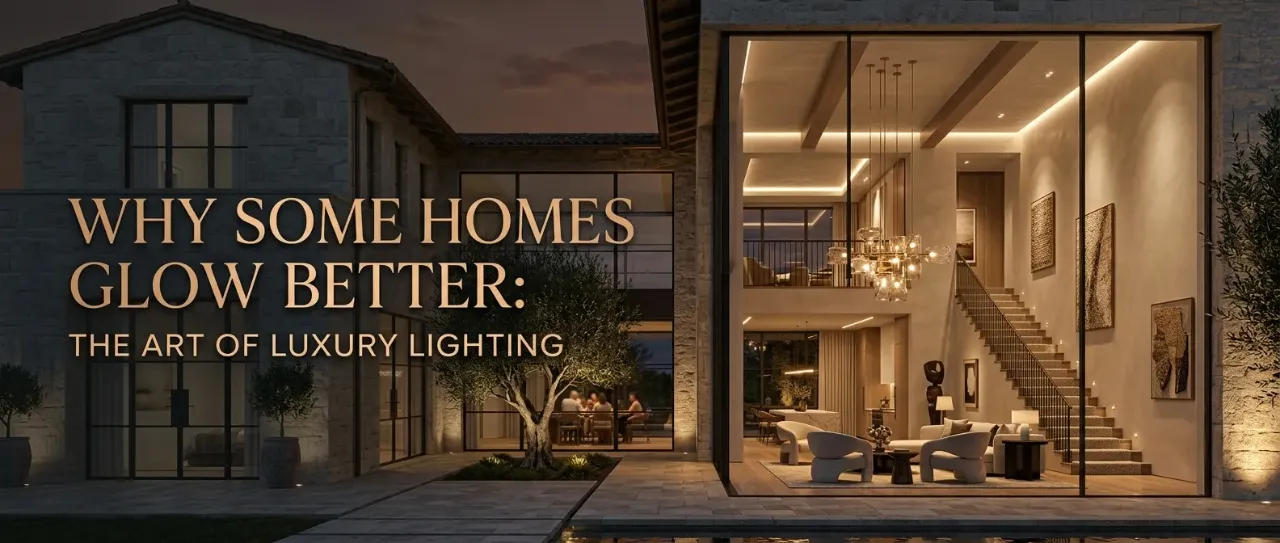
Why Some Homes Glow Better: The Art of Luxury Lighting
Lighting is one of those details you notice most when it is wrong.
A room can have beautiful furniture, expensive finishes, carefully chosen colours, and impressive architecture, yet still feel flat when the lighting has been treated as an afterthought.
On the other hand, a relatively simple room can feel polished, intimate, dramatic, or effortlessly elegant when its lighting is carefully planned.
That is the difference between lighting a room and designing with light.
Standard lighting usually focuses on providing enough illumination to perform everyday tasks.
Luxury lighting goes further.
It considers atmosphere, hierarchy, shadows, proportions, materials, focal points, comfort, and the way the room should feel at different times of the day.
The Biggest Difference: Illumination vs. Experience
Think about a typical room with one central ceiling light.
Switch it on and the entire room becomes brighter. It works.
But every part of the room receives roughly the same visual importance.
Now imagine that same room with a combination of soft ambient light, focused task lighting, subtle wall illumination, a pendant over the dining table, concealed lighting highlighting a textured wall, and a small accent light drawing attention to artwork.
The room has not simply become brighter. It has become more dimensional.
Your eye starts moving through the space. Some areas recede. Others come forward. Materials become more noticeable. Corners feel softer. The room develops a mood.
That is where luxury begins to appear.
Luxury Lighting Is Usually Layered
One of the clearest differences between standard and more sophisticated lighting is the use of multiple layers.
Instead of expecting one fixture to do everything, different sources perform different jobs.
Ambient Lighting
This provides the general illumination that allows you to move comfortably through the room. It may come from ceiling fixtures, recessed lights, indirect lighting, or other broad sources.
Task Lighting
This is focused on activities that require more visual attention. Kitchen counters, reading areas, dressing zones, desks, and bathroom mirrors all benefit from lighting designed around the task.
Accent Lighting
Accent lighting draws attention to something specific. It could highlight artwork, a textured wall, architectural detailing, shelving, plants, or a particular piece of furniture.
Decorative Lighting
This is where the fixture itself becomes part of the design. A sculptural pendant or elegant wall light can act almost like a piece of furniture or artwork.
The strongest luxury interiors rarely depend on just one of these layers. They allow several layers to work together.
Luxury Lighting Creates Hierarchy
Walk into an ordinary brightly lit room and your eye may struggle to decide where to look first. Everything is equally visible.
Luxury lighting can change that.
Imagine a living room where the sofa receives soft ambient illumination, artwork gets a subtle accent, a side table has a warm decorative lamp, and architectural details are gently highlighted.
The room now has a visual hierarchy.
The lighting is telling you what matters.
That does not mean making some areas dramatically dark. It means creating differences in intensity and focus so the room has a visual rhythm.
The Ceiling Is Not the Whole Lighting Plan
A common approach is to start with the ceiling plan and fill the room with downlights.
This can provide functional illumination, but it can also make the ceiling do too much work.
Luxury lighting often looks beyond the ceiling.
Walls can become sources of light. Joinery can glow from within. Shelves can have subtle illumination. Curtains can be washed with soft light. Floor lamps can create pools of warmth. Pendant lights can define a dining or seating zone.
The more thoughtfully these elements are combined, the less the room depends on a grid of visible ceiling fixtures.
Placement Matters More Than Fixture Count
Adding more lights does not automatically make a room feel more luxurious.
In fact, too many poorly positioned fixtures can create the opposite effect. You might get glare, uneven brightness, distracting reflections, or a ceiling that feels visually cluttered.
It is: “Where does the room actually need light?”
Look at the architecture first. What do you want to emphasise? What needs functional illumination? Which surfaces deserve attention? Where will people sit? Where will their faces be visible?
Where could a softer pool of light make an otherwise empty corner feel intentional?
Those questions lead to better lighting than simply increasing the fixture count.
Luxury Lighting Understands Shadows
Good lighting is not about eliminating every shadow.
Shadows create depth.
A room with completely uniform illumination can sometimes look visually flat because there is little variation between surfaces.
Soft shadows help furniture, textures, mouldings, artwork, and architectural features feel more three-dimensional.
This is particularly important in luxury interiors, where materials often carry a significant part of the visual experience.
The goal is not darkness. It is controlled contrast.
Materials Need the Right Kind of Light
The same material can look completely different under different lighting.
Warm wood can become richer under a softer, warmer source. Stone can reveal its texture when light grazes across its surface. Metal finishes can become more reflective when illuminated directly. Textured walls can gain depth when illuminated from an appropriate angle.
This is why lighting should ideally be considered alongside material selection rather than at the very end of the project.
The material and the light should work together.
Colour Temperature Changes the Mood
Not all white light feels the same.
The colour appearance of light can influence whether a space feels warm and intimate or crisp and energetic.
A bedroom may benefit from a softer, warmer atmosphere. A study may need a more focused and functional quality of light. A kitchen needs lighting that supports preparation and visibility.
A living room might need several options depending on whether the family is reading, entertaining, watching television, or simply relaxing.
This is another reason luxury lighting tends to involve control rather than one fixed setting.
Control Is Part of the Design
A sophisticated lighting plan gives the homeowner choices.
Imagine entering your living room in the morning with a bright, clean setting. Later in the evening, the ceiling lighting becomes softer while lamps and accent lights take over.
During a dinner party, the dining area becomes the focus. During television time, distracting sources can be reduced.
The fixtures have not changed. The experience has.
Dimmers, separate circuits, scene controls, and thoughtfully grouped lights can make a significant difference to how flexible a space feels.
Luxury is often less about adding things and more about having control over the things already there.
Decorative Fixtures Are Not the Whole Story
A large chandelier can certainly create a statement.
But a room does not become luxurious simply because it contains an impressive light fixture.
In fact, relying too heavily on statement fixtures can make lighting feel decorative rather than designed.
Think about what happens around the statement piece.
Is the surrounding space appropriately lit? Are the walls too dark? Is artwork visible? Does the furniture receive comfortable illumination? Are there softer secondary sources?
A luxury interior uses decorative lighting as part of a larger composition.
Luxury Lighting Can Be Quiet
Some of the most sophisticated lighting is barely noticed.
A soft glow beneath cabinetry or within joinery can add depth without creating visual clutter.
Subtle illumination can make artwork, textured surfaces, or architectural features stand out.
Hidden illumination behind selected elements can create an atmospheric glow.
A small, carefully positioned light can give an otherwise overlooked corner a sense of purpose.
These details do not necessarily announce themselves. Instead, they make the room feel better.
The goal of luxury lighting is not always to make people notice the light source. Sometimes the goal is to make them notice the room.
Think About the Human Face
Lighting also affects how people experience one another.
In living and dining areas, very strong overhead lighting can create unflattering shadows on faces.
Light that comes from more suitable directions can create a softer and more comfortable social atmosphere.
This is especially important in spaces designed for entertaining.
Luxury is ultimately experienced by people, not just photographed rooms.
Different Rooms Need Different Lighting Strategies
Living Room
Combine ambient illumination with floor or table lamps, accent lighting, and potentially wall or architectural lighting. The aim is flexibility rather than maximum brightness.
Kitchen
Prioritise clear task lighting over work surfaces while keeping ambient lighting comfortable for the overall space. Lighting under cabinets or around work zones can be particularly useful.
Bedroom
Think about calmness and flexibility. Bedside lighting, concealed sources, wardrobe lighting, and softer ambient illumination can work together without making the room feel over-lit.
Dining Area
The dining table deserves specific attention because it is both a functional and social focal point. A pendant or decorative fixture can define the table while supplementary lighting keeps the surrounding room connected.
Bathroom
Lighting needs to support practical tasks while avoiding harsh shadows, particularly around mirrors. Here, placement can matter just as much as fixture appearance.
The Luxury Effect Often Comes From Restraint
This may be the most important point of all.
Luxury does not always mean more. More fixtures. More brightness. More decorative pieces. More dramatic effects.
Sometimes the strongest result comes from doing less, but doing it deliberately.
One softly illuminated wall can have more impact than ten random spotlights.
One well-positioned pendant can feel more elegant than a ceiling crowded with fixtures.
One warm decorative lamp can completely change the atmosphere of a room after sunset.
The luxury comes from the relationship between the elements.
Standard Lighting vs. Luxury Lighting
Focuses primarily on making the room bright enough for everyday use.
Uses light to shape atmosphere, visual hierarchy, comfort, and character.
Often relies heavily on general overhead illumination.
Combines ambient, task, accent, architectural, and decorative layers where appropriate.
Lighting is frequently planned after furniture and finishes are decided.
Lighting is considered alongside architecture, materials, furniture, and room function.
The room often has one primary lighting mood.
Multiple lighting scenes allow the room to adapt throughout the day.
What Homeowners Should Decide Before the Electrical Work
Lighting becomes much harder to fix once the ceiling, walls, and joinery are finished.
Before finalising the electrical plan, think through the room as a series of experiences.
- Where will people sit?
- Where will they work?
- What needs to be highlighted?
- Which areas need task lighting?
- Where do you want a softer atmosphere?
- Which decorative fixtures will be visible?
- Which sources should be concealed?
- Which lights need independent switching?
- Which areas might eventually need dimming?
This is the stage where lighting design becomes much more valuable than simply selecting fixtures later.
The Best Luxury Lighting Is Designed Around the Room
A beautiful light fixture can be bought from a catalogue.
A beautiful lighting scheme has to be designed around the space.
It considers the architecture, materials, furniture, activities, sightlines, shadows, and mood.
That is why two rooms with the same furniture and the same fixtures can still feel completely different.
The difference may be where the light falls.
It becomes: “What should this room feel like?”
That is where lighting stops being an electrical requirement and starts becoming interior design.
Bring the Lighting Idea Into Your Own Space
Before choosing fixtures, look at your room as it is used throughout the day. Identify what needs to be illuminated, what deserves attention, and what could benefit from a softer atmosphere.
With Walls to Wonder’s AI Design My Room tool, you can upload a room photo and explore different interior directions, including lighting and other design elements, around your existing space.
You can also explore interior professionals through the Walls to Wonder designer platform when you are ready to develop the concept further.
Final Thought
Standard lighting helps you see a room.
Luxury lighting helps you experience it.
The difference is not necessarily the price of the fixture. It is the thought behind where the light comes from, what it highlights, what it softens, and how it changes with the way you live.
When light is designed with intention, even simple interiors can feel richer, calmer, and more considered.
Frequently Asked Questions
1. What is the biggest difference between standard and luxury lighting?
Standard lighting primarily focuses on adequate illumination. Luxury lighting considers illumination as well as atmosphere, hierarchy, comfort, materials, focal points, and flexibility.
2. Does luxury lighting always require expensive fixtures?
No. A luxury effect can come from thoughtful placement, layering, control, concealed lighting, and appropriate illumination. Expensive fixtures are not a substitute for good planning.
3. What is layered lighting?
Layered lighting combines different types of illumination, such as ambient, task, accent, architectural, and decorative lighting, so that one room can support different needs and moods.
4. Why are shadows important in luxury lighting?
Controlled shadows create depth and contrast, helping furniture, textures, artwork, and architectural details appear more dimensional.
5. Should every room use the same colour of light?
Not necessarily. Different spaces and activities can benefit from different lighting qualities. The overall plan should feel cohesive while responding to how each room is used.
6. When should lighting be planned in an interior project?
Ideally, lighting should be considered early, alongside the architecture, furniture layout, materials, ceiling design, and electrical planning rather than being added after the interiors are completed.
Turn this idea into a plan for your home
Visualise your space, understand the likely budget, or find a professional who can bring the idea to life.