
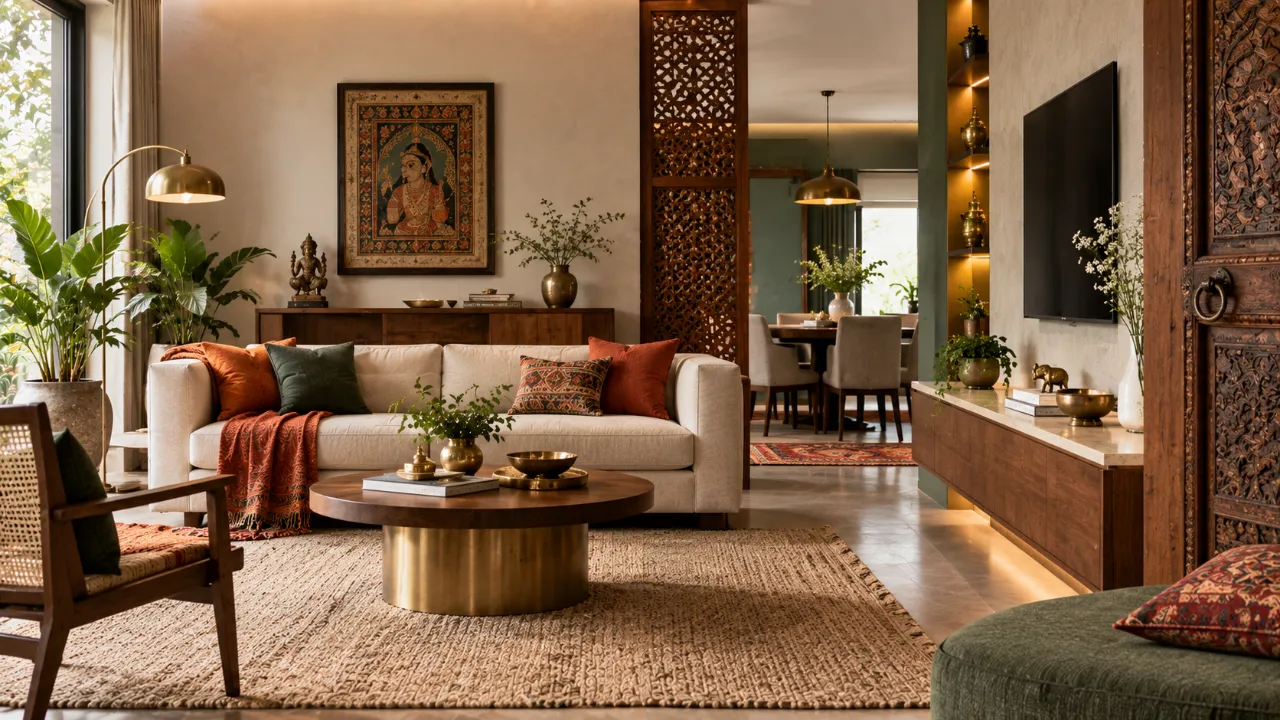
When the Brass Diya Meets the Boucle Chair | Blending Indian and Contemporary Western Interiors
Most Indian homes already live in two design languages at once. There's the inherited layer, a carved wooden chest, brass lamps, a handloom throw, a family painting, and the layer you choose today, a clean-lined sofa, a neutral palette, slim metal legs.
Blending them can look effortless in one home and chaotic in another. The difference is rarely the pieces themselves. It's whether the blend was planned or just accumulated.
- Why blends clash
- Principle 1: Choose a lead style
- Principle 2: Keep the backdrop calm
- Principle 3: Give one piece the spotlight
- Principle 4: Find the common thread
- Principle 5: Mix textures, not just styles
- Pairings that tend to work
- Room-by-room ideas
- Mistakes that break the blend
- Questions to ask your designer
- Frequently asked questions
Why Blends Clash
Both Styles at Full Volume
Ornate carving, heavy patterns and bold colour meeting sharp minimal lines, with nothing calm between them.
Too Many Focal Points
Every piece competes for attention, so the eye has nowhere to rest.
No Common Thread
Nothing in colour, material or shape links the traditional and the contemporary pieces.
Mismatched Scale
A heavy carved sideboard beside spindly modern chairs feels accidental, not intentional.
A fifth cause is simply theming: every corner is "ethnic" or "modern" in a way that reads like a set rather than a home.
Principle 1: Choose a Lead Style
Let one style lead and the other support. A rough guide many designers use is roughly two-thirds one style and one-third the other, though it's a starting point rather than a rule. A calm contemporary base with traditional accents usually feels more cohesive than a fifty-fifty split.
Principle 2: Keep the Backdrop Calm
Walls, large furniture and flooring form the backdrop. Keep these simple and neutral, and let the Indian craft live in the objects on top: brass, textiles, carved pieces, artwork. A busy backdrop plus busy objects is where clashes begin.
Principle 3: Give One Traditional Piece the Spotlight
A single carved jharokha-style panel, an antique chest or a statement brass piece reads as a deliberate hero. Five of them read as a theme. Let one piece anchor each room and give it breathing space.
Principle 4: Find the Common Thread
Link the two styles through something shared:
- Colour: repeat one or two tones from a traditional textile in the contemporary furniture
- Material: wood tones or brass finishes that recur across old and new pieces
- Shape: curves echoing a traditional arch or a rounded motif in a modern chair
Principle 5: Mix Textures, Not Just Styles
Textural contrast makes a blend feel rich rather than confused. Pair handloom cotton, jute or cane with linen, leather, glass or metal. Warm natural materials soften contemporary lines, and clean lines let traditional textures stand out.
Want to See a Blend in Your Own Room First?
Upload a photo of your space and explore how traditional and contemporary pieces could sit together before you buy anything.
Visualise Your RoomPairings That Tend to Work
| Traditional element | Contemporary partner | Why it works |
|---|---|---|
| Carved wooden chest or almirah | Plain neutral wall, minimal lighting | The carving becomes the focal point without competition |
| Brass diyas, urlis, lamps | Sleek console or clean-lined shelf | Warm metal against simple lines feels intentional |
| Handloom or block-print textiles | Solid-colour, low-profile sofa | Pattern is contained to accents, not everywhere |
| Cane or jute furniture | Metal or glass accents | Natural texture balanced by polished contrast |
| Jaali or pierced screens | Open, uncluttered layout | Pattern reads as art, not busyness |
| Traditional artwork or Madhubani/Warli pieces | Simple frames on a neutral wall | The art carries the character |
Room-by-Room Ideas
Living Room
A clean-lined sofa and neutral walls, with one carved piece and brass accents as the traditional layer.
Bedroom
A contemporary bed with handloom bedding and a small carved side table.
Dining Area
A simple modern table with traditional serveware, or a carved sideboard with slim contemporary chairs.
Entry
A plain console with a brass urli or a carved mirror frame as the welcome.
Mistakes That Break the Blend
- Buying matching "ethnic" sets: a full themed set removes the sense that the pieces were chosen over time
- Layering too many patterns: one or two pattern moments per room is usually enough
- Treating heirlooms as clutter: the most convincing blends often build around one real inherited piece
- Mixing every finish: pick two or three wood and metal tones and repeat them
Questions to Ask Your Designer
- Which style should lead in this room, and which should support?
- Which single traditional piece should be the hero here?
- What colour, material or shape ties the old and new pieces together?
- How do we keep the backdrop calm so the craft stands out?
- Can we build around pieces I already own, rather than replacing them?
The Professional Judgement: Blending Is Editing
A successful mix of Indian and Western styles isn't about owning the right pieces. It's about restraint: one lead style, a calm backdrop, one hero, a shared thread. Most clashing rooms don't need different furniture, they need fewer competing statements.
Use AI Before You Meet an Interior Designer
AI tools can help you organise your ideas before meetings. They are not a replacement for professional design judgement.
Visualise Your Room
Upload a room photograph and explore a blended look before committing to any piece.
Design My Room →Estimate Your Budget
Create an initial interior budget based on your rooms and the look you want.
Estimate Interior Cost →Want a Home That Feels Both Rooted and Current?
Take your heirlooms, your favourite pieces and your budget to designers serving your area, and plan a blend that feels deliberate rather than accidental.
Find Interior Designers Visualise Your Room Estimate Interior CostFrequently Asked Questions
Can traditional and modern styles really work together?
Yes. The key is choosing a lead style, keeping the backdrop calm and using a shared colour, material or shape to link old and new.
How do I use heirloom pieces in a modern home?
Give one heirloom piece space to be the focal point, and keep the surrounding walls and furniture simple so it stands out.
What colours blend Indian and Western styles well?
Warm neutrals as a base, with one or two accent tones repeated from traditional textiles, tend to link the styles smoothly.
How many traditional pieces are too many?
There's no fixed number, but if every corner has a statement piece, the room reads as a theme. One hero piece per room is a useful starting point.
Final Checklist
- Have you chosen one lead style for the room?
- Is the backdrop, walls, flooring, large furniture, calm and simple?
- Does one traditional piece act as the clear hero?
- Is there a shared colour, material or shape linking old and new?
- Have you limited pattern to one or two moments per room?
A blended home works when it looks chosen, not collected. Use WallsToWonder to find interior designers, visualise your room and estimate your interior cost before deciding how to combine your styles.
Turn this idea into a plan for your home
Visualise your space, understand the likely budget, or find a professional who can bring the idea to life.