
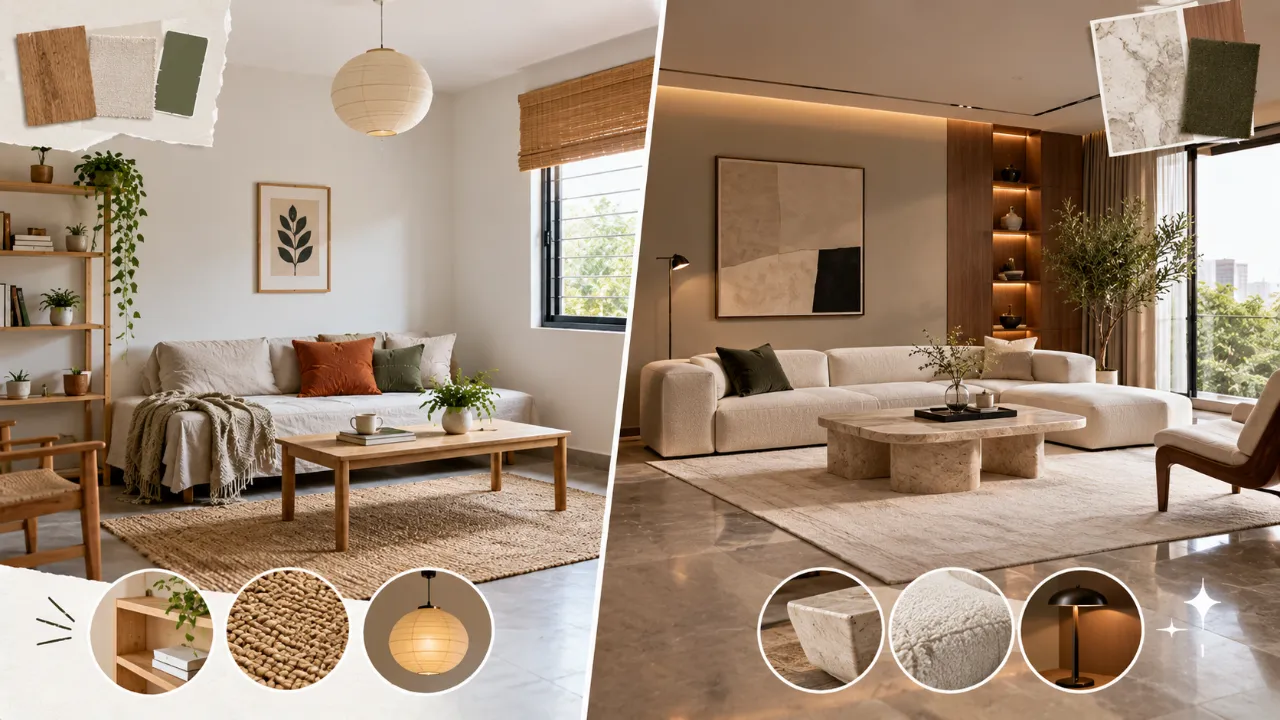
When Less Costs More: Budget vs. Luxury Minimalism
Minimalism often sounds simple: use fewer things, keep the colours restrained, avoid unnecessary decoration and let the room breathe.
But there is an interesting contradiction hidden inside that idea.
A minimalist home can be created on a modest budget. It can also become one of the most expensive interior styles to execute.
The difference is not simply how much furniture is in the room. It is how carefully everything that remains has been selected.
A budget minimalist home focuses on doing more with less. A luxury minimalist home often focuses on making less look exceptionally refined.
- What Minimalism Is Really About
- What Budget Minimalism Is Really About
- What Luxury Minimalism Is Really About
- The Role of Material Quality
- Why Colour Can Look Different at Different Budgets
- Why Detailing Matters
- Furniture and Proportion
- Customisation and Built-Ins
- The Hidden Cost of Minimalism
- Lighting and Visual Calm
- The Role of Empty Space
- The One Expensive Thing Strategy
- Budget vs Luxury Minimalism
- Common Mistakes
- A Better Way to Choose
- FAQ
Minimalism Is Not the Same as Having Less Stuff
A room with very little furniture is not automatically minimalist.
Minimalism depends on decisions such as proportion, visual hierarchy, material coordination, repetition, negative space, lighting, storage and colour discipline.
The real skill is knowing what to remove and what deserves to remain.
What Budget Minimalism Is Really About
Minimalism on a budget is less about buying "cheap minimalist furniture" and more about reducing unnecessary decisions.
Keep useful furniture, remove visual clutter, simplify the colour palette, improve the arrangement and use a few strong materials repeatedly.
Budget minimalism is often strongest when it relies on editing rather than shopping.
What Luxury Minimalism Is Really About
Luxury minimalism follows a different route. There may still be very few visible objects, but the individual elements receive much more attention.
A plain-looking wall may involve carefully selected stone, custom joinery, concealed lighting and precisely detailed edges.
A simple sofa may have high-quality upholstery, a carefully considered profile and proportions designed specifically for the room.
The room looks simple. The decisions behind that simplicity are not.
The Biggest Difference: Material Quality
In budget minimalism, the material strategy often focuses on achieving a clean visual effect efficiently through practical and accessible finishes.
Luxury minimalism may use fewer materials but place greater emphasis on their quality and detailing.
Laminate, practical fabrics, standard tiles, painted surfaces, accessible hardware and simple wood finishes.
Natural stone, premium timber or veneer, high-quality upholstery, custom metalwork and specialist finishes.
Budget minimalism asks: What can achieve the look effectively?
Luxury minimalism asks: What is the most refined version of this element?
The Same Colour Palette Can Look Completely Different
Imagine two interiors using beige, ivory and warm wood.
One has standard cabinetry, simple furniture and carefully edited accessories.
The other has custom joinery, large-format natural materials, integrated lighting and almost invisible hardware.
The colour palette may be nearly identical. The experience will not be.
Detailing Becomes More Important as the Budget Increases
When a room contains fewer elements, small details become more visible.
A slightly uneven panel junction, an exposed wire, a bulky handle, an awkward filler piece or an inconsistent gap can interrupt the feeling of calm.
Luxury minimalist interiors often invest heavily in resolving these transitions.
Furniture Is About Proportion, Not Price Alone
An expensive chair can still look wrong in a room. A relatively affordable sofa can look sophisticated if its proportions work.
Pay attention to scale, visual weight, leg profile, seat depth, height and spacing between pieces.
Minimalist rooms expose proportion very clearly because there are fewer competing elements.
Luxury Minimalism Often Uses Customisation
One major difference between budget and luxury interiors is how closely elements fit the architecture.
Budget solutions often adapt standard products to the room. Luxury solutions may adapt the room's furniture and storage to the architecture.
- A wardrobe reaches exactly where it needs to.
- A media unit fits the wall precisely.
- A study desk is integrated into the cabinetry.
- A kitchen appliance aligns with surrounding panels.
This level of customisation creates visual calm that can be difficult to achieve when every element has been selected independently.
Storage Is One of the Hidden Costs of Minimalism
A minimalist room usually has to hide more than it shows.
You may need places for electronics, paperwork, cleaning supplies, toys, clothing, appliances and everyday objects.
In a budget interior, clever use of existing cabinets and standard storage can help.
In a luxury interior, storage may be completely integrated into the architecture.
Lighting Makes a Huge Difference
Minimalist interiors depend heavily on lighting because there are fewer decorative elements to create visual interest.
Budget minimalism can still use layered lighting through a combination of the main light, floor lamps, table lamps and carefully selected fixtures.
Luxury minimalism may take this further by integrating lighting directly into the architecture through concealed and recessed sources.
The fixture itself may not even be the visual focus. The effect is.
Hardware Is More Visible Than You Think
Handles, hinges, taps, switches and other functional elements become part of the visual field in highly minimalist interiors.
The important thing is consistency. Five different finishes can make a restrained room feel surprisingly busy.
Empty Space Is Free, but Good Composition Is Not
One of the great advantages of minimalism is that empty space costs nothing.
You do not have to fill every wall. You can remove an unnecessary side table, leave space around a sofa or allow one artwork to stand alone.
But negative space only works when the remaining elements are properly positioned.
Where Budget Minimalism Can Have an Advantage
A smaller budget can sometimes encourage better discipline.
You cannot buy every attractive object. You have to choose. You may need to reuse furniture, prioritise layout over expensive finishes and focus on decluttering before shopping.
These constraints can actually support the minimalist principle of intentionality.
Where Luxury Minimalism Spends More
- Custom dimensions
- Premium materials
- Precise joinery
- Concealed services
- Integrated lighting
- High-quality hardware
- Carefully controlled finishes
- Custom upholstery
- Architectural detailing
The "One Expensive Thing" Strategy
You do not have to choose between a completely budget interior and a luxury interior.
A useful middle ground is to spend selectively.
Keep most of the room simple and affordable, then choose one or two elements where quality really matters.
- A beautiful light
- One strong lounge chair
- A natural stone surface
- A high-quality rug
- A statement artwork
- Custom joinery in one important area
Where Not to Spend More
Luxury does not automatically mean every element should be upgraded.
The best minimalist interiors tend to prioritise the things that affect the space repeatedly: layout, comfort, materials, lighting and detailing.
Budget Minimalism vs Luxury Minimalism
- Edits what already exists
- Uses a restrained palette
- Prioritises practicality
- Uses accessible materials
- Relies on good arrangement
- Spends selectively
- Uses fewer but more refined elements
- Prioritises material quality
- Uses more customisation
- Conceals services and storage
- Emphasises precision and detailing
- Spends heavily on execution
Neither approach requires a room to look cold or empty. Both can be warm, comfortable and personal.
Common Mistakes in Minimalist Interiors
Buying cheap versions of everything
Affordable minimalism is not about filling the home with low-cost objects that imitate luxury pieces.
Removing too much
A room still needs comfort, function and personality.
Using too many different finishes
Minimalism benefits from repetition and visual consistency.
Confusing empty with finished
Negative space should feel intentional, not accidental.
Spending heavily on appearance but ignoring function
A beautiful room still needs to work for everyday life.
Forgetting warmth
Minimalism can become sterile when texture, softness and personal details are removed completely.
A Better Way to Choose Your Version of Minimalism
Identify clutter and unnecessary visual noise.
What do I want to keep?
Protect the furniture, objects and details that matter.
Where does quality matter most?
Spend where you interact with something every day.
What can stay simple?
Not everything needs to be a statement.
What needs to be concealed?
Plan storage for the things you do not want visually present.
The Real Luxury in Minimalism
Luxury is not always expensive marble or custom furniture.
Sometimes the most luxurious part of a minimalist home is the feeling that nothing is fighting for attention.
The storage works. The lighting is comfortable. The room is easy to move through. The materials feel coherent. The furniture has breathing room. There is visual quiet.
Those qualities can exist at different price points.
Explore Your Minimalist Design Direction
Whether you are refining an existing room or exploring a completely new look, visualising different interior directions can make the design process clearer.
Final Thought
Budget minimalism and luxury minimalism may look similar from a distance.
Both can have clean lines, neutral colours, fewer objects and generous negative space. But look more closely and the difference becomes clearer.
Budget minimalism achieves simplicity through editing, restraint and smart priorities.
Luxury minimalism achieves simplicity through precision, customisation and highly resolved materials and details.
The important lesson is that minimalism is not defined by how much you spend. It is defined by how deliberately you decide what deserves to stay.
FAQ
Yes. Minimalism can rely heavily on decluttering, furniture arrangement, repetition of finishes and selective purchasing rather than expensive materials.
Because a simple visual result often depends on custom furniture, premium materials, integrated storage, concealed services and precise detailing.
No. Minimalist interiors can use colour. What matters more is how consistently and intentionally colour is used.
Prioritise elements you use frequently and elements that strongly affect the room, such as comfortable furniture, lighting, key materials, storage and important built-ins.
Focus on proportion, consistency, decluttering, coordinated finishes, layered lighting and a few carefully chosen focal pieces rather than trying to make every element look expensive.
Get a personalised estimate for your home
Choose your rooms, materials and preferences to understand a practical interior budget before you commit.