
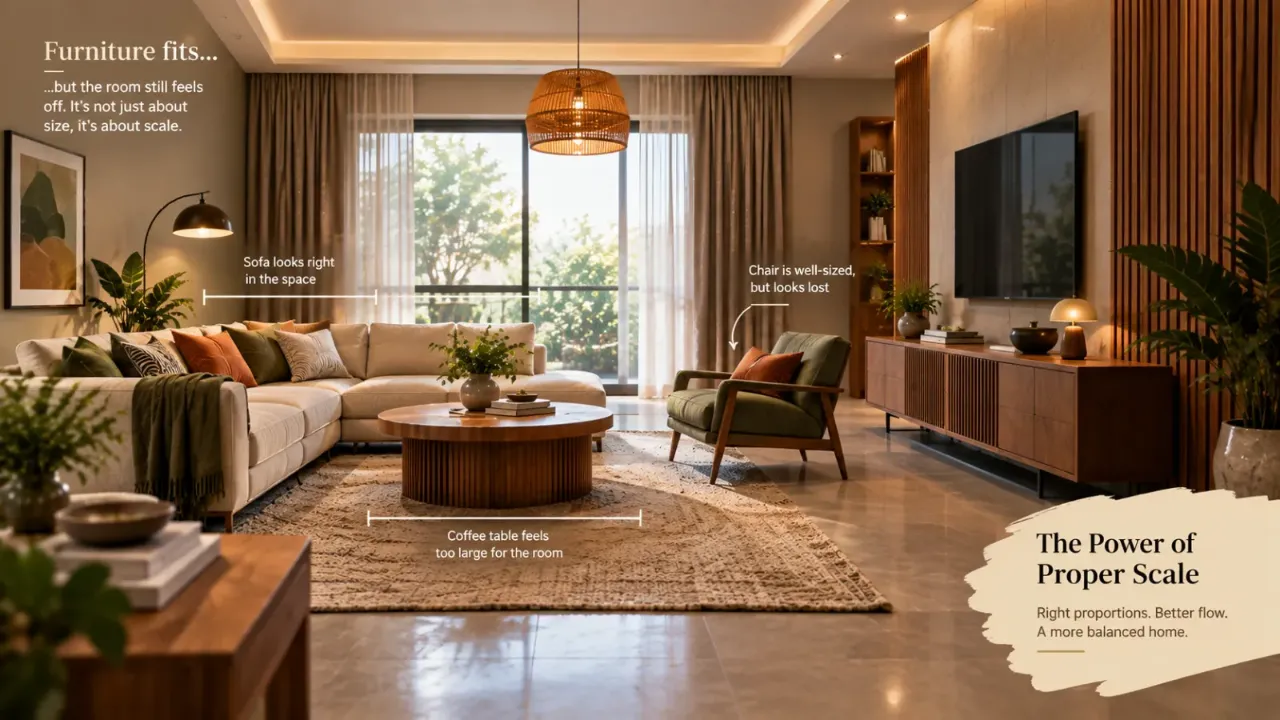
When Furniture Fits but the Room Doesn't: Understanding Scale
A sofa can fit through the door. A dining table can fit inside the room. A bed can fit between the walls. And yet the space can still feel completely wrong.
The problem is often furniture scale. A piece can be beautiful on its own and still be too large, too small, too deep, too tall or visually too heavy for the room around it.
That is why furniture scale is such an important part of interior design. It is not simply about whether something fits. It is about whether it belongs to the space.
- What Furniture Scale Actually Means
- Why Furniture Scale Is Such a Common Design Problem
- A Room Can Feel Cramped Even When Furniture Fits
- Oversized Furniture Changes Circulation
- Why the Sofa Is Often the Biggest Culprit
- Big Does Not Automatically Mean Luxurious
- Undersized Furniture Creates a Different Problem
- The Coffee Table Matters More Than You Think
- Dining Tables Need to Be Judged With Chairs Pulled Out
- Beds Can Overwhelm a Bedroom
- Wardrobe Depth Is Critical
- Height Changes How a Room Feels
- Visual Weight Matters Too
- Furniture Scale Affects Room Proportions
- Don't Choose Furniture From Photographs Alone
- Measure Clearance, Not Just Furniture
- Match Furniture to the Room's Visual Scale
- Don't Let One Large Piece Take Over
- Scale Matters Even More in Small Homes
- Sometimes Less Furniture Is the Answer
- Common Furniture-Scale Mistakes
- A Simple Furniture-Scale Test
- A Practical Room-by-Room Check
- FAQ
What Does Furniture Scale Actually Mean?
Furniture scale is the relationship between the size of a furniture piece and the room, the other furniture around it and the people who will use it.
It includes more than width. Think about overall height, width, depth, seat height, visual weight, relationship to nearby furniture, relationship to doors and windows, the amount of floor space it occupies and the clearance needed to use it.
A large sofa in a large room may feel perfectly proportioned. The same sofa in a compact apartment can make the room feel crowded.
Why Furniture Scale Is Such a Common Design Problem
Furniture is often selected based on appearance first. A sofa looks beautiful in a showroom. A bed looks luxurious online. A dining table looks perfect in a photograph.
But the more useful question is not simply, “Do I like this piece?” It is, “What does this piece do to the room when it is placed inside it?”
A showroom gives you context. Your home does not.
A Room Can Feel Cramped Even When the Furniture Technically Fits
There is a difference between furniture fitting and furniture functioning comfortably.
The piece physically fits within the available room dimensions.
The piece can be used comfortably while doors, circulation routes and surrounding furniture remain usable.
A sofa may fit against the wall, but there may be too little room to move around it. A bed may fit into the bedroom, but opening the wardrobe may become difficult.
The floor plan can therefore be technically correct while the room still feels uncomfortable.
1. Oversized Furniture Changes Circulation First
The easiest way to notice a scale mistake is often through movement.
Imagine a living room with a deep sectional sofa, a large coffee table, two lounge chairs, a TV unit and a console.
Each piece may individually fit. Together, they can eliminate the walking paths that make the room usable.
This is why furniture planning should start with circulation rather than simply filling available floor area.
2. The Sofa Is Usually the Biggest Culprit
Sofas often become the dominant furniture piece in a living room. Depth is particularly important.
A sofa that is just slightly deeper can push the rest of the room forward. Then the coffee table moves. Then the chairs move. Then the walking route becomes narrower.
The issue may not even be the sofa's width. It could be the combination of width, depth, arm thickness, back height and surrounding clearance.
3. Big Does Not Automatically Mean Luxurious
There is a common assumption that larger furniture looks more premium.
Sometimes it does. Sometimes it simply looks oversized.
A beautifully proportioned sofa can look more sophisticated than an enormous sectional squeezed into a room. The same applies to beds, dining tables, wardrobes and occasional furniture.
4. Undersized Furniture Creates a Different Problem
Scale mistakes do not always mean “too big.” Furniture can also be too small.
A very small sofa in a large living room can make the room feel unfinished. A tiny rug under a large seating group can disconnect the furniture visually.
A small coffee table can look lost between oversized sofas. A narrow console can disappear on a large wall.
Undersized furniture creates visual gaps that may make the room feel less balanced.
5. The Coffee Table Has a Bigger Role Than People Expect
Coffee tables are often chosen almost like accessories. But their size affects the entire seating arrangement.
Too small, and the table can feel disconnected from the sofa. Too large, and it can reduce the circulation space around it.
Its height matters too. A dramatic height difference between the sofa and coffee table can make the arrangement look awkward.
A good coffee table should relate to the seating around it in both size and proportion.
6. Dining Tables Need to Be Judged With the Chairs Pulled Out
Dining tables create another classic scale mistake.
A table may fit beautifully when the chairs are pushed underneath it. But that is not how people use a dining room.
Chairs move out. People sit. People stand. Someone may walk behind the chair.
The real question is therefore not, “Does the table fit?” It is, “Does the table work when everyone is using it?”
7. Beds Can Overwhelm a Bedroom
A bedroom is particularly sensitive to scale because the bed is already a large visual and physical element.
A king-size bed can be luxurious. But if the room is small, it can leave very little flexibility for side tables, wardrobes, dressing areas, walkways, curtains, storage and seating.
The issue is not that a large bed is wrong. It is whether the room can support it without everything else becoming compressed.
8. Wardrobes Are Where Depth Becomes Critical
People often focus on wardrobe width and forget about depth.
A deep wardrobe can reduce the usable room around it significantly, especially when it faces the bed, a dressing area, a desk, a doorway or another storage unit.
A wardrobe that is physically possible to install may still make the bedroom feel tight because of the space needed to stand, open doors and use the storage.
9. Height Changes How a Room Feels
Scale is also vertical.
A very tall cabinet can visually dominate a small room. A low sofa below a tall ceiling can make the room feel beautifully relaxed, or strangely disconnected if everything else is also too low.
Curtain height, wardrobe height, headboard height, TV unit height and ceiling treatment all contribute to the visual proportions of a room.
10. Visual Weight Matters as Much as Physical Size
Two pieces can have the same dimensions and still look completely different.
Slim legs, thinner arms, open bases and lighter finishes can make furniture appear less bulky.
Thick arms, deep bases, solid forms and darker finishes can make a piece feel much larger.
A glass-top table may visually occupy less space than a solid stone table of similar dimensions. A floating cabinet may feel lighter than a floor-to-ceiling storage wall.
11. Furniture Scale Affects Room Proportions
A room is a collection of relationships.
The sofa relates to the coffee table. The coffee table relates to the seating. The seating relates to the rug. The rug relates to the room. The room relates to the doors and windows.
When one piece is dramatically out of proportion, the whole composition can feel wrong.
This is why a room can feel “off” even when you cannot immediately identify the problem. You are often noticing a mismatch in proportion.
12. Don't Choose Furniture From Photographs Alone
Online furniture shopping makes scale mistakes easier.
A product photograph may show a beautiful chair against a large studio background. Without a reference object, it can be difficult to understand its actual size.
Even room photographs can be misleading because of wide-angle lenses, camera height, perspective, cropping, furniture placement and ceiling height.
Always check the actual dimensions, then compare those dimensions with your floor plan.
13. Use the Room Itself as the Reference
Before buying furniture, measure the room.
Then measure the furniture.
But do not stop there. Mark the furniture footprint on the floor using masking tape, newspaper, cardboard or temporary boxes.
This can immediately reveal whether a piece feels too large.
Walk around the marked footprint. Sit beside it. Open nearby doors. Pull out dining chairs. Stand in front of the wardrobe.
14. Think About Clearance Separately From Furniture Size
One of the biggest planning mistakes is measuring only the object.
A sofa may be 2200 mm wide. But it does not need only 2200 mm. It also needs space for walking, side tables, coffee tables, door movement, curtains and access to windows.
Likewise, a wardrobe is not just its cabinet depth. It also needs a usable zone in front.
Furniture therefore consumes floor area twice: once through its physical size, and again through the space needed to use it.
15. Match Furniture to the Room's Visual Scale
A room with large architectural features can usually support larger furniture more comfortably.
- High ceilings
- Large windows
- Wide walls
- Deep floor plates
- Generous openings
A compact apartment with low ceilings and smaller openings may need furniture with lighter proportions.
This does not mean every small room needs tiny furniture. It means the furniture should respect the visual character of the room.
16. Keep One Large Piece From Becoming the Entire Room
Statement furniture can be useful. But one oversized piece can easily become the visual centre of everything.
- A huge sectional
- A massive bed
- An oversized dining table
- A full-height storage wall
- A giant accent chair
If one piece dominates, the rest of the furniture often has to become smaller or more restrained to compensate.
The room should feel like a composition rather than a collection of individually impressive objects.
17. Scale Matters in Small Homes Even More
In a compact home, every oversized decision has a greater impact.
An extra 150 mm of sofa depth can reduce circulation. A deeper wardrobe can make a bedroom feel significantly tighter. A large dining table can consume the flexibility of an entire dining area.
This is why small-space design should often prioritise proportion, flexibility, multi-functionality, visual lightness and clear circulation instead of simply choosing smaller versions of everything.
18. Use Fewer Pieces Rather Than Squeezing in More
When furniture does not fit comfortably, the solution is not always smaller furniture.
Sometimes the better answer is less furniture.
A living room may work beautifully with one sofa, two occasional chairs and a small table. Adding another chair simply because there is an empty corner may destroy the balance.
A bedroom may not need a bench, lounge chair, dresser and extra side table.
Good scale often comes from editing.
19. Common Furniture-Scale Mistakes
- Buying furniture first and checking the floor plan later: A beautiful piece can create circulation problems once it enters the room.
- Measuring only width: Depth, height and working clearances can be equally important.
- Copying an inspiration image literally: The original furniture may have been chosen for a very different room size and proportion.
- Ignoring visual weight: Dark, bulky pieces can feel much larger than lighter pieces of similar dimensions.
- Ignoring working clearances: Dining chairs, wardrobes, desks and appliances all require space beyond their physical footprint.
- Trying to fill every empty corner: Empty space is not automatically wasted space. Sometimes it is what makes the furniture look right.
20. A Simple Furniture-Scale Test
Before finalising a piece, ask five questions:
Can the furniture physically fit into the room?
2. Can it function?
Can doors, drawers, chairs and other parts be used properly?
3. Can people move?
Is there enough clear circulation around it?
4. Does it relate?
Does its size make sense beside the other furniture?
5. Does the room still breathe?
Is there enough visual and physical space around the composition?
If the answer to the first question is yes but the others are no, the furniture does not really fit the room.
21. A Practical Room-by-Room Check
Check sofa depth, coffee-table size, seating relationships and the main walking routes.
Check bed size, bedside tables, wardrobe access and circulation around the sleeping area.
Check the table against the number of users and allow for chairs to pull out comfortably.
Check desk depth, chair movement, storage access and the amount of space behind the user.
22. The Best Furniture Is Not Always the Biggest or Smallest
Scale is not a competition.
A larger room does not automatically require oversized furniture. A smaller room does not automatically require miniature furniture.
The right piece is the one that works with the room's proportions, the people using it and the activities happening around it.
Sometimes that means going larger. Sometimes it means going smaller. Sometimes it means removing one more piece entirely.
The important thing is that the room remains balanced.
Plan Your Room Before Choosing Furniture
Visualising your room before making furniture decisions can help you explore layouts, proportions and design directions before committing to a purchase.
Final Thought
Furniture scale is easy to underestimate because we tend to judge furniture one piece at a time.
But a room does not experience a sofa, bed or dining table individually.
It experiences the relationship between all of them.
A piece can be beautiful, expensive and perfectly functional on its own and still make the room feel cramped, empty or unbalanced.
Good interior design is not about fitting the maximum amount of furniture into a space.
It is about choosing furniture that gives the room the right proportions, the right circulation and enough space to breathe.
FAQ
Furniture scale is the relationship between the size of a furniture piece, the room around it, the other furniture and the people using the space.
Furniture size refers to the actual dimensions of a piece. Scale refers to how those dimensions relate to the room and everything around the furniture.
Yes. Large furniture can reduce circulation, cover more visual area and leave less negative space, making a room feel more crowded.
Yes. Undersized furniture can look visually disconnected and may make a large room feel unfinished or poorly proportioned.
Measure the furniture, mark its footprint on the floor and test the surrounding circulation, doors, drawers and working clearances before purchasing.
An inspiration image can help with style, but always check the actual furniture dimensions and compare them with your own room measurements.
Turn this idea into a plan for your home
Visualise your space, understand the likely budget, or find a professional who can bring the idea to life.