
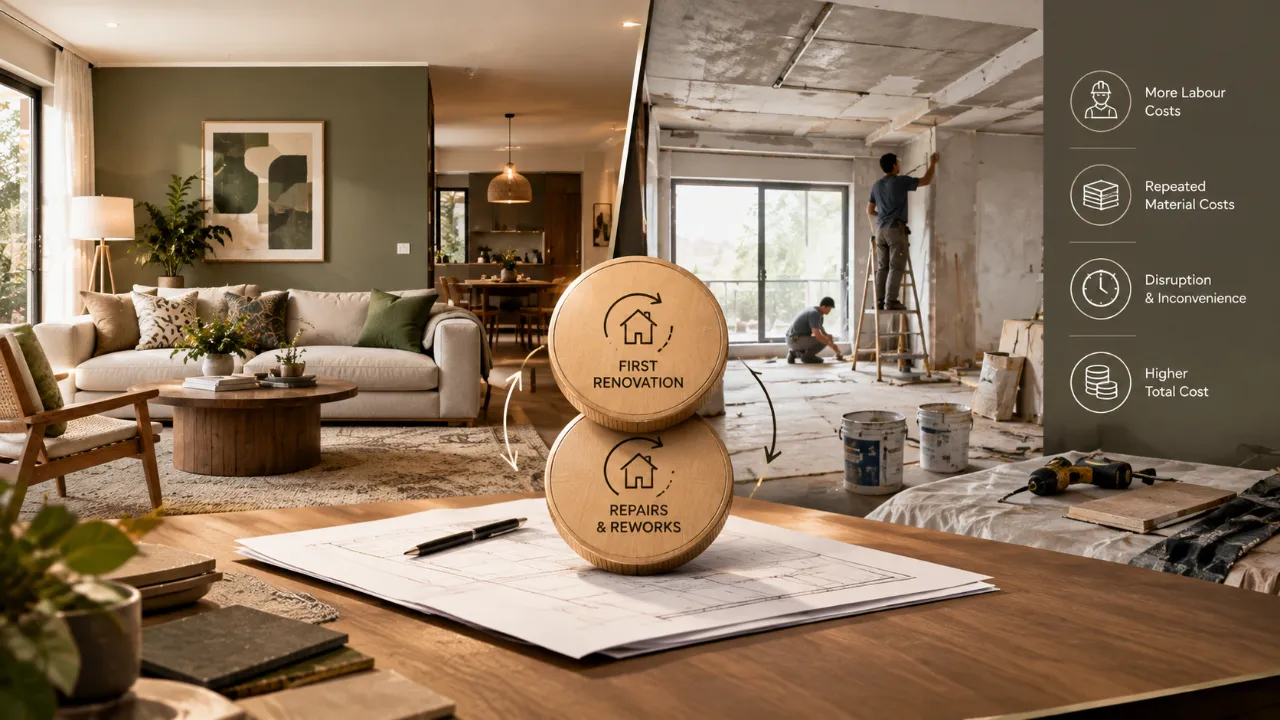
What You Pay Twice When You Renovate in Pieces
The question sounds like it should have a clean answer. It doesn't. "Should I do the whole house at once, or one room at a time?" gets asked at the very start of almost every renovation conversation, and the honest answer is: it depends on where the money actually goes, not on which approach feels more manageable.
Here's what actually changes in cost, and what doesn't, between the two, and the one number that decides it in most cases.
- The case for doing it all at once
- The case for doing it room by room
- The number that actually decides it
- Where phased renovation still wins
- Where whole-house renovation wins
- The hidden cost neither approach mentions
- A practical way to decide
- Questions to ask your contractor
- Frequently asked questions
The Case for Doing It All at Once
Contractors price mobilisation, labour teams, and material ordering more efficiently across one continuous project than across several disconnected ones. When everything happens together, site setup happens once, the labour team doesn't demobilise and remobilise between phases, and bulk material orders, tiles, paint, hardware, often qualify for better rates than smaller, separate purchases.
The Case for Doing It Room by Room
Spreading a renovation across rooms and months means the cost hits your wallet in smaller pieces, which matters more to some households than the total figure ever will. It also lets you course-correct: if the kitchen renovation goes over budget, the bedroom renovation two months later can be adjusted, something a single locked-in whole-house quote doesn't allow for.
Where it costs more: each phase effectively restarts mobilisation. If your contractor's team leaves the site after the kitchen and returns for the bedroom three months later, you're often paying a second, smaller, mobilisation charge, a second material delivery cost, and sometimes a second site-visit fee, depending on how your contractor structures pricing.
The Number That Actually Decides It: Mobilisation as a Percentage
For a large renovation, mobilisation, sourcing and setup might be a small percentage of the total project cost, easily absorbed. For a single room done in isolation, that same fixed mobilisation cost is a much larger percentage of a much smaller bill.
This is the actual mechanism behind "whole house is cheaper." It isn't that materials cost less overall, it's that fixed costs get spread across more work.
Where Phased Renovation Still Wins on Cost
Cash Flow Matters More Than Total Cost
If financing the whole project upfront isn't realistic, financing costs and interest, if any, on a large loan can outweigh the savings from doing it all together.
You Don't Know Your Priorities Yet
Committing to a full-house design before living in a space, especially a newly possessed one, risks paying for choices you'll want to undo later.
Rooms Have Different Urgency
A leaking bathroom needs fixing now; a study you use twice a week doesn't. Forcing them into one timeline for a marginal materials discount doesn't make sense.
You Can Course-Correct Between Phases
If one room's budget runs over, later phases can be adjusted, something a single locked-in whole-house quote won't allow.
Where Whole-House Renovation Wins on Cost
You Already Know What You Want
If the design decisions are made everywhere, phasing gains you nothing except repeated mobilisation charges.
Rooms Share Systems
Electrical rewiring, plumbing lines, or a false ceiling running across multiple rooms are far more expensive to do twice than once.
You're Not Living in the Home Yet
Pre-possession or between-tenancy renovations remove the biggest reason to phase, there's no daily disruption to manage around.
Material Rates Lock In Once
A single bulk order avoids the risk of rates shifting between an early phase and a later one, months apart.
The Hidden Cost Neither Approach Mentions Upfront: Living Through It
A whole-house renovation while living elsewhere is disruptive but contained, it ends. A phased renovation while living in the home means months, sometimes over a year, of ongoing dust, noise and rooms out of use, one at a time, indefinitely. That's not a line item on a quote, but it's a real cost in comfort and time worth weighing honestly before choosing to phase purely for the flexibility.
A Practical Way to Decide
- Ask your contractor what percentage of the total quote is mobilisation and setup
- Ask directly whether that charge repeats per phase if you split the project
- Check whether any rooms share plumbing, wiring or false-ceiling work, those shouldn't be phased separately
- Be honest about whether you can finance the whole project upfront, or whether phasing is really a cash-flow decision, not a design one
- Weigh the total disruption time of phasing against the contained disruption of doing it all together
Questions to Ask Your Designer or Contractor
- What percentage of my quote is mobilisation, sourcing and setup?
- Does that cost repeat if I split this project into phases?
- Which of my planned rooms share electrical, plumbing or ceiling work?
- If I phase this, will material rates be locked in now or repriced later?
- How long would each approach realistically take, start to finish?
Not Sure Which Approach Fits Your Home?
Get a room-by-room estimate first, it makes the mobilisation cost of phasing versus doing it all together much easier to see.
Estimate Your Interior CostThe Professional Judgement: It's a Cash-Flow Decision Wearing a Cost Decision's Clothes
Whole-house renovation usually costs less in total, because fixed costs get spread across more work. But "less in total" and "manageable for you" aren't the same question. If financing the whole project upfront is genuinely difficult, or if some rooms are urgent and others aren't, phasing isn't a mistake, it's just a different trade: smaller totals against repeated fixed costs and longer overall disruption.
Use AI Before You Meet an Interior Designer
AI tools can help you organise your ideas before meetings. They are not a replacement for professional design judgement.
Estimate Your Budget
Create an initial interior budget based on your rooms and requirements, whether you're planning to phase or do it all together.
Estimate Interior Cost →Visualise Your Room
Upload a room photograph and explore a fresh interior concept before committing to a phase or a full renovation.
Design My Room →Ready to Plan Your Renovation, in Phases or All Together?
Take your rooms, budget and timeline to designers serving your area, and compare what phasing versus a full renovation would actually cost for your home.
Find Interior Designers Visualise Your Room Estimate Interior CostFrequently Asked Questions
Is it always cheaper to renovate the whole house at once?
Usually, yes, in total cost, because mobilisation, sourcing and setup costs are spread across more work instead of repeating per phase. But cheaper in total doesn't automatically mean better for your situation, especially if upfront financing is the real constraint.
What's the biggest hidden cost of phased renovation?
Repeated mobilisation. Your contractor's team and setup costs effectively restart each time they return for a new phase, a fixed cost your whole-house renovation only pays once.
Should I ever avoid phasing, regardless of budget?
Yes, when rooms share systems, electrical wiring, plumbing lines or a continuous false ceiling running through more than one room. Splitting shared-system work across phases is usually more expensive and more disruptive than doing it together.
Is phased renovation ever the financially smarter choice?
Yes, when it converts an unaffordable lump sum into a manageable cash flow, and the interest or financing cost of a large loan would exceed what phasing costs in repeated mobilisation.
Final Checklist Before You Choose an Approach
- Have you asked what percentage of your quote is mobilisation and setup?
- Do you know whether that cost repeats per phase?
- Have you identified which rooms share plumbing, wiring or ceiling work?
- Have you been honest about whether phasing is a cash-flow decision or a design one?
- Have you weighed the total disruption time of phasing against a contained, all-at-once renovation?
The cheaper total isn't always the right answer for your situation, it depends on what you can finance, what's urgent, and what you can live with while the work happens. Use WallsToWonder to find interior designers, visualise your room and estimate your interior cost before deciding which way to go.
Get a personalised estimate for your home
Choose your rooms, materials and preferences to understand a practical interior budget before you commit.