
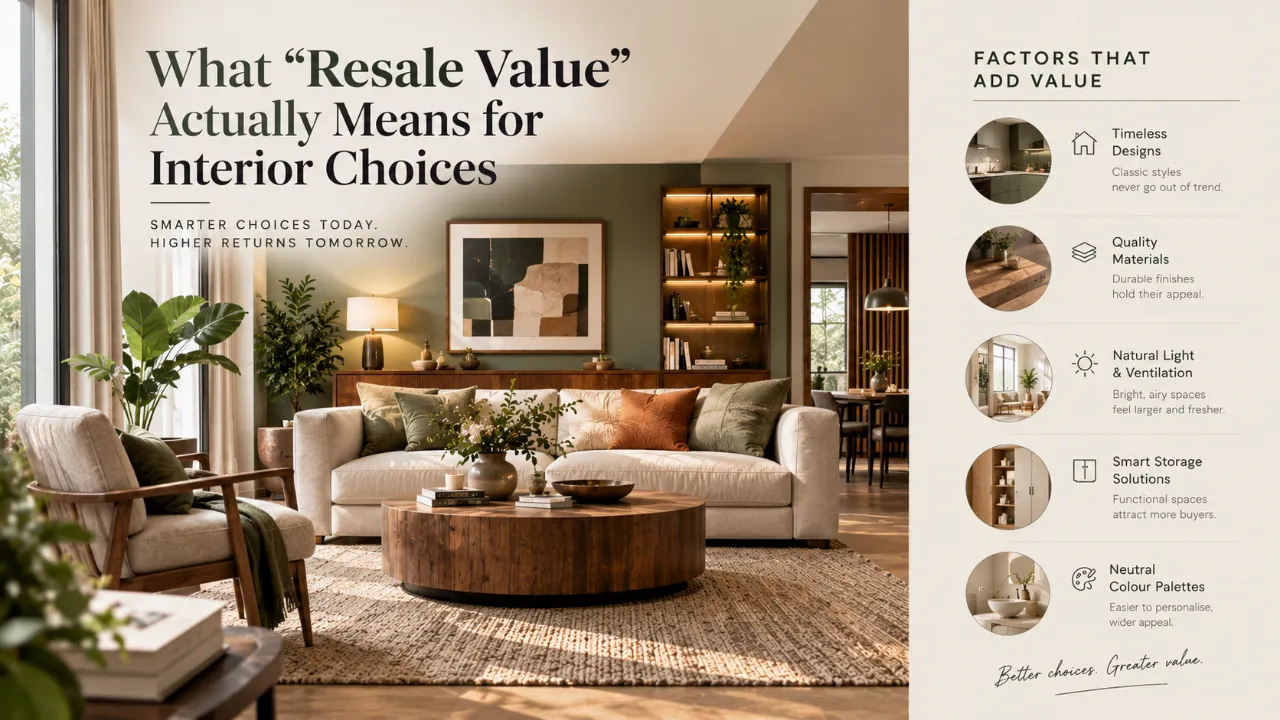
What “Resale Value” Actually Means for Interior Choices
“Will this increase my home's resale value?”
It is one of the most common questions homeowners ask before spending money on interiors.
But resale value is often misunderstood.
A new kitchen, custom wardrobe, premium flooring or designer lighting may make a home more attractive, more comfortable or easier to sell. That does not automatically mean the owner will recover the full amount spent on it when the property is sold.
Those are different outcomes.
The better question is: “How might this choice affect the home's condition, usability, buyer appeal and the amount of money I may or may not recover later?”
Quick answer: Resale-friendly interior choices generally focus on practical layout, useful storage, good condition, durability, manageable maintenance, flexible spaces and broad visual appeal. However, no interior upgrade guarantees that its full cost will be recovered at resale.
- Resale value vs. cost recovery
- Why property context matters
- Function, storage and layout
- Kitchens and bathrooms
- Durability and maintenance
- Neutral finishes and personalisation
- Built-ins, lighting and flooring
- Flexibility for future buyers
- How to think about budget
- A resale-friendliness test
- What tends to travel better than personal styling
- A practical resale-focused checklist
- Frequently asked questions
Resale Value Is Not the Same as Renovation Cost Recovery
These ideas are often mixed together.
Resale Value
Broadly, what a buyer may be willing to pay for the property when it is sold, influenced by the property, location, condition and market.
Cost Recovery
How much of the money spent on an improvement might be recovered through the eventual sale.
Buyer Appeal
Whether potential buyers find the home easy to understand, use and imagine themselves living in.
Personal Value
What the interior gives you while you live there: comfort, convenience, storage, aesthetics and lifestyle fit.
These four things can point in different directions. A renovation can make you much happier without recovering its full cost. Another improvement may be relatively unexciting but make the home easier to market.
1. Start With the Property, Not the Trend
Interior choices do not exist independently of the property.
A compact apartment, large villa, older resale flat and new developer apartment all have different resale considerations.
Consider property type, location, size, building age, existing condition, typical buyer profile, competing properties and maintenance requirements before describing an upgrade as a resale investment.
2. Function Usually Travels Better Than Personal Taste
Future buyers may not share your colour preferences, furniture style or decorative taste. But they are more likely to notice whether the home works.
Useful Storage
Makes everyday organisation easier and can improve how efficiently the home uses its space.
Sensible Layout
Supports practical movement, furniture placement and different ways of using the rooms.
Functional Kitchen
Balances preparation space, storage, appliances, circulation and maintenance.
Well-Planned Lighting
Helps rooms feel comfortable, usable and visually clear.
3. Storage Can Be More Valuable Than It Looks
Storage is rarely the most glamorous part of an interior renovation, but it solves a very visible problem.
Useful wardrobes, kitchen storage, utility storage, entryway storage, linen storage, shoe storage and pantry capacity can make a home feel more organised and functional.
Keep it proportional: More cabinetry is not automatically better. Storage should solve realistic household needs without unnecessarily reducing flexibility.
4. A Good Layout Is Difficult to Undo
Layout decisions can influence a home's usefulness for years.
Think carefully before permanently changing room sizes, door positions, kitchen locations, bathroom layouts, circulation routes or major partitions.
A layout designed around one very specific lifestyle may be harder for another homeowner to adapt.
5. Avoid Confusing Expensive With Valuable
A premium finish may be beautiful without providing a proportional resale benefit.
Marble, imported fittings, bespoke furniture, designer lighting and extensive custom carpentry can increase the renovation budget significantly. That does not mean a future buyer will pay the full additional amount.
Remodeling research also shows that homeowner enjoyment and estimated cost recovery are not identical measures.
6. Condition Can Matter More Than Decoration
A home with beautiful styling but worn-out surfaces, poor fittings or maintenance issues may not create the impression you expect.
Surface Condition
Look for damaged flooring, peeling paint, worn cabinets and damaged hardware.
Plumbing
Address leaks, moisture problems and poorly maintained fittings.
Lighting
Replace failed or poorly planned fixtures where they affect usability and presentation.
Bathrooms
Prioritise good condition, ventilation, cleanliness and reliable fittings before decorative upgrades.
7. Kitchens Are Important, but Bigger Is Not Always Better
Kitchen improvements can influence buyer appeal, but that does not mean every kitchen needs a luxury renovation.
Consider cabinet condition, storage, counter space, workflow, ventilation, lighting and ease of maintenance.
If resale is a major consideration, think carefully before choosing highly specific colours, elaborate finishes or expensive custom details.
8. Bathrooms Should Feel Clean, Functional and Well Maintained
A bathroom can strongly affect how buyers perceive the condition of a home.
Focus first on reliable fittings, adequate ventilation, storage, easy-clean surfaces, appropriate lighting and proper maintenance.
9. Neutral Does Not Mean Completely Generic
A relatively flexible base can make it easier for potential buyers to imagine their own furniture and lifestyle in the home.
But neutral does not have to mean characterless. Natural materials, thoughtful lighting, subtle texture and a few distinctive details can still give the interior personality.
10. Personalisation Has a Resale Trade-Off
A highly personal design may require more adaptation when the home is sold.
Examples include dramatic colour schemes, highly themed rooms and built-ins designed around one very specific use.
That does not make personal design a mistake. It simply means the choice may be primarily a lifestyle decision rather than a guaranteed resale investment.
11. Durability Matters More Than Trend Longevity
An interior that still looks and functions well after years of daily use can have an important practical advantage.
Consider durability in flooring, kitchen surfaces, cabinet hardware, bathroom fittings, upholstery, paint and wardrobe systems.
12. Maintenance Is Part of Value
A beautiful material that requires constant maintenance may not be the best fit for every home.
Ask whether the material is easy to clean, sensitive to moisture, repairable, replaceable and likely to age well.
13. Think About the Buyer After You
You do not need to design your house around an imaginary buyer. But some flexibility can help.
A future owner may want different bedroom uses, a home office, more storage, a children's room, a guest room or a multipurpose space.
Avoid permanently designing every room so narrowly that changing its function becomes difficult.
14. Built-Ins Can Help or Hurt
Built-in storage can use space efficiently, but excessive built-ins can limit future options.
Before installing a major fixed element, ask: “Does this solve a common problem, or does it solve only my very specific problem?”
15. Lighting Can Improve Perceived Quality
Lighting does not automatically increase a home's sale price. But poor lighting can make a well-designed home look tired.
Consider ambient, task and accent lighting where appropriate while preserving useful natural daylight.
16. Flooring Is a Long-Term Decision
Flooring covers a large visual area, making durability and maintenance particularly important.
Think about material availability, repairability, consistency and compatibility with different furniture styles.
17. Preserve Useful Natural Light
Do not unnecessarily block useful daylight with oversized storage, permanent partitions or poorly positioned furniture.
Window treatments and interior layout should balance daylight, privacy, heat and practical use.
18. Think About Energy and Operating Costs Too
Efficient lighting, useful shading, appropriate ventilation and thoughtfully planned appliances can influence ongoing energy use.
These should not automatically be labelled as resale-value improvements, but they can contribute to the practical quality of the home.
19. Do Not Renovate Only Because Someone Says It Adds Value
Before approving a major upgrade, ask:
What problem is this solving? What benefit will I receive while I live here? What evidence do I have that a future buyer will value it enough to justify the cost?
If the third answer is uncertain, treat the project primarily as a lifestyle improvement rather than a guaranteed financial return.
20. Think in Terms of Broad Appeal
| Interior Choice | Potential Resale Relevance |
|---|---|
| Good layout | Broad functional appeal |
| Useful storage | Solves a common household need |
| Well-maintained kitchen | Supports everyday use |
| Practical bathrooms | Signals condition and usability |
| Durable flooring | Long-term usability |
| Good lighting | Improves visibility and presentation |
| Neutral base finishes | Easier for buyers to adapt |
| Highly personalised décor | Stronger lifestyle value than universal appeal |
| Expensive bespoke details | May not recover full cost |
| Trend-heavy finishes | May date more quickly |
This is a planning framework, not a guarantee of financial return.
21. Use the Five-Question Resale-Friendliness Test
1. Is It Useful?
Does the choice solve a real problem?
2. Is It Durable?
Will it continue to perform after years of use?
3. Is It Maintainable?
Can it be cleaned, repaired or replaced reasonably easily?
4. Is It Flexible?
Could another homeowner use the space differently?
5. Is It Highly Personal? If it is, are you making the choice because you love it rather than because you expect a guaranteed resale return?
22. A Better Way to Allocate Your Interior Budget
| Budget Category | Examples |
|---|---|
| Protect | Maintenance, repairs, worn surfaces, plumbing and essential condition work |
| Improve | Functionality, storage, durability, lighting and usability |
| Personalise | Colours, furniture, materials and details chosen primarily for your enjoyment |
This framework prevents every interior purchase from being treated as a “resale investment.”
23. If You Plan to Sell Soon, Think Differently
If a sale is likely in the near term, a major personal renovation deserves extra scrutiny.
Separate the project into maintenance, functional improvements, presentation improvements, lifestyle upgrades and highly personal changes.
The closer you are to selling, the more carefully these categories should be evaluated.
24. If You Plan to Stay for Years, Your Calculation Changes
A homeowner planning to live in a house for many years has a different decision framework from someone expecting to sell soon.
A personalised kitchen, custom library or statement bathroom may provide substantial value through years of use even if the full spend is not recovered later.
25. The Best Interior Choice May Be the One You Enjoy
There is nothing wrong with choosing an interior because you love it.
The important distinction is understanding whether the benefit is primarily personal enjoyment, functionality, buyer appeal or expected cost recovery.
26. A Practical Resale-Focused Interior Checklist
Before finalising major interior work, ask:
Is the layout functional? Is storage sufficient? Are the kitchen and bathrooms practical? Are surfaces durable? Is maintenance manageable? Is the lighting good? Is natural light being preserved? Are the major finishes reasonably flexible? Are there highly personal choices that a future buyer may need to undo? Am I expecting too much resale recovery from the amount I am spending? Would I still be happy with this choice if I never sold the home?
Final Takeaway
“Resale value” is not a promise that an interior upgrade will return its full cost.
It is better understood as one consideration among several: condition, functionality, flexibility, buyer appeal, maintenance and cost recovery.
A beautifully designed home can be highly valuable to the person living in it without being a perfect financial investment.
So separate the goals. If you are improving the home for yourself, choose what makes daily life better. If you are preparing it for sale, prioritise condition, functionality, broad appeal and sensible improvements.
Design for the life you are living—and understand the resale trade-off before treating an interior choice as an investment.
Plan Your Interior With More Clarity
Explore design professionals, estimate your project requirements and visualise your space before committing to major interior decisions.
Explore Interior Designers Design My Room with AI Estimate Interior CostFrequently Asked Questions
Does interior design increase resale value?
Some improvements can improve buyer appeal or help recover part of their cost, but there is no universal guarantee. The effect depends on the property, market, condition, improvement and buyer expectations.
Do expensive interiors always increase resale value?
No. Higher spending does not automatically mean higher cost recovery. Personalised or premium choices may provide more enjoyment to the current owner than financial return at resale.
Is a neutral interior better for resale?
A flexible neutral base can make it easier for some buyers to imagine their own furniture and style, but neutral design is not a guarantee of a higher sale price.
Does storage add resale value?
Useful storage can improve functionality and buyer appeal, but the financial effect varies by property and market. Storage should be designed around realistic household needs.
Should I renovate my kitchen before selling?
It depends on the condition of the kitchen, the property, local market expectations and renovation cost. A practical improvement may make more sense than an expensive redesign if the goal is primarily resale.
Do custom interiors hurt resale?
Not necessarily. Well-designed custom work can improve functionality, but highly personalised built-ins or finishes may be less adaptable for future owners.
What interior improvements are usually safest to prioritise for resale?
Start with condition, practical functionality, useful storage, durable finishes, good lighting and flexible layouts rather than assuming that the most expensive upgrade will produce the highest return.
Should I design my home for future buyers?
If resale is an important near-term goal, buyer flexibility can be useful. If you plan to live in the home for many years, personal enjoyment and everyday functionality may reasonably carry more weight.
Get a personalised estimate for your home
Choose your rooms, materials and preferences to understand a practical interior budget before you commit.