
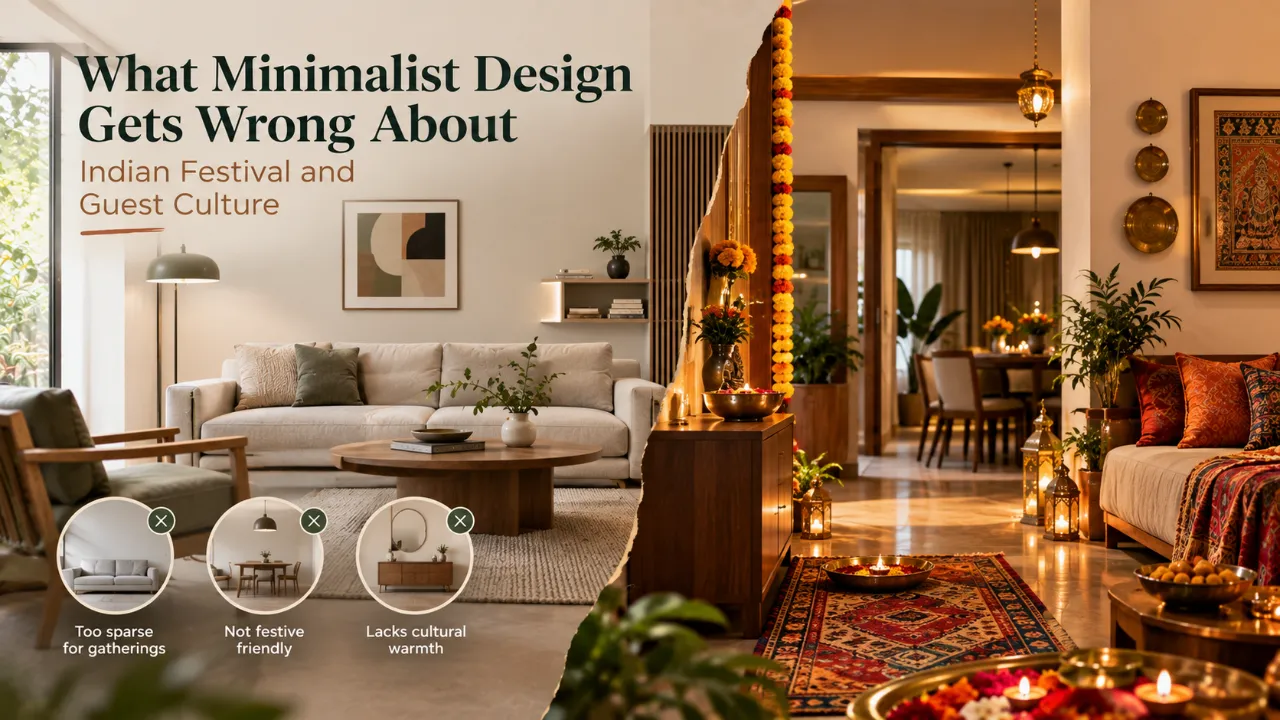
What minimalist design gets wrong about Indian festival and guest culture
Minimalist design is built on a quiet assumption: that the people using the home are few, and the home is mostly empty of activity. Clear surfaces, a compact sofa, hidden everything, a calm neutral palette. It photographs beautifully.
Then Diwali arrives, or a Ganesh Chaturthi puja, or twenty relatives for a wedding week, and the same home suddenly has nowhere to seat people, nowhere to put the diyas, and nowhere to sleep the guests. The problem isn't minimalism. It's minimalism designed only for an ordinary Tuesday, in a culture where hosting is a regular part of home life.
The Assumption Minimalism Makes
Western-origin minimalism generally designs for the everyday household: two to four people, occasional small gatherings, few seasonal possessions. Indian homes often run on a different rhythm. Festivals recur through the year, guests arrive unannounced, families host across generations, and rituals need physical space and objects.
A home that only works in "living mode" struggles in "hosting mode."
Where Minimalism Breaks Down
Seating for a Crowd
A compact sectional and two chairs seat five or six. A festival or a puja can mean fifteen. Minimalist rooms rarely have hidden seating capacity.
Storage for Rarely Used Things
Diyas, torans, festive lights, extra utensils, spare bedding, decorative pieces. Minimalism assumes you own little, but festival culture means owning a lot you use only a few times a year.
A Place for the Pooja
Many minimalist layouts tuck the pooja away or treat it as a visual afterthought, when it may need real space, ventilation for incense and lamps, and storage for pooja items.
Cooking and Serving Capacity
Festival cooking is bulk cooking. Compact kitchens and small serving areas designed for everyday meals can become bottlenecks when a dozen people are eating.
Surfaces That Take Punishment
Turmeric, kumkum, ghee, oil, diya soot and rangoli colour all stain. All-white or delicate finishes, common in minimalist palettes, show every mark.
Sleeping Extra Guests
Guest rooms are a luxury in most apartments. Minimalist homes rarely plan where extra mattresses will be stored, or where they'll go.
What Actually Works: Minimalism With a Hosting Mode
You don't have to abandon the calm, uncluttered look. You design the home with two modes in mind: the quiet everyday mode, and the hosting mode that unfolds from it.
| Minimalist assumption | Indian hosting reality | Practical adaptation |
|---|---|---|
| Compact seating for a few | 10 to 20 guests at a festival | Floor cushions, poufs, nesting stools stored out of sight |
| Few possessions, minimal storage | Seasonal decor, extra utensils, spare bedding | Loft storage, box beds, concealed high cabinets |
| Pooja as a small visual accent | Daily and festive ritual use | A dedicated niche with ventilation and storage below |
| Small dining for the household | Feeding a crowd | Extendable or foldable dining, a serving counter |
| Delicate, light finishes | Turmeric, oil, soot, rangoli | Wipeable, stain-tolerant finishes in high-traffic zones |
| Clean empty entry | Footwear, rangoli, torans | Closed shoe storage, a defined rangoli zone, wall hooks for torans |
| Guest room not needed | Overnight relatives | Storage for extra mattresses, a convertible sofa or daybed |
Planning a Home That Hosts Well?
Estimate a realistic budget that includes hidden storage, flexible seating and a proper pooja space, not just the everyday look.
Estimate Your Interior CostSmall Details That Make Hosting Easier
- Extra electrical points near the entrance, windows and balcony for festive lights, so cords don't run across the floor
- Wall hooks or a concealed torans rail at the door, instead of nails hammered in each year
- A "festive shelf" or cabinet for seasonal decor, so it stays out of daily view
- Flexible furniture that is light, folds or nests, rather than heavy fixed pieces that lock the room's layout
Where Minimalism Still Fits Perfectly
Minimalism's strengths, calm, order, less visual noise, clear surfaces, actually help a busy hosting home, because a clean base makes the festive layer stand out instead of piling onto clutter. The point isn't fewer minimalist principles. It's applying them with hosting capacity built in from the start.
Questions to Ask Your Designer
- How many people can this living room realistically seat during a festival or puja?
- Where will seasonal decor, extra utensils and spare bedding be stored?
- Does the pooja have proper space, ventilation and storage, or is it just decorative?
- Can the dining area extend for a crowd without buying furniture later?
- Which finishes in this plan will stain from turmeric, oil or diya soot?
- Are there enough electrical points for festive lighting, and has an electrician confirmed the load?
The Professional Judgement: Design for the Busiest Week, Not Just the Quietest
A home that only works on an ordinary day is designed for a fraction of the year. Minimalism can absolutely suit an Indian household, provided the design plans for the festival week: hidden seating, generous storage, a real pooja space and finishes that forgive a stain.
Confirm the electrical and structural details with your designer or electrician, especially for festive lighting.
Use AI Before You Meet an Interior Designer
AI tools can help you organise your ideas before meetings. They are not a replacement for professional design judgement.
Estimate Your Budget
Create an initial interior budget that accounts for storage, seating and pooja space alongside the everyday look.
Estimate Interior Cost →Visualise Your Room
Upload a room photograph and explore a calm, minimal look before committing to it.
Design My Room →Want a Calm Home That Still Handles Festival Season?
Take your hosting habits, guest counts and pooja needs to designers serving your area, and plan a minimalist home with a hosting mode built in.
Find Interior Designers Visualise Your Room Estimate Interior CostFrequently Asked Questions
Can a minimalist home work for an Indian family that hosts often?
Yes, if it's designed with a hosting mode built in: hidden storage, flexible seating and durable finishes. The minimalism lives in the everyday look, while the hosting capacity stays tucked away.
How do I store festive decor without cluttering a minimalist home?
Use loft storage, box beds or a concealed cabinet dedicated to seasonal items, so decor appears only when needed.
What finishes suit a home with festivals and poojas?
Wipeable, stain-tolerant finishes in high-traffic and pooja-adjacent zones handle turmeric, oil, ghee and soot better than delicate white surfaces.
How can a small apartment seat guests during festivals?
Stored floor cushions, poufs, nesting stools and a convertible or extendable dining setup add seating without permanent furniture.
Final Checklist
- Have you counted how many people your home must seat during a festival?
- Is there dedicated storage for seasonal decor, utensils and bedding?
- Does the pooja have real space, ventilation and storage?
- Are your high-traffic finishes stain-tolerant?
- Do you have enough electrical points for festive lighting, confirmed by an electrician?
A calm home and a hosting home don't have to be different homes. Use WallsToWonder to find interior designers, visualise your room and estimate your interior cost before finalising a minimalist design for your family.
Get a personalised estimate for your home
Choose your rooms, materials and preferences to understand a practical interior budget before you commit.