
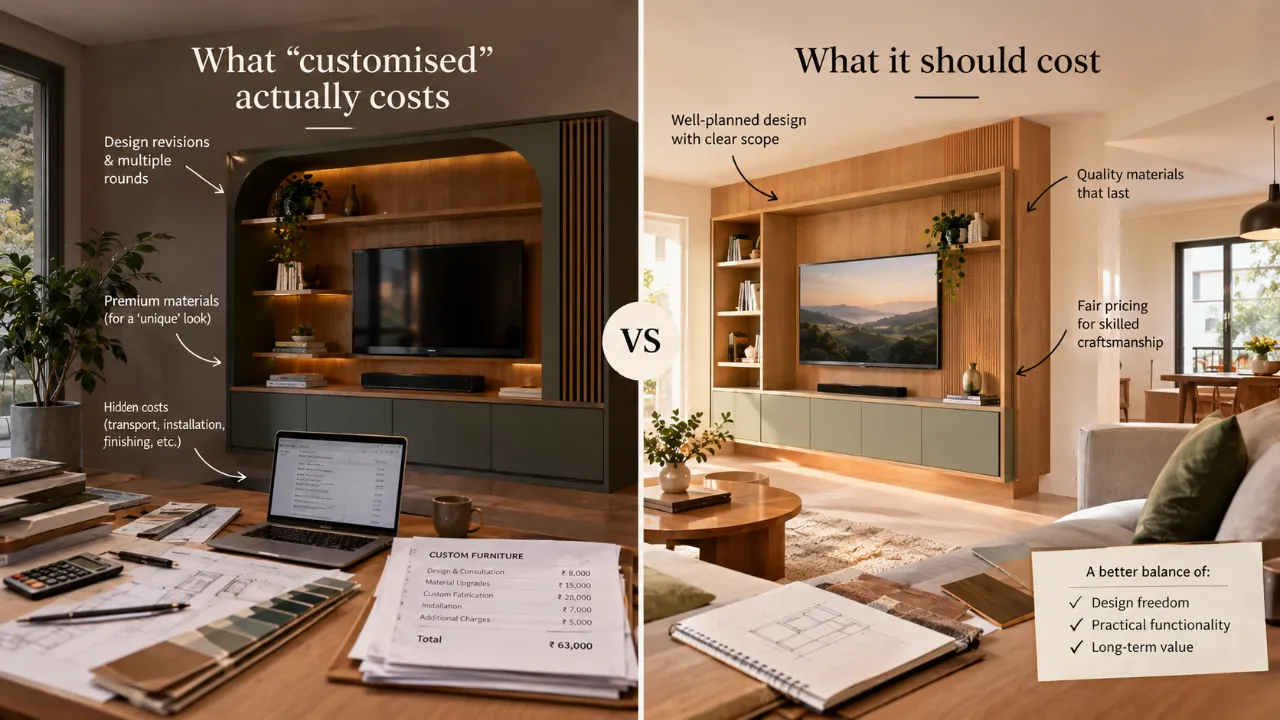
What "customised" actually costs vs. what it should cost
"Customised" is one of the most profitable words in interior design, and one of the least defined. It can mean a genuinely bespoke, hand-built piece engineered for your exact space, or it can mean a standard product with a minor tweak and a premium price tag. Both get called "customised" on the invoice.
Knowing which one you're actually paying for is the difference between fair pricing and a markup with no real cost behind it.
- What genuine customisation actually costs
- What gets labelled "customised" but isn't
- The real cost difference: a rough comparison
- Questions that expose the real cost
- Where customisation premiums are usually justified
- Where to push back
- Questions to ask before paying a customisation premium
- Frequently asked questions
What Genuine Customisation Actually Costs
Real customisation involves real extra work: non-standard measurements requiring custom cutting, unique material sourcing, additional design and drafting time, one-off fabrication rather than assembly-line production, and often a longer lead time because nothing is pre-made. Each of these has a real, traceable labour and material cost.
What Gets Labelled "Customised" But Isn't
A Different Handle or Finish
Swapping a stock component isn't structural customisation, it's a minor variant.
Resizing Within the System's Flex Range
Many modular systems already flex within a range; that flexibility often gets billed as a special request.
Colour or Laminate From the Existing Catalogue
Choosing from an existing options list isn't custom work.
"Custom" as a Marketing Label
Some brands simply call their regular catalogue "customised interiors" as a positioning choice, not a pricing reality.
The Real Cost Difference: A Rough Comparison
| Type of work | What actually happens | Fair cost impact |
|---|---|---|
| Genuinely bespoke, non-standard dimensions | Custom cutting, one-off fabrication, extra design time | Meaningful premium, reflects real extra labour and material |
| Modular unit resized within the system's flex range | Standard components, adjusted within existing tolerances | Little to no real extra cost |
| Finish or hardware swap from existing catalogue | Different pre-made option, same base structure | Minimal to no real extra cost |
| Fully custom-built furniture, non-standard design | Built from scratch to a unique design and size | Highest premium, justified by design and fabrication time |
Questions That Expose the Real Cost
- Is this outside your standard size range, or within your modular system's normal flexibility?
- What specifically is different about the fabrication process for this item versus your standard product?
- How much of this premium is material cost versus labour versus margin?
- Would this same request cost anything extra from a different vendor, or is it standard for the industry?
Reviewing a Quote With Customisation Charges?
Estimate a realistic budget first, so you can spot where a customisation premium looks out of line.
Estimate Your Interior CostWhere Customisation Premiums Are Usually Justified
Non-standard room dimensions that don't fit any standard module, unusual material requests sourced specifically for the project, one-off design work like a custom headboard or a bespoke storage unit built for an awkward space, and genuinely hand-crafted detailing, carving, inlay work, that takes real skilled hours.
Where to Push Back
If a "custom" quote is simply a standard product with a colour or hardware change already available in the vendor's own catalogue, ask directly why it's priced as custom. If a modular system's own published range already includes your requested size, that's not customisation, it's standard product use.
Questions to Ask Before Paying a Customisation Premium
- Can you show me exactly what's different about this compared to your standard offering?
- Is this size or finish within your own catalogue's normal range?
- What's the breakdown of the premium, material, labour, or margin?
- Would I pay this same premium with a different designer or vendor for the identical request?
The Professional Judgement: Ask What's Actually Different, Not Just What It's Called
The word "customised" tells you nothing about cost by itself. Genuine customisation, unique measurements, one-off fabrication, real design time, deserves a fair premium. A minor variant from an existing catalogue, labelled custom for positioning, doesn't. Ask what's structurally different about the work, not just what it's called on the quote.
Use AI Before You Meet an Interior Designer
AI tools can help you organise your ideas before meetings. They are not a replacement for professional design judgement.
Estimate Your Budget
Create an initial interior budget so you have a baseline to compare quoted customisation premiums against.
Estimate Interior Cost →Visualise Your Room
Upload a room photograph and see whether a standard option would actually fit before paying for custom work.
Design My Room →Comparing "Custom" Quotes?
Take your quote, line by line, to designers serving your area and confirm which charges reflect real customisation.
Find Interior Designers Visualise Your Room Estimate Interior CostFrequently Asked Questions
Is "customised" furniture always more expensive than it should be?
Not always, genuine customisation involves real extra labour and material cost. The overpricing happens when standard catalogue options get relabelled as custom without any real extra work behind them.
How do I know if I'm paying for real customisation?
Ask what specifically is different about the fabrication process, and whether the size or finish falls within the vendor's own published standard range. If it does, it likely isn't true customisation.
Does customisation always mean a longer wait?
Genuine customisation usually does, since nothing is pre-made. If a "custom" order ships as fast as a standard one, that's worth asking about directly.
Should I avoid customisation altogether to save money?
Not necessarily, genuine customisation for non-standard spaces or genuinely bespoke pieces is often worth the cost. The goal is confirming the premium reflects real extra work, not assuming customisation is always overpriced.
Final Checklist
- Have you confirmed what's structurally different about this "custom" item?
- Is the requested size or finish within the vendor's own standard range?
- Has the vendor broken down the premium into material, labour and margin?
- Would this request cost the same with a different vendor?
- Does the lead time reflect genuine one-off fabrication, or is it as fast as standard stock?
"Custom" should describe the work, not just the invoice line. Use WallsToWonder to find interior designers, visualise your room and estimate your interior cost before paying a customisation premium.
Get a personalised estimate for your home
Choose your rooms, materials and preferences to understand a practical interior budget before you commit.