
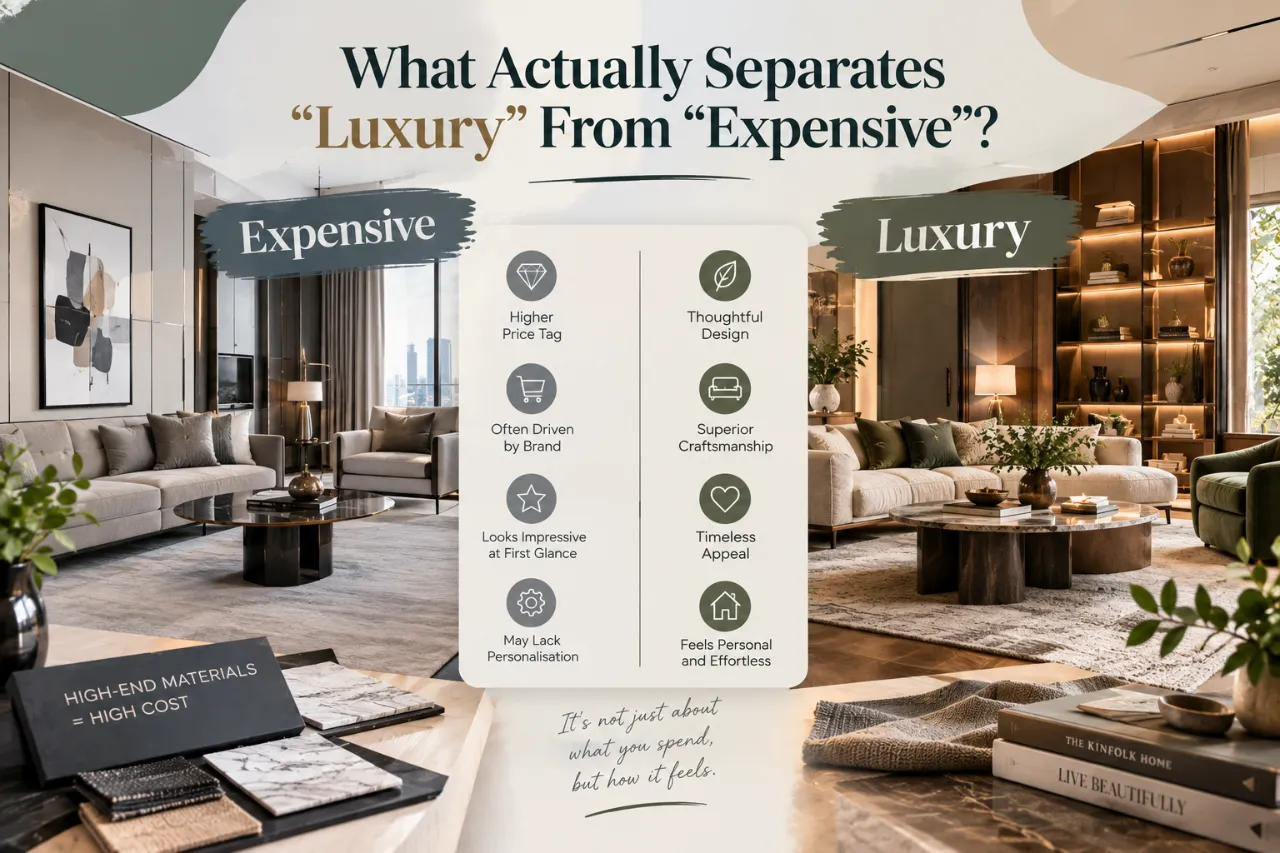
What Actually Separates “Luxury” From “Expensive”?
A room can contain expensive furniture, premium materials and designer products without actually feeling luxurious.
Luxury is not simply the result of spending more. It is often the result of how carefully the different elements of a space work together — from proportion and material selection to lighting, detailing, craftsmanship and visual restraint.
This is why a thoughtfully designed room with fewer high-quality elements can sometimes feel more sophisticated than a room filled with expensive finishes and decorative objects.
An expensive interior is defined primarily by what has been spent on it. A luxurious interior is defined more by how successfully the space uses its materials, proportions, lighting, detailing, furniture and finishes together.
Luxury often comes from quality, consistency, proportion and restraint rather than simply adding more expensive things.
- Luxury vs. Expensive: The Difference
- Why Proportion Matters
- Material Quality and Selection
- The Role of Restraint
- Lighting Can Change the Entire Experience
- Small Details Create a Refined Look
- Craftsmanship Matters
- Consistency Across the Space
- Furniture and Scale
- Colour Does Not Have to Be Loud
- Layering Textures
- Hardware and Fittings
- Why Clutter Can Reduce the Luxury Effect
- Can Luxury Be Created on a Controlled Budget?
- Common Mistakes That Make a Space Look Expensive Instead of Luxurious
- Luxury vs. Expensive: Quick Comparison
- A Simple Luxury Design Checklist
- FAQs
1. Luxury vs. Expensive: The Difference
The two terms are often used interchangeably, but they describe different ideas.
An expensive interior may have a high project cost because it uses premium materials, designer products, imported finishes, custom furniture or specialised craftsmanship.
A luxurious interior goes further. It considers how those elements relate to each other and to the architecture of the room.
Expensive
Focuses more on the individual price or brand value of products and finishes.
Luxurious
Focuses on the overall experience created through proportion, quality, detailing, lighting, comfort and visual harmony.
2. Why Proportion Matters
Proportion is one of the least obvious but most important elements of a sophisticated interior.
A sofa that is too large for a living room, an oversized chandelier in a low-ceilinged room or cabinets that feel visually heavy can make even premium materials look poorly planned.
Luxury often comes from getting the scale of furniture, lighting, wall treatments, openings and storage to work together.
3. Material Quality and Selection
Luxury does not necessarily mean using the most expensive material available.
It means selecting materials that suit the space, using them consistently and paying attention to how they meet, transition and age.
A carefully selected combination of stone, wood, metal, fabric, glass or textured finishes can feel more refined than using several premium materials without a clear relationship between them.
Material quality matters, but so does material discipline.
4. The Role of Restraint
One of the easiest ways to make a space feel expensive rather than luxurious is to keep adding things.
More decorative objects, more metallic finishes, more patterns and more statement pieces do not automatically create a more sophisticated room.
Restraint allows important elements to have visual space around them.
- Choose a controlled material palette.
- Limit competing statement elements.
- Allow negative space around key furniture.
- Use decorative pieces selectively.
- Let architectural features remain visible.
5. Lighting Can Change the Entire Experience
Even expensive materials can look ordinary under poor lighting.
A well-designed lighting scheme can reveal texture, create depth and make materials appear more intentional.
Consider layering:
- Ambient lighting
- Task lighting
- Accent lighting
- Decorative lighting
- Integrated cabinet lighting
The goal is not to make every surface bright. Different levels of illumination can create depth and allow architectural and decorative elements to stand out naturally.
6. Small Details Create a Refined Look
Luxury is often experienced through details that are not immediately noticed.
These can include:
- Clean junctions between materials
- Consistent reveals and gaps
- Well-aligned cabinetry
- Integrated handles
- Neat shadow gaps
- Carefully finished edges
- Consistent hardware
- Thoughtful transitions between surfaces
These details can make a room feel resolved rather than simply decorated.
7. Craftsmanship Matters
Premium materials cannot compensate for poor execution.
Uneven installation, visible joints, inconsistent gaps, misaligned cabinetry or poorly finished edges can reduce the overall quality of an interior regardless of how much was spent.
Craftsmanship is therefore an important part of the perceived quality of a space.
8. Consistency Across the Space
A luxurious interior usually feels connected from one area to another.
This does not mean every room must look identical. Instead, there should be a relationship between the materials, colours, hardware, lighting language and architectural detailing.
A consistent design language helps the home feel considered rather than assembled room by room.
9. Furniture and Scale
Furniture has a major influence on how luxurious a room feels.
Premium furniture placed incorrectly can still make a room feel uncomfortable or visually crowded.
Pay attention to:
- Furniture proportions
- Clearances between pieces
- Seat height
- Visual weight
- Relationship to windows and doors
- Relationship to rugs and lighting
- Overall circulation
Comfort and proportion are often more important than simply choosing the most expensive furniture available.
10. Colour Does Not Have to Be Loud
Luxury interiors can use dramatic colours, but they do not have to.
A restrained palette can create a sophisticated foundation, especially when different tones and textures are layered carefully.
Instead of using many unrelated colours, consider building a palette around a few connected tones and introducing contrast through materials, lighting and furniture.
11. Layering Textures
When colour is restrained, texture can create visual richness.
Wood grain, stone, fabric, brushed metal, glass, plaster-like finishes and textured walls can introduce depth without requiring excessive decoration.
The key is to create contrast while keeping the overall palette connected.
12. Hardware and Fittings
Small hardware choices can influence the overall impression of cabinetry and furniture.
Handles, hinges, drawer mechanisms, taps, switches and other fittings should work with the design language of the space.
The goal is not necessarily to choose the most expensive hardware. It is to select hardware that is appropriate to the application, consistent with the design and well executed.
13. Why Clutter Can Reduce the Luxury Effect
A carefully designed interior can lose some of its visual impact when surfaces become overloaded.
Storage therefore plays an important role in luxury interiors.
Concealed storage, organised display areas and clear surfaces can allow the architecture and key furniture pieces to remain visible.
This does not mean a luxury home has to look empty. It means the objects in the room should have a deliberate place within the composition.
14. Can Luxury Be Created on a Controlled Budget?
A sophisticated interior does not require every element to be premium-priced.
If the budget is controlled, prioritise the elements that have the greatest visual and functional impact.
Prioritise
- Good proportions
- Quality lighting
- Key furniture pieces
- High-use materials
- Important architectural details
Control
- Excessive decoration
- Too many materials
- Unnecessary statement pieces
- Over-designed walls
- Low-impact upgrades
Spending selectively can produce a more coherent result than distributing a large budget across too many competing elements.
15. Common Mistakes That Make a Space Look Expensive Instead of Luxurious
- Using too many premium materials at once
- Adding excessive metallic finishes
- Overloading walls with decorative elements
- Choosing furniture that is too large for the room
- Ignoring lighting quality
- Mixing unrelated design styles
- Using luxury brands without considering proportion
- Prioritising appearance over comfort
- Ignoring installation quality
- Leaving little visual or physical breathing room
The common thread is a lack of hierarchy. When every element tries to attract attention, the space can lose the sense of calm and control often associated with luxury.
16. Luxury vs. Expensive: Quick Comparison
| Element | Expensive Approach | Luxury Approach |
|---|---|---|
| Materials | Focus on premium price or brand | Focus on suitability, quality and combination |
| Furniture | High-priced individual pieces | Correct scale, comfort and proportion |
| Lighting | Decorative fixtures as focal points | Layered lighting that supports the entire space |
| Colour | Multiple bold or premium finishes | Controlled and coordinated palette |
| Details | Visible decorative additions | Careful junctions, alignment and finishing |
| Decoration | More statement objects | Selective and intentional objects |
| Budget | Higher spending can be the focus | Spending is prioritised around impact and quality |
| Overall effect | Signals cost | Creates a cohesive experience |
17. A Simple Luxury Design Checklist
Before finalising an interior, ask:
- Are the furniture proportions appropriate for the room?
- Does the material palette feel connected?
- Is the lighting layered rather than simply bright?
- Are important details properly finished?
- Do cabinetry and furniture align cleanly?
- Is there enough visual breathing room?
- Are statement elements being used selectively?
- Does the space feel comfortable as well as visually impressive?
- Are expensive materials actually improving the experience?
- Would removing one element make the composition stronger?
Planning a More Refined Interior?
Start with the overall composition before choosing individual premium finishes. Explore Design My Room to experiment with interior concepts and visual directions.
You can also explore interior designers on Walls to Wonder when you want professional help developing the complete design.
Frequently Asked Questions
What is the difference between a luxury interior and an expensive interior?
An expensive interior is primarily defined by the amount spent on products, materials and finishes. A luxury interior is more concerned with how proportion, quality, lighting, detailing, craftsmanship and materials work together.
Do luxury interiors always use expensive materials?
No. Material quality matters, but selection, proportion, application and coordination can be just as important as price.
Can a small home look luxurious?
Yes. Good proportion, organised storage, layered lighting, a controlled material palette and careful detailing can create a refined interior without relying on excessive decoration.
Does using gold automatically make an interior look luxurious?
No. Metallic finishes can contribute to a luxury aesthetic, but excessive or poorly coordinated use can make a room feel visually busy. Context, proportion and restraint matter.
Why does lighting matter so much in luxury interiors?
Lighting affects how materials, textures, furniture and architectural details are perceived. Layered lighting can create depth and highlight important elements without making the entire room uniformly bright.
What is the most important element of a luxurious interior?
There is no single element. A convincing result usually comes from several elements working together, including proportion, material selection, lighting, detailing, craftsmanship, comfort and restraint.
Final Takeaway
Luxury is not simply a higher price tag.
A genuinely refined interior comes from making deliberate choices about proportion, materials, lighting, furniture, detailing, craftsmanship and visual restraint.
Instead of asking how to make a room look more expensive, ask how to make every element feel intentional, appropriate and connected. That shift can create a space that feels sophisticated without relying on excess.
Turn this idea into a plan for your home
Visualise your space, understand the likely budget, or find a professional who can bring the idea to life.