
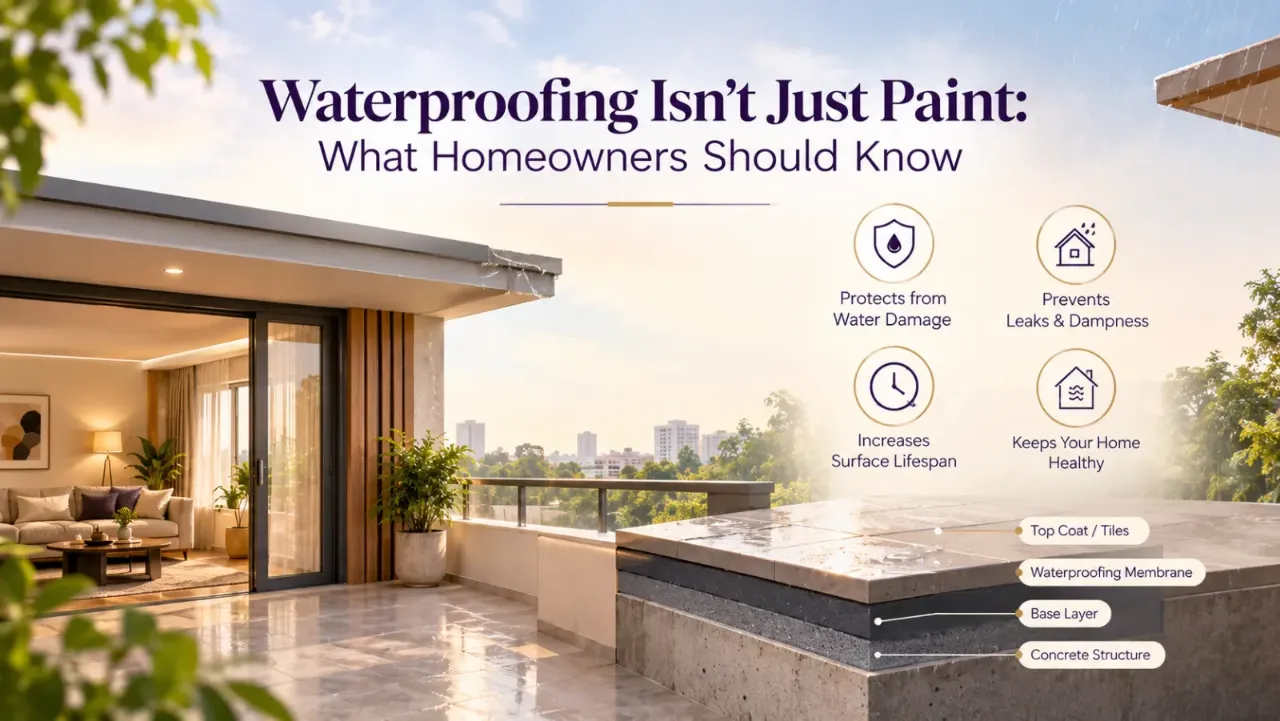
Waterproofing Isn’t Just Paint: What Homeowners Should Know
When a wall develops a damp patch, the instinct is often simple: “Just use waterproof paint.” It sounds reasonable. The paint says waterproof on the label. The wall looks better afterward. But there is an important question hiding underneath: What is actually causing the moisture?
Not every waterproof product is designed to solve the same problem.
And the terms themselves can be confusing. Some products sold as waterproof paint are specialised protective coatings. Other waterproofing coatings are designed as part of a broader system for surfaces exposed to significant or repeated moisture.
Compare them by the job the product is expected to do, the surface being protected, the level of water exposure, and whether the source of the moisture has already been addressed.
First, Understand the Terminology
“Waterproof paint” and “waterproofing coating” are not always completely separate categories.
A waterproof paint can itself be a type of coating.
The difference is often more about intended application, formulation, thickness, flexibility, durability, and the level of protection required than about the name printed on the front of the package.
That is why two products can both claim water resistance but perform very differently in a real building.
The First Question Is Not “Which Product?”
Before choosing anything, ask: Where is the water coming from?
- Rain entering through an exterior wall
- A crack in the façade
- A leaking terrace
- Water from an adjoining bathroom
- A plumbing leak
- Failed sealant around a window
- Moisture rising from another part of the building
- Condensation or high indoor humidity
These problems may look similar on the inside. The treatment may be completely different.
A fresh coat of paint cannot permanently solve a plumbing leak hidden behind the wall.
Likewise, applying an interior coating may not be the best way to deal with rainwater entering through the exterior surface.
What Waterproof Paint Usually Tries to Do
The phrase “waterproof paint” generally makes homeowners think about a paint that keeps water away from the wall.
In practice, specialised waterproof or water-resistant paints can provide the surface with added resistance to moisture while also acting as a decorative finish.
They can be useful when the underlying surface is reasonably sound and the exposure is appropriate for the product.
Typical applications may include exterior walls, areas exposed to weather, walls that need additional moisture resistance, and surfaces where appearance and protection need to be combined.
But the word “paint” is important. The product may still be primarily a finish applied over a prepared surface.
It should not automatically be treated as a substitute for every kind of waterproofing system.
What a Waterproofing Coating Is Intended to Do
A dedicated waterproofing coating is generally selected for its protective function rather than simply its appearance.
Depending on the product and application, the coating may be designed to reduce water penetration, create a more continuous moisture barrier, tolerate some movement or minor cracking, protect a particular substrate, handle more demanding weather exposure, or form part of a larger waterproofing system.
The exact performance depends on the product.
That matters because “waterproofing coating” is not one universal material.
A coating suitable for an exterior masonry wall may not be the right solution for a terrace.
The application matters as much as the product.
Paint Can Hide the Symptom Without Solving the Cause
A damp patch appears. The damaged paint is scraped. A waterproof-looking product is applied. The wall looks fresh.
Then the next monsoon arrives.
The patch returns. Maybe the paint bubbles. Maybe the surface starts peeling. Maybe white deposits appear.
At that point, it is easy to assume the product “didn’t work.”
But the real problem may be that the original moisture pathway was never addressed.
Exterior Wall Problems Need an Exterior Strategy
Imagine a wall that becomes damp after heavy rain. The interior side shows staining. The first instinct might be to repaint the interior wall.
But the actual water may be entering from the outside through cracks, joints, failed surface protection, window junctions, or another external pathway.
In that situation, simply improving the interior finish may treat the visible symptom while leaving the source untouched.
A better approach is to investigate the external surface and identify the likely entry route.
Terraces Are a Different Problem
A terrace experiences a very different kind of water exposure from an ordinary vertical interior wall.
- Direct rainfall
- Standing or ponding water
- Strong sunlight
- Temperature changes
- Surface movement
- Repeated wetting and drying
That means the protection system needs to be selected around those conditions.
Roofs and terraces can require a system specifically suited to their water exposure, substrate and movement conditions.
Bathrooms Need Another Kind of Thinking
Bathrooms create a different waterproofing challenge because water is part of everyday use.
The important question is not only whether the visible wall can resist moisture. You also need to think about what protects the concealed construction behind the finished surfaces.
Water can reach floors, wall junctions, plumbing penetrations, shower areas, and other vulnerable locations.
That is why bathroom waterproofing is commonly planned as part of the construction system beneath the final finish rather than relying only on a decorative paint applied afterward.
Waterproofing Should Match the Surface
The same product should not be assumed to work equally well everywhere.
Think about the substrate: masonry, concrete, plaster, cement-based surfaces, existing painted walls, terrace surfaces, bathroom floors, or tile assemblies.
Then think about the exposure. Is the surface indoors? Is it exposed to rain? Does it remain wet? Does it experience movement? Could water be sitting on it?
These questions help determine what kind of system makes sense.
Crack Repair Comes Before the Final Finish
One of the biggest mistakes is treating visible cracks as purely cosmetic.
A crack may be harmless, or it may provide a pathway for moisture. The right response depends on the type, size, location, movement and cause of the crack.
But as a general principle, the surface should be properly assessed and prepared before the waterproofing or finishing layer is applied.
Surface Preparation Matters More Than Homeowners Expect
Even a good waterproofing material can perform poorly if the surface underneath is not properly prepared.
Dust, loose paint, damaged plaster, grease, algae, weak substrate and unfilled cracks can all interfere with adhesion or performance.
That means “apply two coats” is not a complete waterproofing plan.
A proper process may include cleaning, removal of unsound material, crack treatment, surface correction, priming where specified, application of the waterproofing product, curing, inspection and compatible finishing.
More Coats Do Not Automatically Mean Better Waterproofing
Another common assumption is that if one coat provides protection, three or four coats must provide even more.
Not necessarily.
Waterproofing systems are formulated around specific application thicknesses, coverage rates, drying intervals, surface conditions and installation methods.
The correct approach is to follow the specified system rather than inventing one.
Look at Flexibility, Not Just “Waterproof”
Buildings move. Materials expand and contract. Small cracks can develop. Temperature changes can affect exposed surfaces.
Therefore, when a waterproofing product is selected for a demanding application, properties such as flexibility and crack-bridging capability may matter alongside basic water resistance.
This becomes particularly relevant on exposed exterior walls and roofs.
Paint and Coating Can Work Together
The comparison does not always have to be paint OR coating.
Waterproofing system + compatible finishing paint
The waterproofing layer deals with the protection requirement. The finishing coat provides the appearance and, depending on the product, additional weather resistance or surface protection.
The key is compatibility. Not every decorative paint should be placed over every waterproofing material.
What About Interior Dampness?
Interior dampness needs diagnosis before treatment.
Look at the pattern.
- Is the patch near a bathroom?
- Is it below a terrace?
- Does it worsen during rain?
- Is it concentrated around a window?
- Is there a plumbing route behind the wall?
- Does it keep returning after repainting?
- Does it appear at the lower portion of the wall?
The location and pattern can provide clues about the likely source, but homeowners should be careful about assuming the cause from appearance alone.
Water Stains and Efflorescence Are Warning Signs
A wall may show more than just a dark patch.
Paint or plaster begins separating from the surface.
The finish develops bubbles or raised areas.
Salt-like deposits can appear on moisture-affected masonry surfaces.
The same damp patch returns even after repainting.
A persistent musty smell can accompany ongoing moisture problems.
Algae or fungal growth can indicate persistent damp conditions.
Do Not Confuse Water Resistance With Complete Waterproofing
A product can make a surface more resistant to water without being the complete solution for a building element that faces sustained water exposure.
Think about an umbrella versus a waterproof roof. Both are related to keeping water out, but they perform very different jobs.
The same logic applies to building materials.
Compare Products by Application, Not Marketing Language
When shopping for a waterproofing product, do not compare only what the bucket claims.
Look at the technical information provided for the specific product.
- Recommended surface
- Recommended area
- Water exposure
- Application method
- Number of coats
- Coverage
- Drying or curing requirements
- Crack-bridging or flexibility claims
- Compatibility with topcoats
- Expected service conditions
- Manufacturer's limitations
This is far more useful than comparing bucket labels.
The Cheapest Option Can Become the Most Expensive
Suppose one litre of a surface coating looks inexpensive. You apply it. The dampness returns. You repaint. It returns again. Then the plaster gets damaged.
By this point, you may have paid for several rounds of temporary cosmetic work before addressing the actual problem.
That is why waterproofing should be treated as a maintenance decision, not just a painting expense.
When a Paint-Based Solution May Make Sense
- The surface is otherwise sound.
- The moisture exposure matches the product's intended use.
- The issue is surface-level protection rather than active leakage.
- Proper surface preparation can be carried out.
- The product is suitable for the substrate.
- The manufacturer specifies it for that application.
When You Should Think Beyond Paint
- Water is actively entering the building.
- Dampness repeatedly returns after painting.
- The source is a terrace or roof.
- A bathroom is leaking into another space.
- Significant cracks or joints are involved.
- There is persistent exterior seepage.
- Water is accumulating or ponding.
- The substrate itself has been affected.
- The problem involves concealed construction.
Don't Forget the Junctions
Water often finds the weak point.
Look closely at window edges, door frames, wall-to-floor junctions, parapets, pipe penetrations, construction joints, corners, terrace edges and bathroom transitions.
A large wall surface may be perfectly treated while one poorly sealed junction continues to let water through.
Monsoon Is When Problems Reveal Themselves
Many homeowners discover waterproofing failures during or after heavy rain.
Instead of immediately repainting the stain, document it.
- Take photographs.
- Note where the patch begins.
- Observe whether it grows after rainfall.
- Check whether it appears near openings or plumbing.
- Investigate the likely entry path before choosing the repair.
A Simple Decision Tree for Homeowners
Start by finding and addressing the source. Do not treat the visible paint as the whole problem.
A suitable moisture-resistant paint or coating may be appropriate when exposure and product specifications match.
Roofs, terraces and demanding exterior conditions may require a dedicated waterproofing system rather than a decorative finish alone.
Investigate the concealed waterproofing system instead of simply coating the visible surface.
What Homeowners Should Ask the Contractor
Do not settle for: “We'll put waterproofing on it.”
Ask:
- What is causing the moisture?
- What surface is being treated?
- What product or system is being proposed?
- Is the product designed for this application?
- What surface preparation is included?
- How will cracks and junctions be treated?
- How many coats are specified?
- What curing time is required?
- What finishing coat will go over it?
- What happens if the dampness returns?
A Practical Comparison
Often combines decorative finishing with added moisture or weather resistance. Best considered according to the specific product and surface.
Generally selected primarily for protective performance and may form part of a dedicated waterproofing system.
Surface appearance plus added resistance to moisture and weather exposure.
Water penetration control, durability, flexibility or other performance requirements suited to the application.
Should not automatically be treated as a solution for active leakage or major moisture ingress.
A coating is still not automatically the right solution for every substrate, water source or building element.
The Most Important Rule: Choose the System, Not the Label
The word “waterproof” is useful. But it is not enough.
Source + Surface + Exposure + Product + Application
Get those five things right and the result is far more likely to last. Ignore them and even an expensive product may disappoint.
Before You Repaint a Damp Wall
Stop and inspect first.
Ask where the moisture is coming from. Check whether the issue is active. Look for cracks, failed joints, plumbing problems, terrace leakage, exterior exposure, or bathroom-related moisture.
Then choose the treatment.
And a wall that needs the source of a leak repaired should not be given another layer of paint and called finished.
Bring the Right Solution Into Your Home
Waterproofing decisions become much easier when you first understand the condition of the actual space.
Once the moisture issue is properly addressed, you can then think about the visual finish you want for the room.
Visualise Your Interior After the Repair
With Walls to Wonder's AI Design My Room tool, you can upload a room photo and explore different interior directions around your existing space.
When you are ready to work on the broader interior project, you can also explore professionals through Walls to Wonder's designer platform.
Final Thought
Waterproofing is not simply about finding a bucket that says “waterproof.”
It is about understanding where the water is coming from, what surface is being affected, and what level of protection the building element actually needs.
Sometimes a specialised paint may be enough. Sometimes a dedicated coating makes more sense. And sometimes neither will solve the problem until the source of the moisture is fixed.
The best waterproofing choice is not the product with the strongest claim on the label. It is the one matched to the actual problem.
Frequently Asked Questions
1. Is waterproof paint the same as a waterproofing coating?
Not always. The terms can overlap because some waterproof paints are themselves specialised coatings. The more useful distinction is what the product is designed to protect against and where it is intended to be used.
2. Can waterproof paint stop an active wall leak?
You should not assume it can. If water is actively entering through a crack, plumbing issue, terrace, joint or exterior surface, the source should be identified and addressed rather than relying only on a new finish.
3. Is waterproofing coating better than waterproof paint?
There is no universal winner. The correct choice depends on the surface, source of moisture, level of exposure, movement, location and manufacturer's specified application.
4. Can I use exterior waterproofing paint on a terrace?
Do not assume that a product suitable for an exterior wall is automatically suitable for a terrace. Terraces can face different water and environmental exposure and may require a system specifically designed for roof or terrace conditions.
5. Does bathroom waterproofing happen under the tiles?
In many bathroom construction systems, waterproofing is incorporated beneath the finished tile surface so that water is prevented from reaching the underlying construction. The exact system depends on the construction method and specified materials.
6. Why does dampness return after repainting?
Repeated dampness usually means the underlying moisture source has not been fully addressed, although the exact cause needs to be diagnosed. Repainting can improve appearance without eliminating the pathway through which moisture is entering.
7. What should I check before buying a waterproofing product?
Check the recommended surface, intended application, water exposure, preparation requirements, coverage, application method, curing requirements, compatibility with finishing coats, and any limitations specified by the manufacturer.
8. Should I waterproof before painting?
Where waterproofing is required, the moisture-protection work should generally be addressed before the final decorative paint. Painting over an unresolved dampness problem can lead to peeling, bubbling, staining or repeated repair work.
Turn this idea into a plan for your home
Visualise your space, understand the likely budget, or find a professional who can bring the idea to life.