
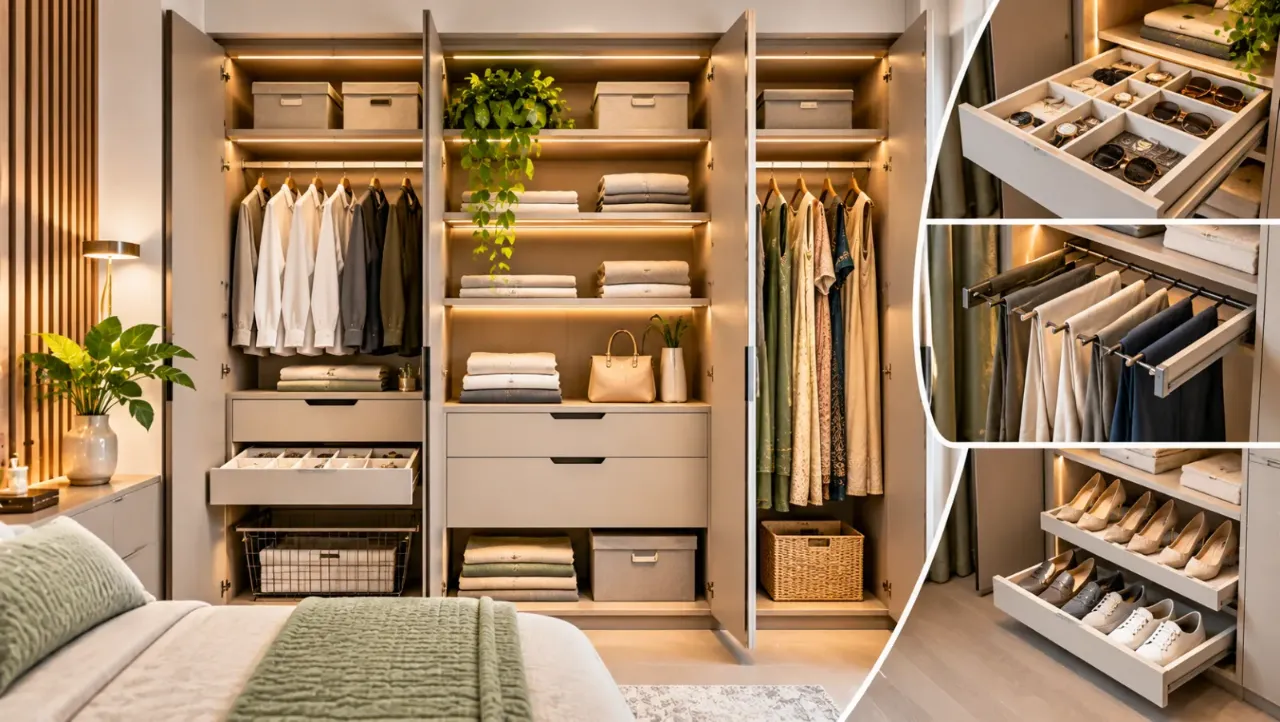
Wardrobe Internal Layout Ideas for Better Storage
A wardrobe can look spacious from the outside and still be difficult to use once you open it. Shelves may be too deep, drawers may not fit the items you want to store, and hanging sections may leave too much unused space above or below your clothes.
This usually happens when the wardrobe is designed around its external appearance rather than the belongings that need to go inside it.
A practical wardrobe interior should be planned around your clothing, accessories, storage habits and available room dimensions. The aim is to make everyday items easy to reach, keep less frequently used belongings organised and avoid paying for compartments that serve little purpose.
Here is how to plan the inside of a wardrobe before finalising its design.
1. Start by Listing What You Need to Store
Before deciding the number of shelves or drawers, understand what the wardrobe will hold. Two people using wardrobes of the same size may need completely different internal arrangements.
Make a simple inventory of:
- Daily-use shirts, trousers, dresses and other clothing.
- Clothes that need to be hung rather than folded.
- Folded garments such as T-shirts, sweaters and everyday wear.
- Sarees, ethnic clothing and occasion wear.
- Innerwear, socks and smaller accessories.
- Bags, belts, watches and jewellery.
- Shoes, if they will be stored inside the wardrobe.
- Bed linen, blankets and seasonal clothing.
- Luggage or items that are used only occasionally.
Also consider how many people will share the wardrobe. If two people use it, dividing the internal layout into clearly assigned sections can make organisation easier.
2. Divide the Wardrobe Into Functional Zones
A well-organised wardrobe generally works best when its interior is divided into zones rather than a collection of unrelated compartments.
You can plan the wardrobe using five main zones:
- Hanging zone: For garments that crease easily or need to remain on hangers.
- Folded-clothing zone: For T-shirts, jeans, sweaters, nightwear and other garments that can be stacked.
- Drawer zone: For smaller clothing items, accessories and belongings that are easier to organise in pull-out compartments.
- Accessory zone: For belts, watches, jewellery, handbags and other smaller possessions.
- Top storage zone: For seasonal clothing, spare bedding, luggage and items that are not required every day.
The exact proportion of each zone should depend on your storage inventory. Avoid dividing the wardrobe into equal sections simply because it looks symmetrical.
3. Plan Shelves According to What They Will Hold
Shelves are among the most common elements in a wardrobe, but their usefulness depends on their depth, spacing and accessibility.
Different belongings need different shelf arrangements:
- Everyday folded clothes: Use shelves with enough vertical room to remove a stack without disturbing everything above it.
- Sweaters and heavier garments: Avoid excessively tall stacks that become unstable.
- Bags: Give larger handbags their own compartments so they retain their shape.
- Bed linen: Wider shelves can make it easier to store sheet sets and spare pillow covers together.
- Storage boxes: Plan shelf dimensions around the boxes you intend to use.
For a starting point, many folded-clothing shelves work well with approximately 30–40 cm of clear vertical space, but the final spacing should be checked against the actual garments and storage boxes.
Very deep shelves can create hidden areas where clothes get forgotten. If the wardrobe is deep, consider pull-out shelves or organisers rather than storing multiple rows of folded clothes behind one another.
Adjustable shelves can also be useful because storage requirements may change over time.
4. Decide How Much Hanging Space You Actually Need
Hanging space should be planned according to garment length, not divided randomly between wardrobe sections.
A useful arrangement may include:
- Short hanging section: For shirts, blouses, jackets and folded-over trousers. Two levels of hanging can sometimes fit into the same vertical area.
- Long hanging section: For dresses, coats, long garments and sarees that you prefer to hang.
- Separate everyday section: Keep frequently used clothes at a convenient height so you do not need to reach above your head or bend down repeatedly.
As a preliminary guide, short garments may need around 85–105 cm of hanging height, while longer garments may require approximately 140–170 cm. These are planning ranges, not fixed rules. Measure your longest garments and allow suitable clearance below the hanging rail.
Also check:
- The rod is strong enough for the expected load.
- Hangers can slide without hitting the wardrobe sides.
- The rail is placed at a comfortable height.
- The lower area is not wasted if a shorter hanging section is used.
For Indian wardrobes, consider the actual length and storage preference of sarees, lehengas, kurtas and other traditional garments. Some may need dedicated hanging space, while others are better stored folded in wide drawers or shelves.
5. Design Drawers for Different Categories
Drawers are particularly useful for items that are difficult to organise on open shelves. They make it easier to separate belongings and see what is stored inside.
Instead of making every drawer identical, assign different purposes:
- Shallow drawers: For watches, jewellery, belts and smaller accessories.
- Medium-depth drawers: For socks, innerwear, scarves and everyday clothing.
- Deeper drawers: For bulkier garments, folded sweaters or larger accessories.
Consider drawer dividers for items that tend to become mixed together. Removable organisers are useful because they can be adjusted when storage needs change.
Check the usable internal drawer depth, not just the external drawer-front size. Drawer runners, side panels and the cabinet construction reduce the actual space available inside.
Also check that the drawers can be pulled out fully without hitting the bed, bedside table or nearby furniture.
6. Give Accessories Their Own Space
Small belongings often create the most disorder when they do not have a dedicated place.
Depending on what you own, consider:
- Divided trays for watches and jewellery.
- Pull-out belt and tie organisers.
- Small compartments for sunglasses.
- Dedicated handbag shelves.
- Removable fabric organisers for scarves.
- A pull-out trouser rack, if it suits your clothing collection.
- Shoe shelves with adequate height and ventilation.
Do not add every available wardrobe accessory automatically. Some fittings occupy valuable space and may not be useful for your daily routine.
Choose accessories based on the belongings you actually have and how often you use them.
7. Use the Top and Bottom Sections Wisely
The upper and lower parts of a wardrobe are often underused because their accessibility is not considered during planning.
Top shelves and lofts
These are suitable for:
- Seasonal clothing.
- Spare blankets and bed linen.
- Travel bags.
- Storage boxes.
- Items used only occasionally.
Keep frequently used belongings away from difficult-to-reach shelves. If the top section is high, plan safe access rather than relying on unstable stools or furniture.
Bottom sections
These can accommodate:
- Shoe storage.
- Pull-out drawers.
- Folded clothing.
- Storage boxes.
- Less frequently used accessories.
Check the available height before assigning the bottom section to shoes or boxes. Ensure the arrangement allows easy cleaning and access.
8. Consider Wardrobe Lighting and Visibility
A well-divided wardrobe can still be inconvenient if its internal compartments are poorly lit.
Useful lighting options include:
- LED strips along the vertical sides of wardrobe sections.
- Lighting below shelves to illuminate hanging clothes.
- Integrated lights near drawers and accessory trays.
- Door-activated lighting, where compatible with the electrical design.
Position lighting so that it illuminates the storage area without creating glare or obstructing shelves and rails.
Plan wiring and access before the wardrobe is installed. Electrical components should be suitable for the installation and accessible for maintenance.
9. Choose Materials and Hardware for Everyday Use
The internal finish and hardware affect how well a wardrobe performs over time.
- Board quality: Select a suitable board or construction system based on the wardrobe design, expected load and site conditions.
- Edge finishing: Properly finished edges help protect exposed board surfaces and improve the final appearance.
- Drawer runners: Choose runners suited to the drawer size, load and frequency of use.
- Hinges: Check opening angles, load capacity and the quality of the fittings.
- Hanging rods: Ensure the rod and its supports can handle the weight of the clothes stored on it.
- Handles and profiles: Choose a design that is comfortable to use and does not obstruct adjacent shutters or drawers.
Do not judge hardware only by appearance. Ask for the specifications, load suitability, warranty and maintenance requirements before approval.
10. Plan Wardrobe Dimensions Before Finalising the Internal Layout
The external dimensions determine how much usable internal storage you can create.
A few details need to be checked before the design is approved:
- Overall wardrobe width, height and depth.
- Wall irregularities and skirting projections.
- Ceiling height and loft access.
- Door and shutter opening clearance.
- Bedside furniture and other nearby obstructions.
- The depth needed for hanging garments.
- Drawer extension and access.
- The actual usable height inside each compartment.
For many conventional wardrobes, an external depth around 55–60 cm is a common starting point for hanging clothes, but the final requirement depends on the shutter construction, hanging direction and garments. Check the internal clear depth rather than relying only on the outside measurement.
If the bedroom is compact, sliding shutters may help where hinged doors would obstruct movement. However, the internal arrangement must still allow convenient access to every section.
11. Common Wardrobe Interior Planning Mistakes
Too many small shelves: Numerous narrow compartments can restrict what you can store and make rearrangement difficult.
Insufficient hanging space: A wardrobe designed mainly with shelves may not suit someone with many formal clothes, dresses or garments that need hanging.
Identical drawers throughout: Different belongings need different drawer depths and organisers.
Excessive shelf depth: Deep shelves can hide belongings at the back and make everyday access inconvenient.
Ignoring the door and drawer movement: A beautiful internal layout is not practical if drawers cannot open fully.
Adding unnecessary accessories: Extra pull-outs and organisers may consume space without solving a real storage problem.
Not planning for future changes: A wardrobe should allow some flexibility as clothing and storage habits change.
12. Final Checklist Before Approving Your Wardrobe Interior
- Have you listed all the belongings that need storage?
- Is hanging space sufficient for your longest garments?
- Are folded-clothing shelves spaced appropriately?
- Are drawer depths suited to their intended contents?
- Have you planned separate storage for accessories?
- Can you reach the upper shelves safely?
- Is the bottom section easy to access and clean?
- Can every drawer and shutter open fully?
- Are the hanging rods and hardware suitable for the expected load?
- Is wardrobe lighting planned?
- Are the internal measurements confirmed?
- Is there some flexibility for future storage needs?
Final Thoughts
A good wardrobe interior is not about adding the maximum number of shelves, drawers or accessories. It is about giving every category of belonging a suitable place.
Start with your storage habits, divide the wardrobe into functional zones and then decide the right balance of hanging space, shelves, drawers and accessory compartments. Check the actual measurements and opening clearances before approving the final design.
When the internal layout is planned properly, a wardrobe becomes easier to use, simpler to maintain and far more valuable in everyday life.
Frequently Asked Questions
1. How should I divide the inside of a wardrobe?
Start by separating belongings into hanging clothes, folded garments, accessories, everyday items and seasonal storage. Allocate space according to the quantity and type of belongings rather than dividing the wardrobe into equal sections.
2. How much hanging space does a wardrobe need?
It depends on the length and quantity of garments. Short clothes may need around 85–105 cm of vertical space, while longer garments may require approximately 140–170 cm. Measure your own clothes before finalising the design.
3. How deep should wardrobe shelves be?
Shelf depth should suit the garments, boxes and accessories being stored. Avoid making shelves unnecessarily deep, as items at the back can become difficult to reach.
4. How many drawers should a wardrobe have?
There is no fixed number. Plan drawers according to your storage needs. Shallow drawers work for smaller accessories, while deeper drawers are useful for folded clothes and bulkier items.
5. Are adjustable shelves useful in wardrobes?
Yes. Adjustable shelves allow you to change compartment heights as your storage needs evolve. They are particularly useful for wardrobes shared by multiple people.
6. What should be stored on the top shelf of a wardrobe?
Use the top section for seasonal clothing, spare bedding, luggage and belongings that are not needed every day. Keep frequently used items in easily accessible sections.
Plan Your Wardrobe With Walls to Wonder
Make better decisions before finalising your wardrobe design. Explore Walls to Wonder's AI tools to visualise ideas, understand costs and review your interior plans.
- Whole Home Visualizer – Visualise how your wardrobe fits into your overall home design.
- Design My Room – Explore different bedroom and wardrobe design directions.
- Interior Design Cost Estimate – Get an initial estimate for your interior design requirements.
- Interior Quotation Checker – Review an interior quotation before making decisions.
- Rate My Room Design – Get feedback on your bedroom design.
- Interior Style Finder – Discover an interior style that suits your preferences.
Explore more at Walls to Wonder.
Turn this idea into a plan for your home
Visualise your space, understand the likely budget, or find a professional who can bring the idea to life.