
Wall Art and Gallery Walls: How to Choose the Right Scale and Layout
A blank wall can make a room feel unfinished, but filling it with artwork does not automatically make the space look better. A painting that is too small can disappear above a large sofa, while several frames arranged without a clear plan can make a wall feel crowded.
Wall art works best when its size, position and arrangement relate to the furniture and proportions of the room. Whether you prefer one large statement piece, a pair of coordinated prints or a gallery wall with different frames, the goal is to create a composition that feels intentional.
Here is how to choose artwork and arrange it in a way that suits your home.
1. Start by Understanding the Wall
Before buying artwork or selecting frames, look at the wall you want to decorate. Its width, height, surrounding furniture and visibility from the entrance all influence what will work.
Consider these questions:
- Is the wall wide and open, or narrow and restricted?
- Is there furniture directly below it?
- Will the artwork be viewed from close range or across the room?
- Does the wall already have architectural details, shelving or lighting?
- Is it intended to be the main focal point or a supporting decorative feature?
A large empty wall may benefit from one substantial artwork or a carefully planned gallery arrangement. A smaller wall may look better with one framed print, a pair of artworks or a compact vertical arrangement.
Do not choose artwork simply because it fits the available empty space. Think about how it relates to the entire room.
2. Choose the Right Artwork Size
Scale is one of the most important factors in wall-art placement. Even an attractive piece can look out of place if it is too small or too large for its surroundings.
Artwork Above a Sofa
When placing artwork above a sofa, consider the width of the sofa as your starting point.
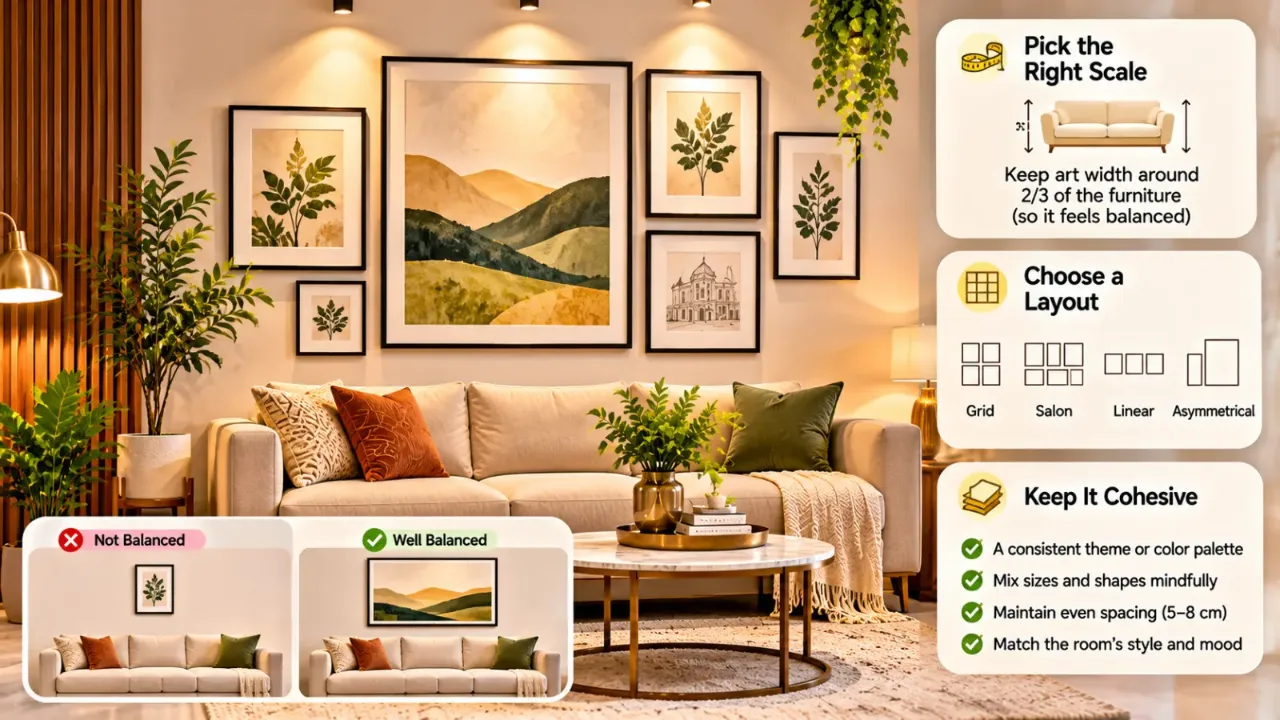
As a practical design guideline, a single artwork or combined artwork arrangement often looks balanced when it occupies around 60–75% of the furniture width. This is not a strict rule, but it helps prevent a small frame from looking disconnected from a large sofa.
For example, if a sofa is approximately 240 cm wide, an artwork arrangement around 145–180 cm wide may be a useful starting point.
Artwork Above a Console or Sideboard
The artwork should relate to the furniture beneath it. A very narrow frame above a wide console can look disconnected, while an oversized piece may overpower the furniture.
A single large print, a pair of coordinated artworks or a compact gallery arrangement can work well.
Artwork on a Large Empty Wall
A substantial wall may need a larger artwork or a group of frames to create enough visual presence. Consider the distance from which the wall will usually be viewed. Artwork in a spacious living room may need more scale than a piece in a narrow passage.
3. Decide Between One Large Artwork and a Gallery Wall
Not every wall needs several frames. Sometimes one well-chosen artwork creates a stronger result.
Choose One Large Artwork When:
- You want a clear focal point.
- The wall has enough uninterrupted space.
- The room already contains several decorative elements.
- You prefer a simple, uncluttered arrangement.
Choose a Gallery Wall When:
- You want to display several photographs or artworks.
- You have pieces of different sizes that share a visual connection.
- The wall needs more visual interest.
- You want to create a personalised collection over time.
A gallery wall does not have to contain many frames. Three or four carefully arranged pieces can be enough to establish a focal point.
4. Choose a Gallery Wall Layout
A gallery wall looks more organised when the arrangement has a clear structure. You do not have to make every frame identical, but the overall composition should feel balanced.
Symmetrical Grid
A grid layout uses frames of similar size arranged in aligned rows and columns. It works well for photographs, illustrations and coordinated prints.
It is particularly suitable for:
- Dining areas.
- Home offices.
- Formal living rooms.
- Walls where a neat, orderly appearance is preferred.
Organic or Asymmetrical Arrangement
This arrangement combines different artwork sizes and orientations. It can look relaxed and personal, provided the pieces have some connection through colour, subject, frame finish or visual weight.
It works well for:
- Living rooms.
- Staircase walls.
- Creative spaces.
- Personal collections of photographs and artwork.
Linear Arrangement
A linear arrangement places artwork along one horizontal or vertical line. It is useful when the wall is long and narrow or when you want to maintain a simple visual rhythm.
Salon-Style Arrangement
A salon-style arrangement uses multiple pieces of different sizes, sometimes with tighter spacing. It can create a rich, collected appearance, but it needs careful planning to avoid looking random.
5. Get the Spacing Between Frames Right
Spacing can make the difference between a gallery wall that looks cohesive and one that feels disconnected.
For many home interiors, a gap of approximately 5–8 cm between frames is a useful starting point. Smaller arrangements may benefit from slightly tighter spacing, while larger compositions can accommodate more room.
Keep these principles in mind:
- Maintain consistent gaps in a grid arrangement.
- Use spacing to visually connect different-sized frames.
- Avoid leaving one frame isolated from the rest.
- Check the outer boundaries of the complete arrangement.
- Consider the wall edges, furniture and nearby doors before finalising the layout.
For an asymmetrical arrangement, the gaps do not always need to be identical, but the overall composition should still feel deliberate.
6. Select Frames That Work Together
Frames influence the overall appearance of wall art. They can make a collection feel coordinated, understated, traditional or more contemporary.
- Black frames: Create contrast and work well with graphic prints, photography and contemporary interiors.
- Natural wood frames: Add a softer appearance and pair well with neutral and natural-material palettes.
- White frames: Keep the arrangement light and understated.
- Metallic frames: Introduce a decorative finish, particularly in selected traditional or refined interiors.
- Mixed frames: Add variety, provided the collection has a consistent visual connection.
You can use different frame styles in one gallery wall. However, repeating at least one element—such as colour, material, matting or artwork theme—helps the collection feel connected.
7. Choose Artwork That Complements the Room
Artwork should relate to the room without needing to match every cushion, curtain or furniture finish.
Colour: Pick up one or two colours already present in the room, or introduce a deliberate accent shade.
Subject: Abstract art, landscapes, photography, illustrations and personal photographs can all work. Choose pieces that suit the atmosphere you want.
Style: A minimal room may benefit from restrained artwork, while a more expressive interior can accommodate varied colours and subjects.
Texture: Canvas, framed prints, textile art and relief artwork create different visual effects.
Personal meaning: Family photographs, travel memories and collected pieces can make a home feel individual. They do not need to follow a strict decorating theme.
8. Plan Wall Art Room by Room
The best arrangement depends on the room, its furniture and how the wall is used.
Living Room
The living room is often a suitable place for a larger artwork or a gallery wall because it has a natural focal area around the sofa or seating arrangement.
- Relate the artwork width to the sofa.
- Avoid placing frames too high above the furniture.
- Keep the arrangement balanced with the coffee table and other major elements.
- Make sure nearby lamps and wall lights do not create distracting reflections.
Bedroom
Bedroom artwork should support a calm atmosphere. A pair of prints, a single horizontal artwork or a small gallery arrangement above the headboard can work well.
Keep frames securely fixed and avoid arrangements that interfere with bedside lights or other functional elements.
Dining Area
Dining areas can accommodate artwork that adds interest without interfering with the table arrangement.
A linear set of prints, a large artwork or a small collection above a sideboard can work well. Consider the view from the dining chairs as well as from the entrance.
Corridor and Staircase
Corridors and staircases can be useful places for personal photographs and smaller framed pieces.
- Maintain a consistent relationship between frames.
- Follow the visual direction of a staircase where appropriate.
- Keep the arrangement clear of door swings and circulation areas.
- Check the composition from both ends of the passage.
9. Use a Simple Planning Method Before Hanging
One of the easiest ways to avoid unnecessary drilling is to plan the arrangement on the floor first.
- Measure the wall and the furniture below it.
- Measure each artwork, including its frame.
- Cut paper templates to match the frame dimensions.
- Arrange the templates on the floor or temporarily attach them to the wall.
- Adjust the layout until the spacing and overall shape look balanced.
- Photograph the arrangement so you can refer to it during installation.
- Mark fixing points and check wall construction before drilling.
For heavier frames, use suitable fixings for the wall material and artwork weight. If you are unsure about the wall construction or concealed services, seek professional guidance before drilling.
10. Common Wall Art Mistakes to Avoid
- Choosing artwork that is too small: A tiny frame can look lost above a large sofa or console.
- Hanging everything too high: Artwork should relate to the furniture and normal viewing positions.
- Using inconsistent spacing: Random gaps can make a gallery wall look unfinished.
- Mixing too many unrelated frames: Different styles can work together, but the arrangement needs a visual connection.
- Ignoring furniture proportions: The complete artwork arrangement should relate to the furniture beneath it.
- Filling every empty wall: Not every wall needs decoration. Negative space can help the room feel balanced.
- Drilling before testing the layout: Paper templates and a trial arrangement can prevent avoidable mistakes.
11. Wall Art Planning Checklist
Before installing artwork, check the following:
- Measure the wall and the furniture below it.
- Decide between a single artwork and a gallery wall.
- Choose artwork sizes that suit the available space.
- Select a layout that complements the room.
- Coordinate frame colours, materials or finishes.
- Plan consistent spacing between pieces.
- Check the arrangement from the main viewing positions.
- Make sure artwork does not interfere with doors, switches or lighting.
- Test the layout with paper templates.
- Select appropriate wall fixings for the artwork weight.
Final Thoughts
Wall art should feel like part of the room rather than something added simply to fill an empty wall. The right scale gives it presence, a thoughtful layout creates visual order and suitable frames bring the collection together.
Start by measuring the wall, understanding the furniture around it and deciding what you want the artwork to achieve. Whether you choose one statement piece or a gallery wall, a little planning can make the result feel more balanced, personal and complete.
Plan Your Home Interiors with Walls to Wonder
Planning your wall decor as part of a larger home makeover? Explore Walls to Wonder's AI tools to visualise rooms, explore styles and plan your interiors.
- Whole Home Visualizer – Explore how different design choices can work across your home.
- Design My Room – Experiment with room layouts and interior design ideas.
- Interior Design Cost Estimate – Get an initial estimate for your interior project.
- Interior Quotation Checker – Review and understand your interior design quotation.
- Rate My Room Design – Get feedback on your room design.
- Interior Style Finder – Discover an interior style that suits your preferences.
Visit Walls to Wonder to explore more interior design ideas and tools.
Frequently Asked Questions
1. How do I choose the right size of wall art?
Start by measuring the wall and the furniture beneath it. Consider the width and height of the artwork in relation to the surrounding elements. For artwork above a sofa, a combined arrangement around 60–75% of the sofa width is a useful starting point.
2. How much space should I leave between gallery wall frames?
A gap of approximately 5–8 cm is a practical starting point for many gallery walls. Adjust it according to frame size, wall dimensions and the overall layout.
3. Should all gallery wall frames match?
No. Matching frames create a uniform look, while mixed frames can make the arrangement more personal. Repeat at least one visual element, such as frame colour, material or artwork style, to maintain cohesion.
4. Is a gallery wall suitable for a small living room?
Yes. A small living room can accommodate a compact gallery wall with a few carefully selected frames. Keep the arrangement proportional to the wall and avoid overcrowding it with too many pieces.
5. Should artwork be centred above a sofa?
Usually, the artwork or complete gallery arrangement should be visually centred in relation to the sofa or seating area. This helps the furniture and artwork read as one composition.
6. Can I mix photographs and paintings in one gallery wall?
Yes. Photographs, illustrations and paintings can work together when there is a connection through colour, frame style, subject or overall composition.
7. How do I arrange different-sized frames?
Begin with the largest piece and use it as an anchor. Position smaller frames around it, balancing visual weight and maintaining a consistent relationship between the gaps. Test the complete layout before hanging.
8. What is the easiest way to plan a gallery wall?
Measure the frames, create paper templates and arrange them on the floor or temporarily on the wall. Photograph the final layout and mark the fixing positions before drilling.
Turn this idea into a plan for your home
Visualise your space, understand the likely budget, or find a professional who can bring the idea to life.