
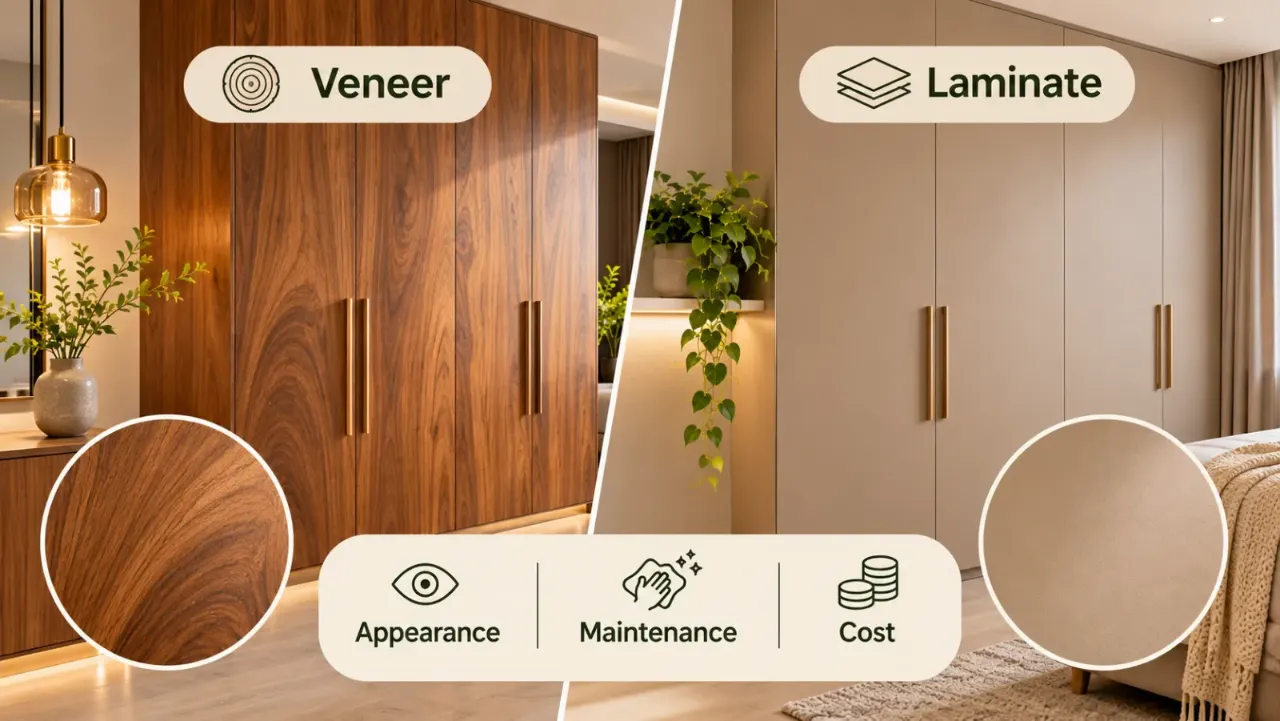
Veneer vs Laminate: Appearance, Maintenance and Cost Differences
When choosing finishes for wardrobes, kitchen cabinets, TV units, dining tables or other furniture, veneer and laminate are two options that frequently come up. Both are applied over a base material such as plywood or MDF, but they create very different results.
Veneer is made from thin slices of real wood, while laminate is a manufactured decorative surface. One offers natural grain and variation; the other provides a wider range of patterns, colours and practical surface options.
The difference goes beyond appearance. Maintenance, resistance to everyday wear, repair possibilities, installation and overall cost all influence which finish makes sense for a particular piece of furniture.
1. What Is Wood Veneer?
Wood veneer is a thin sheet of natural wood applied to a base material such as plywood, MDF or another suitable board. It is produced by slicing or peeling timber into thin layers, allowing the natural grain and character of the wood to be used without making the entire furniture panel from solid timber.
Because veneer comes from real wood, each sheet can have its own grain pattern, colour variation and natural markings.
After application, the surface generally needs sanding and a suitable protective finish, such as polish, lacquer or another specified coating.
Key characteristics of veneer:
- Made from real wood.
- Displays natural grain and colour variation.
- Available in different wood species and cuts.
- Can be stained or finished in different shades.
- Usually requires a protective coating.
- May be professionally refinished, depending on veneer thickness and condition.
Veneer is often selected when the natural appearance of timber is an important part of the interior design.
2. What Is Laminate?
Laminate is a manufactured decorative sheet generally made using layers of paper and resin pressed together. Its visible surface can carry a printed design, solid colour, texture or wood-grain pattern.
The finished sheet is bonded to a suitable substrate, such as plywood, MDF or particle board, using an appropriate adhesive and application method.
Unlike veneer, laminate does not contain a natural wood surface. Even when it imitates oak, teak or walnut, the pattern is manufactured.
Key characteristics of laminate:
- Manufactured using decorative paper and resin-based layers.
- Available in wood, stone, solid colours and many other designs.
- Comes in matte, gloss and textured finishes.
- Generally supplied as a ready-finished surface.
- Usually needs less routine maintenance than veneer.
- Cannot be sanded and refinished like real wood.
Laminate is popular for furniture that needs a consistent appearance and a surface that is relatively easy to clean.
3. Veneer vs Laminate: Main Differences at a Glance
| Factor | Veneer | Laminate |
|---|---|---|
| Material | Thin slice of real wood | Manufactured decorative sheet |
| Appearance | Natural grain and variation | Printed or solid-colour designs |
| Design options | Depends on wood species, cut and stain | Wide range of colours, patterns and textures |
| Surface finish | Needs a suitable protective coating | Usually factory-finished |
| Maintenance | Needs more careful cleaning | Generally easy to clean |
| Scratch resistance | Can scratch or wear through | Generally better everyday surface resistance |
| Moisture | Sensitive to prolonged moisture and damaged coating | Surface generally handles routine spills better, depending on grade and edge detailing |
| Repair | May be sanded and refinished within limits | Chips and deep damage are difficult to repair invisibly |
| Installation | Application followed by finishing | Application and edge detailing |
| Cost | Often higher after finishing and labour | Often more budget-friendly |
| Best suited for | Feature furniture and natural wood appearance | Practical, frequently used furniture and varied designs |
Neither material is automatically better in every situation. The choice depends on the furniture, expected use, finish quality and budget.
4. Appearance: Natural Wood vs Manufactured Designs
Appearance is often the biggest reason homeowners choose one finish over the other.
Why Choose Veneer?
Veneer offers the character of natural timber. Its grain is not perfectly repeated, and small variations in colour and pattern give each surface an individual appearance.
It works particularly well when you want:
- A natural wood look.
- Rich grain patterns and visible timber character.
- A premium appearance on statement furniture.
- The option to stain the surface in a selected shade.
- A coordinated natural wood finish across selected interior elements.
Veneer can look especially attractive on dining tables, TV units, sideboards, feature cabinets and selected wardrobe shutters.
Why Choose Laminate?
Laminate offers more flexibility in design and finish. You can choose from natural-looking wood patterns, solid colours, stone-inspired designs and textured surfaces.
It works well when you want:
- A consistent colour across multiple furniture units.
- A wide choice of wood-look finishes.
- Matte, gloss or textured surfaces.
- Bold colours and contemporary patterns.
- A coordinated finish across wardrobes, cabinets and storage units.
Modern wood-grain laminates can look convincing from a distance, although their printed patterns may repeat and their surface character differs from real timber.
5. Durability: Which Finish Handles Everyday Use Better?
Durability depends on the quality of the surface, substrate, adhesive, edge treatment and workmanship. However, the two finishes respond differently to everyday use.
Veneer Durability
Veneer has a natural wood surface protected by a coating. It can be affected by scratches, dents, heat, moisture and wear to the protective finish.
Common concerns include:
- Scratches from sharp objects.
- Dullness or damage to the polish.
- Discolouration from prolonged sunlight exposure.
- Lifting or damage around poorly sealed edges.
- Moisture-related problems if water reaches the substrate.
The protective coating helps, but it does not make veneer waterproof or immune to damage.
Laminate Durability
Laminate generally provides a harder, more wear-resistant decorative surface for everyday furniture use.
Its advantages include:
- Good resistance to routine surface wear.
- Easier cleaning of many common spills.
- A consistent finish across large panels.
- Availability of specialist grades for particular applications.
However, laminate also has limitations:
- Edges can chip if struck.
- Deep scratches may remain visible.
- Poor bonding can lead to lifting.
- Water entering through damaged edges or joints can affect the board underneath.
- Heat resistance varies by product and does not mean the surface is heatproof.
For busy furniture, a suitable quality of laminate is often the more practical option. For a statement piece where natural wood character matters, veneer may be worth the additional care.
6. Maintenance: How Much Care Does Each Require?
Maintenance is an important factor, particularly for homes with children, pets or frequently used furniture.
How to Maintain Veneer
- Dust regularly with a soft, dry or slightly damp cloth.
- Wipe spills promptly.
- Avoid leaving water on the surface.
- Use only cleaners approved for the protective finish.
- Avoid abrasive scrubbers and harsh chemicals.
- Protect the furniture from prolonged direct sunlight.
- Follow the recommended care instructions for periodic polishing.
If the surface becomes dull or scratched, professional refinishing may be possible, depending on the thickness of the veneer and the extent of the damage.
How to Maintain Laminate
- Wipe the surface with a soft damp cloth.
- Use a mild cleaning solution when necessary.
- Dry the surface after cleaning.
- Avoid abrasive pads that can damage the decorative layer.
- Do not use excessive water around joints and edges.
- Follow the manufacturer's instructions for specialist finishes.
Laminate usually requires less specialised maintenance, making it convenient for everyday furniture.
7. Repair and Replacement: What Happens When the Finish Gets Damaged?
This is one of the most important differences between veneer and laminate.
Veneer repair: Because veneer is real wood, it may be possible to sand, stain and refinish the surface. Minor surface wear can sometimes be improved by a professional.
However, veneer is thin. Deep scratches, peeling or damage that has gone through the veneer layer may not be repairable without replacing the affected section.
Laminate repair: Laminate cannot be sanded and refinished like natural wood. Small chips may sometimes be filled or concealed with a colour-matched repair product, but the repair may remain visible.
If the decorative layer is badly damaged, replacing the affected panel or sheet is often the more reliable solution.
Before choosing either material, ask the fabricator how repairs would be handled and whether matching replacement material will be available.
8. Veneer vs Laminate: Understanding the Cost Difference
Veneer is generally more expensive than standard laminate, but the final cost depends on much more than the sheet price.
What Affects Veneer Cost?
- Wood species and availability.
- Natural grain pattern and veneer cut.
- Thickness and quality of the veneer.
- Substrate and adhesive.
- Staining, sanding and polishing.
- Labour and installation.
- Complexity of matching grain across panels.
Premium species, distinctive grain patterns and more involved finishing can increase the total cost.
What Affects Laminate Cost?
- Brand and product range.
- Laminate grade and thickness.
- Matte, gloss or textured finish.
- Special features such as anti-fingerprint or other performance properties.
- Substrate and adhesive.
- Edge banding and installation labour.
Standard laminates are often more economical, while premium decorative and specialist laminates can cost considerably more.
Compare the Complete Installed Cost
| Cost Component | Veneer | Laminate |
|---|---|---|
| Decorative surface | Depends on species and grade | Depends on brand and grade |
| Application | Requires careful bonding | Requires accurate bonding |
| Finishing | Sanding, staining and polishing may be needed | Usually supplied ready-finished |
| Labour | Can be higher due to finishing | Often more straightforward |
| Maintenance | May include periodic professional refinishing | Usually routine cleaning |
| Repair | Professional refinishing may be possible | Panel or sheet replacement may be needed |
Do not compare only the price per sheet. Ask for the complete installed cost, including substrate, adhesive, finishing, labour and edge treatment.
9. Where Should You Use Veneer and Laminate?
The right finish depends on how frequently the furniture is used and what kind of appearance you want.
| Furniture or Area | Veneer | Laminate |
|---|---|---|
| TV unit | Excellent for a natural feature finish | Practical for storage and everyday use |
| Wardrobe shutters | Suitable for a premium natural look | Practical for regular use and wider design choices |
| Kitchen cabinets | Best limited to carefully selected, protected areas | Often more practical for frequently used shutters |
| Dining table | Attractive when properly protected | Convenient for easier routine cleaning |
| Bedroom side tables | Good for natural wood character | Easy-care option |
| Study table | Suitable with suitable protection | Practical for regular use |
| Feature wall panels | Good for natural grain and warmth | Offers consistent patterns and textures |
| Decorative console | Suitable for a statement finish | Good for a wider range of designs |
For kitchens, bathrooms and other moisture-prone spaces, do not assume either finish is waterproof. Check the product specification, substrate, edge sealing and exposure conditions.
10. Can You Combine Veneer and Laminate in One Home?
Absolutely. You do not have to use one finish throughout the home.
Combining them can help balance appearance, maintenance and cost.
- Use veneer on the TV unit or a feature wall to introduce natural wood character.
- Choose laminate for wardrobe interiors and frequently used storage.
- Use laminate on kitchen shutters where easy cleaning is a priority.
- Add veneer to a dining table or console where its grain can become a visual feature.
- Coordinate the wood shades so that both materials belong to the same overall palette.
The important thing is to select complementary undertones and grain patterns. Veneer and wood-look laminate do not need to be identical, but their colours should work together.
11. Common Mistakes to Avoid
| Mistake | Why It Matters |
|---|---|
| Choosing veneer only by appearance | The maintenance may not suit the household |
| Assuming laminate is waterproof | Water can enter through edges and joints |
| Ignoring the substrate | The base board affects strength and performance |
| Comparing only sheet prices | Finishing and installation change the final cost |
| Using harsh cleaners | They can damage protective coatings and decorative surfaces |
| Expecting laminate to be refinished | Deep surface damage usually requires replacement |
| Assuming all veneers look alike | Wood species and grain cuts create different results |
| Ignoring edge detailing | Poor edges can lead to lifting or moisture damage |
12. A Practical Checklist Before Finalising Your Finish
- Decide whether natural wood grain or design flexibility matters more.
- Identify how frequently the furniture will be used.
- Check the substrate and board specification.
- Compare veneer species, grain and finish samples.
- Check laminate grade, thickness and surface texture.
- Ask about scratch, stain, moisture and heat performance.
- Confirm how edges and corners will be finished.
- Compare complete installed quotations.
- Ask about cleaning and repair requirements.
- Keep approved material samples for execution.
Final Thought
Veneer and laminate serve different purposes in home interiors. Veneer brings the natural character of real wood and may be refinished when the surface and construction allow it. Laminate offers a wider design range, convenient cleaning and generally better resistance to everyday surface wear.
If natural wood appearance is your priority and you are prepared for more careful maintenance, veneer can be a worthwhile choice. If you want a practical, consistent and often more budget-friendly surface, laminate is usually the easier option.
You can also combine both. Use veneer where its natural grain will make a visual difference and laminate where everyday convenience matters most.
The best finish is the one that suits the furniture, the room and the way your home is used.
Explore More Interior Design Tools with Walls to Wonder
Explore finishes, plan furniture and discover ideas for your home with Walls to Wonder AI tools.
- Whole Home Visualizer – Explore coordinated design ideas for your home.
- Design My Room – Visualise different room styles and finishes.
- Interior Design Cost Estimate – Get an initial estimate for your interior project.
- Interior Quotation Checker – Review and understand an interior quotation.
- Rate My Room Design – Get feedback on your room design.
- Interior Style Finder – Discover an interior style that suits your preferences.
Visit Walls to Wonder for more home interior inspiration and design tools.
Frequently Asked Questions
1. Is veneer better than laminate?
Neither is better in every situation. Veneer is preferred for genuine wood grain and natural variation, while laminate is often more practical for easy maintenance, design flexibility and everyday surface wear.
2. Is veneer more expensive than laminate?
Veneer is generally more expensive once the cost of the wood species, application, sanding and polishing is included. Premium laminates can also be costly, so compare complete installed quotations.
3. Does veneer require regular polishing?
Veneer needs a suitable protective finish and careful cleaning. Periodic refinishing may be needed depending on its coating, usage and condition. Follow the manufacturer's or fabricator's care instructions.
4. Is laminate waterproof?
No. Many laminates have surfaces that resist routine spills, but water can enter through joints, edges or damaged areas and affect the substrate. Product grade and installation matter.
5. Can veneer be repaired if scratched?
Some scratches and surface wear can be improved by professional sanding and refinishing. Deep damage may not be repairable if it has gone through the thin veneer layer.
6. Can laminate be polished again?
No. Laminate cannot be sanded and refinished like natural wood. Minor damage may be concealed, but serious damage usually requires replacing the affected surface or panel.
7. Which finish is better for wardrobes?
Both can work. Laminate is often practical for frequently used wardrobes because it is easy to clean and available in many finishes. Veneer is suitable when a natural wood appearance is a priority and the surface can be maintained carefully.
8. Can veneer and laminate be used together?
Yes. Many interiors combine veneer on feature furniture and laminate on practical storage units. Choose complementary colours, undertones and textures to keep the overall design coordinated.
Get a personalised estimate for your home
Choose your rooms, materials and preferences to understand a practical interior budget before you commit.