
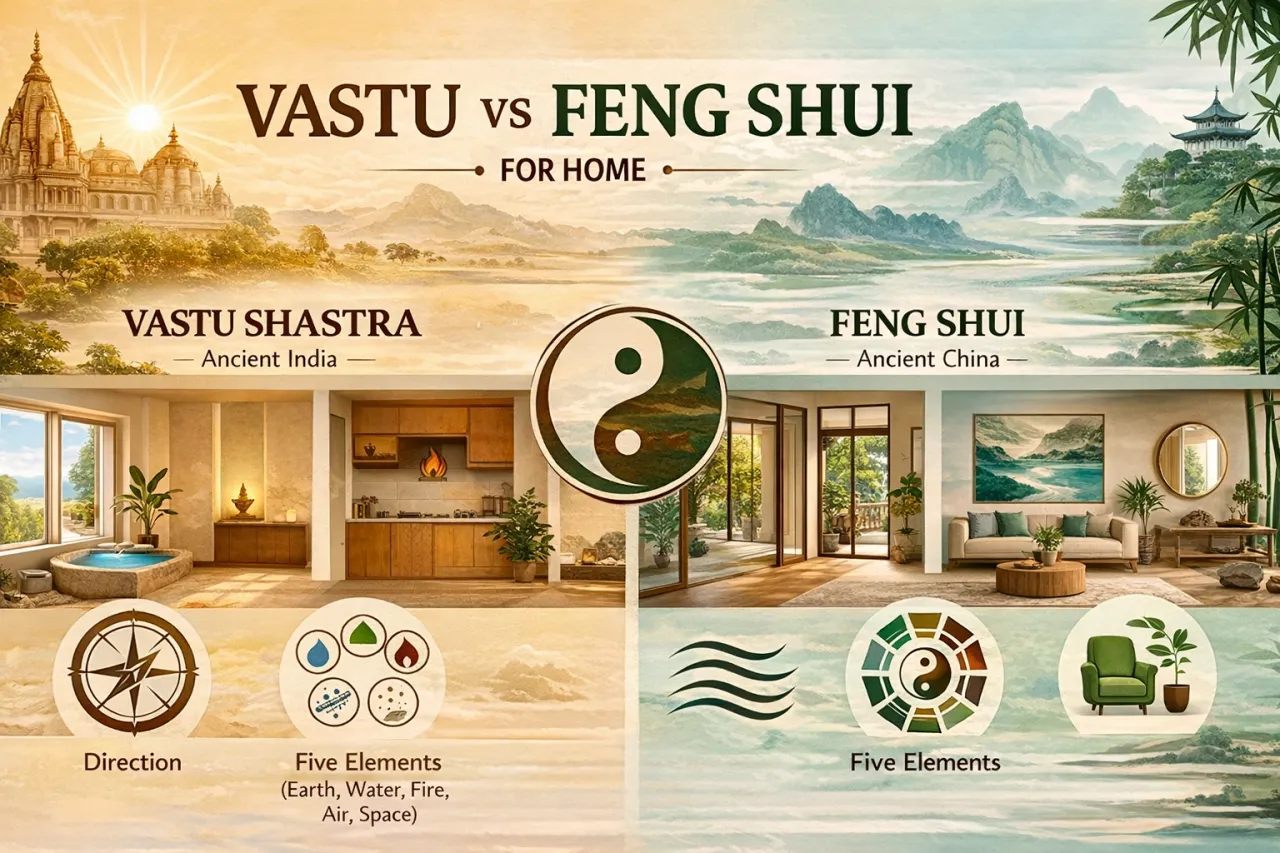
Vastu and Feng Shui for Home: The Basics, the Philosophy, and the Key Differences
A home is more than a physical structure. It is a space where routines settle, emotions build, and energy is constantly experienced through light, layout, movement, materials, and atmosphere. This is why traditional spatial systems such as Vastu Shastra and Feng Shui continue to influence modern home design. Both are often discussed in the same breath, and both are used to create more harmonious living environments, yet they come from very different cultural and philosophical foundations.
For homeowners, designers, and anyone planning interiors, it is useful to understand that Vastu and Feng Shui are not interchangeable ideas. They may overlap in their goal of improving balance, comfort, and well-being in a home, but their methods, principles, and interpretation are distinct. A thoughtful understanding of both can help people make better design decisions without reducing either system to superstition or surface-level décor.
This article explains the basics of Vastu for home, the fundamentals of Feng Shui for home, and the striking differences between the two in a clear, professional, and practical way.
Understanding the Purpose of Vastu and Feng Shui
At a basic level, both Vastu and Feng Shui are traditional systems that try to align the built environment with natural forces. They are based on the belief that the arrangement of space affects the experience of the people living in it. The location of rooms, the flow of movement, the presence of light, the orientation of the house, and the placement of objects are all considered meaningful.
What makes them relevant even today is that they are not only about symbolism. In many cases, their recommendations connect with real design principles such as ventilation, sunlight, order, zoning, proportion, and psychological comfort. That is one reason why these systems continue to be consulted in architecture, interior design, and home planning.
Still, the way they arrive at their recommendations is very different. To understand that properly, it is important to look at each system on its own terms.
What Is Vastu Shastra?
Vastu Shastra is an ancient Indian system of architecture and spatial planning. The word “Vastu” refers to dwelling or built space, while “Shastra” means science or doctrine. In simple terms, Vastu is a traditional design framework that guides how land, buildings, rooms, and directions should be organized to support harmony and well-being.
Vastu is strongly connected to directional logic. It gives great importance to the orientation of the site and structure, the five natural elements, and the relationship between human life and cosmic order. It is often used in the planning of homes, temples, offices, commercial buildings, and even cities in traditional Indian architecture.
Core Principles of Vastu for Home
1. Direction Matters Deeply
Vastu places strong emphasis on the eight directions: north, south, east, west, northeast, northwest, southeast, and southwest. Each direction is believed to carry a particular quality and influence. The location of rooms is often recommended according to these directional attributes.
For example:
- The northeast is usually considered highly auspicious and is often associated with prayer, meditation, or open space.
- The southeast is linked with fire and is often recommended for the kitchen.
- The southwest is commonly considered suitable for the master bedroom because of its association with stability.
2. The Five Elements
Vastu works with the concept of earth, water, fire, air, and space. A home is ideally designed in a way that maintains a healthy balance among these five elements. Their placement in relation to direction is considered important.
For example:
- Water-related areas are often preferred in the north or northeast.
- Fire-related functions, such as cooking, are generally aligned with the southeast.
- Open spaces and ventilation are also part of balancing these elements.
3. Site and Layout Are Important
Vastu is not only about placing furniture after construction. Ideally, it begins much earlier, at the level of plot shape, slope, entrance direction, room planning, and structural design. That is why Vastu tends to be more architecture-led than décor-led.
4. Central Space Should Be Balanced
Traditional Vastu often treats the center of a home as an important energy zone. It is ideally kept open, light, and less burdened by heavy structural or cluttered elements.
What Is Feng Shui?
Feng Shui is a traditional Chinese system of spatial harmony. The term literally translates to wind and water, reflecting its roots in observing how natural forces move and interact within the environment. Feng Shui aims to create balance in a home by improving the flow of Qi or Chi, which is understood as life energy.
Unlike Vastu, Feng Shui often feels more fluid and adaptive in its application. It is concerned not only with direction but also with energy flow, symbolism, placement, form, and environmental relationships. It can be applied to architecture, interiors, landscaping, room arrangement, and object placement.
Core Principles of Feng Shui for Home
1. Flow of Energy Matters
A key concept in Feng Shui is the movement of energy through a space. A home should support smooth, calm, and balanced flow. Spaces that are cramped, dark, blocked, or cluttered are often seen as interrupting healthy energy flow.
This is one reason Feng Shui places importance on:
- Clear entryways
- Organized interiors
- Comfortable circulation
- Balanced furniture placement
2. The Bagua Map
One of the best-known Feng Shui tools is the Bagua, an energy map used to divide a space into different life areas such as career, relationships, health, family, wealth, and creativity. Depending on the school of Feng Shui being followed, the Bagua may be applied based on compass directions or aligned with the front entrance.
This makes Feng Shui more interpretive in some cases, because the same room may be analyzed according to symbolic life zones rather than only physical direction.
3. Yin and Yang Balance
Feng Shui values the balance of yin and yang, meaning calm and active qualities. A home should not feel excessively dull or excessively stimulating. Bedrooms may require softer and more restful yin qualities, while living areas may benefit from more active yang energy.
4. The Five Elements
Like Vastu, Feng Shui also works with five elements, but they are different: wood, fire, earth, metal, and water. These elements are used to understand relationships between materials, colors, shapes, and emotional qualities within a space.
For example:
- Wood may represent growth and vitality.
- Fire may represent passion and energy.
- Water may represent flow and opportunity.
Basics of Vastu for Home Planning
For people new to the subject, some of the commonly discussed Vastu basics for a home include:
- A well-placed main entrance, often considered one of the most important aspects
- Kitchen placement in the southeast when possible
- Master bedroom placement in the southwest
- Prayer or meditation area in the northeast
- More openness, light, or water elements toward the north or northeast
- Avoiding excessive clutter and poor ventilation
- Keeping the home clean, ordered, and balanced
In practice, many homeowners use Vastu as a guiding framework rather than following every rule rigidly. In urban apartments, especially, complete compliance may not be possible, so designers often focus on the spirit of balance, direction, and practical arrangement.
Basics of Feng Shui for Home Planning
For beginners, Feng Shui often starts with improving how a home feels and flows. Some widely used Feng Shui ideas include:
- Keep the entrance clean, welcoming, and unobstructed
- Allow energy to move smoothly through the home
- Avoid clutter, especially in key circulation areas
- Use mirrors carefully and intentionally
- Place furniture in supportive positions where the person feels secure
- Balance natural light, textures, colors, and materials
- Strengthen different life areas through placement, symbolism, or the Bagua map
Feng Shui is often more flexible in interior application than Vastu. It may recommend shifting furniture, changing colors, using specific materials, adding plants, or adjusting symbolic placement to improve energy quality.
The Striking Differences Between Vastu and Feng Shui
Although both systems aim to create harmony, their foundations are meaningfully different. This is where many people become confused, because the end goal sounds similar while the logic behind it is not.
1. Cultural Origin
The most fundamental difference is origin.
- Vastu Shastra comes from India
- Feng Shui comes from China
Each system emerges from a different cultural worldview, traditional philosophy, and architectural history.
2. Design Approach
Vastu is generally more structural and architectural in nature. It is strongest when considered during site selection, planning, and construction.
Feng Shui is often more spatial and energetic in application. It can be used both at planning stage and after the home is already built, often through interior adjustments.
3. Direction vs Energy Flow
Vastu places stronger emphasis on cardinal directions and the fixed relationship between direction and function.
Feng Shui focuses more on Qi flow, balance, and symbolic or energetic mapping. Compass direction can matter a lot in some Feng Shui schools, but the approach still tends to be more fluid than Vastu’s fixed directional logic.
4. Element Systems Are Different
This is one of the most overlooked distinctions.
Vastu uses:
- Earth
- Water
- Fire
- Air
- Space
Feng Shui uses:
- Wood
- Fire
- Earth
- Metal
- Water
So even when both talk about “five elements,” they are not talking about the same system.
5. Role of Remedies
Vastu is often associated with planning, orientation, and built form. While modern practice includes remedies, traditional Vastu is more powerful when applied at the design stage.
Feng Shui more commonly includes adjustive remedies such as mirrors, colors, plants, materials, symbolic objects, and furniture repositioning.
6. Central Philosophy
Vastu is more closely tied to cosmic order, direction, and elemental placement in built form.
Feng Shui is more focused on energy flow, environmental harmony, balance, and symbolic influence.
7. Flexibility in Existing Homes
In an already built apartment:
- Feng Shui often feels easier to apply because it allows more post-construction adaptations
- Vastu can still guide arrangement, but many of its strongest recommendations relate to original planning and orientation
Can Vastu and Feng Shui Be Used Together?
This is a common question, especially in modern interior design. The answer depends on how seriously one wants to follow each system.
Because the two systems are based on different principles, mixing them casually can sometimes create confusion. For example, one system may recommend a certain placement based on direction, while the other may focus on flow or symbolic energy in a different way.
A more practical approach is to avoid blending them randomly. Instead:
- Choose one as the main framework
- Use the other only where it supports comfort, order, and good design without contradiction
In many modern homes, people take inspiration from both without claiming strict traditional compliance. They may adopt Vastu-conscious room planning while also using Feng Shui-inspired decluttering and flow principles. This can work well when done thoughtfully.
A Practical Modern View for Homeowners
For contemporary homeowners, the most useful approach is often a balanced one. Whether one follows Vastu, Feng Shui, or neither in a formal sense, both systems highlight design truths that remain relevant:
- Natural light matters
- Ventilation matters
- Clutter affects mental comfort
- Entrances shape first impressions and movement
- Room placement changes how a home functions
- Order, balance, and proportion improve well-being
Seen this way, both Vastu and Feng Shui can be understood not only as traditional belief systems but also as spatial philosophies that encourage mindful living.
Final Thoughts
Vastu and Feng Shui both seek to create homes that feel balanced, supportive, and harmonious, but they do so through very different ideas. Vastu is rooted in Indian architectural tradition and gives strong importance to direction, elemental placement, and structural planning. Feng Shui comes from Chinese spatial philosophy and focuses on the flow of energy, symbolic balance, and environmental harmony.
Understanding the basics of both helps homeowners move beyond confusion and make more informed choices. The real value lies not in blindly following trends, but in understanding what each system is trying to achieve and how that aligns with the way you want your home to feel.
A well-designed home is never only about style. It is also about the invisible quality of comfort, balance, and ease. That is precisely where both Vastu and Feng Shui continue to hold lasting appeal.
Turn this idea into a plan for your home
Visualise your space, understand the likely budget, or find a professional who can bring the idea to life.