
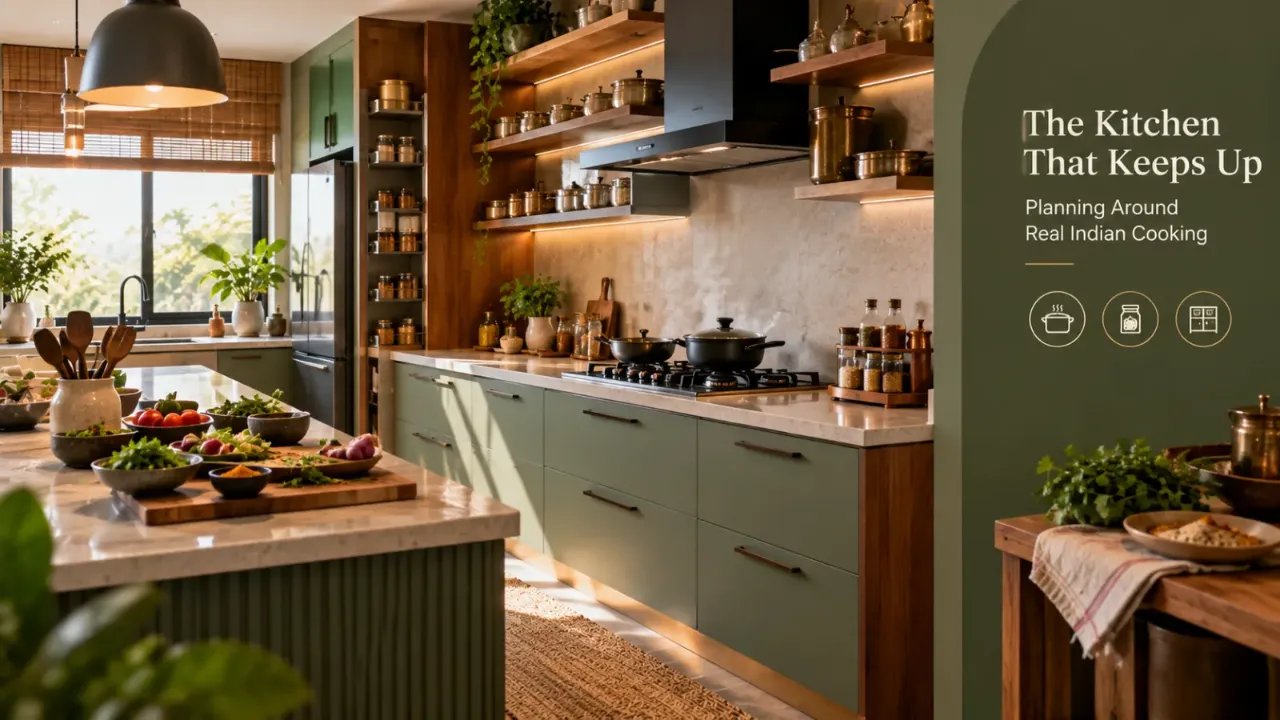
The Kitchen That Keeps Up: Planning Around Real Indian Cooking
A kitchen can look perfectly organised in a showroom and still become frustrating once real cooking begins.
The pressure cooker comes out. The mixer-grinder needs a plug. Three different containers are needed for ingredients. Another container is needed for leftovers. Suddenly, the beautiful kitchen has become a game of moving things around.
This is why kitchen planning should start with how you actually cook, not just how you want the kitchen to look.
- Start With the Things You Actually Use
- Make Frequently Used Items Easy to Reach
- Plan a Specific Home for the Pressure Cooker
- The Mixer-Grinder Needs Its Own Thinking
- Give the Mixer a Proper Electrical Point
- Your Containers Need a System
- Store Containers Based on Their Shape
- Think About Where Containers Are Filled
- Plan the Counter Around Activities
- Keep a Clear Landing Zone
- Keep Frequently Used Ingredients Close
- Give the Spice Box Its Own Zone
- Plan for Oil Bottles
- Design Storage Around Weight
- Do Not Put Every Appliance Away
- Plan for Jars and Accessories
- The Sink Zone Needs Its Own Logic
- Plan for Drying, Not Just Washing
- Make the Refrigerator Part of the Workflow
- Design for Two People, Not Just One
- Think About Noise and Location
- Ventilation Matters With Heavy Cooking
- Do Not Forget the Lids
- Plan Drawers for What Goes Inside Them
- Use Vertical Space Carefully
- Create a Reset Zone
- Common Indian Kitchen Planning Mistakes
- A Better Way to Design the Kitchen
- A Practical Kitchen Planning Formula
- Design Around Your Habits
- FAQ
Start With the Things You Actually Use
Before planning cabinets, make an inventory of the equipment and containers you use regularly.
- Pressure cookers
- Mixer-grinder
- Kadai
- Tawa
- Saucepan
- Large cooking vessels
- Spice boxes
- Oil bottles
- Grain containers
- Food-storage containers
- Lunch boxes
- Serving bowls
- Strainers
- Chopping boards
- Jars
Then separate them into three groups: used every day, used regularly and used occasionally.
The Most-Used Items Should Be the Easiest to Reach
A common storage mistake is giving the same amount of accessibility to everything.
A pressure cooker used almost daily should not be buried behind rarely used serving dishes. A mixer-grinder should not need to be lifted over three other appliances every morning.
Regular Use → Convenient Access
Occasional Use → Higher, Deeper or Less Accessible Storage
1. Plan a Specific Home for the Pressure Cooker
Pressure cookers are often underestimated during kitchen planning because their footprint looks manageable when empty.
But real use involves more than storage. You need room to take the cooker out, fill it, place it on the hob, open it safely after cooking, let it cool, wash the vessel and store the lid and accessories.
If you use pressure cookers of different sizes, plan for all of them rather than only the one you use most often.
2. The Mixer-Grinder Needs Its Own Thinking
The mixer-grinder has the base unit, jars, lids and the ingredients being prepared. This means storing the machine as a single object is not enough.
A good setup should make it easy to access the appliance, connect power, place the jar, work around the machine, store the jars securely and clean the area afterward.
3. Give the Mixer a Proper Electrical Point
A mixer-grinder should not have to rely on a loose extension wire stretched across the counter.
Before finalising the kitchen, identify where the mixer will normally be used and plan the socket position around the appliance's actual location.
4. Your Containers Need a System, Not Just a Cabinet
Containers are among the biggest sources of kitchen clutter because they multiply easily.
Different sizes, shapes, materials, lids and uses can quickly turn one cabinet into a storage problem.
Think about body storage, lid storage, tall-container storage, small-container storage, daily-use containers and occasional-use containers.
5. Store Containers Based on Their Shape
Store where there is enough vertical height and easy access without hitting the shelf above.
Use drawers or lower shelves where they can be seen and reached without digging.
Give lids their own organised zone instead of mixing them randomly with container bodies.
Keep the most frequently used sizes in the easiest-to-reach storage.
6. Think About Where the Containers Are Filled
Storage and workflow should be connected.
Where do you fill containers? Where do you measure rice? Where do you transfer cooked food? Where do you pack lunch? Where do you store leftovers?
The storage should support the sequence rather than interrupt it.
7. Plan the Counter Around Activities
One long counter does not automatically equal a good kitchen counter.
Space for chopping, sorting, measuring and preparing ingredients.
Space around the hob for cookware, ingredients and cooking activity.
Space for frequently used equipment such as a mixer-grinder.
A clear surface for hot vessels, groceries, plates and temporary placement.
8. Keep a Clear Landing Zone
A landing zone is simply a clear section of counter where you can temporarily place something.
A hot pan. A pressure cooker. A serving bowl. Groceries. A plate. A kettle.
Without a landing zone, everything ends up being placed on top of something else.
9. Keep Frequently Used Ingredients Close to Where They Are Used
The same logic applies to ingredients.
Spices near the cooking zone. Oil near the hob. Cutting boards near the preparation area. Frequently used containers near the storage or packing zone.
The kitchen should follow the way your hands move.
10. The Spice Box Deserves Its Own Zone
A spice box may be opened multiple times during one cooking session.
That means it should not be stored in a difficult-to-reach cabinet. A shallow drawer, nearby shelf or dedicated pull-out zone can make more sense depending on the layout.
11. Oil Bottles Are Small but Awkward
Oil bottles are tall, frequently used and often heavy when full. They also need to be positioned conveniently near the cooking area.
A narrow pull-out or dedicated bottle zone can sometimes make more sense than a deep cabinet where the bottles disappear behind other items.
12. Design Storage Around Weight Too
Not everything that is frequently used should go in the same kind of cabinet.
Heavy cookware, large pressure cookers, cast-iron cookware, serving vessels and bulk food containers can become inconvenient when stored overhead.
13. Do Not Put Every Appliance Away
Hidden storage looks attractive, but an appliance used several times a day may not benefit from being completely concealed.
Consider easy-access or dedicated counter zones.
Keep accessible, but they do not necessarily need permanent counter space.
Store them in closed cabinets or higher-access storage where practical.
Reserve less accessible storage for things used only occasionally.
14. Plan for the Jars and Accessories Too
A mixer-grinder becomes inconvenient when its jars are stored separately from the machine.
The same applies to blender jars, food processor attachments, measuring cups, strainers, hand-blender accessories, spare blades and appliance lids.
Storage should reflect the complete appliance system.
15. The Sink Zone Needs Its Own Logic
The kitchen sink is connected to both cooking and cleaning.
You may wash vegetables, rinse containers, wash the pressure cooker, clean mixer jars and drain cooked food.
Frequently washed items should have a practical path to drying and storage.
16. Plan for Drying, Not Just Washing
A kitchen can have a perfectly designed sink and still fail immediately after cooking.
Where do wet utensils go? Where do washed containers drain? Where does the pressure cooker dry? Where do mixer jars sit?
A dish rack, drain board, open drying area or dedicated drying arrangement should be considered as part of the kitchen plan.
17. Make the Refrigerator Part of the Workflow
Think about the refrigerator as part of the cooking sequence.
The exact sequence depends on the household, but frequently accessed ingredients should not require crossing the entire kitchen while another person is cooking.
18. Design for Two People, Not Just One
A kitchen can work beautifully when empty and become chaotic when two people enter.
One person is chopping. One is cooking. Someone opens the refrigerator. The mixer is running. A cabinet door is open.
19. Think About Noise and Location
A mixer-grinder is also a noisy appliance. Where you place it can affect the rest of the home.
If the kitchen opens directly into the living room, consider whether the mixer will be used during times when other people are watching television, working or resting.
The layout cannot remove the appliance noise entirely, but it can help make its use less disruptive.
20. Ventilation Becomes More Important With Heavy Cooking
Indian cooking can involve frying, tempering, boiling and pressure cooking. This can create heat, moisture, smoke and strong aromas.
A kitchen planned around real cooking therefore needs appropriate ventilation.
- Hob location
- Chimney or exhaust arrangement
- Window placement
- Cross ventilation
- Heat movement
- Relationship between cooking and dining areas
21. Do Not Forget the Pressure Cooker Lid
The cooker itself gets planned. The lid gets ignored.
The same problem can happen with pan lids, container lids, mixer lids and appliance attachments.
Small irregular objects often create more storage frustration than large ones.
22. Plan Drawers for What Actually Goes Inside Them
A drawer is not automatically better storage. Its height and depth should match its contents.
Useful for spices, small containers, cutlery and kitchen tools.
Better suited to pressure cookers, kadai, heavy pans and large vessels.
Do not design a generic drawer system and expect every object to fit comfortably.
23. Use Vertical Space Carefully
Upper cabinets can be useful for less frequently accessed items.
But high storage should not become the default location for everyday objects. Frequently used pressure cookers, daily containers or heavy appliances should not require climbing or excessive stretching.
24. Create a “Reset Zone”
After cooking, the kitchen needs to return to a usable state.
Where do the dirty utensils go? Where do leftovers go? Where are the containers stored? Where does the mixer go? Where does the pressure cooker go?
A well-planned kitchen makes resetting easier.
25. Common Indian Kitchen Planning Mistakes
- Designing for photographs instead of cooking: A visually clean kitchen may still be difficult to use when all the real equipment is present.
- Hiding every appliance: Frequently used appliances may become irritating when they have to be unpacked every day.
- Creating storage without usability: Large storage spaces are not helpful when their contents are difficult to access.
- Forgetting container lids: Containers and their lids need to be considered as one storage system.
- Ignoring appliance electrical points: Mixer-grinders and other appliances should have convenient connections where they are actually used.
- Forgetting the countertop: A plan can look generous while appliances and daily-use items eventually occupy most of the available work surface.
- Ignoring different cooking periods: Breakfast, lunch preparation, dinner and cleaning can place different demands on the same kitchen.
26. A Better Way to Design the Kitchen
Start with the workflow. Then list the objects. Then assign storage. Then assign counter zones. Then assign electrical points. Then check movement.
Only after that should you refine the appearance.
27. A Practical Kitchen Planning Formula
Frequency → How often do you use it?
Location → Where is it used?
Access → How easily should it be reached?
Workflow → What comes before and after it?
Clearance → What space does the activity require?
Storage → Where does everything return after use?
28. The Best Kitchen Is Designed Around Your Habits
There is no single perfect Indian kitchen.
Some households use pressure cookers every day. Some rely heavily on mixer-grinders. Some store large quantities of grains and ingredients. Some use dozens of containers.
Some households cook once a day. Others cook multiple meals from scratch. Some have one person cooking. Others have two people working together.
Identify what you use regularly and where each appliance is normally operated.
Group them by frequency, shape, size and purpose.
Consider the amount of preparation, grinding, frying, pressure cooking and storage your meals require.
Plan for the number of people who cook, clean and move through the kitchen.
Your kitchen should respond to those habits.
What a Kitchen Inventory Should Tell You
Before finalising your kitchen, create a practical inventory.
Cookware → Pressure cookers, kadai, tawa, pans and vessels
Ingredients → Spices, grains, oils and frequently used items
Containers → Daily-use, storage, lunch and leftover containers
Accessories → Lids, attachments, strainers and tools
Cleaning → Sink, drying and cleaning supplies
Once you see everything together, cabinet planning becomes much easier.
Design Your Kitchen Around the Way You Cook
A better kitchen starts with understanding your space, your storage needs and the way you actually use it every day.
Final Thought
The best kitchen storage is not the storage that holds the most things.
It is the storage that puts the right thing in the right place at the right time.
A pressure cooker needs more than a cabinet. A mixer-grinder needs more than a shelf. Containers need more than empty space.
They need to fit into the workflow of your actual cooking.
When the kitchen is planned around those everyday realities, cooking becomes less about moving things around and more about simply getting on with the meal.
FAQ
Store frequently used pressure cookers in easily accessible lower storage or drawers where their weight can be handled comfortably. Also consider where the lids and accessories will go.
If it is used frequently, consider a dedicated counter or appliance zone with a convenient electrical point and enough room for the base, jars and accessories.
Separate container bodies and lids where useful, group containers by size and shape, and keep the most frequently used ones in the easiest-to-access storage.
No. Appliances used several times a day may be more practical in a dedicated easy-access zone, while occasional appliances can be stored away.
The required amount depends on kitchen size and cooking habits. What matters is keeping enough uninterrupted work surface for preparation, cooking, appliance use and temporary placement of utensils.
Make an inventory of appliances, cookware, ingredients, containers and accessories, then map where each item is used and how frequently it needs to be accessed.
Separate key activities where possible, provide adequate circulation and avoid placing major appliance, cabinet and drawer openings directly in the busiest movement paths.
Turn this idea into a plan for your home
Visualise your space, understand the likely budget, or find a professional who can bring the idea to life.