
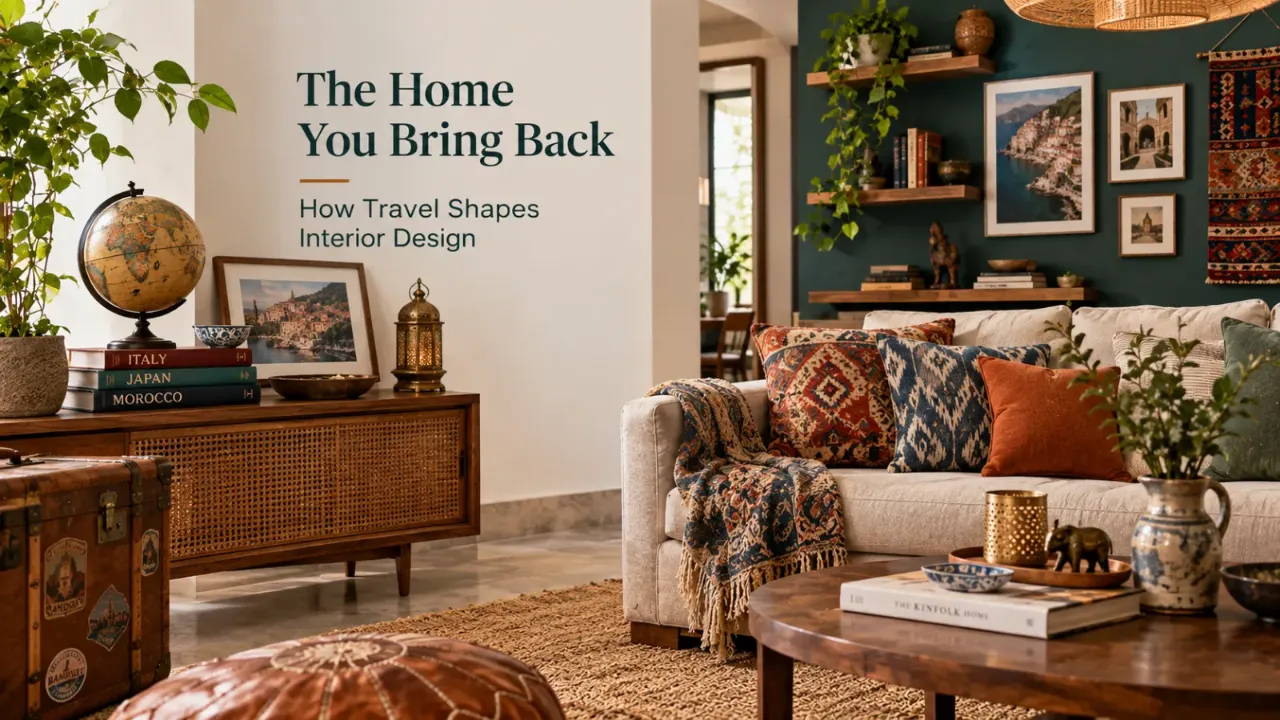
The Home You Bring Back: How Travel Shapes Interior Design
Travel changes more than your camera roll. Sometimes it changes the way you see your own home.
You notice how a hotel uses warm lighting. You remember the colour of a Mediterranean wall. You notice the quiet luxury of a Japanese room. You remember the texture of a Moroccan rug.
Then you return home and realise that your idea of what a room should feel like has changed.
- Travel Influences Interiors Through Experience
- Start With a Feeling, Not a Country
- How Travel Can Change Your Colour Choices
- Architecture Can Change What You Want From Home
- What Hotels Teach Us About Comfort
- Small Details Can Become Big Ideas
- Materials Can Bring Back a Memory
- Do Not Turn the Home Into a Theme
- Use One Strong Memory
- Give Souvenirs a Role
- Build a Collection Slowly
- How Travel Influences Furniture Preferences
- Travel Can Change Your Idea of Luxury
- Indoor-Outdoor Living Lessons
- How Travel Can Influence Lighting
- Approaching Cultural Influence Thoughtfully
- Bring Back Craftsmanship
- Let Travel Change Your Relationship With Imperfection
- Reconsider What You Display
- Why Personal Memories Matter More
- Create a Travel Palette
- Let Your Own Home Lead
- Travel Can Change Your Space-Planning Priorities
- Do Not Copy the Photograph
- Common Travel-Inspired Interior Mistakes
- A Travel-to-Home Design Framework
- A Room-by-Room Approach
- FAQ
Travel Influences Interiors Through Experience, Not Just Souvenirs
When people think about travel-inspired interiors, they often imagine souvenirs: a ceramic piece, woven basket, framed photograph or decorative sculpture.
These can certainly become part of a home. But travel can influence design much more deeply.
- Colour
- Material
- Lighting
- Furniture
- Spatial planning
- Patterns
- Landscaping
- Texture
- Privacy
- Connection to the outdoors
The most personal travel-inspired interiors are often not the ones with the most souvenirs. They are the ones where a travel experience has changed the way the homeowner wants to live.
Start With a Feeling, Not a Country
One of the easiest ways to make travel influence your home tastefully is to avoid starting with a destination.
Instead, start with the feeling you remember.
Think sunlight, earthy materials and layered textures.
Think soft colours, quiet materials and uncluttered spaces.
Think deeper colours, contrast and stronger lighting moments.
Think daylight, lighter surfaces and stronger connections to the outdoors.
You may not actually want a “Greek-style home.” You may simply love the combination of pale walls, natural textures, sunlight and deep blue accents you experienced on a trip.
1. Travel Can Completely Change Your Idea of Colour
Colour is often one of the first things people bring back from travel without realising it.
A city may introduce you to a combination you had never considered at home.
Cobalt + Sand
Deep Green + Warm Wood
Ivory + Muted Blue
A travel memory can become the starting point for a new home palette. Rather than recreating an entire destination palette, isolate the one or two colours that actually stayed with you.
2. Architecture Can Influence What You Want From Your Own Home
Travel exposes us to different ways of planning buildings.
- Courtyards
- Shaded verandas
- Deep windows
- Arched openings
- Sliding screens
- High ceilings
- Indoor-outdoor rooms
- Layered thresholds
- Built-in seating
These experiences can change what you think is possible in your own home.
You may return from a trip wanting more connection with the outdoors, or realise that you enjoy smaller, more enclosed spaces for reading and resting.
3. Hotels Often Change Our Expectations of Comfort
Staying somewhere new gives you an unusually concentrated experience of interior design.
You notice things you may overlook at home: bedside lighting in the right place, curtains that filter light well, a proper place for luggage, useful bathroom storage and seating positioned around a view.
You may not want to copy the hotel furniture. You may simply want to bring back the level of thoughtfulness.
4. Travel Teaches You That Comfort Can Come From Small Details
A hook in the right place or a bench near the entrance can make a room easier to use.
Reading light, charging access and useful surfaces can change the experience of a bedroom.
Concealed compartments and well-planned storage can make functionality feel effortless.
A shaded seat or well-positioned outdoor area can turn leftover space into a retreat.
5. Materials Can Bring Back a Memory
Some travel memories are tactile.
You remember the coolness of stone, the warmth of timber, the softness of linen, the texture of woven cane or the irregularity of handmade ceramic tiles.
Materials can therefore become emotional reminders of a place.
You do not have to use the exact material. You can interpret it through another material with a similar visual or tactile quality.
6. Do Not Turn the Home Into a Theme Park
This is where travel-inspired design can easily go wrong.
You visit a Moroccan riad and fall in love with arches, patterned tiles, brass lanterns and jewel tones. Then you bring all four into one room.
Suddenly the room feels like a theme.
The problem is not cultural inspiration. The problem is literal replication without context.
7. Use One Strong Memory and Let the Rest Stay Quiet
A better approach is to choose one or two elements from a travel experience and let them influence the room.
- A deep blue from a coastal trip
- A textured rug inspired by a market
- A handcrafted lamp
- A wood tone remembered from a traditional home
- An earthy colour from an old city
- A sculptural object
That single influence can sit comfortably inside a contemporary home. The result feels collected rather than themed.
8. Souvenirs Work Best When They Have a Role
Not every travel object needs to become decorative clutter.
A ceramic bowl can be used. A woven textile can become a cushion. A hand-carved tray can sit on a coffee table. A framed textile can become wall art.
The object becomes part of everyday life rather than sitting in a corner labelled “travel.”
9. Build a Collection Slowly
Travel-inspired interiors often become more beautiful over time.
One trip gives you one object. Another gives you a colour. Another changes your lighting preferences. Another introduces you to a new form of craftsmanship.
Together, these memories can gradually form the personality of the home.
10. Travel Can Influence Furniture Preferences
You may return from a trip noticing that you prefer low seating, deep lounge chairs, compact side tables, built-in benches, rounded furniture, lightweight chairs, large dining tables or minimal bedside tables.
The useful question is:
Shape? Comfort? Height? Conversation? Proportion? Relationship with the room?
That answer is more useful than simply buying a similar-looking product.
11. Travel Can Change Your Definition of Luxury
In one place, luxury may feel like polished stone, dramatic lighting and rich fabrics. In another, it may feel like quiet materials, natural light, handmade objects and space.
Attention to making and detailing becomes part of the experience.
Generous negative space can feel as luxurious as decorative richness.
Well-considered seating, lighting and everyday functionality can define premium living.
Timber, stone, linen and other tactile materials can create a quieter kind of luxury.
12. Travel Changes How You Think About Indoor-Outdoor Living
A memorable resort, courtyard home or terrace can make the boundary between indoor and outdoor space feel very different.
You may return wanting your own balcony, terrace, garden or courtyard to become a more intentional part of the home.
The idea can be adapted to scale. Even a small balcony can become a meaningful retreat when it is treated as part of the home rather than leftover space.
13. Travel Can Influence How You Use Light
A memorable place is often remembered partly because of its light.
Warm restaurant lighting, soft hotel bedside lamps, sunlight through shutters, lanterns in an old market or strong shadows across stone walls can all influence how you think about lighting at home.
The travel memory becomes a lesson in atmosphere rather than something you have to reproduce literally.
14. Cultural Influence Should Be Approached With Context
Travel can expose homeowners to design traditions from different cultures.
The most thoughtful way to bring those influences home is to understand what specifically attracted you to them.
- Craftsmanship
- Proportion
- Material
- Colour
- Pattern
- Spatial planning
- Connection to climate
This is better than collecting visual symbols simply because they look exotic.
15. Bring Back Craftsmanship, Not Just Decoration
One of the strongest things travel can teach you is how much character comes from handmade work.
- Slightly irregular ceramics
- Handwoven fabrics
- Carved wood
- Hand-finished metal
- Local stone
- Traditional joinery
You do not need dozens of handmade pieces. Even one or two carefully selected objects can add an important layer.
16. Travel Can Change Your Relationship With Imperfection
Travel exposes you to places where irregularity is part of the beauty.
Tiles may vary slightly. Plaster may not be perfectly smooth. Wood may show grain variation. A handmade object may not be perfectly symmetrical.
These qualities can make an interior feel less manufactured and more individual.
17. Travel Can Influence How Much You Want to Display
Some homes you visit may be highly decorative. Others may have almost nothing visible.
A trip can therefore make you reassess your own display habits.
Keep only the pieces that add real character or meaning.
Let travel memories become intentional focal points.
Use selected shelves or niches for objects worth seeing.
Allow the rest of life to disappear when you want visual calm.
18. The Best Travel-Inspired Interiors Are Personal
There is a major difference between “I like this style” and “I remember how I felt in this place.”
The second creates a stronger design story.
Maybe the home reminds you of a quiet hotel morning, a dinner under warm lights, a slow afternoon in a courtyard, a mountain lodge filled with timber and stone, or a coastal room full of daylight.
These memories can become design cues.
19. Create a “Travel Palette” Instead of a Souvenir Shelf
One useful exercise is to create a small visual palette from your journeys.
Then ask how those elements could live inside your existing home.
This creates a design direction without forcing the entire room to imitate a destination.
20. Let the Architecture of Your Own Home Lead
Travel inspiration should always be filtered through the house you actually have.
A dark apartment cannot become a sun-filled Mediterranean villa simply through paint. A compact bedroom cannot reproduce the proportions of a large resort suite.
The better approach is adaptation.
21. Travel Can Influence Your Space-Planning Priorities
Sometimes the biggest change is not decorative at all.
- More concealed storage
- A better entrance
- A proper reading corner
- A more comfortable bedroom
- A clearer kitchen workflow
- Better privacy
- A larger dining surface
- A more useful balcony
- A better work-from-home zone
The trip has therefore changed your priorities. That is one of the most meaningful ways travel can improve a home.
22. Do Not Copy the Photograph; Remember the Experience
A travel photograph captures appearance. Your memory captures experience.
A room photographed in a hotel may look beautiful because of the furniture, but perhaps what you actually loved was waking up to soft light and seeing trees outside.
You do not need to buy the same bed. You need to understand what made that room memorable.
Light? View? Quiet? Material? Scale? Layout? Privacy? Atmosphere?
Once you know that, you can design for the experience instead of copying the image.
23. Common Travel-Inspired Interior Mistakes
- Reproducing an entire destination: Too many literal references can make a room feel themed.
- Buying too many souvenirs: Objects need a design context rather than simply filling shelves.
- Mixing unrelated influences: Several strong travel references can compete when there is no shared visual language.
- Ignoring your own architecture: A travel aesthetic still has to work with the proportions, light and layout of your home.
- Using cultural motifs without understanding the appeal: It is more meaningful to translate craftsmanship, material or spatial principles than to collect symbols purely for decoration.
- Over-curating: The best travel-inspired homes often feel collected over time rather than designed in one shopping trip.
24. A Practical Travel-to-Home Design Framework
Identify → Was it colour, material, light, space, craft or atmosphere?
Translate → How could that quality work in your own home?
Edit → Choose one or two strong references instead of copying everything.
Adapt → Adjust the idea to your home's architecture, climate and lifestyle.
Personalise → Combine the travel influence with things already meaningful to you.
25. A Room-by-Room Way to Bring Travel Home
Use a travel-inspired colour, textile, artwork or furniture shape while keeping the layout grounded in everyday life.
Borrow the atmosphere of a favourite hotel through softer lighting, layered bedding, calm colours and better bedside functionality.
Recreate the warmth of a memorable restaurant through lighting, table setting, materials or seating arrangement.
Turn a small outdoor area into a personal retreat inspired by a place where you enjoyed slowing down.
Build a Home That Remembers Where You've Been
The most interesting homes are not necessarily the ones that follow one design style perfectly.
They are the ones that reveal something about the people who live there.
Travel can help with that.
A colour from one city. A fabric from another. A lighting idea from a hotel. A piece of craftsmanship from a market. A furniture preference discovered in a café.
None of these has to dominate the interior. Together, they can quietly create a home that feels collected rather than manufactured.
Turn Inspiration Into Your Own Interior
Travel can give you ideas, but your home still needs to respond to your space, lifestyle and everyday routines. Explore your room and start translating inspiration into something personal.
Final Thought
Travel does not have to tell you exactly what your home should look like.
It can simply teach you what you love.
Maybe it is the calm of a minimal room, the warmth of a small restaurant, the texture of handmade materials, the drama of a colour combination or the way a space connects with the outdoors.
Those experiences can become design choices once you understand what actually stayed with you.
The goal is not to recreate the place you visited.
It is to bring back the feeling, translate it through your own home's architecture and combine it with your own life.
That is when travel stops being inspiration on a mood board and becomes part of the story your home tells.
FAQ
Travel can influence colour preferences, materials, lighting, furniture, layouts, patterns, craftsmanship and the way homeowners think about comfort and space.
Choose one or two qualities from the experience, such as a colour, material, lighting mood or furniture shape, and adapt them to your existing home instead of copying an entire destination style.
Yes. Souvenirs can become meaningful parts of an interior when they are intentionally placed, useful, visually compatible or connected to an important memory.
Hotels can reveal useful ideas about lighting, bedside functionality, storage, seating, privacy, comfort and the small details that make a space feel effortless.
Yes. A memorable destination can introduce new colour combinations or inspire a new accent colour. The most successful approach is usually to adapt a few remembered colours rather than copy the entire destination palette.
Identify what you remember most strongly—light, colour, material, atmosphere, furniture, architecture or texture—then translate that quality into a design element that suits your own home's size and lifestyle.
You can, but the influences should have some relationship through colour, material, scale, mood or overall design language. Otherwise the room can feel visually disconnected.
Turn this idea into a plan for your home
Visualise your space, understand the likely budget, or find a professional who can bring the idea to life.