
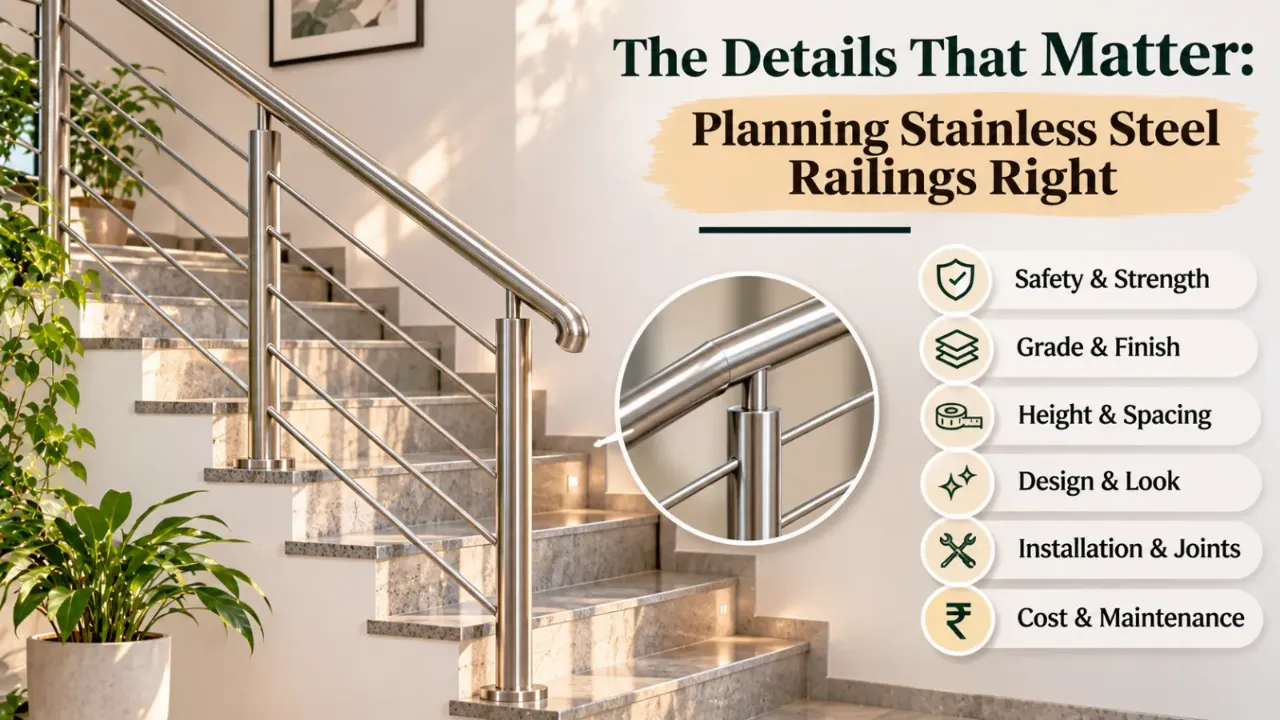
The Details That Matter: Planning Stainless Steel Railings Right
Stainless steel railings are popular in modern Indian homes because they offer a clean appearance and can work across staircases, balconies, landings and terraces. Their simple lines can complement glass panels, wooden elements and contemporary interiors without making a space feel visually heavy.
But a good-looking S S railing design is not created by choosing a pattern from a catalogue alone. Material grade, measurements, fabrication quality, joint detailing and installation all influence how the finished railing performs.
Some mistakes become visible only after installation. Others may affect stability, safety or long-term maintenance. Planning these details early can help avoid unnecessary rework and unexpected costs.
Here are the important mistakes to avoid before approving an S S railing for your home.
1. Choosing Stainless Steel Without Checking the Grade
One of the most common mistakes is accepting a quotation that simply says “stainless steel” without specifying the grade.
Different stainless steel grades have different properties and levels of corrosion resistance. The appropriate choice depends on where the railing will be installed and the conditions it will face.
For example, an indoor staircase in a relatively dry environment may have different requirements from an outdoor balcony exposed to rain, humidity or pollution.
Before approving the material, ask for:
- The exact stainless steel grade.
- Material documentation or a test certificate, where applicable.
- The specified thickness and section dimensions.
- Suitability for the installation environment.
- Details of the finish and maintenance requirements.
Do not assume that a shiny surface proves the quality or grade of the steel.
2. Selecting the Design Before Taking Proper Measurements
A railing pattern may look attractive in a reference image, but it still needs to fit the actual site.
Measurements should account for the staircase slope, floor levels, landing dimensions, wall positions, edge conditions and available fixing points. Even a small measurement error can create alignment problems during installation.
Before fabrication begins, confirm:
- Total railing length and height.
- Staircase angle and changes in level.
- Post and support locations.
- Wall clearances and corner conditions.
- Glass or infill panel dimensions, if included.
- Any site constraints that may affect installation.
The final measurements should be checked at the site after relevant civil and flooring work has reached the appropriate stage. Avoid fabricating solely from approximate drawings or verbal dimensions.
3. Treating Pipe Thickness and Section Size as Decorative Choices
A slim railing can look elegant, but the dimensions of its components should never be selected only for appearance.
The required section sizes and thicknesses depend on the railing configuration, span, support arrangement, intended use and design loads. An underspecified component may affect stiffness and stability.
Ask the designer or fabricator to provide a clear material and component schedule. The structural professional should verify that the proposed arrangement is suitable for the site and applicable requirements.
A visually light design should still feel secure and perform as intended.
4. Ignoring the Quality of Joints and Welding
The joints are among the most important parts of a stainless steel railing. Poor welding, uneven finishing or inconsistent connections can affect both appearance and durability.
Look out for:
- Uneven or visibly rough welds.
- Gaps or inconsistent connections.
- Discolouration around welded areas.
- Sharp edges or unfinished corners.
- Poorly aligned handrail joints.
- Visible differences between fabricated sections.
Ask how the fabricator will finish and clean welded areas. The method should be appropriate for the specified stainless steel and should not leave the surface vulnerable to corrosion.
Inspect a sample or a completed section before approving large-scale fabrication.
5. Choosing a Finish Without Considering Maintenance
Mirror, brushed and satin finishes create different visual effects. The right choice depends on the location, surrounding materials and the amount of cleaning the homeowner is comfortable with.
A mirror finish reflects more light and can look polished, but fingerprints and smudges may be noticeable. A brushed or satin finish can create a more understated appearance, though it still requires suitable cleaning.
Before selecting a finish, consider:
- Whether the railing is indoors or outdoors.
- Exposure to dust, rain and humidity.
- How visible fingerprints and water marks will be.
- Whether the finish can be maintained with locally available products.
- Whether the same finish can be consistently matched across all sections.
Do not choose a finish based only on a small showroom sample. View it in lighting conditions similar to the actual installation.
6. Overlooking the Fixing and Support Details
A railing is only as dependable as its supporting structure and connections. Choosing attractive posts and handrails without planning how they will be fixed can lead to problems on site.
The design should clearly identify whether the railing will be fixed to the floor, side of a slab, wall or another structural element.
Check the following before execution:
- The type and location of anchors or brackets.
- The condition and suitability of the supporting concrete or masonry.
- Edge distances and embedment requirements.
- Waterproofing details for exterior installations.
- Access for tightening, inspection and maintenance.
- Whether the fixing method has been checked for the expected loads.
The fixing arrangement should be verified by a qualified structural professional. Do not allow installers to make last-minute changes to anchor locations or support details without approval.
7. Forgetting About Glass and Other Infill Components
Some S S railing designs combine stainless steel with glass, cables or other infill materials. These combinations can look refined, but they need coordination before fabrication.
For glass railing systems, confirm the appropriate safety-rated glass, panel dimensions, edge treatment, support system and compatible fittings. Glass thickness and fixing requirements should be determined by the design professional.
For other infill types, check the spacing, tensioning or connection details as applicable.
Avoid finalising the steel frame first and leaving the infill dimensions to be figured out later. The two systems should be designed together.
8. Prioritising Appearance Over Safety
A railing should provide a dependable barrier and a usable handhold where required. A decorative pattern should not introduce unsafe gaps, sharp edges, climbable features or awkward transitions.
Before approving the design, check:
- Applicable railing height requirements.
- Opening and gap limitations.
- Handrail continuity and grip.
- Sharp corners and protruding fittings.
- Stability under expected loads.
- Suitability for children, older adults and regular users.
Requirements can vary by building type, location and application. A qualified architect or structural engineer should confirm the relevant local rules and approve the final design.
9. Not Coordinating the Railing With the Rest of the Space
A stainless steel railing can appear disconnected if its finish and proportions are not considered alongside the staircase, flooring, walls and other metal elements.
For a cohesive result, decide how the railing will relate to:
- Staircase material and colour.
- Floor and skirting finishes.
- Glass, wood or stone elements.
- Door and window hardware.
- Balcony or terrace railings elsewhere in the home.
- Interior lighting and the overall design style.
For example, a brushed finish may complement a restrained contemporary interior, while a polished finish can work as a brighter accent. The goal is consistency rather than matching every metal surface exactly.
10. Comparing Quotations Only by Price
Two S S railing quotations may have very different specifications even when their descriptions sound similar.
One may include a clearly stated steel grade, fabrication, finishing, transport and installation. Another may quote only a basic running-foot rate with several items excluded.
Compare the complete scope, including:
- Steel grade and material specifications.
- Pipe or section dimensions and thickness.
- Total measured length and railing height.
- Design, posts, brackets and infill components.
- Welding and surface finishing.
- Anchors, fasteners and installation.
- Transport, site handling and taxes.
- Warranty, exclusions and maintenance guidance.
Ask for a written breakdown. Compare quotations on an equivalent specification rather than selecting the lowest number.
11. Starting Fabrication Before the Site Is Ready
Fabrication too early can create avoidable complications. Flooring thickness, staircase finishes, wall plaster, cladding and other civil work may change the final dimensions or fixing conditions.
Before giving the go-ahead:
- Confirm the latest approved drawings.
- Complete the necessary site measurements.
- Coordinate with the civil and flooring teams.
- Confirm the fixing locations and supporting structure.
- Approve the material, finish and sample.
- Agree on the installation sequence.
A final site check before fabrication can prevent mismatched dimensions, unnecessary cutting and patchwork adjustments.
12. Skipping the Final Inspection
The work is not complete simply because the railing has been installed. A final inspection helps identify defects before the contractor closes the job.
Check for:
- Loose or unstable sections.
- Misaligned posts and handrails.
- Uneven gaps or inconsistent spacing.
- Rough welds and sharp edges.
- Scratches, stains or damaged finishes.
- Incomplete fixing and finishing work.
- Poor transitions at corners, landings and ends.
The completed railing should be reviewed against the approved drawings and specifications. Any required corrections should be documented and completed before final handover.
13. Plan the Rest of Your Home With Walls to Wonder
While railing dimensions, structural details and installation must be checked by qualified professionals, visualisation and budgeting tools can help you organise the wider home-design process.
- Design My Room – Explore room designs, finishes and furniture arrangements.
- Whole Home Visualizer – Explore coordinated design concepts across different areas of your home.
- Interior Design Cost Estimate – Plan an indicative interior budget before making design decisions.
- Interior Quotation Checker – Review interior quotation scope, materials, charges and exclusions.
These tools support interior planning and visualisation. They do not replace structural calculations, railing safety checks or technical approval for railing fabrication and installation.
Final Thought
A reliable S S railing design begins long before the first section is fabricated. The steel grade, measurements, section sizes, joints, finish, supports and installation sequence all need to be considered together.
Avoiding these planning mistakes helps create a railing that looks consistent with the home while meeting its practical and safety requirements. Take time to approve the specifications, inspect the workmanship and have the structural details checked before execution.
Frequently Asked Questions
1. Which stainless steel grade is suitable for home railings?
The appropriate grade depends on the installation location, exposure to moisture and other environmental conditions. Ask the supplier to specify the grade and provide supporting material documentation.
2. What should I check before approving an S S railing quotation?
Check the steel grade, section dimensions, thickness, finish, fabrication details, fixing method, installation scope, taxes, exclusions and warranty.
3. Which finish is better for stainless steel railings?
Brushed, satin and mirror finishes can all work. The choice depends on the desired appearance, lighting, location and cleaning expectations.
4. Can stainless steel railings be used outdoors?
They can be used outdoors when the material grade, finish, connections and installation details are suitable for the exposure conditions. Maintenance should also be planned.
5. Why should railing measurements be taken after site work?
Flooring, plaster and other finishing work can change the final dimensions and fixing positions. A site measurement at the appropriate stage helps reduce fabrication and installation errors.
6. Should a structural professional check an S S railing?
Yes. The support arrangement, connections, dimensions and expected loads should be reviewed by a qualified professional to confirm that the railing is suitable for its intended use.
Turn this idea into a plan for your home
Visualise your space, understand the likely budget, or find a professional who can bring the idea to life.