
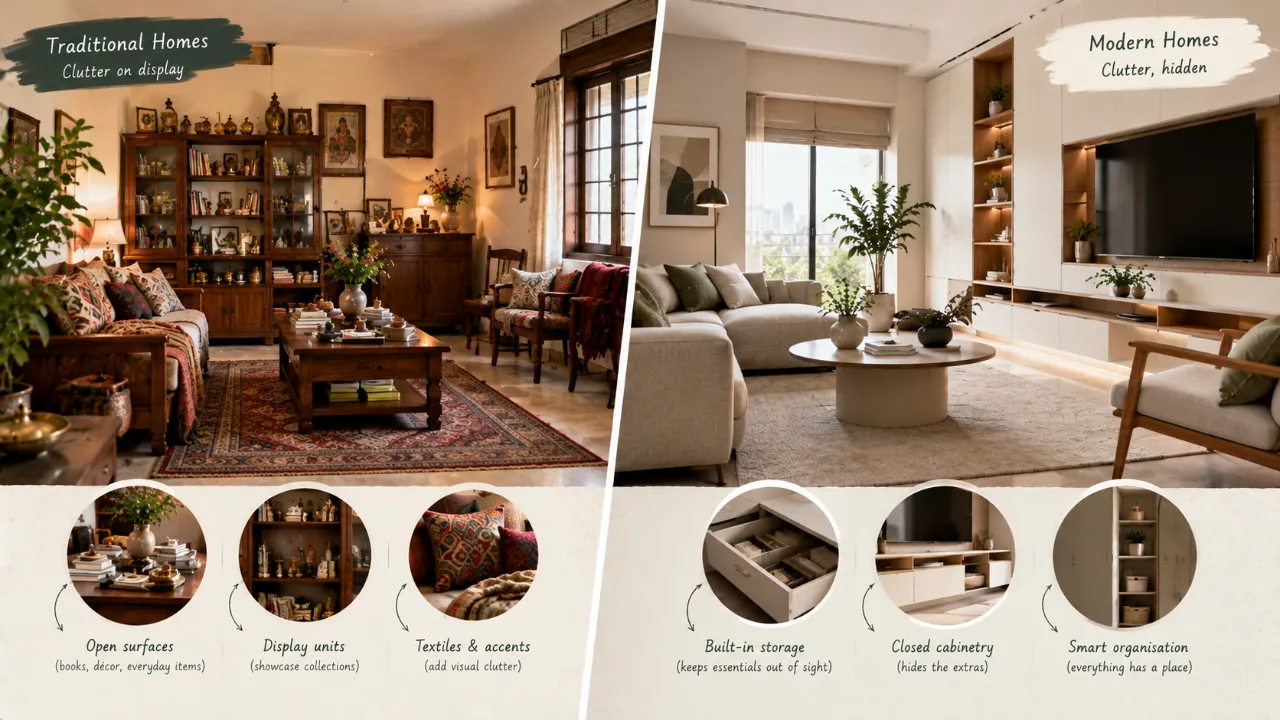
The Clutter Question: How Modern and Traditional Homes Differ
Clutter is often treated as a simple organisational problem. But clutter is also a design question. Every home has objects that need to remain visible, objects that can be hidden and objects that naturally accumulate where people use them.
What changes is how the interior design responds to those objects.
Modern and traditional homes can both be organised and beautiful, but they often approach visibility differently.
A modern interior may aim to reduce visual noise through concealed storage, cleaner surfaces and fewer competing elements. A traditional interior may allow more objects to remain visible, using furniture, shelves, niches, textiles and decorative elements to create a layered environment.
- Clutter Is Not the Same as Having Many Things
- How Modern Design Reduces Visual Noise
- How Traditional Interiors Use Display
- The Different Role of Storage
- Open Shelving and Visual Density
- How Everyday Objects Are Handled
- Furniture and Visual Complexity
- The Kitchen Example
- Living Room Clutter
- Bedroom Clutter
- Family Objects and Heirlooms
- Colour and Clutter
- Texture and Visual Richness
- Modern Clutter Mistakes
- Traditional Clutter Mistakes
- A Simple Clutter Framework
- FAQ
Clutter Is Not the Same as Having Many Things
A room can contain many objects without feeling cluttered. It can also contain very few objects and still feel visually messy.
Clutter is partly about visual organisation.
A room with books, artwork, cushions, lamps and decorative objects can feel intentional when they relate in colour, scale and placement.
A room with only a few objects can feel more chaotic when each uses a different colour, finish and style.
Modern Design Often Tries to Reduce Visual Noise
Modern interiors frequently aim for a cleaner visual field.
- Fewer objects left on open surfaces
- Larger areas of uninterrupted material
- Concealed storage
- Simpler furniture silhouettes
- Restrained colour palettes
- Fewer competing focal points
The idea is not necessarily to own fewer things. It is to make fewer things visible at the same time.
Traditional Interiors Often Treat Display as Part of the Design
Many traditional design approaches make more room for visible objects.
Books, ceramics, framed photographs, collected artefacts, textiles, decorative furniture and family pieces can become part of the interior itself.
In a well-composed traditional room, these layers can establish warmth and personality.
The organising principle is not always concealment. Sometimes it is curation.
The Key Difference Is Often What "Belongs" in View
What can be hidden so the room feels visually calm?
What is worth displaying as part of the room's character?
These are tendencies rather than fixed rules. Many contemporary traditional homes combine both approaches.
Storage Has a Different Visual Role
In a modern home, storage often tries to disappear.
Full-height wardrobes, flush cabinetry, concealed handles and continuous panels can make storage read almost like architecture.
Traditional interiors may give storage more visible presence. A chest, sideboard, display cabinet, bookshelf or console may become a furniture feature in its own right.
Open Shelving Behaves Differently in Each Approach
In a modern interior, open shelves may be lightly styled with a limited number of objects. The empty space between items becomes important.
In a traditional interior, shelving may be more densely layered with books, decorative objects, framed photographs and collected pieces.
The lesson is not that one style should always have sparse shelves. It is that shelf density should match the visual language of the room.
Modern Design Often Hides Daily-Life Evidence
Modern interiors frequently attempt to separate the visual image of the room from the practical evidence of daily life.
- Chargers disappear.
- Remote controls have drawers.
- Printers are concealed.
- Cleaning supplies move behind cabinet doors.
- Kitchen appliances are integrated.
- Technology is visually minimised where possible.
This creates a calm backdrop, but it also requires storage that is convenient enough to use every day.
Traditional Design Can Absorb Daily Objects More Naturally
In a layered traditional interior, some everyday objects may blend more easily into the overall environment.
Books on a side table, baskets beside chairs, collections on cabinets and visible textiles can become part of the lived-in character.
Furniture Plays a Major Role in Controlling Clutter
The furniture itself can either reduce or increase visual noise.
Modern furniture is often designed with simpler silhouettes and fewer visible details. Traditional furniture may introduce carved details, richer upholstery, decorative edges, patterned surfaces and more substantial forms.
A traditional room can therefore carry more visual information even before accessories are added.
Negative Space Matters More in Some Modern Interiors
Modern design often uses empty space deliberately: an open section of wall, a clear tabletop, space between furniture or a relatively empty shelf.
More layered traditional interiors may rely more heavily on rhythm, repetition and grouping.
Traditional Does Not Mean Chaotic
One of the biggest misconceptions is that a traditional home must look crowded.
A traditional interior can be extremely disciplined through symmetry, repetition, grouping, proportion, hierarchy and controlled collections.
Modern Does Not Mean Empty
The opposite misconception is that modern interiors must look almost bare.
A modern home can contain books, artwork, plants, textiles, family photographs and collections. The difference is often in how these elements are grouped and how much visual competition exists between them.
The Kitchen Shows the Difference Particularly Well
The kitchen is where everyday clutter becomes unavoidable.
Traditionally influenced spaces may allow some utensils, containers and cookware to remain visible, depending on the style and household.
Modern kitchens often aim for a cleaner work surface by moving more items behind doors, into drawers or into dedicated appliance storage.
The Living Room Needs a Clutter Strategy
Every living room accumulates objects: remote controls, books, chargers, blankets, toys, magazines and devices.
Concealed media storage, closed side tables, baskets, integrated cabinetry and limited open shelving.
Sideboards, baskets, open bookshelves, decorative boxes, trunks and display furniture.
Bedrooms Reveal the Difference Quickly
Bedrooms are especially sensitive to visual clutter because they are meant to feel restful.
A modern bedroom may prioritise clean bedside surfaces, integrated wardrobes, concealed storage and simplified bedding.
A traditional bedroom may allow more visible layering through textiles, lamps, artwork, furniture and decorative pieces.
Family Objects Change the Equation
Homes contain history: photographs, heirlooms, souvenirs, artwork, gifts and inherited furniture can carry emotional importance.
A purely conceal-everything approach does not always make sense. Traditional interiors may naturally accommodate such pieces through display cabinets, consoles, walls and shelves.
Modern interiors can accommodate them too, but may use a more selective approach—displaying fewer pieces while giving important ones more space.
Clutter Can Come From Design Inconsistency
Sometimes the problem is not quantity. It is mismatch.
- Every cabinet has a different finish.
- Handles do not match.
- Furniture comes from unrelated styles.
- Accessories use too many unrelated colours.
- Shelving proportions change constantly.
- Too many visual materials compete.
Colour Also Changes How Clutter Is Perceived
A room with ten objects in a closely related palette may feel calmer than a room with five objects in five unrelated colours.
Modern homes often use a restricted palette to reinforce visual simplicity. Traditional interiors may use richer colour combinations, but these still work best when there is some relationship between the tones.
Texture Can Make a Room Feel Rich Without Looking Messy
Traditional interiors often use layers of texture through timber, fabrics, woven materials, rugs, patterned textiles and decorative surfaces.
Modern interiors can use texture in a quieter way. A few strong material contrasts may be enough.
Visual richness does not always come from more objects. It can come from better material variation.
The Modern Approach Often Requires Better Storage Discipline
There is a hidden cost to a visually clean home: everything needs a place.
- Charging and electronics
- Cleaning supplies
- Laundry
- Paperwork
- Children's belongings
- Seasonal objects
- Kitchen appliances
- Bags and shoes
Traditional Interiors Can Use Decorative Storage
Traditional homes have another tool available: storage that is also furniture.
A sideboard stores things and contributes to the room. A cabinet displays some objects while concealing others. A trunk can provide storage while becoming part of the styling.
Common Clutter Mistakes in Modern Homes
Hiding everything without enough storage
Eventually, objects end up on counters and floors.
Creating too many closed cabinets
A room can start feeling heavy even when there is no visible clutter.
Using open shelves as display storage
Everyday items rarely look as calm as curated objects.
Designing around an empty-room image
Real homes need places for real belongings.
Common Clutter Mistakes in Traditional-Inspired Homes
Displaying everything
Collections need editing too.
Mixing too many decorative styles
Layering works best when there is a relationship between the pieces.
Filling every surface
A traditional room still needs visual pauses.
Treating storage as an afterthought
Even highly decorative rooms need practical places for everyday belongings.
A Better Way to Decide What Should Stay Visible
Objects that add personality, meaning or visual interest.
Use
Objects needed regularly and kept accessible.
Hide
Objects that are useful but visually distracting when left out.
This simple system works whether your home is modern, traditional or somewhere between the two.
Think About the Room at Two Different Times
Design for two states: the room while you are using it and the room after you are finished using it.
During cooking, studying, working or entertaining, some objects will naturally be visible. The real question is whether the room has a practical way to reset afterwards.
Design Around the Way You Actually Live
Explore room visualisation and designer resources to think through furniture, storage and styling before committing to a final direction.
Final Thought
Modern and traditional interiors do not necessarily disagree about clutter. They simply express order differently.
Modern design often creates calm by reducing what remains visible. Traditional design can create calm by organising a richer collection of visible elements.
One relies more heavily on concealment. The other can rely more heavily on curation.
But the underlying principle is the same:
A beautiful home is not one without belongings. It is one where belongings do not compete with the experience of living in the space.
FAQ
Not necessarily. Traditional interiors may display more objects, but those objects can be carefully curated and organised. Modern interiors may conceal more belongings, but they still require good storage to stay visually calm.
They frequently use concealed storage, simpler furniture, restrained palettes and fewer visible objects. The effect depends heavily on planning and storage capacity.
Absolutely. Closed cabinetry, wardrobes, drawers, sideboards and built-ins can be integrated into traditional interiors without removing their layered character.
Introduce meaningful objects, artwork, books, textiles, plants and varied materials while keeping a clear visual hierarchy.
Edit collections, group similar objects, repeat colours and materials, and deliberately leave some surfaces and wall areas quiet.
It depends on what you need to store. Open shelving works best for selected display items. Everyday clutter is generally easier to control with closed or concealed storage.
Turn this idea into a plan for your home
Visualise your space, understand the likely budget, or find a professional who can bring the idea to life.