
The Ceiling Line That Hides the Real Cost
You are reviewing an interior quotation. One line says: “False ceiling included.”
It sounds reassuring. You may assume that the entire ceiling is covered—framework, boards, finishing, lights, wiring, painting and all the details shown in the design.
But that may not be what the quotation actually means.
A quotation line this short can describe a complete ceiling package, a basic ceiling construction, or simply a limited scope that leaves several related items outside the quoted amount.
- Why “False Ceiling Included” Is Not Enough
- Start With the Area
- Ask for the Unit Rate
- Ask What Material Is Being Quoted
- Check the Framework
- Is the Finishing Included?
- What About Ceiling Paint?
- Are Light Fixtures Included?
- Ask About Electrical Wiring
- Cove Lighting Needs Extra Questions
- What Happens With Light Cut-Outs?
- Is Fan Support Included?
- Access Panels Are Easy to Forget
- What Happens at the Edges?
- Curves, Layers and Special Shapes
- What About Curtain Tracks?
- Whole Room or Design Feature?
- Site Conditions Can Change the Scope
- Ask What Is Excluded
- Compare Specifications, Not Just Prices
- Quotation Checklist
- FAQ
Why “False Ceiling Included” Is Not Enough
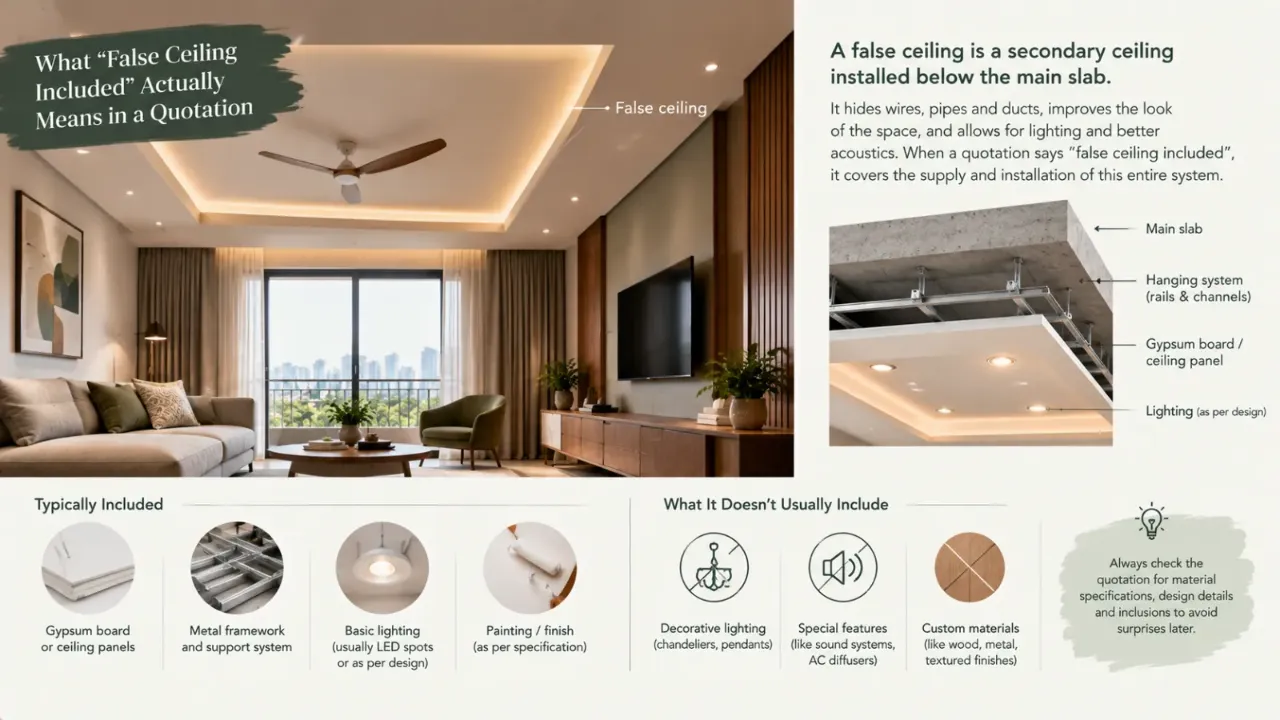
A false ceiling is not one single item.
Depending on the design, it may involve support framework, gypsum or another ceiling board, screws and fixing materials, joint treatment, edge profiles, access panels, paint, electrical provisions, light cut-outs, cove details and additional framing.
Not every quotation includes all of these.
That is why the word included needs a specification beside it.
Start With the Area
The first question should be: How much ceiling area is actually included?
A quotation may cover the full room, a partial ceiling, a perimeter border, a central feature, selected rooms or a stated square-foot area.
A full-ceiling treatment is very different from a narrow perimeter design.
Ask for the Unit Rate
Ask whether the false ceiling is priced per square foot or as a lump-sum package.
If it is a lump sum, ask what quantity and specification were used to arrive at that number.
A unit rate can make variations easier to understand later.
Ask What Material Is Being Quoted
“False ceiling” describes the type of construction, not necessarily the exact material specification.
The quotation should ideally identify what is being used, such as gypsum board, cement board, mineral fibre, metal ceiling system or another specified product.
Ask What the Framework Includes
The board is visible. The framework is not. But the support system is an important part of the ceiling.
Ask whether additional framing is included for heavy light fixtures, curtain tracks, access panels, bulkheads, cove lighting or decorative shapes.
Is the Finishing Included?
Ask whether the quoted price includes joint treatment, tape, putty, sanding, primer and final paint.
Sometimes “false ceiling” refers only to construction. Sometimes the quotation includes the finished surface.
What About the Ceiling Paint?
Paint may be included separately under the overall painting scope, included only for a standard finish or excluded from the ceiling item.
Read the quotation as a group of connected line items rather than assuming one heading covers everything around it.
Are Light Fixtures Included?
A ceiling design may show spotlights, recessed lights, pendant lights, cove lighting or profile lights.
But a drawing showing a light does not automatically mean the fixture is included in the false-ceiling price.
Ask About Electrical Wiring Separately
False ceiling work and electrical work interact closely, but they are not necessarily the same quotation item.
- Wiring to light points
- Junction boxes
- Conduits
- Drivers or power supplies
- Switches or dimmers
- Electrical shifting
- Additional circuit work
Sometimes the false ceiling quotation covers only the physical ceiling. The electrical quotation carries everything else.
Cove Lighting Needs Extra Questions
A cove may involve additional framing, profiles, wiring and lighting components.
Ask whether the cove itself, LED strip, aluminium profile, driver and installation are included.
What Happens With Light Cut-Outs?
Recessed fixtures require openings in the ceiling. Those cut-outs may or may not be covered by the quoted ceiling work.
If the design contains multiple light types or unusually shaped cut-outs, ask whether preparation and finishing are included.
Is Fan Support Included?
Ask whether the quoted scope includes the necessary support arrangement for ceiling fans, chandeliers, pendant lights and other hanging fixtures.
Access Panels Are Easy to Forget
Some services need future access. An access panel can provide a way to reach concealed equipment, connections or maintenance points without opening the entire ceiling.
Ask whether access panels are included, charged separately or excluded.
What Happens at the Edges?
The perimeter of the ceiling can contain shadow gaps, cove profiles, borders, bulkheads, curtain recesses and wall transitions.
These details can change the final quantity of work.
Curves, Layers and Special Shapes May Cost More
A straight ceiling is relatively straightforward to describe. Custom shapes are more complicated.
- Curves
- Stepped levels
- Floating panels
- Decorative cut-outs
- Geometric forms
- Recessed features
The more customised the shape, the more important the scope description becomes.
Are Curtain Tracks Part of the Ceiling?
A concealed curtain track may require a ceiling recess or specially formed pocket.
But that does not automatically mean the quotation includes the track, curtains, motors or electrical provisions.
Does the Quote Include the Whole Room or Only the Design Feature?
Sometimes a design shows a central floating panel with a plain ceiling around it. The quotation might cover only the feature.
Ask: Is the quoted area measured as the complete ceiling surface or only the designed feature?
Check the Height and Existing Ceiling Condition
False ceiling work reduces the available ceiling height.
The quotation may also depend on existing beams, pipes, service routes or other site conditions.
Site Conditions Can Change the Scope
Actual site conditions can reveal beams, uneven slabs, existing wiring, plumbing routes, AC lines, structural projections or inaccessible areas.
These may affect the ceiling design or installation process.
Ask What Is Excluded
- Light fixtures
- Electrical rewiring
- Premium profiles
- Decorative finishes
- Special paint
- Access panels
- Curtain systems
- Fan supports
- Additional framing
- Service relocation
The exact exclusions depend on the project. The important part is not to guess them.
Compare Specifications, Not Just Prices
A lower quotation may simply represent a smaller scope.
Quote B — Gypsum ceiling + finishing + paint + cove profile + integrated lighting preparation
The numbers are not directly comparable until the scope is aligned.
The Quotation Should Connect the Drawing to the Scope
If something appears important in the design but is not mentioned in the quotation, ask about it before approval.
Watch for "Standard" Without a Specification
Terms such as “standard gypsum,” “standard profile,” “standard paint” or “standard fitting” can still be vague.
Ask what “standard” means for the particular project.
Don't Assume the 3D Design Is the Contract
A 3D visual can show the intended appearance. It may not define every construction detail.
For quotation purposes, what matters is the documented scope.
The Most Important Questions to Ask
What area is included?
What material and specification are included?
Is the framework included?
Is finishing included?
Is painting included?
Are electrical points included?
Are light fixtures included?
Are cove profiles and LED lighting included?
Are cut-outs included?
Is fan or fixture support included?
Are access panels included?
Are special shapes included?
What is excluded?
A Simple False Ceiling Quotation Checklist
Material — What board or ceiling system is specified?
Framework — What support system is included?
Finish — Are joints, putty, primer and paint included?
Details — Are coves, profiles, steps and special shapes included?
Electrical — Are wiring, cut-outs and electrical preparation included?
Lighting — Are fixtures, LED strips, profiles and drivers included?
Support — Are fans and heavy fixtures accounted for?
Access — Are maintenance panels included?
Exclusions — What will be billed separately?
How to Compare Two Ceiling Quotations Fairly
When you have multiple quotes, create the same checklist for each one.
Record the area, material, framework, finishing, paint, electrical work, lighting, special details, access panels and exclusions.
Then compare like with like.
The useful comparison is not just price per square foot. It is what you are actually receiving for that price.
Planning an Interior Project?
Clear planning makes it easier to understand layouts, finishes, storage and design decisions before you commit to a quotation.
Final Thought
“False ceiling included” should never be the end of the conversation. It should be the beginning of a few very specific questions.
A ceiling is a combination of structure, material, finishing, lighting, electrical coordination and architectural details.
Before approving the number, understand the scope.
Because the cheapest-looking quotation can become expensive when the things you assumed were included start appearing as separate charges later.
A clear quotation is not just easier to compare. It makes the entire interior project easier to plan.
FAQ
Not necessarily. The quotation may cover the ceiling construction while lighting fixtures, wiring, profiles, drivers or installation are priced separately. Check the written scope.
Not always. Some quotations include complete finishing and painting, while others price painting separately. Confirm whether joint treatment, putty, primer and final paint are included.
Not necessarily. “False ceiling” is a general description. The quotation should identify the actual ceiling material or system being proposed.
The ceiling cove, LED strip, aluminium profile, driver and electrical work may all be separate items. Ask for each component to be identified.
Because two quotations can have different prices simply because they cover different quantities of ceiling work. The area makes the scope easier to compare.
Check the complete scope and exclusions. Understand the area, material, framework, finishing, electrical work, lighting-related items, special details and anything that will be charged separately.
Get a personalised estimate for your home
Choose your rooms, materials and preferences to understand a practical interior budget before you commit.