
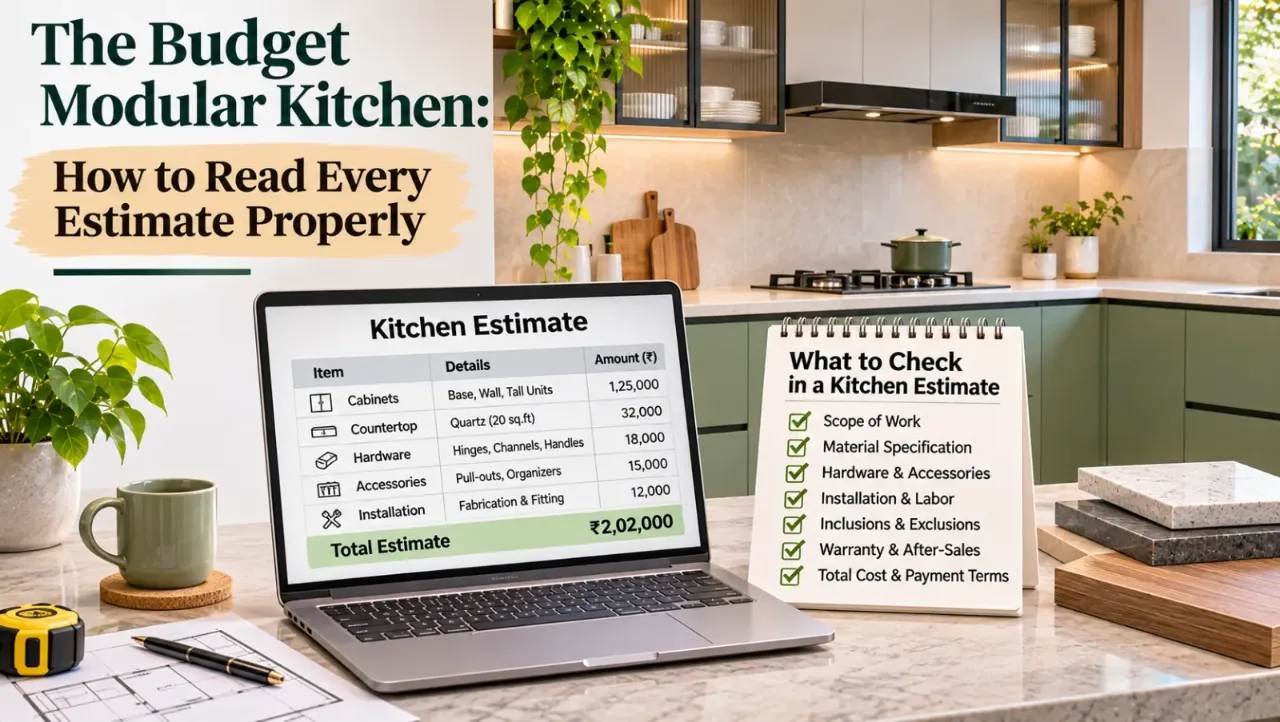
The Budget Modular Kitchen: How to Read Every Estimate Properly
A compact kitchen does not necessarily need an expensive makeover to become organised, practical and attractive. With a well-planned modular layout, suitable materials and carefully selected storage, even a limited space can work efficiently. The challenge often begins when you receive estimates from different kitchen vendors or interior designers.
One quotation may appear considerably cheaper than another, but does it include the same cabinet dimensions, materials, hardware, accessories and installation work? A lower total may simply mean that certain items have been left out or priced separately.
When planning a low budget small space modular kitchen design, comparing estimates carefully is just as important as choosing the layout. Instead of looking only at the final amount, understand exactly what each vendor is offering.
1. Give Every Vendor the Same Kitchen Requirements
Before requesting estimates, prepare a common brief. If each vendor works with different measurements or requirements, their quotations will not be directly comparable.
Share the same information with everyone:
- Kitchen dimensions and available wall lengths.
- Existing plumbing, gas and electrical point locations.
- Preferred layout, such as straight, L-shaped or parallel.
- Approximate number of base and wall cabinets.
- Storage requirements for utensils, groceries and appliances.
- Preferred finish, colour and material range.
- Appliances or accessories you expect to include.
For a small kitchen, even a minor difference in cabinet length or storage configuration can change the estimate. Ask vendors to quote against the same drawing or measurement sheet wherever possible.
Also clarify whether the measurements are preliminary or based on a final site visit. Confirm when the final measurements will be taken and how changes will affect the price.
2. Compare the Cabinet Material, Not Just the Finish
Two kitchens can look almost identical in a catalogue but have different internal construction. The visible laminate or acrylic finish does not tell you everything about the material used for the cabinet body and shutters.
Ask each vendor to specify:
- The material used for the cabinet carcass.
- The material and thickness of the shutters.
- The external finish, such as laminate, acrylic or another specified surface.
- The finish on internal and less-visible surfaces.
- Edge-banding details.
- Any moisture-resistant treatment or material specification being offered.
Do not assume that a material described as premium or waterproof has a particular performance level. Request the exact product or grade, written specification and applicable warranty.
For a budget kitchen, the objective is not necessarily to select the most expensive board. It is to understand what is being supplied and whether it is appropriate for the kitchen's expected use.
3. Check the Hardware and Accessories Separately
Hardware can make a noticeable difference to the price and everyday experience of a modular kitchen. A quotation that includes basic hinges and channels is not equivalent to one that includes specified soft-close systems or specialised storage accessories.
Check whether the estimate lists:
- Hinges and their type.
- Drawer channels and load specifications.
- Handles or handle profiles.
- Corner-unit mechanisms, if required.
- Cutlery trays and drawer organisers.
- Bottle pull-outs or other internal accessories.
- Tandem drawers or specialised storage systems.
For a small kitchen, accessories should be selected according to actual requirements. A pull-out unit may improve access in a narrow space, but adding several premium mechanisms can increase the total significantly.
Ask for the brand, model or specification wherever a particular hardware product has been promised. If the estimate says only “branded hardware,” request more detail before comparing it with another vendor's offer.
4. Understand What the Storage Layout Includes
Small kitchens need careful storage planning. However, a quotation may list a total cabinet length without explaining how that space is divided.
Review the proposed drawing and check:
- Number and dimensions of base cabinets.
- Number and dimensions of wall cabinets.
- Drawer count and internal arrangement.
- Corner storage, if applicable.
- Space allocated for the refrigerator, microwave and other appliances.
- Tall units or pantry storage, if included.
- Open shelves or other special features.
Compare the actual storage provided, not just the number of cabinets. One estimate may offer more drawers while another provides more shelves. Their prices may differ because the internal configurations are different.
Avoid paying for storage features that do not solve a real problem. In a compact kitchen, clear work surfaces, accessible everyday items and sensible appliance placement can be more useful than adding cabinets everywhere.
5. Look for the Countertop, Sink and Backsplash Details
A modular kitchen estimate may cover cabinets alone, while another may include countertop and related finishing work. This is one reason two totals can look very different.
Ask whether the quotation includes:
- Countertop material, thickness and dimensions.
- Sink supply and installation.
- Faucet or mixer.
- Backsplash material and finishing.
- Cut-outs for the sink and hob.
- Sealing and edge finishing.
- Any supporting structure or related work.
If these items are excluded, ask for separate prices or identify who will arrange them. Also confirm whether the quoted countertop is based on a particular material, colour or thickness.
Do not compare a cabinet-only estimate with a more complete kitchen package as if they cover the same work.
6. Check Installation, Delivery and Site Work
A quotation should make it clear whether the price includes getting the kitchen from the workshop to your home and installing it properly.
Look for separate details on:
- Transportation and delivery.
- Loading and unloading, where applicable.
- Cabinet assembly and installation.
- On-site adjustments and alignment.
- Cutting and finishing work.
- Removal of old cabinets, if required.
- Plumbing and electrical modifications.
- Civil repairs, tiling or painting around the kitchen.
Some vendors include installation in the overall price, while others charge separately. Ask whether the quoted amount includes labour and what happens if additional site work is needed.
For apartments, also check whether building access, lift restrictions or delivery arrangements could create additional charges.
7. Identify Exclusions and Provisional Costs
A low estimate can become expensive when excluded items are added later. Read the exclusions section carefully and ask the vendor to identify costs that are not yet final.
Common items to check include:
- Hob, chimney and other appliances.
- Refrigerator and microwave.
- Sink and faucet.
- Countertop or backsplash.
- Electrical and plumbing changes.
- Additional tiles, painting or civil work.
- Transportation and installation.
- Taxes or other applicable charges.
- Accessories not listed in the main scope.
A provisional amount is an allowance that may change once the final selection, measurement or site condition is confirmed. Ask what assumptions have been used and when the amount will be finalised.
If an item is important to your kitchen, do not leave it as an informal verbal promise. Have its inclusion, exclusion or separate cost recorded in writing.
8. Compare the Estimates Line by Line
Once you have the quotations, place them side by side. Compare each item against the same requirement rather than choosing the lowest total.
A simple comparison sheet can include:
| Item to compare | Vendor A | Vendor B |
|---|---|---|
| Cabinet dimensions and layout | Confirm | Confirm |
| Carcass material and specification | Confirm | Confirm |
| Shutter material and finish | Confirm | Confirm |
| Hinges and drawer channels | Confirm | Confirm |
| Internal storage accessories | Confirm | Confirm |
| Countertop and sink | Confirm | Confirm |
| Delivery and installation | Confirm | Confirm |
| Plumbing and electrical work | Confirm | Confirm |
| Taxes and additional charges | Confirm | Confirm |
| Warranty and after-sales terms | Confirm | Confirm |
Ask vendors to explain significant differences. If one quotation is lower, identify whether it uses different materials, includes fewer accessories or excludes installation.
Where possible, request quantities, dimensions, unit rates and item totals. This makes it easier to understand how the final price has been calculated.
9. Decide Where to Save and Where to Spend
A limited budget does not mean every component should be selected at the lowest available price. Prioritise items based on how frequently they are used and how difficult they may be to replace later.
Consider keeping the design simple:
- Choose a practical layout that uses the available wall space efficiently.
- Avoid unnecessary decorative panels and complicated profiles.
- Use standard cabinet sizes where they suit the space.
- Limit specialised pull-outs to locations where they genuinely improve access.
Be more careful with frequently used components:
- Check the specification of hinges and drawer channels.
- Choose cabinet materials suitable for the kitchen environment.
- Review countertop durability and maintenance requirements.
- Make sure installation and edge finishing are properly described.
The best saving is not always the cheapest material or the smallest quotation. It is avoiding unnecessary features while keeping the essential components clearly specified.
10. Confirm the Final Price, Timeline and Warranty
Before approving an estimate, ask for a revised quotation that reflects all agreed selections and changes.
Confirm the following in writing:
- Final dimensions and approved layout.
- Material, finish and hardware specifications.
- Complete list of inclusions and exclusions.
- Total price and applicable taxes.
- Payment milestones.
- Delivery and installation timeline.
- Process for additional work or changes.
- Warranty coverage and after-sales contact.
Ask what the warranty covers and whether it applies separately to materials, hardware and workmanship. Do not assume that every component has the same warranty period or conditions.
Keep the final quotation, drawings, invoices and approved changes together. These records help you check whether the completed kitchen matches what was agreed.
11. Use Planning Tools Before You Approve the Design
A visual plan can help you review the proposed kitchen before committing to materials and costs. You can explore different room concepts with Design My Room and use the Whole Home Visualizer to consider how the kitchen fits into the wider home.
For preliminary budgeting, try the Interior Design Cost Estimate. Once you receive vendor quotations, the Interior Quotation Checker can help you review the scope, materials, charges and exclusions.
These tools support visualisation and planning. They do not replace final site measurements, product specifications, vendor confirmation or a detailed written quotation.
Final Thought
A small modular kitchen can be planned on a limited budget without making every decision a compromise. The important step is understanding what each estimate actually includes.
Compare the same layout, cabinet dimensions, materials, hardware, accessories, countertop, installation and exclusions before deciding. Ask questions wherever a description is vague, and get every important commitment in writing.
A slightly higher quotation may offer better value if it covers more of the work and specifies better-suited components. Choose the estimate that gives you the clearest picture of the finished kitchen—not simply the smallest number at the bottom.
Frequently Asked Questions
1. How do I compare two modular kitchen quotations?
Compare both quotations using the same layout, measurements and requirements. Check cabinet materials, shutter finishes, hardware, accessories, countertop, installation, exclusions, taxes and warranty terms.
2. What affects the cost of a small modular kitchen?
The layout, cabinet dimensions, materials, shutter finish, hardware, storage accessories, countertop, appliances and installation requirements can all affect the final estimate.
3. Is a low-cost modular kitchen suitable for a small home?
It can be, provided the design meets your storage and daily-use requirements. A simple layout, carefully selected materials and limited unnecessary accessories can help manage the budget.
4. Should modular kitchen hardware be included in the quotation?
Yes. The quotation should identify the hardware being supplied, including hinges, drawer channels, handles and any specialised accessories. Ask for specifications rather than accepting a vague description.
5. Does a modular kitchen quotation include appliances?
Not necessarily. Appliances such as a hob, chimney, microwave and refrigerator may be excluded or quoted separately. Confirm this before comparing estimates.
6. What should I check before paying an advance for a modular kitchen?
Confirm the final scope, measurements, materials, hardware, total price, exclusions, payment schedule, delivery timeline and warranty terms. Keep the approved quotation and agreed specifications in writing.
Get a personalised estimate for your home
Choose your rooms, materials and preferences to understand a practical interior budget before you commit.