
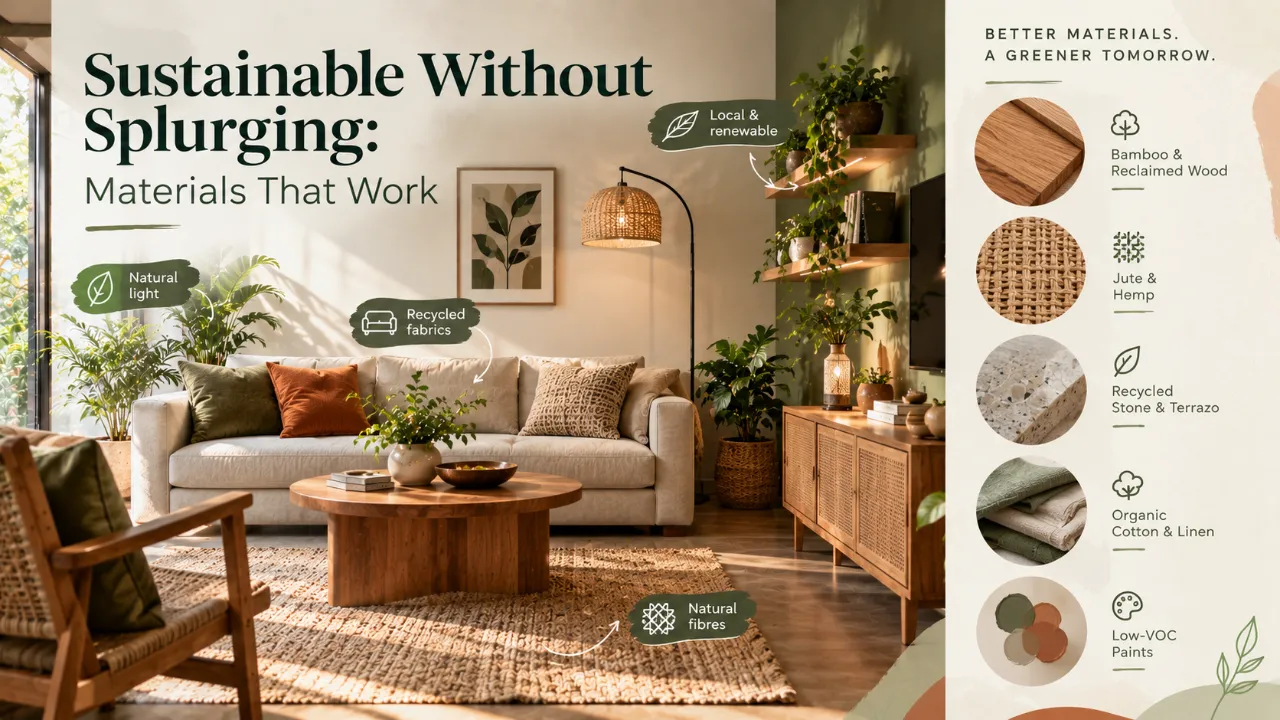
Sustainable Without Splurging: Materials That Work
“Sustainable” and “expensive” are often treated as if they go together.
But a more sustainable interior does not have to depend on premium specialty products. It can come from using less, reusing what already exists, choosing locally available products, selecting durable finishes and avoiding unnecessary replacement.
- Start by using less
- Choose local materials
- Explore reclaimed materials
- Consider recycled-content products
- Prioritize durability
- Think about low-emission finishes
- Do not assume natural always means sustainable
- Use sustainable choices where they matter most
- Build the budget strategically
- Use the five-question test
Sustainability Starts With Using Less
The most affordable sustainable decision is sometimes not to buy another material at all.
Before replacing flooring, doors, furniture, hardware or cabinetry, ask whether the existing element can be repaired, refinished, repainted, reused or incorporated into the new design.
Keeping a usable component in place can avoid the cost and waste associated with removing it and purchasing a replacement.
This is particularly useful in renovations, where homeowners often spend a significant amount simply replacing things that were still functional.
Local Materials Can Be a Smart Budget Choice
Materials that are available closer to the project can sometimes make practical sense from both a sourcing and sustainability perspective.
Local availability can make it easier to compare suppliers, inspect samples physically, find replacement material later, work with familiar installers and manage lead times.
A beautiful local stone, locally manufactured tile or regionally produced material may make more sense than choosing a specialised imported product simply because it has a sustainability label.
Reclaimed Materials Can Add Character Without Buying “Luxury”
Reclaimed wood, old doors, salvaged hardware, reused furniture and recovered architectural pieces can become strong design elements precisely because they are not new.
The visual advantage is that they often bring texture, variation and a sense of history.
A reclaimed wooden panel might become a feature wall. An old piece of furniture might be refinished for a new room. Recovered timber can become shelving or a console. Existing hardware can sometimes be cleaned, restored and reused.
The important part is checking condition, safety, durability and suitability before reuse.
Recycled-Content Materials Can Be More Accessible Than You Think
Not every recycled material is a niche designer product.
Recycled content can appear in everyday interior applications, depending on the manufacturer and product specification.
- Recycled-content boards
- Recycled glass surfaces
- Recycled metal components
- Recycled-content tiles
- Products made partly from agricultural or industrial by-products
The important distinction is to look at the actual product specification, rather than assuming that a marketing term automatically means the entire product is sustainable.
Durable Materials Often Make Better Long-Term Choices
A material does not have to be made from an unusual eco-friendly ingredient to be a sensible sustainability choice.
Durability matters.
A surface that lasts for many years without frequent replacement can reduce the need to consume more material later.
This is why durable flooring, robust countertops, repairable furniture and hard-wearing finishes can all be part of a sustainable interior strategy.
Think beyond the purchase price. A cheaper material that needs replacement or major repair after a short period may not remain the cheaper option over its useful life.
Low-Emission Finishes Can Be Considered Without Redesigning the Whole Home
Paints, coatings, adhesives and sealants are another area where material specification matters.
When selecting paints or finishes, look for products with relevant low-emission or low-VOC claims and check the manufacturer's technical information.
You do not need to replace every finish in your home at once. During a repainting cycle or renovation, better product selection can gradually improve the material profile of the home without turning the entire project into a premium sustainability exercise.
Natural Materials Are Not Automatically the Sustainable Option
A common assumption is that anything natural must be environmentally better.
It is more complicated than that.
A natural material can still have a significant environmental footprint depending on where it comes from, how it is processed, how far it travels, how much material is used and how long it lasts.
The same principle applies to bamboo, cork, timber, stone, cotton and other natural materials.
Bamboo, Cork and Similar Materials Need Context
Materials such as bamboo and cork can be interesting options for certain applications because they can offer distinctive textures and renewable-material characteristics.
But the sustainability of a particular product still depends on sourcing, processing, adhesives, finishes, transportation and lifespan.
Do not buy a material because its category sounds sustainable. Evaluate the actual product.
Use Sustainable Materials Where They Matter Most
A common mistake is trying to make every single surface in the house sustainable at the same time.
Instead, identify the areas where material choices have the biggest practical impact.
Kitchen
Consider durable boards, long-lasting countertops, efficient storage and easily maintained finishes.
Living Room
Reuse furniture, consider local materials and refinish existing pieces where practical.
Bedroom
Look at low-emission paints, durable furniture and natural or recycled textiles where appropriate.
Bathroom
Prioritize durable surfaces, repairable fixtures and finishes suited to moisture.
Workspace
Reuse furniture, choose durable surfaces and consider modular elements that can adapt later.
Spend on Performance, Not Just the Label
Suppose two materials have similar visual appeal.
One has a strong sustainability story but requires specialised installation and expensive maintenance. The other is locally available, durable, easy to repair and significantly less expensive.
The second option may make more sense for your project even if it does not sound as glamorous.
A material should be evaluated as a complete package:
Reduce Waste Through Smarter Planning
Sometimes sustainability has less to do with what you buy and more to do with how you plan.
Poor planning creates waste.
Incorrect measurements can lead to unnecessary material purchases. Overly complicated joinery can create more offcuts. Changing specifications late in the project can make already purchased materials unusable.
Standardized dimensions, accurate measurements and early material decisions can help reduce unnecessary waste.
Choose Materials That Are Easy to Maintain
Maintenance is part of sustainability.
A material that looks beautiful but requires specialised cleaning, delicate treatment or frequent replacement may create additional resource use over time.
For busy homes, especially Indian households with children, pets, frequent guests or high cooking activity, practical maintenance matters.
- Can the surface be cleaned easily?
- Can small damage be repaired?
- Is replacement available locally?
- Does it need specialised maintenance?
- Will it still look good after everyday use?
Design for Repair Instead of Replacement
Another useful principle is to select materials and furniture that can be repaired.
A modular cabinet that allows individual components to be replaced is easier to maintain than a completely integrated system that needs full replacement after one component fails.
- Replaceable upholstery
- Refinishable wood
- Modular storage
- Replaceable hardware
- Repairable furniture
- Accessible lighting components
Mix Premium and Budget Materials Strategically
A sustainable interior does not need every material to be expensive or highly specialized.
You can create a better result by deciding where the budget deserves to go.
One Feature Material
Use a reclaimed wood panel or locally sourced stone where it creates strong visual impact.
Budget-Friendly Support
Use straightforward painted walls and standard supporting materials elsewhere.
Reuse Existing Elements
Refinish furniture, reuse wood or retain functional components rather than replacing them automatically.
Spend on Longevity
Prioritize good-quality flooring, hardware or other elements that are difficult and expensive to replace later.
A Practical Material Comparison
| Material Strategy | Budget Potential | Design Value | What to Check |
|---|---|---|---|
| Existing material reuse | Very high potential | High | Condition and suitability |
| Local materials | Often competitive | High | Availability and sourcing |
| Reclaimed materials | Variable | Very high | Safety, condition and treatment |
| Recycled-content products | Variable | Medium to high | Actual recycled content |
| Durable conventional materials | Often competitive | High | Lifespan and maintenance |
| Specialty imported sustainable products | Can be expensive | High | Shipping, installation and replacement |
| Natural materials | Highly variable | High | Source, processing and durability |
The table is not a fixed price guide. Material cost varies by city, supplier, quantity, specification and installation.
Where You Should Be Careful
“Sustainable” has become a powerful marketing word, which means it is worth asking questions before paying a premium.
- Does the product provide meaningful sustainability information?
- Is the environmental benefit clearly defined?
- Is the price justified by measurable performance?
- Will installation or maintenance add significantly to the cost?
- Is the product available locally for future repairs or replacement?
A higher price can sometimes be justified, but it should be tied to something concrete.
A Better Way to Build a Sustainable Material Budget
Instead of creating a completely separate “sustainable materials” budget, divide your decisions into three groups.
Keep
What can remain and continue working?
Upgrade
Where would a better material improve durability, maintenance, comfort or environmental performance?
Replace
What genuinely needs to be removed because it no longer works?
This approach prevents sustainability from becoming an excuse for unnecessary renovation.
The 5-Question Test Before Buying
1. Do I actually need to replace this?
2. Is there a local or simpler alternative?
3. How long will it last?
4. Can it be repaired, reused or recycled later?
5. Am I paying for measurable performance or simply for a sustainability label?
Sustainable Does Not Have to Look Rustic
Another misconception is that sustainable interiors have to look like exposed wood, cane furniture and earthy beige everywhere.
They do not.
A sustainable material strategy can work with:
- Contemporary interiors
- Minimalist homes
- Warm modern spaces
- Classic interiors
- Luxury-inspired rooms
- Indian traditional interiors
- Compact apartments
The design language comes from proportion, colour, lighting, furniture and detailing. Sustainable choices can simply become part of that language.
The Smartest Sustainable Interior May Be the One You Don't Over-Renovate
A home does not become more sustainable simply because more new materials are added.
Sometimes the smarter solution is to redesign the room around what already exists.
Keep the flooring. Refinish the cabinet. Reupholster the chair. Reuse the wood. Change the lighting. Improve storage. Repaint the walls.
Then introduce only the materials that genuinely improve the space.
This approach can save money while also reducing unnecessary material consumption.
Plan the Budget Before You Buy
Sustainable choices work best when they are planned alongside the rest of the interior budget. Explore your room, estimate costs and find professionals through Walls to Wonder.
Start with Design My Room, check your Interior Design Cost, or explore Interior Designers.
The Final Takeaway
Sustainable interiors do not have to be a premium category reserved for large budgets.
The biggest opportunities often come from using less, keeping more, sourcing locally, choosing durable products, reducing waste and evaluating materials based on their complete life cycle rather than their marketing label.
The goal is not to make every material in your home “green.”
The goal is to make better decisions about where materials come from, how long they last, how much you use and what happens when they are no longer needed.
Frequently Asked Questions
No. Cost varies widely by material, supplier, sourcing, installation and specification. Reuse, local materials, durable products and some recycled-content options can be cost-competitive in the right project.
Start by reducing unnecessary replacement. Reuse, repair or refinish functional elements before purchasing new materials.
Local sourcing can reduce some transportation-related impacts and may simplify procurement, but the overall environmental performance still depends on the material, production process, durability and sourcing distance.
Not automatically. Look at actual recycled content, manufacturing, durability, performance, maintenance and what happens to the product at the end of its useful life.
Prioritize reuse, reduce material waste, compare local alternatives, select durable finishes and spend selectively on changes that provide meaningful long-term value.
Turn this idea into a plan for your home
Visualise your space, understand the likely budget, or find a professional who can bring the idea to life.