
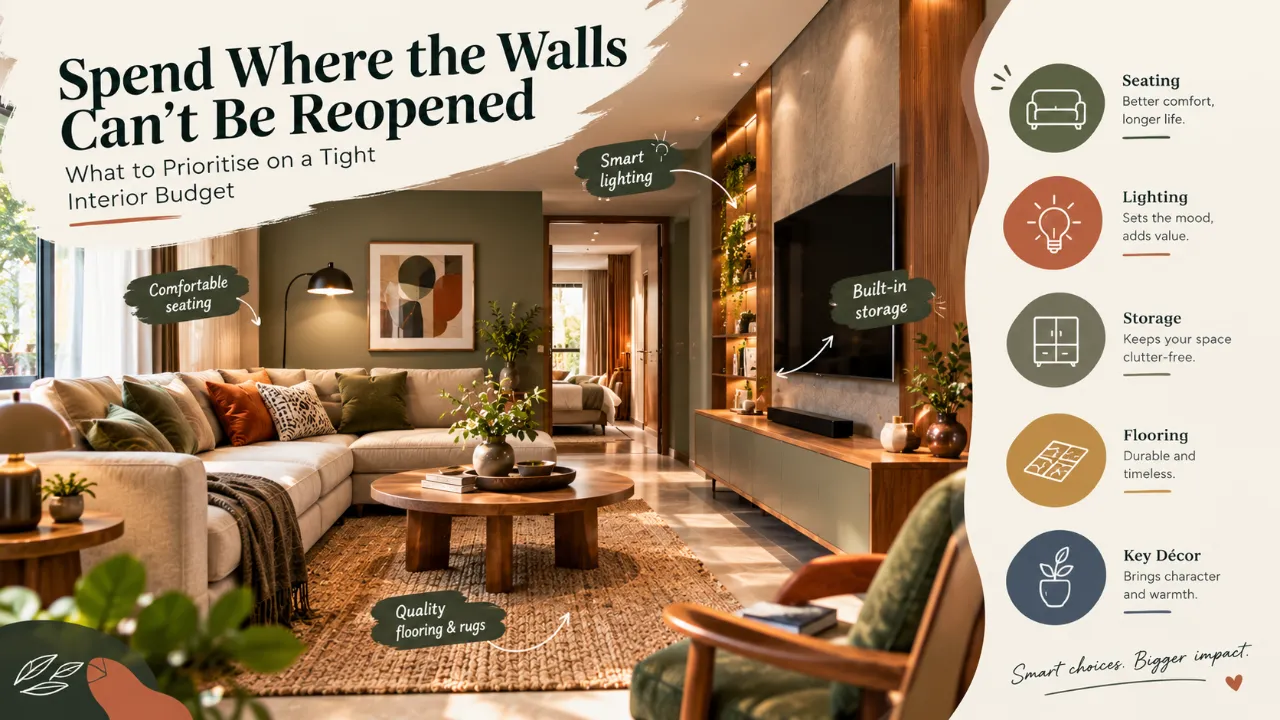
Spend Where the Walls Can't Be Reopened | What to Prioritise on a Tight Interior Budget
Almost nobody's budget covers the full wish list. The kitchen, the wardrobes, the false ceiling, the sofa, the lighting, the wallpaper, all of it, at the quality you imagined. So the real question isn't "what can I afford?" but "what happens if I get the order wrong?"
Some spending can wait a year without any regret. Other spending becomes painfully expensive the moment the walls are closed and the paint is dry.
- The one rule that sorts everything
- Priority 1: The invisible layer
- Priority 2: Fixed elements
- Priority 3: Daily-use comfort
- Priority 4: The easy-to-add layer
- A practical priority table
- Where you can cut without regret
- The mistake that costs the most
- A simple way to rank your own wish list
- Questions to ask your designer
- Frequently asked questions
The One Rule That Sorts Everything: Hard to Redo vs Easy to Add
Every interior item falls somewhere on a spectrum. At one end are things buried behind walls, floors and fixed carpentry, which can only be changed with demolition, dust and money. At the other end are things you can buy, move or swap on a weekend.
Spend first at the hard-to-redo end. Leave the easy-to-add end for later, when the budget recovers.
Priority 1: The Invisible Layer
This is the work nobody photographs and everyone regrets skimping on: waterproofing in bathrooms, balconies and wet walls, electrical wiring and enough points in the right places, plumbing lines, and any structural or seepage repair. A wrong decision here doesn't just look bad, it damages everything built on top of it.
Priority 2: Fixed Elements You Can't Cheaply Change
Modular kitchen carcasses, built-in wardrobes, flooring, the false ceiling and concealed lighting channels. These are installed once and stay. Their carcass quality, hardware and layout matter more than their finish, because a finish can be refreshed, a poor structure can't.
Priority 3: Daily-Use Comfort
The things you touch or rely on every day: a functional kitchen layout, a good mattress, enough fan and AC points, proper task lighting, and storage that matches how you actually live. Comfort spending pays back every single day, unlike decorative spending.
Priority 4: The Easy-to-Add Layer (Wait on This)
Sofas and accent chairs, curtains, rugs, art, decorative lights, indoor plants, wallpaper and styling accessories. All of these can be added gradually, and most people's taste shifts after living in a space for a few months anyway.
A Practical Priority Table
| Priority | What it covers | Why this order |
|---|---|---|
| 1. Invisible layer | Waterproofing, wiring, plumbing, seepage repair | Redoing it means demolishing finished work |
| 2. Fixed elements | Kitchen carcass, wardrobes, flooring, false ceiling | Installed once, expensive to alter |
| 3. Daily comfort | Kitchen layout, mattress, lighting, AC/fan points | Pays back every day |
| 4. Easy to add | Furniture, curtains, rugs, decor, art | Can be bought and swapped anytime |
Not Sure What Your Full Plan Costs?
Estimate the whole project first, then decide which layers to fund now and which to leave for a later phase.
Estimate Your Interior CostWhere You Can Cut Without Regret
Premium Finishes on Low-Touch Surfaces
Upper cabinets and inner shutters rarely need the top finish.
Over-Customisation
Custom-built pieces cost far more than standard sizes that fit well.
Imported Fittings in Low-Use Areas
A guest bathroom doesn't need the same fittings as your main one.
Every Room at Once
Finish the essential rooms well, and leave the rest simple until later.
The Mistake That Costs the Most: Spending on What's Visible First
The most common budget mistake is putting money where guests will see it, the living room, the feature wall, the statement lighting, and running short for the bathroom waterproofing or the kitchen hardware. The visible layer impresses for a week. The hidden layer decides whether you're calling a contractor in year two.
A Simple Way to Rank Your Own Wish List
- List everything you want, room by room.
- Mark each item "hard to redo" or "easy to add."
- Move every hard-to-redo item to the top and fund those first.
- Within that group, rank by daily use.
- Whatever remains unfunded becomes phase two, not a compromise.
Questions to Ask Your Designer
- Which items in this plan are the hardest and most expensive to change later?
- Where can we simplify the finish without weakening the structure?
- What can we leave for a later phase without redoing any work?
- Which of my choices are driven by looks, and which by daily use?
- If the budget dropped by 15%, what would you remove first, and why?
The Professional Judgement: Order Matters More Than Amount
A modest budget spent in the right order beats a larger budget spent on the wrong things. Fund the layers that hide behind walls first, then the fixed elements, then daily comfort, and let decor come last.
Before finalising, confirm with your designer or contractor which items in your specific home are truly hard to change later, since that depends on your building and plan.
Use AI Before You Meet an Interior Designer
AI tools can help you organise your ideas before meetings. They are not a replacement for professional design judgement.
Estimate Your Budget
Create an initial interior budget so you can see what fits now and what belongs in a later phase.
Estimate Interior Cost →Visualise Your Room
Upload a room photograph and explore a look before committing money to it.
Design My Room →Planning Around a Fixed Budget?
Take your wish list and your budget to designers serving your area, and ask them to help you sequence it so nothing has to be redone.
Find Interior Designers Visualise Your Room Estimate Interior CostFrequently Asked Questions
What should I spend on first in a new home?
Start with the invisible layer, waterproofing, electrical and plumbing, then fixed elements like the kitchen and wardrobes. These are the hardest and most expensive to fix once the interiors are finished.
What can I safely postpone?
Furniture, curtains, rugs, wall decor and styling accessories can all be added gradually without redoing any work, and you'll choose better after living in the space.
Is it better to finish one room fully or every room partially?
Usually finish the essential rooms properly, kitchen, bathroom and bedroom, and keep the remaining rooms simple, rather than compromising quality everywhere.
How do I avoid overspending on looks?
Sort your list into hard to redo and easy to add. Anything decorative that can be added later waits, so the budget goes to what can't be changed cheaply.
Final Checklist
- Is waterproofing, wiring and plumbing funded before anything decorative?
- Have you put carcass quality and hardware ahead of shutter finish?
- Are daily-use items, kitchen, mattress, lighting, funded before styling?
- Is every unfunded item something you can add later without redoing work?
- Have you confirmed the hard-to-change items with your designer or contractor?
A tight budget doesn't have to mean a compromised home, it means a well-ordered one. Use WallsToWonder to find interior designers, visualise your room and estimate your interior cost before deciding what to fund first.
Get a personalised estimate for your home
Choose your rooms, materials and preferences to understand a practical interior budget before you commit.