
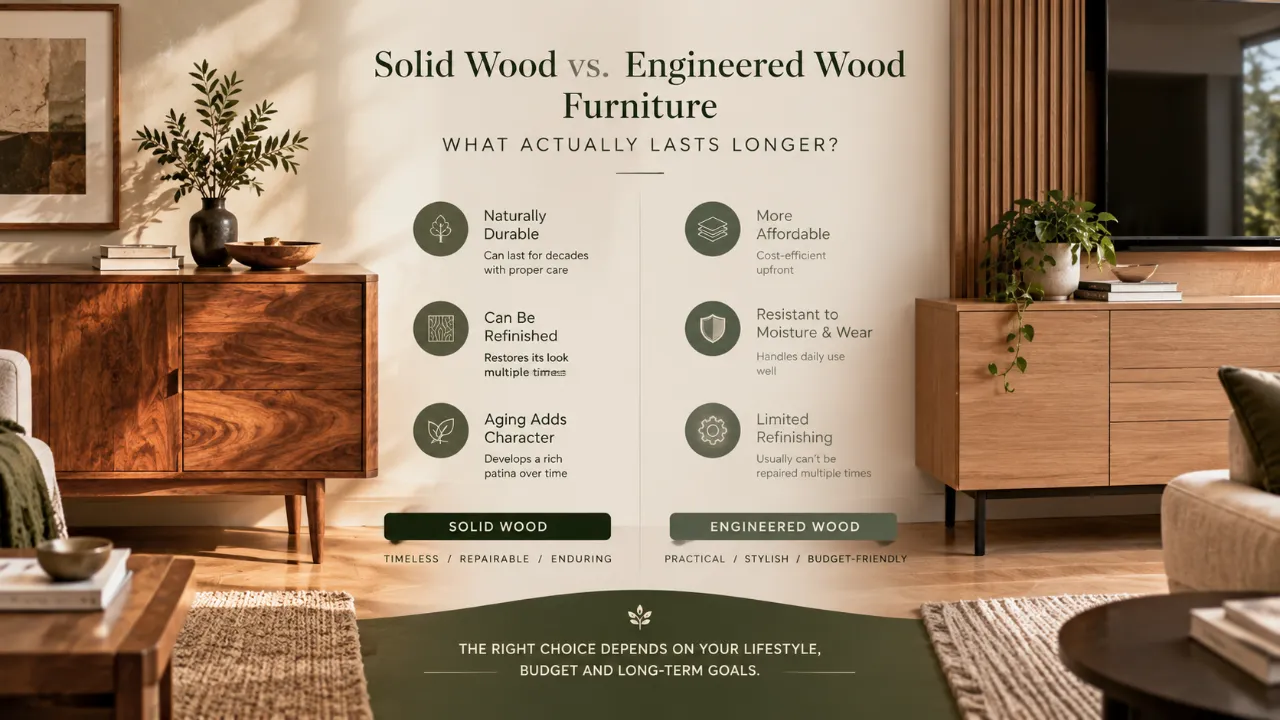
Solid wood vs. engineered wood furniture: what actually lasts longer
"Solid wood lasts longer" gets repeated so often in furniture shopping that it's treated as settled fact. It isn't, not universally. Solid wood and engineered wood each fail in different ways, under different conditions, and which one actually lasts longer in your home depends more on climate, usage and how the piece is built than on the material alone.
What "Engineered Wood" Actually Means
"Engineered wood" isn't one material, it's a category, and the differences inside it matter more than people assume.
Plywood
Thin layers of wood veneer glued together, cross-grained for strength. Generally the most durable engineered option.
MDF
Wood fibres compressed with resin, smooth and stable, but more vulnerable to moisture than plywood.
Particleboard
Wood particles and resin, the least durable and most moisture-sensitive of the common options.
Block Board
Solid wood strips sandwiched between veneer sheets, a middle ground in both strength and cost.
Lumping all of these together as "engineered wood is weaker" misses that plywood and particleboard perform very differently under the same conditions.
Where Solid Wood Genuinely Wins
Solid wood, teak, sheesham, mango wood, among others, handles structural stress and repeated weight-bearing use exceptionally well when properly seasoned and finished. A solid wood bed frame or dining table, built correctly, can outlast most engineered alternatives by decades, and it can be sanded and refinished multiple times over its life, something engineered wood generally cannot do.
Where Engineered Wood Genuinely Wins
Good-quality plywood is dimensionally stable, it doesn't expand and contract with humidity the way solid wood does, because the cross-grained layering cancels out that movement. This makes it a strong choice for modular furniture, wardrobes, and kitchen cabinetry, where precise, lasting dimensions matter more than showcasing natural wood grain.
The Real Deciding Factor: Where the Piece Lives
| Location / use | Better suited material | Why |
|---|---|---|
| Kitchen cabinets, under-sink units | Marine or waterproof-grade plywood | Water exposure is frequent and unavoidable |
| Wardrobes, modular storage | Plywood or block board | Dimensional stability matters more than grain |
| Dining tables, bed frames | Solid wood | Structural load-bearing, refinishable over decades |
| Bathroom cabinetry | Marine plywood only, never MDF/particleboard | Constant humidity destroys standard engineered wood |
| Budget furniture, short-term use | Particleboard or MDF | Lower cost, acceptable given shorter expected life |
The Termite Question
Solid wood is not termite-proof by default; that depends entirely on the wood species and the quality of chemical treatment during processing. Properly treated teak or sheesham resists termites well; untreated or poorly treated solid wood does not. Engineered wood, particularly plywood with resin bonding, is generally more termite-resistant than untreated solid wood, though it isn't immune either, especially at exposed or damaged edges.
The Cost-vs-Lifespan Trade-Off
Solid wood furniture costs more upfront and, if properly maintained in suitable conditions, can last generations. Engineered wood costs less upfront, and quality varies enormously, marine plywood is a durable, sensible material; low-grade particleboard is often not built to last more than a few years under regular use. Comparing "wood" against "engineered wood" without specifying quality grade is comparing two different things.
Choosing Furniture for a New Space?
Estimate a realistic interior budget first, so the material grade you can actually afford is part of the decision from the start.
Estimate Your Interior CostQuestions to Ask Before Buying
- What specific type of engineered wood is this, plywood, MDF, or particleboard, and what grade?
- Is this marine-grade or moisture-resistant plywood, or standard grade?
- Was the solid wood kiln-dried and seasoned before use, or air-dried only?
- What's the warranty period, and what does it actually cover, structural failure, warping, termite damage?
- For kitchen or bathroom furniture specifically: is this rated for moisture exposure?
The Professional Judgement: The Material Isn't the Whole Answer
Solid wood usually lasts longer for load-bearing, refinishable furniture in stable indoor conditions. Good-grade plywood usually lasts longer for modular, moisture-prone applications like kitchens and wardrobes. The furniture that actually fails early, in either material, is usually the low-grade version of whichever one was chosen, not the category itself.
Use AI Before You Meet an Interior Designer
AI tools can help you organise your ideas before meetings. They are not a replacement for professional design judgement.
Estimate Your Budget
Create an initial interior budget based on your rooms, including realistic material grade choices.
Estimate Interior Cost →Visualise Your Room
Upload a room photograph and explore how different furniture choices would actually look in your space.
Design My Room →Choosing Furniture That Actually Holds Up?
Take your rooms, climate and budget to designers serving your area, and get material recommendations suited to your actual home, not just a showroom sample.
Find Interior Designers Visualise Your Room Estimate Interior CostFrequently Asked Questions
Is solid wood always better than engineered wood?
No. Solid wood is generally better for load-bearing, refinishable furniture like dining tables and beds. Good-quality plywood is often the better choice for kitchens, wardrobes and moisture-prone areas, since it resists warping from humidity better than solid wood does.
Which lasts longer in a humid or coastal climate?
Marine-grade plywood typically outperforms solid wood in consistently humid conditions, since solid wood expands and contracts with moisture and can warp or crack over time without proper seasoning and sealing.
Is MDF a bad material overall?
Not inherently, MDF is smooth, stable in dry conditions, and cost-effective, but it's significantly more vulnerable to moisture than plywood and shouldn't be used in kitchens, bathrooms or other high-humidity areas.
Does more expensive always mean more durable?
Usually within the same material category, yes, but not across categories. A high-grade plywood piece can outlast a poorly seasoned, cheaply finished solid wood piece, despite solid wood generally carrying a higher price tag.
Final Checklist Before You Choose
- Have you identified the exact type and grade of engineered wood, not just "engineered wood" as a category?
- Is the piece going somewhere with regular moisture exposure, kitchen, bathroom, balcony-adjacent?
- Was solid wood furniture properly kiln-dried and sealed before purchase?
- Does the warranty cover warping and termite damage specifically, not just manufacturing defects?
- Have you matched the material to the piece's actual job, load-bearing vs. modular storage?
Neither material wins outright, the right choice depends on where the piece lives and what grade you're actually buying. Use WallsToWonder to find interior designers, visualise your room and estimate your interior cost before deciding on materials.
Turn this idea into a plan for your home
Visualise your space, understand the likely budget, or find a professional who can bring the idea to life.