
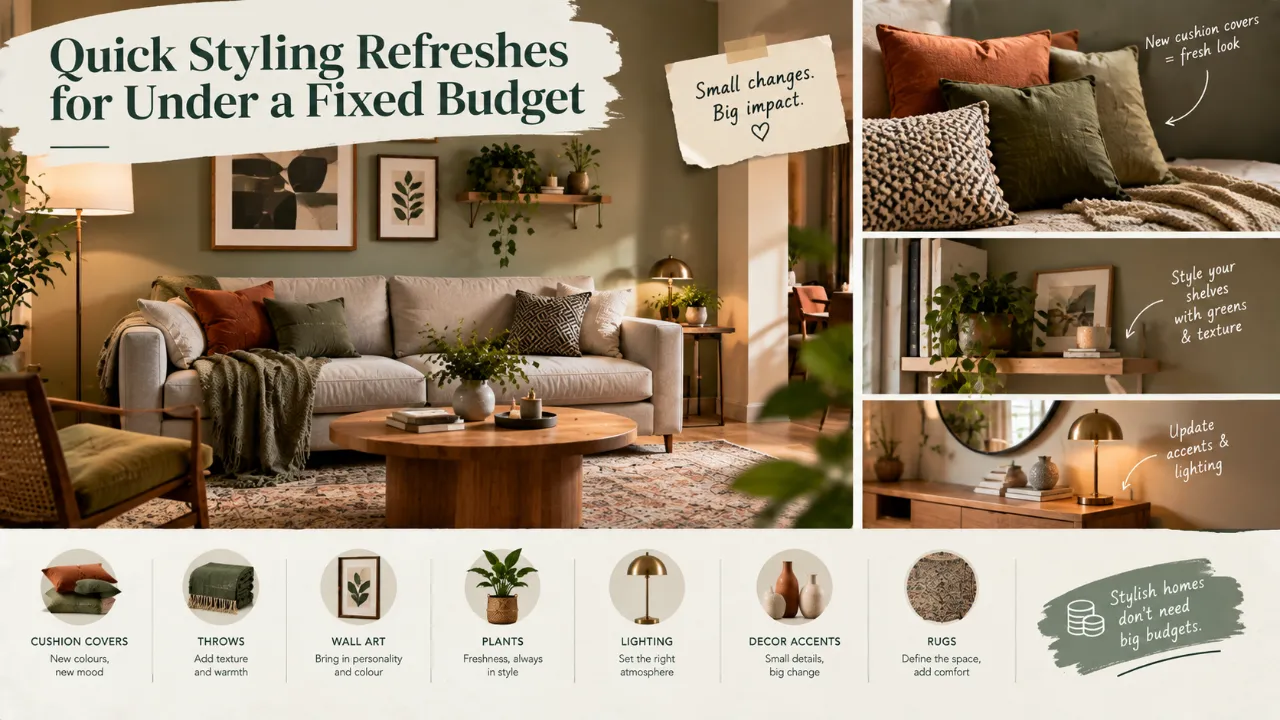
Small Changes, Big Difference: How to Refresh Your Home on a Fixed Budget
Sometimes a home does not need a makeover. It just needs a reset. A few carefully chosen changes can alter how a room feels without turning the project into a renovation.
The key is having a fixed budget and deciding where that money will create the most visible difference.
Because when the budget is small, buying more is usually not the answer. Choosing better is.
- Set the Budget Before You Shop
- Do a Styling Audit
- Rearrange the Furniture
- Refresh Soft Furnishings
- Use a New Colour Combination
- Change the Lighting Mood
- Swap Accessories
- Add One Statement Element
- Bring in Texture
- Refresh the Bedroom
- Style Shelves Better
- Focus Your Budget Where You Notice It
- Common Budget Styling Mistakes
- Fixed-Budget Refresh Formula
- A 24-Hour Styling Refresh
- FAQ
Start by Setting the Budget Before You Shop
A fixed budget changes the way you make design decisions.
Instead of asking, "What else can I buy?" ask: "What will make the biggest difference for this room?"
Decide the total amount first. Once the limit is established, divide it between the areas that need attention.
A budget becomes much easier to manage when every purchase has a role.
You can think of it as one major visual change, two or three supporting changes and a few finishing details.
Do a Styling Audit Before Buying Anything
Before spending money, remove what is not helping.
Ask yourself:
- What feels cluttered?
- What looks outdated?
- What is visually repetitive?
- What is no longer being used?
- What could simply be rearranged?
- Which existing pieces are actually good?
- What one area attracts too much attention?
Sometimes the quickest refresh is removing five things rather than buying five new things.
Rearrange the Furniture First
This is one of the cheapest ways to change a room because it can cost absolutely nothing.
- Move the sofa.
- Change the angle of the chair.
- Pull furniture slightly away from the wall.
- Reposition a side table.
- Shift the rug.
- Try a different focal point.
Furniture placement changes how a room is experienced even when none of the furniture itself changes.
Before spending on décor, test at least two or three layouts.
Refresh Soft Furnishings Before Hard Furniture
When working with a small budget, soft furnishings often offer more flexibility than replacing large furniture pieces.
- Cushion covers
- Throws
- Curtains
- Bed linen
- Runners
- Table textiles
- Small rugs
You do not need to replace everything. Choose the elements that occupy the most visible surface area.
Use a New Colour Combination Instead of Repainting Everything
A styling refresh does not always require repainting.
Introduce a new accent colour through smaller elements such as cushions, artwork, vases and throws.
For example, a neutral room can take on a new direction through muted olive, deep brown, dusty blue, terracotta, burgundy or soft lavender.
The colour does not have to dominate the room. It simply needs to appear enough times to look intentional.
Change the Lighting Mood
Lighting can dramatically affect how a room looks, yet it does not always require a major electrical change.
Consider whether the room needs another layer of light through a table lamp, floor lamp, portable light or decorative fixture.
Ask whether the room feels warm at night, whether there are dark corners and whether anything interesting is being highlighted.
Style the Coffee Table Instead of Replacing It
The coffee table is often a good target for a small styling refresh because it sits in a highly visible position.
The important part is not the number of objects. It is the composition.
Give One Surface a New Purpose
A small styling refresh can also come from changing how an existing surface is used.
A console can become a display zone. A bookshelf can be edited. A bedside table can become cleaner and more functional.
Think of this as editing the room rather than filling it.
Swap Accessories Instead of Adding More
Accessories are useful because they are relatively easy to change.
But one common mistake is keeping the old accessories and adding new ones on top.
Instead, create a small rotation. Put away some existing pieces, bring out a different combination, change the artwork or regroup decorative objects.
Add One Statement Element
A small budget usually cannot support a complete room transformation. It may, however, support one element that catches the eye.
- A large artwork
- A statement mirror
- A distinctive lamp
- A textured cushion set
- A sculptural vase
- A small accent chair
- A carefully chosen rug
The rest of the room can remain relatively quiet. One intentional focal point is often more effective than several inexpensive decorative purchases competing with one another.
Use Mirrors Strategically
A mirror can change how a space feels without changing its basic architecture.
Consider placing one where it reflects daylight, reflects an attractive view, fills a visually empty wall or sits above a console.
Bring in Texture
If a room feels flat, changing its colour palette is not always necessary. Texture can create the difference.
- Linen
- Cotton
- Woven materials
- Wood
- Ceramic
- Cane
- Textured rugs
- Ribbed or fluted accessories
A neutral room with several textures can feel much richer than a room with multiple colours but very little variation in surface.
Make the Entryway Feel New
The entrance has an outsized effect on how the home feels, and it often does not require much.
- Clear unnecessary objects.
- Add one mirror.
- Introduce a tray.
- Change the lighting.
- Add a small plant.
- Edit the console styling.
- Replace a tired doormat.
Refresh the Bedroom Without Changing the Bed
The bed is usually the largest object in the bedroom, so start there.
You can change its visual character through new bed linen, layered cushions, a throw, updated bedside lamps, different artwork or simplified bedside surfaces.
Style Shelves Like a Collection, Not a Storage Area
Open shelves can make a room feel crowded when everything placed on them is equally visible.
Try combining books, artwork, ceramics, small plants and objects with different heights. Leave some empty space between groups.
The eye needs pauses. A shelf should not look as though every available centimetre was filled.
Use Existing Pieces in Unexpected Places
Before buying something new, move existing objects around the home.
A vase from the dining room may work better in the living room. An artwork from the bedroom may suit the entryway. A side table may work beside another chair.
This is essentially a free styling experiment.
Create a "One-In, One-Out" Rule
Every new cushion, vase or decorative object occupies space. So when you buy something new, consider removing something that no longer works.
Focus Your Budget Where You Notice It Most
Not every room deserves equal spending.
Cushions, throw, artwork and lighting.
Bedding, lamps, curtains and bedside styling.
Centrepiece, lighting and table textiles.
Mirror, console styling, light and décor.
What Not to Spend Your Small Budget On
A fixed budget requires restraint.
- Things that duplicate what you already own
- Things that solve a problem that does not really exist
- Items that are difficult to place
- Pieces with no connection to the room
- Items that require several additional purchases
The Biggest Budget Styling Mistakes
Buying before editing
A room full of clutter will not automatically look better with more décor.
Changing too many things at once
Too many competing changes can make the room feel less coherent.
Choosing the cheapest version of everything
Affordable does not have to mean visually careless. One well-chosen piece can be more useful than several low-impact purchases.
Ignoring what you already have
Existing furniture may only need better placement or styling.
Following trends too literally
A refresh should fit the home rather than make it look like a temporary trend display.
A Simple Fixed-Budget Refresh Formula
Choose the element likely to create the biggest visual impact.
25% — Supporting Pieces
Add one or two elements that strengthen the new direction.
15% — Finishing Details
Use smaller accessories, textiles or styling pieces to connect everything.
10% — Keep as a Buffer
Reserve a little for an overlooked requirement or a better final choice.
The percentages do not need to be exact. The useful part is the hierarchy.
A 24-Hour Styling Refresh
A photo makes it easier to spot visual imbalance that is easy to miss when you are standing inside the room.
Refresh Your Home With More Intention
You do not always need a renovation to explore a different design direction. Start by visualising possibilities, refining your preferences and making more deliberate interior choices.
Final Thought
A small budget does not mean a small result. It simply means every decision has to earn its place.
Instead of trying to make everything new, identify what already works, remove what does not, rearrange what you have and spend selectively on the few changes that will be most visible.
Good styling is not about how much you buy. It is about how intentionally you use what you have.
And sometimes, the best home refresh starts with moving the furniture before opening your wallet.
FAQ
How much should I spend on a quick home styling refresh?
There is no universal amount because it depends on the room and what you already own. The useful approach is to decide your maximum budget first and then prioritise high-impact changes.
Start with decluttering, rearranging furniture, editing shelves and changing the way existing accessories are grouped. These can create a noticeable difference without major spending.
Not necessarily. If the existing walls work well, you may get more visible impact from lighting, textiles, artwork, mirrors or accessories.
It depends on the room, but large visible surfaces and focal areas—such as bedding, curtains, rugs, artwork, lighting and sofa styling—can often change the overall impression significantly.
A single well-chosen focal element can create a clearer result than many unrelated small purchases. The best choice depends on what the room is currently missing.
Get a personalised estimate for your home
Choose your rooms, materials and preferences to understand a practical interior budget before you commit.