
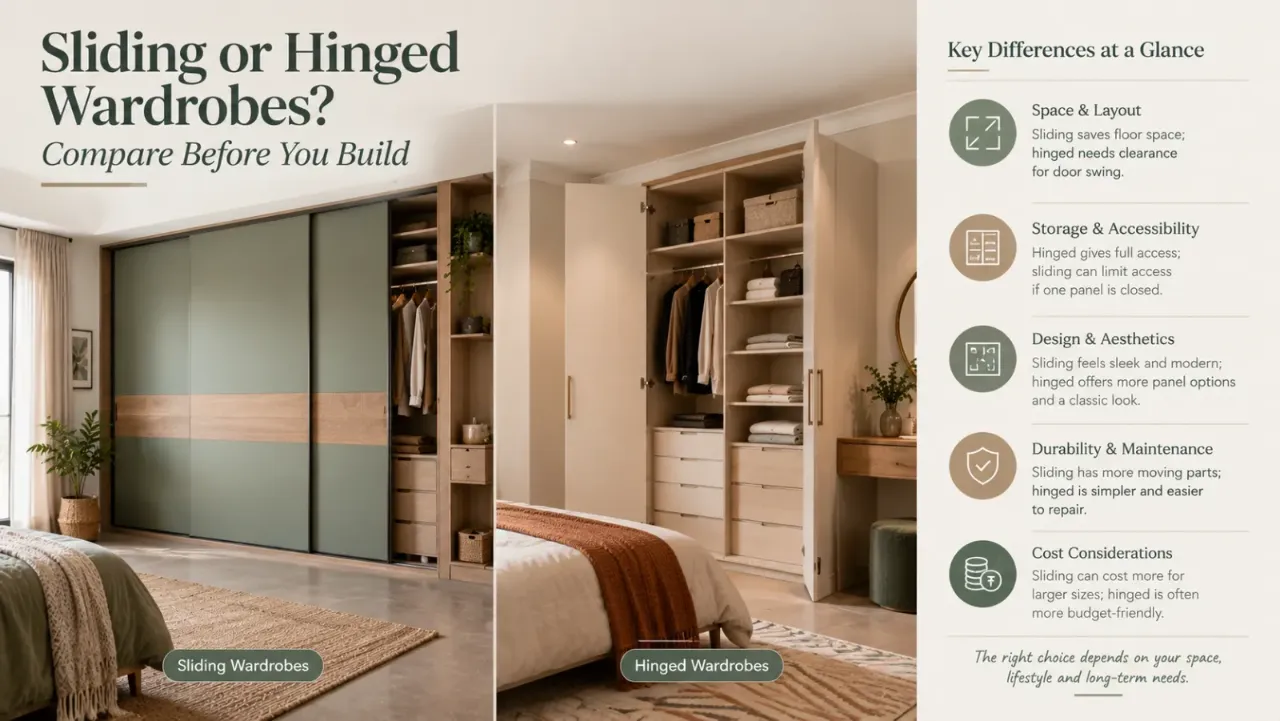
Sliding or Hinged Wardrobes? Compare Before You Build
When choosing a wardrobe, most people focus on colour, finish, handles and internal storage. The door mechanism comes later. But the choice between sliding and hinged wardrobe doors can affect floor space, access, noise, maintenance and cost.
Sliding vs Hinged: The Quick Comparison
Sliding Wardrobe
Best for: tight bedrooms, narrow passages and layouts where front clearance is limited.
Main advantage: doors do not swing outward into the room.
Main trade-off: you cannot open the entire wardrobe at once, and the track-and-roller system adds hardware.
Hinged Wardrobe
Best for: bedrooms with enough clearance in front and homeowners who prioritise easy, wide access.
Main advantage: doors can open wide, giving you a more complete view of the wardrobe interior.
Main trade-off: the door swing needs clear space.
The interesting part is what those differences mean in real life.
1. Space: Sliding Doors Usually Win the Floor-Space Battle
This is the biggest reason homeowners choose sliding wardrobes.
A hinged wardrobe needs room for the door to swing open. That means the area directly in front of the wardrobe has to remain usable as clearance. A bed, side table, chair or passage can make that clearance difficult to achieve.
Sliding doors move across the wardrobe instead of projecting into the room.
That makes them especially useful in:
- Compact bedrooms
- Narrow bedrooms
- Rooms with beds positioned close to the wardrobe
- Dressing areas with limited circulation
- Apartments where floor area is already tight
This is why sliding wardrobes often feel like a natural choice for smaller Indian bedrooms.
But there is an important distinction: sliding doors save floor clearance; they do not magically create more wardrobe storage.
The wardrobe still occupies its own depth. And because the doors overlap, only part of the interior is accessible at any one time.
2. Hinged Doors Need More Clearance, But Give You More Access
Suppose you have a bedroom where the wardrobe is comfortably away from the bed and there is plenty of circulation space in front.
In that case, the biggest advantage of sliding doors may disappear.
A hinged wardrobe can be opened much more completely. Depending on the configuration, you may be able to see several sections at once rather than looking through only the currently exposed portion.
That matters when you are trying to compare clothes, reach shelves or organise storage.
It also makes cleaning and rearranging the internal compartments easier.
Those are two different kinds of space efficiency.
3. Which One Is Quieter?
Noise is often ignored until the wardrobe is installed.
Sliding wardrobes depend on rollers, tracks and guides. A good-quality system that is properly installed can operate smoothly and quietly.
But sliding mechanisms have moving hardware. Dust, debris, wear, poor alignment or lower-quality rollers can eventually create rubbing, rattling or rolling sounds.
The noise can also change as the wardrobe ages.
Hinged wardrobes have a different kind of sound problem. The door itself can make noise when it is opened or closed too quickly. A heavy door that is allowed to slam can be surprisingly loud, especially in a bedroom.
Soft-close hinges can make hinged wardrobes much quieter by slowing the final closing movement.
The hardware matters almost as much as the door style.
4. Where Noise Usually Comes From
For a sliding wardrobe, inspect the moving system.
The track should be properly aligned, rollers should be suitable for the door load and the installation should avoid unnecessary friction.
For a hinged wardrobe, inspect the hinges and the closing mechanism.
A large wardrobe door with a basic hinge can feel very different from the same door fitted with good soft-close hardware.
This is one reason it is risky to compare two wardrobe quotations only by looking at the laminate or finish.
The mechanism may be doing much more work than the decorative surface.
5. Cost: The Door Style Is Only Part of the Price
This is where many homeowners expect a simple answer: “Which is cheaper: sliding or hinged?”
In many standard wardrobes, hinged doors can be more economical because the basic mechanism is relatively straightforward.
Sliding wardrobes use tracks, rollers, guides and other specialised hardware, and larger or heavier panels can require better-quality systems.
That can push the cost upward.
But this is not a universal rule.
A premium hinged wardrobe with concealed soft-close hinges, expensive finishes and elaborate internal accessories can easily cost more than a basic sliding wardrobe.
That is why two wardrobes with the same width can have very different prices.
6. What Makes a Sliding Wardrobe More Expensive?
Several decisions can push a sliding system upward in cost.
- Heavier door panels
- Larger door sizes
- Better-quality rollers
- Premium track systems
- Aluminium or specialised profiles
- Glass or other premium door finishes
- Soft-closing mechanisms
- Customised configurations
The track is particularly important because it is not just decorative hardware. It carries the moving door system and affects how the wardrobe feels every time you use it.
A cheap track may look fine when the wardrobe is new and feel very different after repeated daily use.
7. What Makes a Hinged Wardrobe More Expensive?
Hinged wardrobes can also move quickly from basic to premium.
- Premium hinges
- Soft-close hardware
- Tall or oversized shutters
- Unusual door profiles
- Handle systems
- Acrylic, glass or veneer finishes
- Internal drawers
- Pull-out accessories
- Specialised storage fittings
So a useful rule is: don't ask which door style is cheap. Ask which specification is being quoted.
8. Sliding Doors: The Biggest Limitation Is Access
This is the downside that often gets forgotten in showroom discussions.
A sliding wardrobe may have three door panels, but you can generally only access the section currently exposed.
One door overlaps another.
That means you are not looking at the entire wardrobe at the same time.
For some people, that is completely fine. For others, it becomes irritating.
Imagine trying to find one shirt on a busy morning while one section is hidden behind another door.
That is why internal planning becomes especially important with sliding wardrobes.
9. Hinged Doors Make Full-View Storage Easier
With hinged shutters, opening the doors can reveal a much larger portion of the wardrobe.
That can make it easier to:
- Compare clothes
- Reach different shelves
- See folded items
- Organise sections
- Clean the interior
- Rearrange storage
This can be particularly useful for wardrobes that are used heavily every day.
It also makes the internal layout feel less hidden.
But that convenience comes with the requirement for front clearance.
10. Sliding Wardrobes Can Be Better for Tight Bedroom Layouts
Consider a typical compact room.
There may be a bed, two side tables, a wardrobe, a doorway, a window and a dressing area.
The problem is rarely whether the furniture physically fits. The problem is whether the furniture can still be used comfortably once the doors open.
A hinged wardrobe can fit on paper and still be awkward in reality.
The door may collide with a side table. It may interfere with the bed. It may block the walkway. Or it may force you to leave a larger empty strip in front of the wardrobe than you really wanted.
This is exactly where sliding doors can make the plan work better.
11. Don't Forget the Internal Depth
There is another space issue that is less visible.
Sliding door systems occupy part of the wardrobe's front zone because the doors need tracks and overlap.
That can affect the relationship between the carcass depth and the truly usable internal storage depth.
The exact impact depends on the wardrobe construction and hardware system, so this should be checked in the actual shop drawing rather than assumed.
Hinged wardrobes usually have a simpler front opening, which can make the internal storage arrangement more straightforward.
Ask: “How much of that depth is actually usable for my clothes and accessories?”
12. Which One Is Easier to Maintain?
Hinged wardrobes are mechanically simpler.
A hinge can usually be adjusted, replaced or serviced without dealing with a full-length sliding track.
Sliding wardrobes need more attention to their moving components.
Tracks may collect dust, hair, lint and small debris.
That does not mean sliding wardrobes are difficult to maintain. It simply means the mechanism has more moving parts and those parts need to remain in good condition.
If a sliding door begins sticking or rubbing, the issue may be with alignment, rollers, guides or the track rather than the door panel itself.
13. What Happens When One Door Fails?
With a hinged wardrobe, a problem with one hinge usually affects one shutter.
With a sliding wardrobe, a problem in the track or roller system can affect how smoothly a complete door moves.
Again, this is not a reason to avoid sliding wardrobes. It is a reason to invest in good hardware and proper installation.
The mechanism deserves the same attention as the visible finish.
14. Which Style Looks More Modern?
This is where personal taste comes in.
Sliding wardrobes often create a large, uninterrupted visual plane.
That can work beautifully with:
- Full-height mirrors
- Large laminate panels
- Muted neutrals
- Wood finishes
- Minimal contemporary bedrooms
Hinged wardrobes can look equally modern, especially when multiple shutters are aligned carefully and handles are kept simple.
The design language comes from the complete wardrobe, not just the opening mechanism.
15. What About Mirrors?
Sliding wardrobes are often paired with mirror panels because the large uninterrupted shutters provide a convenient surface.
That can visually expand a compact bedroom and reduce the need for a separate full-length mirror.
But mirrored shutters also add considerations around weight, fingerprints, cleaning and hardware quality.
Hinged wardrobes can use mirrors too.
The point is that the finish should be chosen together with the door mechanism rather than independently.
16. What Works Better for a Shared Wardrobe?
Think about who uses the wardrobe.
For a couple sharing one large wardrobe, sliding doors can create a clean front and save clearance around the bed.
But the overlap means two people may not be able to access all sections simultaneously.
Hinged wardrobes can make shared access easier because multiple sections can be opened at the same time.
So again, the right choice depends on behaviour.
A wardrobe is not just furniture. It is a daily interface.
17. A Bedroom With a Tight Passage
Here, sliding usually has a clear advantage.
When the wardrobe faces a narrow passage or another piece of furniture, the door swing from a hinged shutter can interfere with circulation.
Sliding doors remove that outward swing.
That can make the bedroom feel less cramped even though the wardrobe itself has not become smaller.
18. A Bedroom With Comfortable Clearance
Here, hinged doors deserve a serious look.
When you already have enough front space, there is less reason to pay for a sliding mechanism simply to save clearance you do not actually need.
You may prefer the wider opening, simpler mechanics and easier access of hinged shutters.
Sometimes the best design decision is the less complicated one.
19. Don't Compare Wardrobes Only by Running Feet
A quotation based on wardrobe length can make two options appear comparable.
But they may not be.
One wardrobe may include more drawers, better hinges, soft-close hardware, better internal dividers, better track systems, more shelves, better edge treatment or different door materials.
So a lower price does not automatically mean better value.
Ask for the wardrobe to be broken down by material, mechanism, internal accessories and finish.
That is how you compare like with like.
20. A Better Way to Compare Two Quotations
Space
How much clear floor area is required when the doors are open?
Access
How much of the wardrobe can you see and reach at one time?
Noise
What hinges, rollers, guides and soft-close systems are included?
Hardware
Which brand or specification of tracks, rollers or hinges is being provided?
Storage
How much usable internal space remains after the door system is installed?
Maintenance
What components are likely to need adjustment, cleaning or replacement?
Finish
Are you comparing the same laminate, veneer, acrylic, glass or mirror quality?
Total Cost
What is the complete installed price, including hardware and internal accessories?
So, Which One Should You Choose?
Choose Sliding When
Your bedroom is compact and floor clearance is limited.
The wardrobe sits close to the bed or another piece of furniture.
You want a clean, large visual façade.
You prefer not to deal with door swings in the circulation area.
Choose Hinged When
You have comfortable space in front of the wardrobe.
You want maximum visibility and access to the interior.
You prefer simpler mechanics.
You want to open several wardrobe sections at once.
The key is not to choose based on what is currently trending.
Choose based on what will annoy you less every single day.
The Most Common Wardrobe Mistake
The most common mistake is designing the wardrobe from the wall outward.
Homeowners decide the wardrobe width, choose a finish and then select the doors.
A better process starts with the room.
Measure the circulation. Place the bed. Place the side tables. Mark the wardrobe. Then physically account for what happens when the doors open.
This is especially important with hinged shutters.
For sliding wardrobes, check how much of the interior will actually be accessible from each opening.
The wardrobe should fit the room's behaviour, not just the room's dimensions.
The Bottom Line
There is no universal winner between sliding and hinged wardrobes.
Sliding doors usually win when floor clearance is the problem.
Hinged doors usually win when access and simplicity are the priority.
For noise, the quality of the mechanism and installation matters more than the label alone.
For cost, compare the entire specification rather than assuming one door style is always cheaper.
And for storage, look beyond the external wardrobe size. The real question is how much of the interior you can comfortably use every day.
The best wardrobe door is the one that makes your bedroom easier to live with—not simply the one that looks best in a catalogue.
Plan the Wardrobe Before Finalising the Bedroom
Seeing the wardrobe within the full room can make this decision much easier. You can use Walls to Wonder's Design My Room tool to explore different room layouts and visual directions before finalising the design.
When you are ready for professional planning, you can also explore designers through the Walls to Wonder designer directory.
For a broader budget check, Walls to Wonder's interior design cost calculator can help you think through the larger cost of the project rather than comparing one wardrobe line item in isolation.
Final Thought
A wardrobe door is a small decision that affects one of the most frequently used pieces of furniture in the bedroom.
So don't choose it only for appearance.
Choose it for the room you have, the space you need, the sound you can tolerate, the access you want and the budget you are actually working with.
Because the wardrobe you enjoy most is the one that works without getting in your way.
Frequently Asked Questions
Is a sliding wardrobe better than a hinged wardrobe?
Neither is universally better. Sliding wardrobes are usually better when front clearance is limited, while hinged wardrobes offer wider access and simpler mechanics.
Are sliding wardrobes noisier?
They can be if the track, rollers or guides are poor, dirty or misaligned. A well-installed system with good hardware can operate smoothly. Hinged doors can also be noisy when they slam, although soft-close hinges can reduce this.
Which wardrobe is cheaper, sliding or hinged?
Hinged wardrobes can be more economical in many standard configurations because their mechanism is simpler. However, the total price depends on the door material, hardware, internal accessories, dimensions, finish and installation.
Do sliding wardrobes save more storage space?
They save floor clearance in front of the wardrobe, but they do not necessarily create more internal storage. Because the doors overlap, only part of the wardrobe is accessible at once.
Are hinged wardrobes easier to use?
They can be, especially when you want to see and access several wardrobe sections at the same time. The trade-off is that the doors need enough space to swing open.
Which wardrobe is better for a small bedroom?
A sliding wardrobe is often more practical when a hinged door would interfere with the bed, side table or circulation space. The final choice still depends on the exact room layout.
Do sliding wardrobes need more maintenance?
They have more moving components, so tracks, rollers and guides may need periodic cleaning or adjustment. Hinged wardrobes have simpler mechanisms but their hinges can also need adjustment over time.
What should I check before approving a wardrobe quotation?
Check the carcass material, door material, dimensions, hardware, soft-close features, internal accessories, installation and the complete installed price. Comparing only the wardrobe's total amount can hide important differences.
Get a personalised estimate for your home
Choose your rooms, materials and preferences to understand a practical interior budget before you commit.