
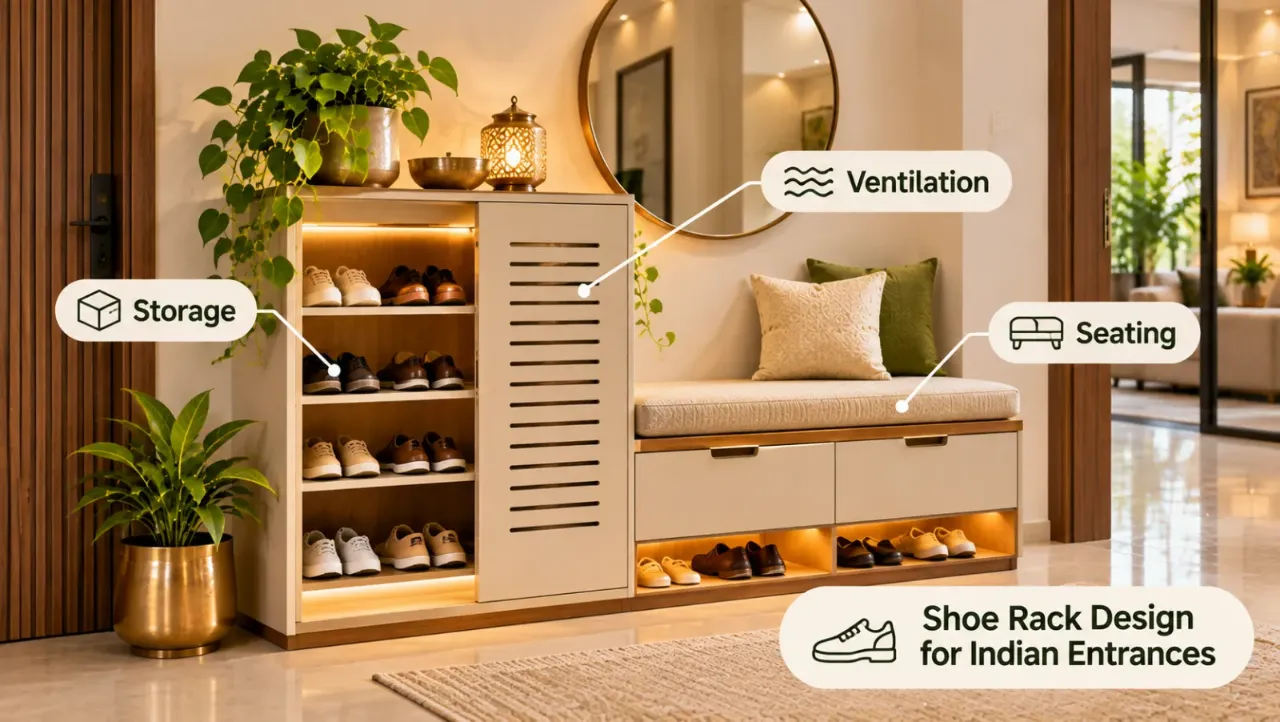
Shoe Rack Design for Indian Entrances: Storage, Seating and Ventilation
The entrance is one of the first areas you use when leaving home and the first space you return to. In many Indian households, it also becomes the everyday drop-off point for footwear, umbrellas, bags, keys and other frequently used items.
Without proper planning, shoes can quickly collect near the door, block movement and make even a well-designed entrance look untidy. A thoughtfully designed shoe rack can solve this problem while adding useful seating and storage.
However, choosing a shoe rack is not simply about finding a cabinet with enough shelves. You need to consider the number of people in the household, the types of footwear they use, ventilation, cleaning access, seating comfort and the available entrance space.
Quick answer: The right shoe rack for an Indian entrance should have enough capacity for everyday footwear, allow suitable airflow, provide easy access to frequently used pairs and maintain clear walking space. A seating bench can make it more practical, especially for children, older family members and households that regularly wear or remove footwear at the entrance.
1. Start With Your Household's Shoe Storage Needs
Before choosing a design, understand what you actually need to store.
A household with two people who mostly wear sandals and slippers will need a different arrangement from a family with children, several pairs of sports shoes, formal footwear, boots and occasional-use footwear.
Make a list of the footwear that needs to be stored at the entrance.
- Everyday slippers and sandals
- Office and formal shoes
- Sports and walking shoes
- Children's footwear
- Rain footwear and frequently used outdoor shoes
- Seasonal or occasional footwear
- Guests' footwear, if you regularly entertain visitors
Do not plan the cabinet around the total number of pairs alone. Different footwear needs different shelf heights and depths. High-top shoes, boots and bulky sports shoes may not fit comfortably into closely spaced shelves.
A useful approach is to separate everyday footwear from occasional-use pairs. Keep frequently used shoes at an accessible height and place less frequently used pairs in upper or lower sections.
2. Open Shoe Rack vs Closed Shoe Cabinet
One of the first decisions is whether to choose open storage or a closed cabinet. Both can work well, but they offer different advantages.
Open Shoe Racks
Open racks have exposed shelves that make footwear easy to see and access.
They are useful when:
- You need quick access to everyday footwear.
- The entrance has limited ventilation.
- You prefer a simple, lightweight design.
- You want to avoid opening cabinet doors repeatedly.
- You need an affordable and easy-to-clean storage solution.
The main disadvantage is that shoes remain visible. Dust can also settle on footwear, and an open rack may look cluttered when too many pairs are stored together.
Closed Shoe Cabinets
Closed cabinets conceal footwear behind shutters, keeping the entrance visually cleaner.
They work well when:
- You prefer a neat, minimal entrance.
- You want footwear hidden from the living area.
- You need a built-in design that matches the interiors.
- You want additional drawers or shelves for accessories.
However, a completely sealed cabinet can trap moisture and odour, especially when damp or recently worn shoes are stored inside.
Closed storage should therefore be planned with suitable ventilation and regular cleaning access.
Which One Should You Choose?
| Feature | Open Shoe Rack | Closed Shoe Cabinet |
|---|---|---|
| Appearance | Shoes remain visible | Cleaner, concealed look |
| Accessibility | Quick access | Requires opening shutters |
| Ventilation | Naturally more exposed | Needs planned airflow |
| Dust Protection | Limited | Better protection from visible dust |
| Cleaning | Easy to inspect and wipe | Requires access to internal corners |
| Space | Often visually lighter | Can look bulky if oversized |
| Best Suited For | Utility-focused entrances | Neat, integrated interiors |
A combination of both can be particularly useful: open shelves for everyday footwear and closed sections for less frequently used pairs.
3. Plan Ventilation to Reduce Trapped Moisture and Odour
Ventilation is one of the most overlooked aspects of shoe-rack design.
Footwear can carry moisture, sweat, dust and outdoor dirt into the cabinet. When damp shoes are placed inside a tightly enclosed space, moisture and odour can build up.
This is especially relevant in Indian homes during monsoon months, when footwear may frequently become wet.
Consider these design features:
- Ventilated shutters: Use louvred, perforated or slatted shutter sections to allow air movement.
- Open-backed sections: Where suitable, a partially open back can improve airflow.
- Gaps between shelves: Avoid packing footwear so tightly that air cannot circulate.
- Separate wet-shoe storage: Keep wet or muddy footwear away from clean, dry pairs.
- Removable trays: Use washable trays in lower sections to collect dirt and make cleaning easier.
- Drying space: Allow wet footwear to dry before placing it in a closed cabinet.
Ventilation openings should be designed as part of the cabinet rather than treated as a decorative afterthought.
A shoe cabinet should not be expected to dry wet footwear simply because it has a few holes in the shutters. Airflow, room conditions and the amount of moisture all matter.
4. Choose the Right Shoe Rack Design for Your Entrance
The best design depends on the entrance layout, available wall space and the number of shoes you need to store.
Slim Vertical Shoe Cabinet
A tall, narrow cabinet uses vertical space instead of spreading across the entrance wall.
It is useful for compact apartments where floor space is limited. Tilt-out compartments can help store footwear in a relatively shallow unit, but check the internal dimensions to ensure your shoes fit.
Low Shoe Cabinet with a Seating Bench
A bench-and-cabinet combination brings two functions into one piece of furniture.
You can sit comfortably while putting on or removing shoes, while the storage below or beside the seat keeps footwear organised.
This is especially useful for families with children and older members.
Floating Shoe Cabinet
A wall-mounted cabinet leaves the floor visible underneath, making a compact entrance feel less crowded.
The open floor area is easier to sweep and mop. However, the wall, fixings and cabinet load must be suitable for the installation.
Open Shoe Shelves
Open shelves are practical for frequently used footwear and are easy to inspect.
They can be a good choice near a utility entrance or in homes where convenience matters more than completely concealing shoes.
Full-Height Shoe Storage Unit
A full-height cabinet offers greater capacity and can include separate compartments for shoes, bags, umbrellas, keys and other entrance essentials.
It is more suitable when the entrance has a dedicated wall or niche. Make sure the cabinet does not interfere with the door swing or narrow the passage.
5. Add Seating Without Blocking Movement
A shoe rack with seating can make an entrance significantly more comfortable.
Instead of balancing on one foot or bending awkwardly, household members can sit while changing footwear. This is particularly useful for children, older adults and anyone who regularly wears shoes with laces or straps.
When planning a bench, consider:
- Seat height: It should allow users to sit and stand comfortably.
- Seat depth: Provide enough space to sit without projecting too far into the passage.
- Cushion: Choose a removable, easy-to-clean cushion or upholstery suitable for everyday use.
- Support: The bench must be structurally strong enough for regular sitting.
- Storage below: Drawers, baskets or open shoe shelves can make use of the space beneath the seat.
- Clearance: Ensure the bench does not obstruct the entrance door or walking route.
Avoid making the bench too narrow just to fit more storage. A seat that is uncomfortable will rarely be used.
6. Get the Dimensions Right Before Fabrication
A shoe rack can look attractive in a design drawing but become inconvenient if the shelves are too shallow or the cabinet projects too far into the entrance.
Measure the available space carefully before finalising the design.
| Component | What to Check |
|---|---|
| Cabinet depth | Must accommodate the actual footwear and door mechanism |
| Shelf height | Must suit sandals, shoes, sports footwear and boots |
| Cabinet width | Should match the household's storage needs |
| Bench height | Should allow comfortable sitting and standing |
| Bench depth | Must provide seating without blocking circulation |
| Door clearance | Shutters and drawers should open without hitting the entrance door |
| Walking space | Keep a comfortable, unobstructed route through the entrance |
Do not rely on a standard shoe-rack dimension without checking your own footwear.
Some compact shoe cabinets use angled or tilt-out shelves. These can save depth, but their internal capacity may be smaller than expected.
Before fabrication, test the proposed shelf arrangement with a few actual pairs of shoes.
7. Plan Storage Beyond Shoes
The entrance often needs to store more than footwear.
A well-planned shoe cabinet can include small compartments for items that are used while leaving or entering the home.
- A drawer for keys, wallets and small everyday items
- Hooks for bags, caps and umbrellas
- A small shelf for frequently used accessories
- A closed compartment for shoe-care products
- A removable tray for wet or muddy footwear
- A small open niche for everyday slippers
- A pull-out or separate compartment for shoe-cleaning accessories
Keep the storage practical. Adding too many small compartments can make the cabinet complicated to use and leave less space for shoes.
8. Select Materials That Can Handle Everyday Use
The entrance is exposed to dust, dirt, moisture and frequent handling. The shoe rack's material and finish should be selected accordingly.
Plywood
Plywood is commonly used for custom furniture and can provide a suitable cabinet structure when the correct grade is selected for the expected exposure.
Pay attention to edge sealing, joints and the quality of the finish.
MDF and HDHMR
MDF and HDHMR can be used for selected cabinet applications, depending on the product specification and exposure conditions.
Avoid assuming that any board is suitable for wet footwear or repeated moisture exposure. Confirm the manufacturer's moisture-resistance information.
Laminates
Laminates provide a wide range of colours, wood patterns and surface finishes. They can be practical for cabinet shutters and exposed surfaces, but the quality of edge finishing matters.
Metal
Metal racks can be useful for open or utility-style storage. They are easy to inspect and can be practical for wet footwear, provided the material and coating are suitable for the conditions.
Natural Wood and Veneer
Natural wood and veneer can create a refined entrance feature. However, they need appropriate protective finishes and care, especially in areas exposed to moisture and dirt.
Choose materials based on location, usage and maintenance rather than appearance alone.
9. Lighting and Styling Around the Shoe Rack
A shoe rack can become part of the entrance design instead of looking like an additional storage cabinet.
A few details can help integrate it into the interior:
- Use a mirror above or beside the cabinet.
- Add a small shelf for keys and everyday essentials.
- Use subtle lighting under a floating cabinet or inside selected niches.
- Coordinate the cabinet finish with the main door or nearby furniture.
- Add a simple wall panel or texture behind the unit.
- Keep decorative accessories limited so the entrance remains functional.
Lighting should make the storage area easy to use without creating glare. If the cabinet is enclosed, interior lighting can help visibility, but it should not be treated as a replacement for ventilation.
10. Common Shoe Rack Design Mistakes to Avoid
Even a custom-designed shoe rack can become inconvenient when practical details are overlooked.
- No ventilation: A completely enclosed cabinet can trap moisture and odour.
- Insufficient depth: Bulky footwear may not fit inside the shelves.
- Too many fixed shelves: Different shoe types need different heights.
- No wet-shoe arrangement: Wet footwear can affect nearby pairs and cabinet interiors.
- Uncomfortable seating: A shallow or poorly supported bench may not be useful.
- Oversized cabinet: A bulky unit can make a small entrance feel cramped.
- Ignoring door movement: Cabinet shutters and drawers may clash with the main door.
- Difficult cleaning access: Dust and dirt can collect in corners and under fixed units.
- Overcomplicated storage: Too many drawers and accessories can reduce usable shoe space.
- Ignoring household habits: A design that does not match everyday routines will quickly become cluttered.
11. Homeowner Checklist Before Finalising a Shoe Rack
Use this checklist before approving the design:
- Count the footwear that needs to be stored.
- Separate everyday and occasional-use pairs.
- Check the dimensions of bulky shoes and boots.
- Decide between open, closed or combination storage.
- Include ventilation for enclosed compartments.
- Plan a separate place for wet footwear.
- Check shelf heights and cabinet depth.
- Add seating if the available space permits.
- Confirm comfortable bench dimensions and structural support.
- Check door swing, drawer movement and walking clearance.
- Select materials and finishes suited to the entrance.
- Ensure the cabinet can be cleaned easily.
12. Final Thought: Make the Entrance Work for Everyday Life
A good shoe rack should do more than hide footwear. It should make the entrance easier to use, keep everyday items organised and support the habits of the people living in the home.
For a compact apartment, a slim cabinet or floating unit may be enough. For a family entrance, a combination of closed storage, ventilated shelves and a comfortable bench can offer more flexibility. If your home frequently receives wet footwear, plan a separate drying area rather than placing damp shoes directly into a closed cabinet.
The most successful shoe rack design is not necessarily the largest or most decorative one. It is the one that stores what your household actually uses, allows suitable airflow and keeps the entrance clear.
Frequently Asked Questions
1. Which shoe rack is best for an Indian home?
A ventilated cabinet with a mix of open and closed storage is a practical choice for many Indian homes. The design should account for household size, footwear types, entrance space and seasonal moisture.
2. Should a shoe rack be open or closed?
Open racks offer quick access and natural exposure to room air, while closed cabinets conceal footwear and create a neater appearance. A combination of both can work well.
3. How can I prevent shoe odour inside a closed cabinet?
Allow damp footwear to dry before storing it, provide ventilation, clean the cabinet regularly and avoid overcrowding shelves. Do not rely on a fragrance product to solve trapped moisture.
4. Is a shoe rack with a seating bench useful?
Yes. It provides a convenient place to sit while changing footwear and can combine seating with storage. It is especially useful for families with children and older adults.
5. What is the best location for a shoe rack near the entrance?
Choose a location that is convenient for removing footwear but does not obstruct the main door, walking route or access to other rooms. The final position should also suit the entrance's ventilation and cleaning needs.
6. What material is best for a shoe cabinet?
The choice depends on the location and exposure. Plywood, suitable MDF or HDHMR products, laminates, metal and finished wood can all be considered. Edge protection, moisture exposure and construction quality are important.
7. How do I design a shoe rack for a small entrance?
Consider a slim vertical cabinet, a wall-mounted unit or a compact bench with storage underneath. Measure the footwear and available passage before finalising the depth.
8. Should wet shoes be stored in the shoe cabinet?
Wet footwear should be allowed to dry first. If wet shoes are frequently brought indoors, provide a separate washable tray or ventilated drying section rather than placing them directly among dry footwear.
Plan Your Home Interiors with Walls to Wonder
A well-planned entrance is one part of creating a home that looks organised and works for everyday life. Explore Walls to Wonder's AI tools to visualise rooms, understand design costs and make more informed interior decisions.
- Whole Home Visualizer – Explore design ideas for your entire home.
- Design My Room – Experiment with different room styles and layouts.
- Interior Design Cost Estimate – Get an indicative estimate for your interior project.
- Interior Quotation Checker – Review and understand your interior quotation.
- Rate My Room Design – Get feedback on your room design.
- Interior Style Finder – Discover an interior style that suits your preferences.
Explore more ideas and tools at Walls to Wonder.
Turn this idea into a plan for your home
Visualise your space, understand the likely budget, or find a professional who can bring the idea to life.