
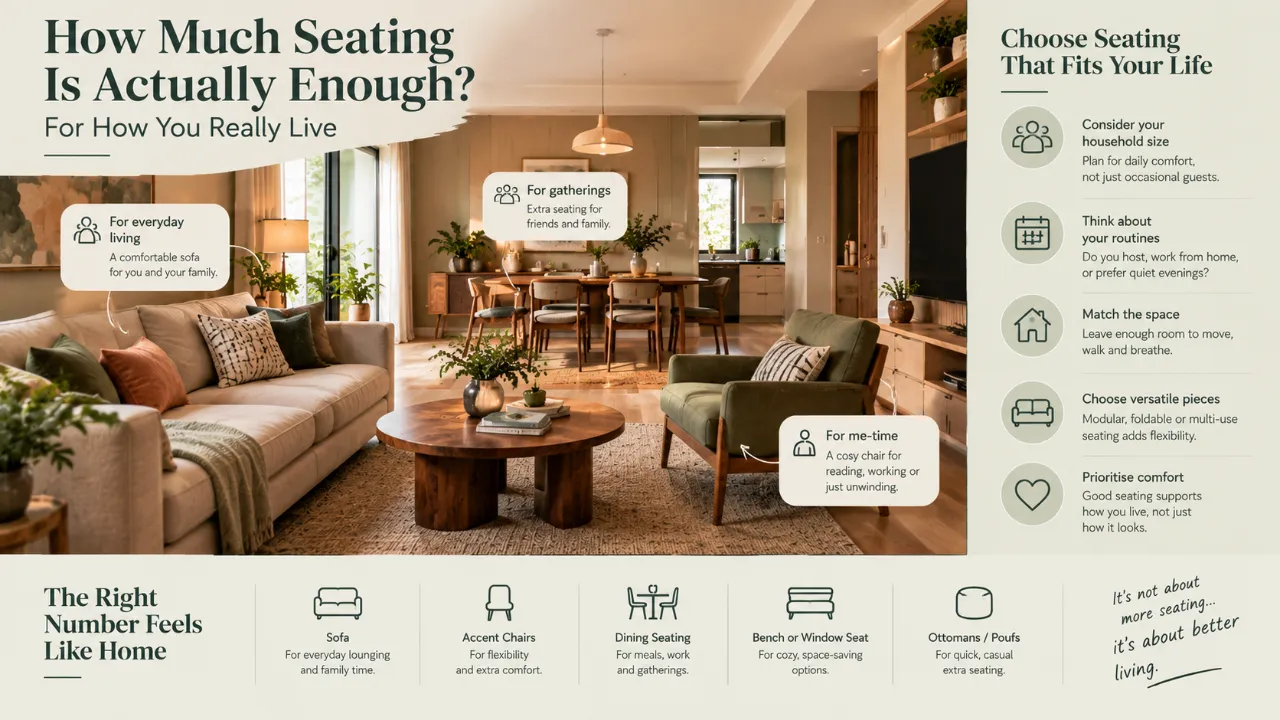
Seating That Fits: How Much Is Enough at Home?
“How many seats should I have?”
It sounds like a simple question.
But real homes are not that simple.
Someone works from the sofa. Children sit on the floor. Friends come over. People gather around the coffee table. Sometimes the whole household wants the same room, and sometimes everyone wants a different corner.
The better question is:
How do people actually use this room?
- Start with the household
- Daily seating vs maximum seating
- Three seating levels
- Planning sofa capacity
- Protect circulation
- Small vs large living rooms
- Match seating to activities
- Plan for guests
- Flexible seating options
- Do not forget dining and kitchen seating
- Run a seating audit
- Use the “enough seating” test
Start With Your Household, Not the Furniture Catalogue
Begin with the people who use the home every day.
- How many adults?
- How many children?
- Does anyone regularly work from home?
- Do grandparents spend long periods in the living room?
- Does someone prefer a separate reading chair?
- Do people sit together or occupy different parts of the room?
This gives you more useful information than simply saying, “We are a family of four.”
Your Daily Seating Number Is Different From Your Maximum Seating Number
A household of four may need four comfortable everyday seats, but that does not necessarily mean it needs ten permanent seats just because six guests occasionally visit.
Flexible guest capacity can come from occasional chairs, poufs, benches, movable dining chairs, stools or floor cushions.
Think in Three Seating Levels
Everyday Seating
The seats your household uses regularly.
Flexible Seating
Pieces that can move or be added when needed.
Occasional Seating
Extra pieces used primarily during larger gatherings.
The Sofa Is Not the Same as Number of People
A three-seater sofa does not always mean three people will comfortably use it.
Actual comfort depends on seat width, armrest width, seat depth, cushion construction and how people actually sit.
Instead of relying only on a manufacturer's seating label, consider whether one person likes to stretch out, whether two people want more personal space and how many people regularly sit together.
Do Not Buy the Largest Sofa That Fits
You measure the wall, find a sofa that technically fits and assume the decision is solved.
Then the coffee table is too close, the walkway becomes narrow, the armchair no longer fits or access to a balcony becomes awkward.
Leave Room for Circulation
Seating planning should always happen alongside circulation planning.
People need to walk behind furniture, reach doors and balconies, get to side tables, stand up without disturbing others and move between seating groups.
Do not use every available centimetre for seating.
Empty space is part of the seating plan.
A Smaller Room Often Needs Fewer, Better Seats
Compact rooms can become uncomfortable very quickly when too many seating pieces are added.
A more successful arrangement may be a compact sofa, one light occasional chair, one flexible pouf and a smaller coffee table.
A Large Room Has the Opposite Problem
A large room can have enough floor area but still feel awkward when all the seating is concentrated in one place.
Large rooms often benefit from multiple seating groups rather than one oversized furniture island.
Conversation Seating and Television Seating Are Not Always the Same
If a room is primarily for television, seating may naturally orient toward the screen. If it is primarily for conversation, seats may work better facing or angling toward each other.
If the room needs to do both, plan for a compromise that allows multiple activities.
| Primary Activity | Seating Priority |
|---|---|
| TV Viewing | Comfortable seats with clear screen orientation |
| Conversation | Seats facing or angled toward one another |
| Reading | Dedicated, supportive individual seat |
| Entertaining | Everyday seating plus flexible guest capacity |
| Work | Upright, supportive seating with suitable table or surface |
Do Not Count Every Chair as “Living Room Seating”
A decorative accent chair that is uncomfortable and rarely used should not automatically be counted as useful seating.
Ask whether someone would voluntarily sit there for an hour, whether it suits the activity and whether it sits naturally within the room.
Think About Who Sits Where
Different users may have different preferences.
One person may like a deep sofa. Someone else may prefer a firmer armchair. An older family member may prefer easier entry and exit. A child may prefer a lower seat.
A living room does not need identical seating for everyone.
It needs appropriate seating for the people who use it.
Seating Needs Change by Time of Day
Morning may involve one or two people with tea. Afternoon may involve work or reading. Evening may bring the whole household together. Weekends may include guests.
Moveable chairs, ottomans and stools can increase flexibility without permanently increasing furniture density.
Plan for Guests Without Designing the Entire Room Around Them
A useful question is:
A home that hosts large gatherings every weekend needs a different strategy from one where a few friends visit every couple of months.
For occasional entertaining, flexible seating can often be more practical than permanent extra furniture.
Benches Can Increase Flexibility
Benches can accommodate several people, move between rooms, work at dining areas and provide temporary seating during gatherings.
They should still be designed around comfort and access. A decorative bench is not automatically equivalent to a comfortable long-term seat.
Poufs and Ottomans Are Useful Flexible Seats
Poufs can act as extra seating, footrests, temporary surfaces or visual accents.
Because they can be moved out of the main circulation area when not needed, they can be particularly useful in homes that need occasional guest capacity without permanent crowding.
Floor Seating Can Count — But Only If Your Household Uses It
Floor cushions, low stools and informal seating can work beautifully in some homes.
They should not be included simply to increase the number on paper. If nobody sits on the floor, it is decorative capacity rather than functional capacity.
Seating Height Matters
A lower lounge chair encourages a different posture from an upright dining chair. A deep sofa creates a different experience from a firm occasional chair.
When combining seating types, make sure they suit the activities taking place in the space.
The Best Seat Is Often the One That Faces Another Seat
Furniture arrangement influences whether people actually interact.
Two chairs angled toward each other create a natural conversation point. A chair facing directly into a wall does not.
Think about who can see whom, who can speak comfortably, who can place a drink nearby and who can get up without crossing another person.
Coffee Tables Affect Seating More Than You Think
You can have the perfect number of seats and still have a poor arrangement because the coffee table is oversized.
The table should support the seating group without making it difficult to reach or stand up.
Side Tables Are Part of the Seating Plan
Regularly used seats need somewhere to place a drink, phone, book or remote.
That does not mean every chair needs a large side table. A small occasional table, shared surface or well-placed console can be enough.
How Many Seats Does a Typical Living Room Actually Need?
There is no universal number.
Couple
Often around two everyday seats plus one flexible seat, depending on how the room is used.
Family of Four
Often around four everyday seats plus one or two flexible seats when the household regularly gathers together.
Frequent Hosts
Everyday seating plus moveable occasional seating and access to nearby dining or auxiliary seating.
These are planning examples, not fixed furniture prescriptions.
Match Seating to the Room's Real Function
| Room Use | Seating Approach |
|---|---|
| TV-Focused Living Room | Sofa or sectional oriented toward screen plus flexible seating |
| Conversation-Focused Room | Seats facing or angled toward each other |
| Family Room | Comfortable everyday seating plus flexible pieces |
| Formal Sitting Room | More structured paired seating |
| Small Apartment | Compact sofa plus one or two flexible seats |
| Frequent Entertaining | Everyday seating plus moveable guest seating |
| Multi-Use Room | Seating that can shift between activities |
Think About Dining Seating Separately
Dining areas need their own logic.
Consider how many people live in the home, how often they eat together, whether guests are common and whether the dining table is also used for homework or work.
The table should provide enough regular seating without creating a constant obstacle in circulation.
Do Not Forget the Kitchen
In many homes, the kitchen becomes a secondary social space.
A breakfast counter or small perch can be useful when people genuinely sit there while cooking, eating or working.
Counter Seating Is Not Automatically Extra Seating
An island with four stools sounds like four additional seats, but if the stools are rarely used, they mostly consume space.
Before adding them, ask whether people eat or work there, whether there is enough legroom and whether circulation remains comfortable.
Seating Capacity Should Follow Storage and Circulation
Extra chairs need somewhere to go when they are not needed. Poufs need a parking location. Foldable or stackable chairs need storage.
Seating planning therefore connects to the wider room strategy.
Think About Future Changes
Households change. Children grow. Work patterns change. Families expand. Hosting habits evolve.
Choose seating arrangements that can adapt without requiring the entire room to be redesigned.
The Biggest Seating Mistakes
- Buying based on headcount alone
- Buying the biggest sofa that fits
- Designing for rare parties
- Counting decorative chairs as useful seating
- Ignoring circulation
- Making every seat face the TV
- Forgetting flexible seating
- Using too many matching pieces
A Quick Seating Audit
Who?
Who will use the seat?
How Often?
How frequently will it actually be used?
For What?
What activity does it support?
Where?
Where will it go without disrupting the room?
When Not in Use?
What happens to the piece when guests leave?
Worth the Space?
Does it improve the room enough to justify its footprint?
The “Enough Seating” Test
Daily use: Everyone who regularly needs a seat can sit comfortably.
Guest flexibility: A reasonable number of visitors can be accommodated without permanently crowding the room.
Conversation: People can see and speak to one another naturally.
Circulation: People can move through the room without constantly navigating around furniture.
Adaptability: At least some seating can move or serve more than one purpose.
The Goal Is Not Maximum Seating
The right amount of seating is not the maximum number of people you could possibly fit into a room.
It is the amount that supports the way your household actually lives.
Design the Seating Around Real Life
A well-planned room begins with understanding how people use the space, then choosing furniture that supports those habits without overwhelming the room.
Explore Design My Room, estimate your Interior Design Cost, or explore Interior Designers.
The Final Takeaway
Start with everyday users. Then consider how they sit, what activities happen in the room, how often you host, how much flexible seating you need and how much circulation space must remain.
A beautifully furnished living room is not successful because every corner contains a chair.
Before buying another seat, ask: “Is this filling a real need, or am I just filling space?”
Frequently Asked Questions
A family of four will often want at least four comfortable everyday seats if they regularly gather together, with additional flexible seating depending on guests and room use.
Not necessarily. Actual comfort depends on seat width, depth, armrests, cushion design and how people use the sofa.
For occasional guests, flexible seating such as poufs, stools, benches or movable chairs can be more practical than permanently filling the room with extra furniture.
There is no single clearance that suits every room. Allow enough space for people to sit, stand, reach tables, move around furniture and access doors and circulation paths comfortably.
It depends on the room and how the household uses it. A sectional can provide substantial everyday seating, while a sofa-and-chair arrangement may offer more flexibility in some spaces.
It can provide an occasional seat, but it should not automatically be counted as equivalent to comfortable living-room seating. Consider whether it suits the activity and duration of use.
Prioritise a correctly scaled sofa and use lightweight, movable pieces such as one occasional chair, poufs or stools rather than adding several large permanent furniture pieces.
Turn this idea into a plan for your home
Visualise your space, understand the likely budget, or find a professional who can bring the idea to life.