
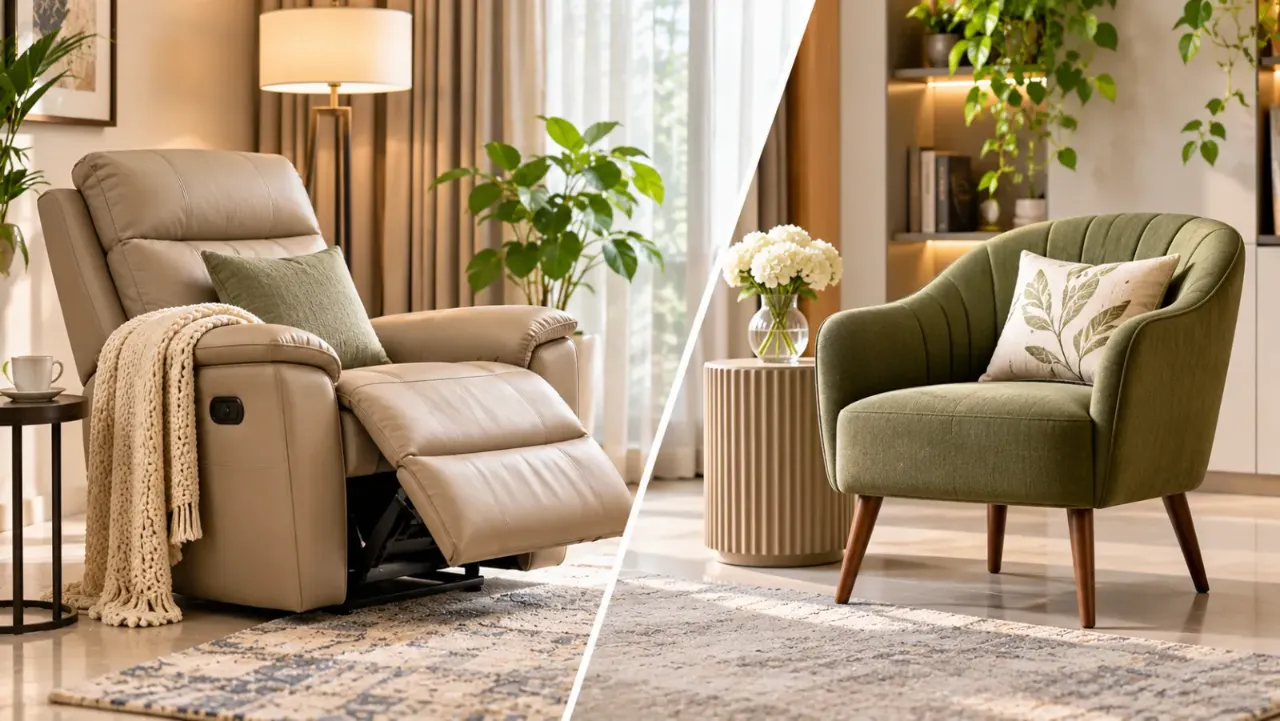
Recliners and Accent Chairs: Where They Fit
A living room does not always need another sofa. Sometimes, a single well-chosen chair can make the space more comfortable, create a quiet corner or complete an otherwise unfinished seating arrangement.
Recliners and accent chairs are two popular options, but they serve different purposes. A recliner is primarily designed for adjustable comfort, while an accent chair adds seating along with a distinct visual element. Some chairs combine both qualities, but their space requirements and everyday uses can still differ.
The right choice depends on how you use the room, who will use the chair and how much space is available around it. Here is how to decide where each type of seating belongs.
1. Understand the Difference Between a Recliner and an Accent Chair
Before choosing a chair, consider what you expect it to do.
Recliners: Seating Designed for Relaxation
A recliner allows the user to change the backrest position and, in many models, raise a footrest. Depending on the mechanism, it may offer manual or powered adjustment.
It is particularly useful for:
- Watching television for extended periods.
- Relaxing after work.
- Reading or resting in a supported position.
- Providing a comfortable individual seat.
- Supporting people who prefer adjustable seating positions.
Recliners are available in different styles, including single-seat models, wall-hugger designs, swivel recliners and powered versions. Some are compact, while others have wide arms and substantial footrests.
Accent Chairs: Seating That Adds Character
An accent chair is an additional chair selected to complement or contrast with the main furniture. It may introduce a different colour, material, shape or design style.
It is useful for:
- Adding one more seat to a living room.
- Creating a reading corner.
- Filling an unused corner without adding another sofa.
- Providing occasional seating in a bedroom.
- Bringing colour or texture into a neutral interior.
Accent chairs are available in many forms, including barrel chairs, wingback chairs, slipper chairs, upholstered armchairs and wooden-frame chairs.
| Feature | Recliner | Accent Chair |
|---|---|---|
| Main purpose | Adjustable relaxation | Additional seating and visual interest |
| Movement | Backrest and footrest may adjust | Usually fixed |
| Space requirement | Needs allowance for reclining | Usually needs a simpler seating footprint |
| Typical placement | TV area or personal relaxation zone | Living room, bedroom or reading corner |
| Design role | Comfort-focused feature | Decorative and functional element |
2. Where Recliners Work Best
A recliner is most useful when it has a clear purpose rather than being placed simply because there is an empty space.
Living Room TV Area
This is one of the most natural locations for a recliner. It can be positioned near the main sofa to create a comfortable viewing seat.
Consider the viewing angle, distance from the television and the position of other seating. The recliner should not block the main walking route or make it difficult for others to move around the room.
Dedicated Relaxation Corner
A recliner can also create an individual relaxation zone in a larger living room.
Place it beside a suitable floor lamp or side table, leaving enough space for the footrest to extend. This arrangement works well when someone in the household regularly uses the chair for resting or reading.
Bedroom Seating Area
In a spacious bedroom, a recliner can create a separate seating area away from the bed.
It may work near a window or in an unused corner, provided it does not interfere with wardrobe doors, bedside access or movement around the room.
A large recliner is not always suitable for a compact bedroom. Check the full operating footprint before selecting one.
Home Theatre or Media Room
A recliner can be a practical choice for a dedicated entertainment room, especially when the room is designed around individual seating.
Multiple recliners may require careful planning for viewing angles, access between seats, power connections and the movement of footrests.
3. Where Accent Chairs Work Best
Accent chairs are more flexible because many designs do not need a reclining mechanism or additional operating clearance.
Beside the Main Sofa
An accent chair can complete a living-room seating arrangement without adding another full-size sofa.
It can face the sofa, sit at an angle towards the coffee table or form a conversation arrangement with the existing seating.
Choose a chair that complements the sofa in scale and style. It does not have to match exactly.
Reading Corner
A comfortable accent chair can turn an unused corner into a small reading area.
Pair it with:
- A suitable reading lamp.
- A compact side table.
- A small rug, if space permits.
- A cushion or throw for additional comfort.
The chair should be comfortable enough for the intended duration of use. A beautiful but shallow or poorly supported chair may not work well for extended reading.
Bedroom Corner
An accent chair can provide a convenient place to sit while dressing, reading or keeping a bag temporarily.
A smaller upholstered chair or wooden-frame design may work well near a window or beside a dresser, provided it does not obstruct circulation.
Entryway or Open Hallway
In a sufficiently wide entrance area, a compact accent chair can provide a convenient place to sit while putting on shoes or waiting.
However, the chair should not narrow the entrance route or interfere with door movement.
Home Office
An accent chair can create a separate informal seating spot for reading, taking a break or having a conversation.
It should not replace an ergonomically suitable work chair for long desk sessions.
4. How to Choose the Right Chair for Your Room
The decision should begin with the room's function, not the chair's appearance.
| Your Requirement | More Suitable Choice | Why |
|---|---|---|
| Relaxing with raised legs | Recliner | Adjustable backrest and footrest |
| Watching television comfortably | Recliner | Supports a relaxed viewing position |
| Adding a contrasting design element | Accent chair | Offers more variety in shapes and finishes |
| Creating a small reading corner | Either | Depends on comfort and available space |
| Adding occasional guest seating | Accent chair | Often simpler to position and move |
| Creating a dedicated media room | Recliner | Designed for individual relaxation |
| Adding a seat beside a bedroom window | Accent chair | Many designs have a smaller operating footprint |
A useful rule is to choose a recliner when adjustable comfort is the main requirement. Choose an accent chair when you want flexible additional seating and a stronger design element.
5. What to Check Before Placing a Recliner
A recliner needs more than enough floor area for its closed position. Its mechanism may move backwards, forwards or both, depending on the model.
Before buying, check:
- The chair's closed and fully reclined dimensions.
- The clearance required behind the backrest.
- The footrest's full extension.
- Whether the model is a wall-hugger or needs additional rear space.
- Access to the power socket for an electric recliner.
- Whether the chair can be moved through the doorway and lift.
- Whether side tables or other furniture will obstruct the mechanism.
Always use the manufacturer's clearance requirements rather than assuming that all recliners need the same amount of space.
6. What to Check Before Buying an Accent Chair
Accent chairs may have fewer mechanical requirements, but comfort and proportion still matter.
Look at:
- Seat height and depth.
- Back support and armrest position.
- Upholstery material and ease of cleaning.
- Frame stability and construction.
- Whether the chair is comfortable for its intended use.
- How its colour and texture work with the existing room.
- Whether the chair can be moved easily when the layout changes.
If possible, sit on the display model. A chair can look attractive in a photograph but feel uncomfortable when used.
7. Styling Ideas That Make Both Chairs Work
The chair should feel connected to the rest of the room rather than appearing like an unrelated purchase.
Match One Element, Not Everything
An accent chair does not need to match the sofa. You can connect them through a shared colour, wood finish, metal detail or upholstery texture.
For example, an olive-green chair can complement a neutral sofa with green cushions, while a tan leather recliner can work with darker wood furniture.
Use Lighting to Define the Seating Zone
A floor lamp near an accent chair can make a reading corner feel intentional. A side table and suitable task lighting can also make the chair more useful.
For a recliner, ensure the lamp and table remain accessible without interfering with the chair's movement.
Keep the Main Walking Route Clear
Do not let a chair obstruct the route between the entrance, sofa, balcony or other frequently used areas.
The arrangement should feel comfortable even when the recliner is fully extended.
Avoid Overfilling the Room
One recliner or accent chair may be enough. Adding several individual seats without a clear seating plan can make a room feel crowded.
8. Common Mistakes to Avoid
Choosing a Recliner Only for Its Appearance
A recliner should provide the comfort and adjustment you need. Check the mechanism and seating position before making a decision.
Ignoring the Recliner's Extended Position
A chair that fits when closed may block a walkway or hit a table when fully reclined.
Treating Every Accent Chair as a Reading Chair
Some accent chairs are designed mainly for occasional seating. Check the seat depth, back support and comfort before using one for long reading sessions.
Selecting a Chair That Is Too Large
A bulky chair can overpower a compact living room or bedroom, even if its design is attractive.
Buying Without Considering the Existing Furniture
The chair's shape, height, upholstery and finish should work with the surrounding furniture.
Forgetting Delivery Access
Measure doorways, corridors, staircases and lifts. A chair that fits the room may still be difficult to bring inside.
9. A Quick Buying Checklist
Before ordering, confirm the following:
- Decide whether you need adjustable relaxation or additional seating.
- Identify the intended room and location.
- Measure the available space.
- Check the recliner's fully extended dimensions, if applicable.
- Confirm the manufacturer's operating clearance.
- Test seat comfort and back support.
- Check upholstery, frame and mechanism quality.
- Coordinate the chair with the existing furniture.
- Check delivery access and installation requirements.
- Review warranty and maintenance instructions.
Final Thoughts
Recliners and accent chairs can both improve a home's seating arrangement, but they should not be selected for the same reason.
A recliner is best when adjustable comfort and relaxation are priorities. An accent chair is useful when you need flexible seating, a reading spot or an additional design element.
The best choice is the one that supports the way you use the room without disrupting movement or making the space feel crowded. Start with the purpose, check the available space and then choose a design that fits naturally into your home.
Frequently Asked Questions
1. Can a recliner be used in a small living room?
Yes, but the model and operating clearance matter. Consider a compact or wall-hugger recliner and check its full reclining dimensions before purchasing.
2. Are accent chairs only decorative?
No. Accent chairs provide functional seating as well as visual interest. Their comfort depends on the design, seat depth, back support and upholstery.
3. Can I place a recliner next to a sofa?
Yes. A recliner can sit beside a sofa if there is sufficient room for its movement and people can still walk around the seating arrangement.
4. Can an accent chair replace a recliner?
It can provide additional seating, but it cannot offer the same adjustable reclining function unless it is specifically designed with that feature.
5. Which chair is better for a reading corner?
Either can work. An accent chair with good back support and suitable seat depth is often sufficient. A recliner may suit someone who prefers adjustable positions.
6. Can an accent chair be placed in a bedroom?
Yes. It can work near a window, beside a dresser or in an unused corner, provided it does not obstruct movement or storage access.
7. What upholstery is suitable for recliners and accent chairs?
The choice depends on use and maintenance. Fabric offers a wide range of textures, while leather and leather-like materials can be easier to wipe clean. Check the manufacturer's care instructions and the suitability of the material for your household.
8. Should a recliner match the sofa?
No. It can complement the sofa through colour, texture or finish without being an identical match. The overall combination should feel balanced.
Make Better Furniture Decisions with Walls to Wonder
Explore design possibilities, plan your rooms and make informed decisions for your home with Walls to Wonder's AI tools.
- Whole Home Visualizer – Visualise design ideas across your home.
- Design My Room – Explore design possibilities for an individual room.
- Interior Design Cost Estimate – Get an initial estimate for your interior project.
- Interior Quotation Checker – Review the details in an interior quotation.
- Rate My Room Design – Get feedback on your room design.
- Interior Style Finder – Explore styles that suit your preferences.
Explore more at Walls to Wonder.
Turn this idea into a plan for your home
Visualise your space, understand the likely budget, or find a professional who can bring the idea to life.