
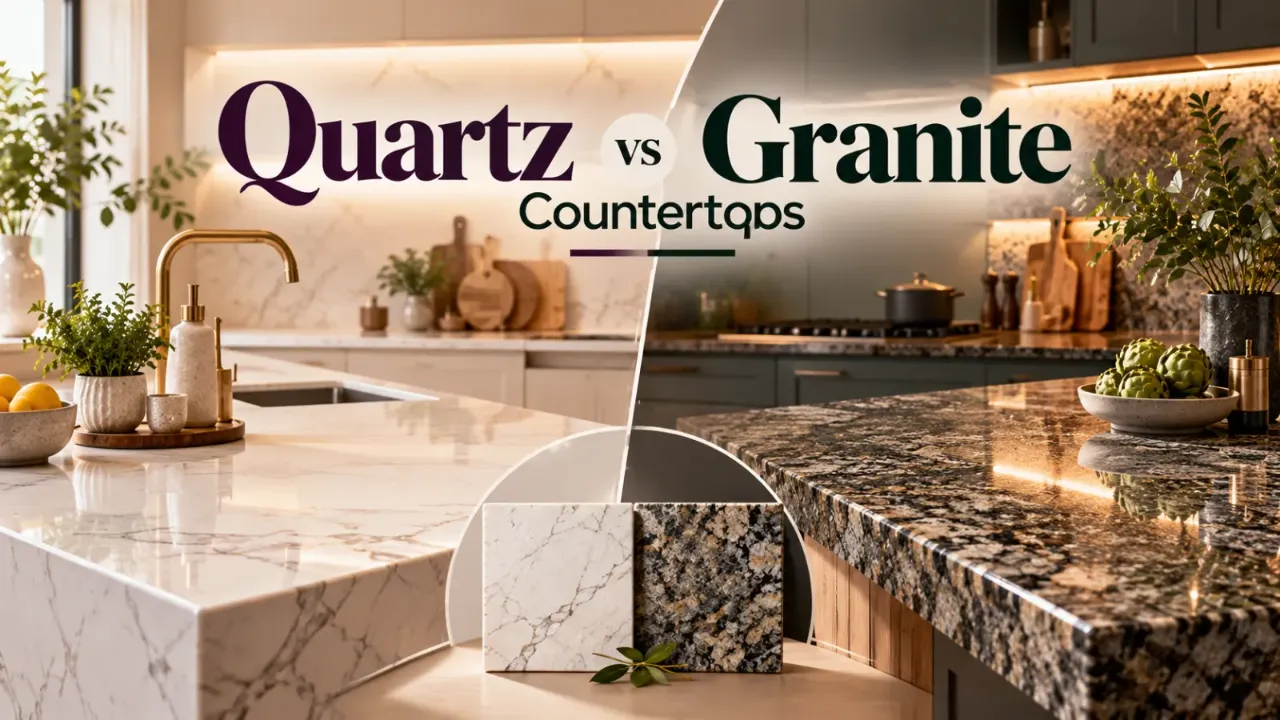
Quartz vs Granite Countertops
Choosing a countertop is one of those decisions that looks simple in a sample showroom and becomes more complicated once cooking habits, cleaning routines, edge details and the rest of the kitchen are considered. The two materials most Indian homeowners usually compare are quartz and granite.
This guide explains quartz vs granite in practical terms. It covers daily use, appearance, maintenance, heat, stains, repairs, room-by-room suitability, pricing factors and the details that should appear in an interior quotation. It is also useful if you are comparing designers and companies serving your area, rather than choosing a surface in isolation.
Quartz vs granite: the short answer
Quartz is an engineered surface made using natural quartz particles and binding materials. Granite is a natural stone cut from large slabs, with each slab showing its own mineral pattern. Both can work well in Indian kitchens when they are correctly specified, fabricated and installed.
Quartz is often chosen for consistent colour, low routine maintenance and a contemporary, controlled look. Granite appeals to homeowners who prefer natural variation, a stone-like character and a surface that can tolerate normal kitchen use. Neither is automatically the right choice for every home.
Core comparison at a glance
| Factor | Quartz | Granite |
|---|---|---|
| Material character | Engineered surface with more predictable colour and pattern. | Natural stone with variation between slabs and sometimes within one slab. |
| Appearance | Useful for uniform modern, plain or marble-inspired schemes. | Useful when a natural, one-of-a-kind pattern is part of the design. |
| Routine cleaning | Usually straightforward with prompt wiping and suitable mild cleaning. | Also straightforward, but porous varieties may need appropriate sealing and care. |
| Heat | Should be protected from very hot cookware and sudden heat exposure. | More tolerant of normal kitchen heat, but trivets remain sensible. |
| Stains and spills | Generally resistant to everyday staining, though spills should not be left indefinitely. | Resistance depends on stone characteristics and sealing; porous stone needs more care. |
| Repairs | Damage at edges or cut-outs can be difficult to disguise. | Chips and cracks may be repairable, but matching depends on the stone and damage. |
| Cost | Depends on brand, range, thickness, finish, cut-outs and installation. | Depends heavily on stone selection, slab grade, thickness, finish, wastage and fabrication. |
Kitchen decisions: where the difference matters most
Quartz in an Indian kitchen
Quartz suits kitchens where the homeowner wants a calm, coordinated surface across the counter, breakfast ledge and perhaps a backsplash. It works particularly well with flat-panel shutters, warm wood finishes and compact kitchens that benefit from a visually continuous colour. A light quartz can brighten a darker kitchen, but the selected finish should still be checked against turmeric, tea, coffee and oil spills.
Do not treat quartz as heat-proof simply because it is hard. Place hot pans on trivets, avoid dragging heavy cookware across the surface and follow the fabricator’s care instructions. The area around a hob, sink and dishwasher deserves special attention because cut-outs and joins are more vulnerable than the uninterrupted slab.
Granite in an Indian kitchen
Granite is a strong option for homeowners who like natural movement in the worktop. Dark granite can be forgiving around active cooking zones, while lighter varieties can support a bright kitchen if the pattern is not too visually busy. The slab’s actual grain direction, shade and variation should be approved before fabrication.
Ask whether the selected stone needs sealing, how often the installer recommends reviewing that seal and which cleaning products should be avoided. A natural stone’s performance depends not only on its name but also on its porosity, finish, thickness, support and workmanship.
Room cards: choosing the surface for different project requirements
Kitchen
Prioritise stain response, heat habits, sink and hob cut-outs, edge strength and ease of cleaning. Quartz is convenient for a consistent scheme; granite is compelling when natural variation is welcome.
Utility and pantry
These areas often handle wet clothes, cleaning supplies and less formal storage. A practical granite or quartz remnant may work, but confirm chemical compatibility and avoid selecting only on leftover availability.
Living spaces
For a bar counter, console or serving ledge, appearance may carry more weight than heavy cooking performance. Match the surface to lighting and adjacent flooring; a busy granite pattern can compete with patterned tiles or wallpaper.
Bedrooms and dressing areas
Quartz can create a controlled, furniture-like finish for a dressing island or vanity. Granite can add a natural note, but check the slab pattern against wardrobe shutters and mirror reflections.
Renovation work
Existing walls and cabinets may not be perfectly square. Confirm site measurements, dismantling, plumbing changes and the method for supporting the new slab before finalising a replacement.
Complete interiors
Ask the designer to coordinate the countertop with shutters, handles, backsplash, flooring, lighting temperature and appliances. A beautiful slab can look disconnected if the surrounding palette is not resolved.
How to compare designers and companies serving the area
A designer’s role may include concept development, space planning, material selection, drawings, vendor coordination, site supervision and handover. Some firms handle only design; others manage procurement and execution. Compare the service scope before comparing a headline fee.
- Review relevant interior design projects and ask which parts were designed, supplied or installed by the team.
- Check whether the proposal includes site measurement, detailed drawings, material samples, fabrication coordination and installation supervision.
- Compare the same countertop brief across proposals: material family, thickness, finish, edge profile, backsplash, sink type, cut-outs and installation.
- Ask how changes are recorded. A written variation process is more useful than an informal promise that small revisions will be managed later.
- Use the designer directory and browse companies serving homeowners with a clear brief, then ask direct questions before shortlisting.
Pricing: what actually changes the countertop budget?
There is no responsible single price for quartz or granite without a defined scope. The material rate is only one part of the calculation. A smaller kitchen may still cost more per usable area if it has several corners, cut-outs, joins or a difficult access route.
- Selected material range, slab availability and whether the slab is locally sourced or specially ordered.
- Thickness, finish, edge profile and the amount of visible front or waterfall detailing.
- Counter length, depth, number of corners, joins, backsplash height and side panels.
- Sink, hob, tap and socket cut-outs, including whether the sink is top-mounted, flush or under-mounted.
- Wastage caused by the slab layout, pattern matching and grain direction.
- Transport, lifting, staircase or service-lift access, dismantling and disposal of the existing counter.
- Cabinet strengthening, wall corrections, plumbing changes and site protection.
- Taxes, installation, sealing where applicable, polishing and post-installation inspection.
Use AI tools to organise the comparison
Digital tools cannot inspect a slab or replace a site measurement, but they can help you structure the early conversation. Use an estimate as a planning reference, then validate it against drawings, measurements and supplier terms.

Cost estimator
Use it to think through scope before requesting quotations. Keep the countertop material, area, fabrication details and related cabinetry as separate questions when you speak with a designer.

Quotation checker
Use the result as a prompt for follow-up questions. It is not a substitute for reading the agreement, confirming measurements or obtaining technical advice on installation.
You can also gather references through design ideas, save suitable posts and guides, or use Design My Room to clarify the wider look before choosing a stone.
Quotation details that should not be vague
Before approving the work, request a material schedule and a countertop drawing. The document should identify the selected material or an agreed equivalent, slab thickness, finish, edge treatment, backsplash, dimensions, cut-outs, joins and installation responsibility.
For granite, ask how the slab will be selected and whether you can approve the actual slab before cutting. For quartz, ask for the product range, finish and care guidance rather than accepting a colour name alone. Confirm who owns the risk if a slab breaks during cutting or if an appliance measurement changes after fabrication.
A useful quotation also states payment stages, lead time assumptions, delivery conditions, warranty or defect-handling terms and the process for variations. Keep the final drawing and approved sample with the quotation.
Red flags before paying an advance
- A very low headline rate that excludes cut-outs, edge work, transport or installation.
- Pressure to choose from a small sample without showing the full slab or a clear equivalent policy.
- No site measurement or drawing despite a complex kitchen, renovation or uneven wall condition.
- Unclear responsibility for sink fitting, plumbing, cabinet support, sealing or appliance coordination.
- Verbal assurances about heat, stain resistance or warranty that do not appear in the written scope.
- A large advance requested before material, timeline, deliverables and cancellation or variation terms are clear.
These are reasons to pause and ask for clarification, not automatic proof of poor workmanship. A transparent designer should be able to explain what is included and what is not.
Questions to ask before signing
- Which exact material, range, thickness and finish are included?
- Can I inspect or approve the actual granite slab, or confirm the quartz sample and batch?
- How many joins and cut-outs are expected, and where will they be placed?
- Is the backsplash included? What height and edge finish are specified?
- Who measures the appliances, sink and hob, and what happens if dimensions change?
- Does the price include transport, lifting, installation, polishing, sealing and taxes?
- What support is required for overhangs, breakfast counters or heavy accessories?
- Who handles chips, cracks, incorrect fabrication or damage during installation?
- What is the expected sequence with cabinetry, plumbing, backsplash and appliances?
- Which payment milestone follows measurement, slab approval, fabrication and installation?
Make the final choice with your own habits in mind
If your kitchen sees frequent frying, pressure cooking, strong spices and several people working at once, focus on cleaning behaviour, hot-pan habits, joins and edge protection. If the kitchen is compact and visually busy, a more consistent quartz pattern may help. If the rest of the room is restrained and you want the counter to provide natural character, granite may be the better visual decision.
Look at the sample in daylight and under the actual kitchen lighting. Place it beside the cabinet shutter, backsplash and floor sample. Check how the front edge feels in use, whether the pattern makes crumbs visible and whether a seam would fall near the sink or hob. These small observations can matter more than a broad material ranking.
For the wider home, use Find My Style to describe the direction you prefer and ask the AI interior assistant for questions to take into a designer meeting. You can then compare the response with real drawings and samples.
Plan your countertop decision with WallsToWonder
Start by collecting design references, define the kitchen or renovation scope and compare quotations line by line. Browse design ideas, explore projects, and review designers and companies serving your area. Use the cost estimator and quotation checker to prepare better questions before you commit.
If you need more context, return to the WallsToWonder posts and guides and save the materials that match your brief. A considered comparison now can prevent an expensive mismatch later.
Frequently asked questions
1. Is quartz better than granite for an Indian kitchen?
Not universally. Quartz offers consistent appearance and convenient routine care, while granite provides natural variation and strong general-purpose performance. Cooking habits, slab quality, installation and maintenance should decide the choice.
2. Can I place hot vessels directly on quartz?
It is safer to use a trivet and avoid sudden or prolonged heat exposure. Follow the manufacturer’s care guidance, especially near joints, edges and cut-outs.
3. Does granite need sealing?
Some granite varieties may benefit from sealing, depending on porosity, finish and installer guidance. Ask which treatment is required, how it should be maintained and whether it is included in the quotation.
4. Which countertop is easier to keep clean?
Both can be practical with prompt wiping and suitable cleaning products. Quartz is generally chosen for low routine maintenance; granite care depends more on the stone’s characteristics and sealing.
5. What should I compare in two countertop quotations?
Compare the actual material, thickness, dimensions, wastage, cut-outs, joins, edge profile, backsplash, transport, installation, taxes, support work, timeline and defect-handling terms—not just the rate per square foot.
Turn this idea into a plan for your home
Visualise your space, understand the likely budget, or find a professional who can bring the idea to life.