
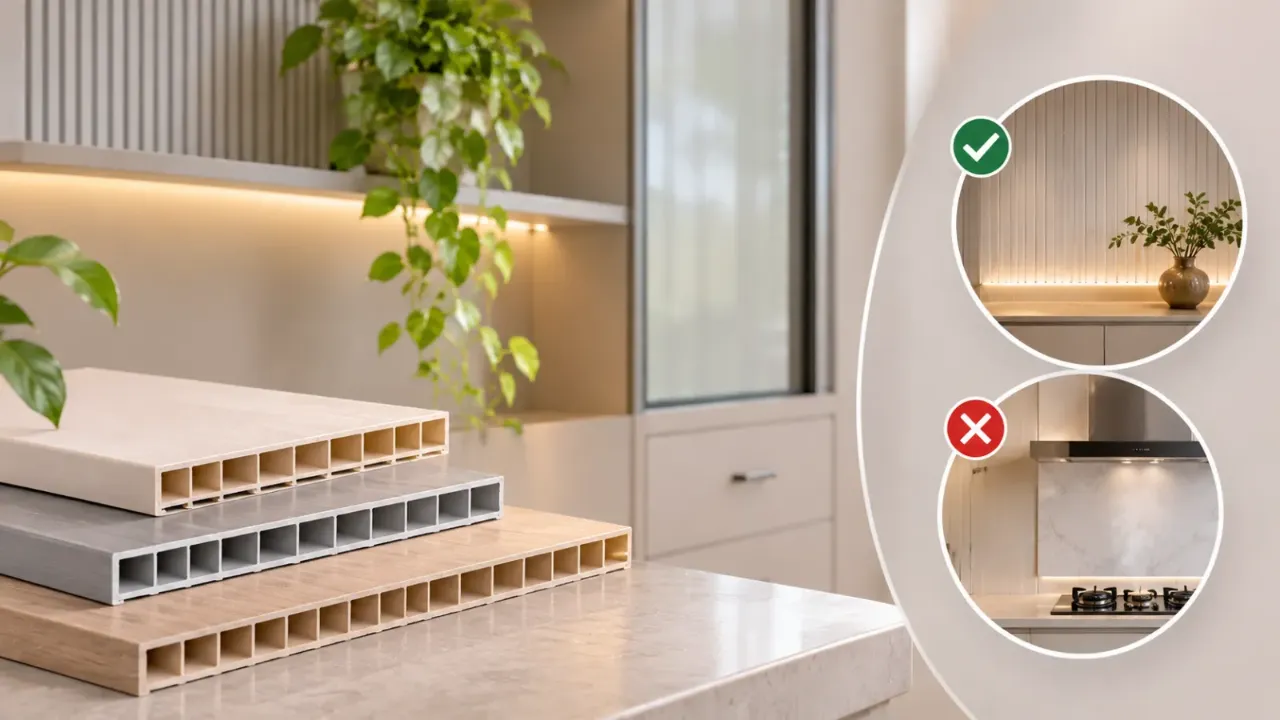
Polyvinyl Chloride in Interiors: Where It's Safe and Where to Avoid It
Polyvinyl chloride, commonly known as PVC, is used in more parts of a home than many people realise. It can be found in plumbing pipes, electrical conduits, wall panels, ceiling systems, flooring, window frames, furniture components and decorative finishes.
Its popularity comes from practical qualities such as moisture resistance, low maintenance, versatility and relatively easy installation. However, PVC is not one uniform material. Some products are rigid, while others are flexible and contain plasticisers. Their composition and performance can vary considerably.
This is why the question should not simply be whether PVC is safe or unsafe. It is more useful to understand which PVC product is being used, where it will be installed, how it is manufactured and what conditions it will be exposed to.
1. What Is Polyvinyl Chloride?
Polyvinyl chloride is a synthetic thermoplastic polymer. It is commonly shortened to PVC and is used to manufacture products with different levels of flexibility, strength and surface finish.
The two broad categories are:
Rigid PVC (uPVC)
Rigid PVC, often called unplasticised PVC or uPVC, is made without the conventional plasticisers used to make flexible PVC.
It is used in products such as:
- Plumbing and drainage pipes
- Electrical conduits
- Window and door frames
- Rigid wall and ceiling panels
- Selected cabinetry and furniture components
Its rigidity makes it suitable for applications where a stable shape is required.
Flexible PVC
Flexible PVC contains plasticisers that make it softer and more pliable. The type and quantity of additives can vary depending on the product.
It may be used in:
- Vinyl flooring
- Flexible wall coverings
- Cable insulation and sheathing
- Some upholstery and coated fabrics
- Flexible trims and accessories
Because the formulation can differ, flexible PVC products deserve particular attention when assessing indoor exposure and product specifications.
2. Why Is PVC Used in Home Interiors?
PVC is popular because it offers several practical benefits.
- Moisture resistance: Certain PVC products perform well in damp conditions because the material itself does not absorb water in the same way as many wood-based materials.
- Low maintenance: Many finished PVC surfaces can be cleaned with a damp cloth and mild cleaning solution, subject to the manufacturer's instructions.
- Design flexibility: PVC can be manufactured in different colours, textures, patterns and surface finishes.
- Lightweight construction: Some PVC panels and components are easier to handle than heavier alternatives.
- Cost considerations: Certain PVC products can be economical to purchase and install, although the total value depends on quality, lifespan, fitting and replacement requirements.
These advantages make PVC useful in selected applications. They do not mean that every PVC product is durable, low-emission or suitable for every room.
3. Where Can PVC Be Used in Interiors?
The suitability of PVC depends on the product specification and its location.
Plumbing Pipes and Concealed Services
Rigid PVC products are widely used in plumbing and drainage applications where the specific pipe type is approved for the intended service.
They can be a practical choice for concealed water or drainage lines, provided the correct pipe specification, fittings, jointing method and installation practices are followed.
Do not assume that every PVC pipe is suitable for hot water, drinking-water contact or every plumbing application. Check the manufacturer's stated use and applicable product requirements.
Electrical Conduits
PVC conduits are commonly used to protect and route electrical wiring.
Use conduits and accessories designed for electrical applications. The material should have the appropriate product specification and should be installed according to electrical requirements.
Avoid using ordinary decorative PVC pipes as substitutes for electrical conduits.
Wall and Ceiling Panels
Rigid PVC panels are sometimes used as decorative wall cladding and ceiling finishes.
They can be considered in selected dry interior areas or locations where the product is specifically designed for the expected moisture exposure.
Before installation, check:
- Whether the panel is intended for interior or exterior use
- Its fire-performance documentation
- Its temperature limitations
- The backing and fixing system
- The adhesive or mechanical installation method
- Whether access to concealed wiring and services will remain possible
PVC panels should not be assumed to be suitable for every kitchen, bathroom or ceiling simply because they are marketed as waterproof.
Vinyl Flooring
Vinyl flooring is a PVC-based flooring category available in different formats, including sheets, tiles and planks.
Some products are designed for residential use and may offer a practical surface that is easy to clean. However, their composition, wear layer, backing, plasticisers and adhesives can vary.
Before buying, ask for information about emissions testing, product composition, installation requirements and the recommended cleaning method.
Window and Door Frames
Rigid PVC is also used in window and door systems. Its suitability depends on the frame design, reinforcement, hardware, glazing arrangement, weather exposure and installation quality.
For interior applications, check that the frame system is appropriate for the opening and that the product documentation covers the intended use.
Furniture and Decorative Components
PVC may appear in furniture through edge bands, decorative films, coated surfaces, trims and selected panel products.
For example, a membrane kitchen shutter can use a PVC-based decorative film over a prepared board. This is different from a cabinet made entirely from rigid PVC.
Ask the manufacturer to identify the actual substrate, surface film, adhesive and intended application instead of accepting a broad description such as PVC furniture.
4. Where Should You Be More Cautious with PVC?
Some applications need closer scrutiny because of heat, indoor exposure, product formulation or fire considerations.
Near Cooking Appliances and High-Heat Sources
Do not install an ordinary PVC decorative panel directly beside a hob, oven, chimney outlet or another high-heat source unless the specific product is documented as suitable for that location.
Heat can affect the shape, surface finish and performance of some PVC products. A product's moisture resistance does not prove its heat resistance.
Follow the manufacturer's minimum clearances and use a finish specifically approved for the application.
Around Open Flames and Fire-Risk Areas
PVC products should not be treated as fireproof. Their fire performance varies by formulation and product construction.
When PVC burns or undergoes severe thermal decomposition, it can produce dense smoke and hydrogen chloride gas, along with other combustion products depending on the conditions.
For ceilings, wall panels and other extensive interior finishes, check the relevant fire-performance classification and local building requirements. Do not rely on a salesperson's verbal claim that a panel is fire-retardant.
Large Areas of Low-Quality Vinyl Flooring or Wall Covering
Flexible PVC products can contain plasticisers and other additives. Some substances used in PVC products have raised health and environmental concerns.
The actual composition and emissions vary by product. For flooring and wall coverings, ask for credible emissions-testing documentation and details about restricted substances rather than assuming that every vinyl product has the same formulation.
Products with Strong, Persistent Odours
A strong smell is not a reliable test of toxicity, and the absence of an odour does not prove that a product is emission-free.
However, a newly installed product with a persistent, unpleasant smell is a reason to investigate. Check the product documentation, adhesive specification and ventilation requirements. If irritation or symptoms occur, leave the affected area and seek appropriate professional advice.
Products with Unclear Composition or Documentation
Avoid making large interior installations with products that have no identifiable manufacturer, unclear composition or no meaningful product information.
Be particularly cautious when the seller cannot explain whether a product is rigid or flexible PVC, what additives or coatings it contains, or where it is intended to be used.
5. What Are the Possible Indoor-Air Concerns?
PVC is a polymer, but finished PVC products may contain additional ingredients. Depending on the product, these can include:
- Plasticisers
- Heat stabilisers
- Pigments and colourants
- Impact modifiers
- Processing aids
- Surface coatings and adhesives
Some plasticisers, including certain phthalates, have been subject to health concerns and regulatory restrictions in particular applications and jurisdictions.
Emissions from a finished product depend on its formulation, age, temperature, installation and surrounding conditions. Flooring, wall coverings and adhesives should therefore be assessed as complete installed systems, not just by the name of the base material.
A useful buying approach is to request independent emissions-test reports or recognised low-emission product certifications where available. A generic label such as "eco-friendly" or "non-toxic" is not a substitute for evidence.
6. PVC Versus Alternative Interior Materials
PVC is not automatically the best or worst choice. Compare it with materials that serve the same function.
| Application | PVC Option | Alternatives to Consider |
|---|---|---|
| Wall finish | PVC wall panel | Paint, ceramic tile, mineral plaster |
| Ceiling finish | PVC ceiling panel | Gypsum board, metal ceiling, suitable fibre-cement system |
| Flooring | Vinyl flooring | Ceramic tile, porcelain tile, timber, linoleum |
| Window frame | uPVC frame | Aluminium, timber |
| Kitchen shutter finish | PVC-based membrane | Laminate, acrylic, veneer |
| Plumbing | Approved PVC pipe | CPVC, HDPE, metal pipe systems, depending on service |
The alternatives are not automatically safer or better in every situation. For example, timber needs protection against moisture and pests, while some adhesives and coatings used with other materials can also emit chemicals.
Compare the complete product system, including its finish, adhesive, installation, maintenance and expected service life.
7. How to Choose a Better-Quality PVC Product
Before buying a PVC product for your home, request clear information from the manufacturer or supplier.
- Check the product identity: Find out whether it is rigid PVC, flexible PVC, uPVC, vinyl flooring or a PVC-based decorative film. These are not interchangeable descriptions.
- Ask for composition information: Request details about relevant plasticisers, stabilisers and other additives, especially for flexible products and large interior surface installations.
- Look for emissions documentation: For products used over large areas indoors, request independent emissions testing or a recognised low-emission certification where available.
- Check the intended application: A product made for concealed plumbing may not be suitable as a decorative surface. A ceiling panel may not be suitable near a cooking appliance.
- Review fire-performance information: For wall and ceiling finishes, request the applicable fire-test or classification documentation and check local requirements.
- Confirm installation materials: Adhesives, sealants, underlays and coatings can affect the performance and emissions of the finished installation.
- Understand the warranty: Check what is covered, what conditions invalidate the warranty and whether replacement parts or panels are available.
8. PVC and Maintenance: What Should Homeowners Know?
PVC surfaces are often promoted as low-maintenance, but they still need appropriate care.
- Use cleaning products recommended by the manufacturer.
- Avoid abrasive pads and harsh solvents unless specifically permitted.
- Keep decorative panels away from heat sources beyond their specified limits.
- Inspect joints, edges and seals for gaps or damage.
- Repair damaged sections rather than leaving exposed edges or loose panels.
- Follow the recommended maintenance routine for vinyl flooring and its protective surface layer.
For concealed pipes and electrical conduits, keep access points and service routes documented. Do not cover joints, inspection points or electrical access areas in a way that prevents future maintenance.
9. A Practical Room-by-Room Approach
| Area | PVC Use to Consider | What to Check |
|---|---|---|
| Bathroom | Approved plumbing pipes and suitable wall or ceiling products | Moisture suitability, ventilation, fire rating and installation |
| Kitchen | Selected concealed services or approved components | Heat exposure, proximity to hob and oven, surface durability |
| Living room | Decorative wall or ceiling panels | Emissions, fire performance, finish and long-term appearance |
| Bedroom | Selected window systems or flooring | Indoor-air documentation, product composition and maintenance |
| Utility area | Approved plumbing and service components | Water exposure, temperature limits and access for repairs |
| Home office | Electrical conduits and suitable flooring | Electrical product compliance, emissions and wear resistance |
This is a starting point, not a blanket approval for every PVC product in each room. The exact product specification still determines suitability.
10. Common Mistakes to Avoid
- Treating all PVC products as if they have the same composition.
- Assuming rigid PVC and flexible PVC carry identical considerations.
- Buying flooring or wall panels without asking about emissions.
- Installing decorative PVC panels near heat sources without checking the product limits.
- Assuming that waterproof means heat-resistant or fireproof.
- Using ordinary PVC products for specialised plumbing or electrical applications.
- Ignoring adhesives, coatings and other materials used during installation.
- Accepting vague claims such as non-toxic, premium or eco-friendly without supporting documentation.
- Choosing only by the initial price instead of considering service life and replacement.
Final Thoughts
PVC can be a practical material in home interiors when the product is correctly specified for its application. Rigid PVC used in an approved plumbing or electrical system is a different proposition from flexible vinyl flooring or a decorative PVC wall covering.
The most useful approach is to evaluate the actual product, not the material name alone. Check its composition, emissions information, fire performance, temperature limits, installation requirements and warranty before approving it.
A well-chosen material should do more than look good on installation day. It should also suit the room, perform reliably and be appropriate for the conditions in which it will be used.
Frequently Asked Questions
1. Is PVC safe to use inside a house?
Some PVC products are suitable for specific interior applications when they meet the relevant product requirements and are correctly installed. Safety depends on the formulation, additives, emissions, exposure conditions and intended use.
2. What is the difference between PVC and uPVC?
PVC is the general polymer name. uPVC is rigid PVC made without the conventional plasticisers used to make flexible PVC. Their properties and common applications differ.
3. Is PVC flooring safe for bedrooms?
It can be considered if the flooring has credible emissions documentation, suitable product specifications and is installed using compatible adhesives and underlay. Ask for the product's testing information rather than relying only on marketing claims.
4. Can PVC panels be used in kitchens?
Selected panels may be suitable in certain areas, but ordinary PVC panels should not be installed close to hobs, ovens or other high-heat sources unless the manufacturer specifically approves the application.
5. Is PVC waterproof?
Many PVC products resist water, but the performance of an installed system also depends on joints, edges, adhesives, seals and the substrate. Water resistance does not automatically mean the product is suitable for every wet-area application.
6. Does PVC release harmful chemicals?
Some PVC products contain additives such as plasticisers, and certain substances have raised health concerns. Emissions and exposure vary by product. Ask for composition and emissions documentation for interior products.
7. Is PVC fireproof?
No. PVC should not be described as fireproof. Its fire performance depends on the product and formulation, and burning PVC can generate dense smoke and hydrogen chloride.
8. What are the alternatives to PVC in interiors?
Depending on the application, alternatives include ceramic and porcelain tiles, timber, aluminium, gypsum board, mineral plaster, linoleum and other flooring or wall-finish systems. Compare their complete performance and installation requirements before choosing.
Explore More with Walls to Wonder
Planning a new interior or comparing design options? Explore Walls to Wonder's AI tools to visualise spaces, understand costs and make more informed design decisions.
- Whole Home Visualizer – Explore how design choices can work across your home.
- Design My Room – Explore ideas for a room you want to redesign.
- Interior Design Cost Estimate – Get an initial understanding of potential design costs.
- Interior Quotation Checker – Review an interior quotation more carefully.
- Rate My Room Design – Get feedback on your room design.
- Interior Style Finder – Explore interior styles that match your preferences.
Discover more ideas and tools at Walls to Wonder.
Turn this idea into a plan for your home
Visualise your space, understand the likely budget, or find a professional who can bring the idea to life.