
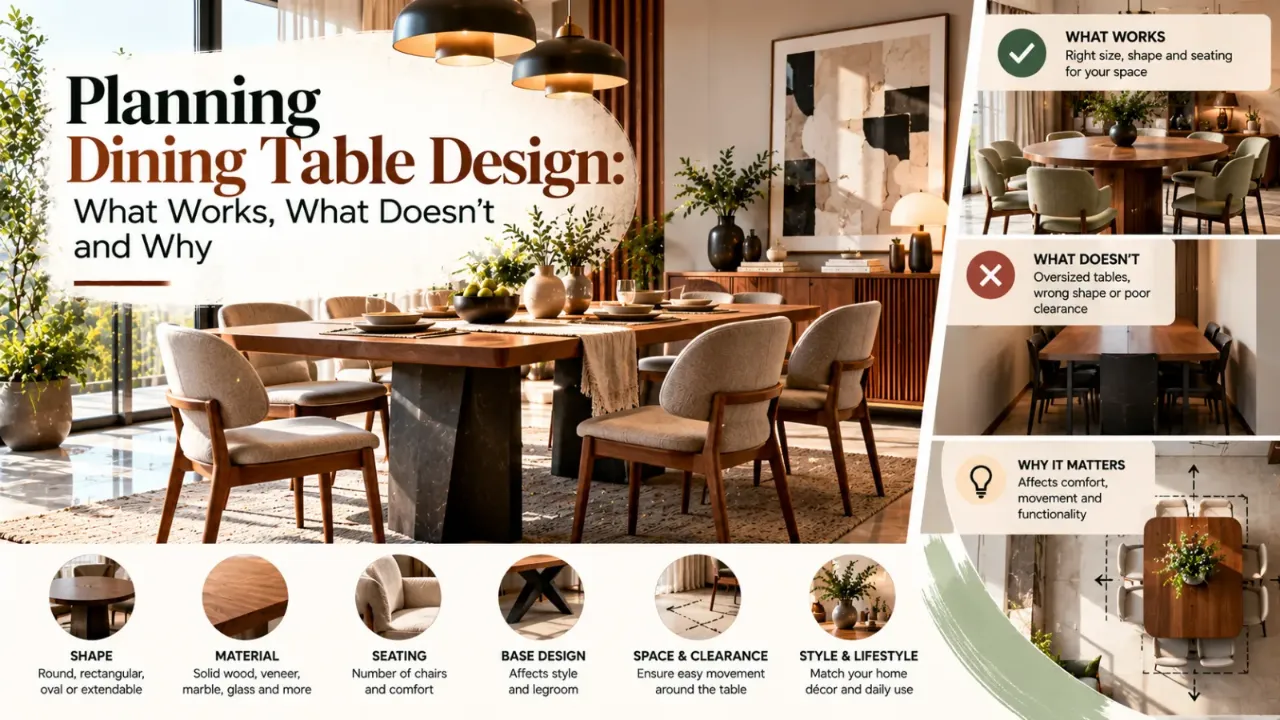
Planning Dining Table Design: What Works, What Doesn't and Why
A dining table is more than a surface for meals. It shapes how people gather, how comfortably they sit and how easily the dining area connects with the rest of the home. A table can look beautiful in a showroom yet feel awkward once chairs are pulled out or people begin moving around it.
Good dining table design starts with practical planning. The table needs to suit the room, accommodate the people who use it regularly and leave enough space for seating, serving and movement. Shape, material, leg placement and lighting all influence the final result.
Quick takeaway: Measure the dining area first, choose a shape and size that suit the room, check seating comfort and compare the full cost before buying.
1. Start With the Space Available
The first step is measuring the dining area—not choosing a table based on appearance alone.
Measure the available floor area, noting nearby walls, doors, windows, kitchen counters and circulation routes. If the dining area is part of an open-plan living room, consider how the table will affect movement between spaces.
- Measure the table area and the surrounding circulation space.
- Account for chairs when they are pulled out for sitting.
- Check whether people can pass behind seated diners comfortably.
- Leave access to doors, cabinets and nearby walkways.
- Consider lights, fans, columns and fixed furniture.
- Plan for serving dishes and movement around the table during meals.
A common mistake is measuring only the tabletop. The usable dining area must accommodate the table, chairs and people moving around them.
As a starting point, allow roughly 90 cm of clearance behind occupied chairs where possible, with more space for a busy passage or serving route. Actual requirements depend on chair dimensions, layout and use.
2. Choose a Table Shape That Suits the Layout
Table shape influences seating, circulation and the overall appearance of the dining room.
Rectangular tables
Rectangular tables work well in many long or narrow dining areas and can accommodate several seating positions along their sides.
What works: A proportionate table aligned with the room and a layout that keeps the main walking route clear.
What doesn't: A table that extends too close to walls or blocks the route between the kitchen and living area.
Round tables
Round tables encourage conversation because diners can face one another without fixed corners. They can also work well in square dining areas.
What works: A diameter that provides enough individual dining space while preserving movement around the table.
What doesn't: A large round table in a narrow room, where its curved perimeter may make circulation difficult.
Square tables
Square tables can suit compact, square-shaped dining areas and smaller households.
What works: A size that allows diners to sit comfortably without making the room feel crowded.
What doesn't: Choosing a square table that becomes impractical when more people need to sit together.
Oval tables
Oval tables combine a longer seating arrangement with rounded ends. They can soften the appearance of a rectangular layout.
What works: Rounded ends that improve visual flow while retaining useful seating along the sides.
What doesn't: Assuming the absence of sharp corners automatically makes a large table suitable for a tight space.
Choose the shape according to the room's dimensions and the way people move through it, rather than relying on a trend alone.
3. Get the Table Size and Seating Capacity Right
The number of people who need to sit at the table regularly should guide its dimensions. A table that is too small can make meals uncomfortable, while an oversized one can dominate the room.
As a general planning guide, allow approximately 55–60 cm of table-edge width per person, then check the actual chair and table design. This is a starting point rather than a fixed rule.
- Count regular users separately from occasional guests.
- Check the tabletop dimensions and practical seating positions.
- Consider chair width and whether arms fit beneath the table.
- Look at leg placement, especially where diners sit at the ends.
- Confirm the table height and chair seat height work together.
- Consider an extendable table for occasional gatherings.
Do not rely on a manufacturer's seating label alone. A table advertised for six may feel crowded if the chairs are wide or the leg positions restrict where people can sit.
4. Choose Materials for Both Appearance and Everyday Use
The tabletop material affects maintenance, durability, weight, appearance and price.
Solid wood
Solid wood creates a warm, natural look and can suit many interior styles.
What works: A finish that complements the room and a care routine suited to the wood and its protective coating.
What doesn't: Assuming all wood finishes tolerate heat, spills, scratches or standing moisture equally well.
Engineered wood and veneer
These options can provide a timber appearance with different construction methods and price points.
What works: A product with suitable edge protection and clear guidance for cleaning and moisture exposure.
What doesn't: Treating every engineered surface like solid wood or allowing water to collect at vulnerable joints and edges.
Glass
Glass can create a visually light appearance and allow more of the surrounding space to remain visible.
What works: A properly supported tabletop, suitable safety glass and a layout that makes the table easy to clean and use.
What doesn't: Choosing glass without considering fingerprints, visible marks, edge safety or the weight and stability of the base.
Natural stone and stone-look surfaces
Stone can create a distinctive focal point, with variations in colour, veining and texture. Stone-look alternatives may offer a different balance of appearance and maintenance.
What works: Matching the material to the intended use, understanding its care requirements and confirming that the base supports the tabletop safely.
What doesn't: Selecting stone based only on a sample or assuming that all varieties resist stains, acids and scratches equally well.
Ceramic and porcelain surfaces
These surfaces offer a broad choice of colours and patterns. Performance depends on the product, construction, edges and support system.
What works: Checking the product specification and confirming that the tabletop is designed for dining-table use.
What doesn't: Assuming a hard surface cannot chip or that every finish has identical maintenance requirements.
The best material is one that suits your routine, maintenance preferences and budget—not simply the one that looks most impressive.
5. Pay Attention to the Base and Leg Design
The base influences stability, legroom, seating flexibility and how the table looks.
- Four-leg tables: Often offer a familiar, straightforward design, but leg positions may interfere with chairs at the corners.
- Pedestal bases: Can provide more flexibility around the edges, depending on the base size and tabletop design.
- Trestle bases: Can suit longer tables, but the supports must not obstruct diners' feet or chairs.
- Metal-frame bases: Can introduce a contemporary look, but their strength, connections and stability still need to be checked.
Before buying, sit at the table if possible. Check whether knees contact the apron or supports, whether chairs can slide into position and whether the table remains stable under normal use.
A visually striking base is not a good choice if it reduces the number of comfortable seating positions.
6. Avoid Common Dining Table Design Mistakes
Several planning errors can make a dining area look less balanced or feel inconvenient.
- Choosing the table before measuring the room: Measure first and confirm the space needed for chairs and circulation.
- Prioritising seating capacity over comfort: Check the actual usable edge length and leg placement.
- Ignoring chair dimensions: Wide, bulky or armchair-style dining chairs can change how many people fit around the table.
- Mixing too many finishes: Choose a few complementary elements instead of allowing the table, chairs and cabinetry to compete.
- Overlooking lighting: Plan the light in relation to the tabletop and ceiling height.
- Choosing a difficult-to-maintain surface: Consider cleaning requirements before committing to a material.
- Blocking circulation: Check routes between the dining area, kitchen, doors and other frequently used spaces.
The goal is not to follow one rigid design formula. It is to avoid choices that interfere with the way the dining area needs to function.
7. Coordinate the Table With Chairs and Lighting
A dining table rarely works in isolation. Its proportions and finish should relate to the chairs, lighting, flooring and surrounding furniture.
- Match chair height to the table and check the available legroom.
- Mix chair styles selectively if you want a more individual arrangement.
- Repeat one or two materials or colours across the dining area.
- Choose a rug only if chairs can move across it comfortably and the rug is easy to maintain.
- Position the dining light to illuminate the tabletop without obstructing views or creating glare.
- Consider the relationship between the table and nearby storage or serving furniture.
If you want to explore different dining-area styles, the Interior Style Finder can help you identify a design direction. You can also use Design My Room to explore furniture and finish concepts before committing to a layout. Treat the visual results as inspiration and verify actual dimensions separately.
8. Plan the Budget Beyond the Tabletop
The final cost of a dining table depends on more than its material. Size, thickness, base construction, finish, customisation and delivery can all influence the price.
- Tabletop material and dimensions
- Base and leg construction
- Chair quantity and specifications
- Custom sizes, extensions or special finishes
- Delivery, assembly and installation
- Protective treatments or care products, where applicable
- Warranty and repair options
Compare quotations with the same scope and specifications. A lower-priced table may exclude chairs, delivery or assembly, while a custom design may include details that are not part of a standard product.
The Interior Design Cost Estimator can help you plan the wider furnishing budget. For a home where the dining area needs to coordinate with adjoining rooms, the Whole Home Visualizer can help you explore an overall design direction.
9. A Practical Checklist Before You Finalise the Table
Before placing an order, confirm these details:
- Have you measured the room and the full area needed for chairs?
- Does the table shape suit the room's proportions?
- Is the seating capacity comfortable for regular users?
- Have chair dimensions and legroom been checked?
- Is the tabletop material suitable for your lifestyle?
- Is the base stable and appropriate for the tabletop?
- Can people move between the dining area and adjacent spaces?
- Does the lighting suit the table's size and position?
- Are the price, delivery, assembly and warranty conditions clear?
- Have you confirmed the table's actual dimensions before ordering?
These checks can help you avoid a table that looks right in a product photograph but feels awkward in your home.
A Final Thought
A successful dining table design balances appearance, seating comfort, proportions and movement. The right choice is not necessarily the largest table or the most expensive material. It is the one that fits your space, suits your household and supports the way you gather every day.
Measure first, test the seating where possible and compare materials and complete costs before buying. Good planning makes the dining area more comfortable to use and easier to coordinate with the rest of your home.
Frequently Asked Questions
1. Which dining table shape is best for a small room?
Round or compact square tables can work well in some small rooms, while a narrow rectangular table may suit a longer space. The best choice depends on room proportions, seating needs and circulation routes.
2. How much space should be left around a dining table?
As a starting point, allow around 90 cm behind occupied chairs where possible. More space may be needed for busy walkways or serving routes. Check the actual chair dimensions and layout before finalising the design.
3. How much table width should be allowed per person?
Approximately 55–60 cm of table-edge width per person is a useful initial guide. Chair size, table shape, leg placement and serving needs can change the amount required.
4. Which material is best for a dining table?
There is no universal best material. Wood, engineered surfaces, glass, stone and ceramic or porcelain surfaces have different appearances, maintenance needs, costs and performance characteristics.
5. Is a pedestal-base dining table better than a four-leg table?
A pedestal can provide more flexible seating around the edges, but its base must not interfere with foot space or stability. Compare the actual design rather than assuming one base type is always better.
6. Should dining chairs match the table?
They do not have to match exactly. Chairs can contrast with the table if their proportions, height, materials or colours work together and the seating remains comfortable.
7. What should I check before ordering a custom dining table?
Confirm the measurements, tabletop material, thickness, base design, legroom, finish, seating capacity, delivery arrangements, installation requirements and complete quotation in writing.
Turn this idea into a plan for your home
Visualise your space, understand the likely budget, or find a professional who can bring the idea to life.