
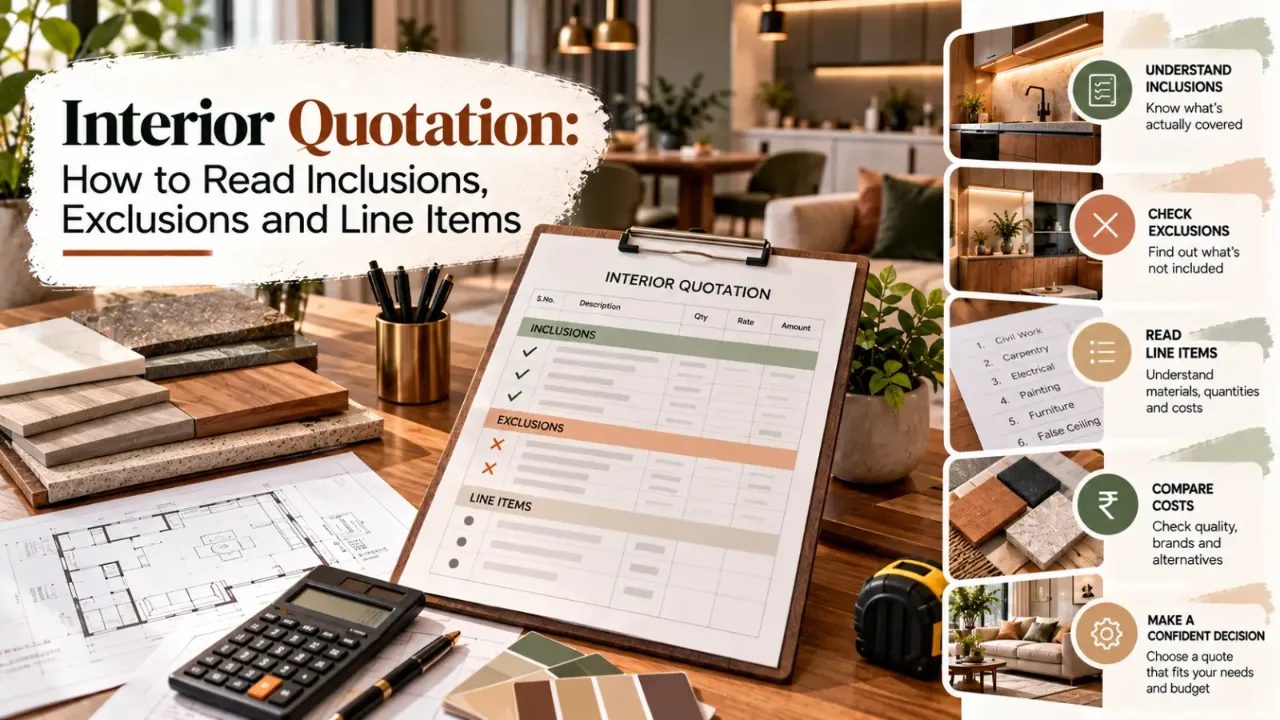
Interior Quotation Decoded: Know What You’re Paying For
An interior design quotation is more than a final price. It is a breakdown of the work, materials, services and responsibilities involved in transforming your home. Understanding it before signing can help you compare designers fairly, manage your budget and avoid unexpected charges during execution.
Quick answer: Before approving an interior quotation, check the total price, project scope, inclusions, exclusions, line-item descriptions, material specifications, payment terms and process for additional work.
1. Start With the Total Price and Project Scope
Begin by identifying the total quoted amount and exactly what the contractor or interior designer has agreed to deliver.
Does the quotation cover the entire home, selected rooms or only specific services? Is it for a complete turnkey project, carpentry and furniture, design services, or civil and electrical work?
Check the project description, room list, quantities and agreed specifications. A quotation should clearly define the scope so you know what the price represents.
Also confirm whether the amount is an estimate, a fixed price for the stated scope or a provisional figure that may change after measurements or material selections. A total without a clearly defined scope is difficult to evaluate.
2. Understand the Inclusions
Inclusions are the products, services and tasks covered by the quotation. They determine what you should expect to receive for the agreed price.
Depending on your project, inclusions may cover:
- Modular kitchen cabinets, wardrobes and other furniture.
- Materials, finishes, laminates, shutters and hardware.
- Electrical points, lighting and false ceiling work.
- Painting, civil modifications and related finishing.
- Delivery, transportation, installation and assembly.
- Design drawings, site coordination or project supervision.
Do not assume an item is included because it appears in a design image or discussion. Ask for it to be listed in writing, along with its quantity, specifications and price where applicable.
For example, a quotation may include wardrobe carcasses but exclude internal accessories, premium handles or specialised organisers. Confirm these details before approving the price.
3. Read the Exclusions Carefully
Exclusions identify the work, products or charges that are not covered by the quotation. They can explain why a seemingly low quote may eventually cost more.
Common exclusions can include appliances, loose furniture, decorative lights, curtains, mattresses, painting outside the stated scope, major civil changes, plumbing modifications, taxes or building-related charges.
The exclusions will vary by project, so ask the designer to list them explicitly rather than relying on assumptions.
For every excluded item, decide whether you still need it and who will arrange it. If you plan to purchase something separately, include its expected cost in your overall budget.
A quote becomes easier to assess when you understand both what you are paying for and what you will need to pay for elsewhere.
4. Decode the Line Items
A line item is an individual entry in the quotation describing a product, task, service or cost component. Each entry should provide enough information to understand what is being charged.
For example, instead of accepting a vague entry such as "wardrobe work," ask for details such as the dimensions, board specification, finish, internal layout, hardware, quantity and installation charges.
Similarly, a kitchen quotation should clarify the cabinets included, shutter finish, drawer systems, hinges, channels and accessories. If lighting is listed, confirm the type, quantity and whether supply and installation are both included.
Look for these details in each relevant line item:
- Description of the work or product.
- Quantity, dimensions or measurement basis.
- Material grade, finish, model or specification.
- Unit rate and total amount, where applicable.
- Labour, fabrication and installation charges.
- Any allowance, assumption or item supplied separately.
If a line item is unclear, ask for a written explanation before signing. Specific descriptions make it easier to compare quotations and resolve disputes later.
5. Check Materials, Brands and Specifications
Words such as "premium," "standard" and "branded" are not precise specifications. Ask which materials and products are actually proposed.
For boards, confirm the specified material and thickness. For laminates, ask about the finish and agreed selection. For hardware, clarify the brand or product range where it matters. For lights, appliances and sanitaryware, confirm the model or technical specification.
Also ask whether the quotation allows you to choose materials later within a fixed price allowance. If the selected product costs more than the allowance, clarify how the additional cost will be calculated.
Do not compare two quotes as equivalent simply because they describe the same furniture. Differences in material quality, internal fittings, hardware and finishing can significantly affect the value of the offer.
6. Identify Charges That May Be Separate
Some quotations show a combined price for materials and work, while others separate them. Either approach can be useful if the details are clear.
Check whether the quoted amount includes:
- Design fees or consultation charges.
- Fabrication and carpentry labour.
- Delivery, transport and installation.
- Site measurements and supervision.
- Dismantling, debris removal or civil repairs.
- Electrical and plumbing work.
- Taxes and other applicable charges.
Ask whether any additional site visits, changes to drawings or revisions after approval may incur a fee.
If a charge is provisional, ask what assumptions it depends on and when the final amount will be confirmed. This helps you distinguish agreed costs from possible future expenses.
7. Review Measurements and Quantities
A quotation may use square feet, running feet, square metres, item counts or lump-sum rates. Understanding the measurement basis is essential when comparing prices.
For wardrobes and modular kitchens, confirm the dimensions and whether the quoted amount includes lofts, side panels, fillers, internal partitions and finishing. For ceilings, wall treatments and flooring, check the area measured and the surfaces covered.
Ask how changes in site measurements will affect the final price. If the quotation is based on preliminary dimensions, confirm when a final measurement will be taken and how any adjustment will be documented.
Do not compare unit rates without checking what each rate covers. Two apparently similar rates may include different materials, labour or finishing work.
8. Understand Payment Terms and Milestones
The quotation or accompanying agreement should explain when payments are due and what each payment covers.
Check the advance amount, subsequent instalments, any payments linked to material procurement or installation, and the final payment terms. Make sure the schedule is written down and that you understand the conditions attached to each stage.
Ask what happens if the project scope changes, materials are delayed or the agreed timeline shifts. Clarify how refunds, cancellations or approved variations are handled under the agreement.
Avoid relying solely on verbal promises. Keep the quotation, signed agreement, invoices and approved changes together so that the commercial terms remain clear throughout the project.
9. Compare Quotations on an Equal Basis
When you receive multiple interior quotations, compare them line by line wherever possible.
One designer may quote for a complete kitchen with hardware and installation, while another may quote only for cabinet fabrication. The lower total does not necessarily represent better value.
Use the same room measurements, design requirements, material specifications and list of expected deliverables when requesting quotations. Then compare:
- Total price and clearly defined scope.
- Materials, finishes and hardware.
- Quantities, unit rates and installation charges.
- Inclusions, exclusions and provisional costs.
- Payment milestones and project timeline.
- Warranty terms and post-installation support.
Ask each designer to explain major differences rather than choosing solely on price. A detailed quotation helps you understand what each professional is offering.
10. Know What Happens When the Scope Changes
Changes are common during interior projects. You may add a storage unit, change a laminate, modify a wardrobe layout or introduce additional lighting after work has begun.
Before approving the original quote, ask how these changes will be priced. Ideally, each variation should describe the additional or removed work, its cost impact and any effect on the timeline.
Request written approval before additional work proceeds, wherever practical. Also clarify how credits will be handled if an item is removed from the original scope.
Keeping a record of approved changes helps prevent disagreements about what was originally promised and what the revised total should be.
11. Check the Timeline and Warranty Terms
A quotation may specify an expected completion date or project duration. Confirm when the timeline begins, which milestones are planned and what factors could cause delays.
Ask whether the schedule includes design approvals, material ordering, fabrication, delivery, installation and finishing. The availability of selected products and changes to the scope can affect the completion date.
Check the warranty or after-sales terms for relevant products and workmanship. Ask what is covered, how long coverage lasts, what exclusions apply and whom to contact if an issue appears after handover.
Keep product details, invoices and any warranty documents in a safe place. Clear records make it easier to request support later.
12. Use Tools to Plan Before You Approve
Before accepting a quotation, make sure the proposed design and budget match your priorities. If you are unsure how a room might look with different furniture or finishes, use Design My Room to explore a visual concept from a photo of your space.
You can also use the Walls to Wonder Interior Design Cost Estimate to explore an indicative room-wise budget and compare your plans with a preliminary cost range.
These tools support early planning; they do not replace a detailed quotation, verified measurements or a signed agreement. Confirm the final materials, quantities, deliverables and charges with your chosen professional before work begins.
A Final Thought
An interior quotation should help you understand the project—not leave you guessing about what is included. Read the scope, examine the line items, clarify exclusions and verify the material specifications before approving the total.
When the quotation and agreement clearly document the work, payment terms and process for changes, you can make a more informed decision and manage your interior project with greater confidence.
Frequently Asked Questions
What is an interior quotation?
An interior quotation is a document that outlines the proposed work, materials, quantities, charges and commercial terms for an interior design or renovation project.
What is the difference between inclusions and exclusions?
Inclusions are the products and services covered by the quoted price. Exclusions are items or tasks that are not covered and may need a separate budget or arrangement.
Why should I check individual line items?
Line items explain how the total is calculated. Reviewing them helps you identify missing work, unclear material specifications, quantity differences and charges that may be billed separately.
Should I choose the lowest interior quotation?
Not automatically. Compare the scope, material quality, hardware, installation, exclusions, payment terms and warranty conditions. A lower quote may omit work that another quote includes.
What should I do if the quotation does not specify a material or charge?
Ask the designer or contractor to clarify the specification or cost in writing before signing. Avoid relying on verbal assumptions about what a product or service includes.
Get a personalised estimate for your home
Choose your rooms, materials and preferences to understand a practical interior budget before you commit.