
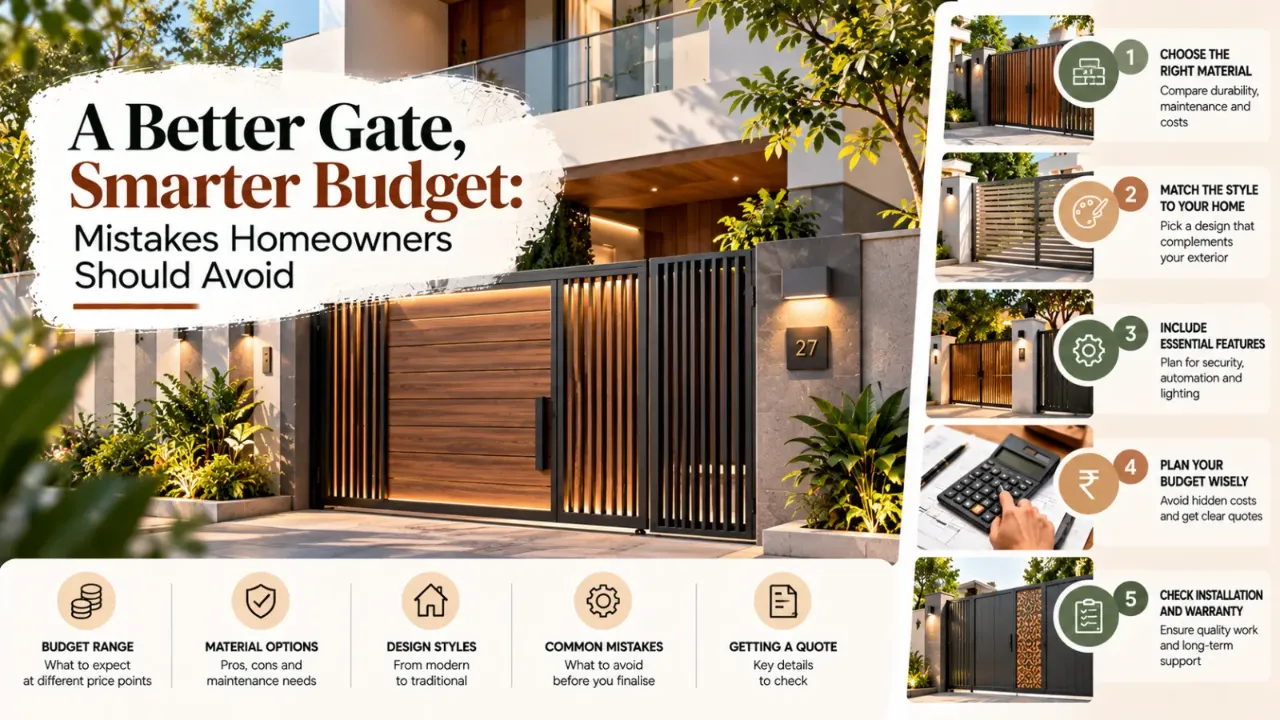
A Better Gate, Smarter Budget: Mistakes Homeowners Should Avoid
A main gate is one of the first features people notice about a home, but its role goes far beyond appearance. It needs to provide suitable security, open and close smoothly, withstand regular use and suit the entrance's available space. When the budget is limited, choosing the simplest design can be a sensible decision—but only if the important practical details are not overlooked.
Quick answer: To keep a main gate affordable, choose a straightforward design, measure the opening accurately, compare itemised fabrication quotes and check material quality, hardware, finishing and installation before approving the price.
1. Choosing a Gate Based on Price Alone
A low price can be attractive, especially when you are working within a fixed home construction budget. However, the cheapest quotation may not cover the same material thickness, hardware, surface preparation or installation work as a more detailed quote.
Before deciding, compare the complete specifications. Check the gate dimensions, material, frame construction, infill design, hinges, locking system, finish and installation charges.
Ask each fabricator to quote for the same requirements. This makes it easier to identify whether the price difference reflects a genuine saving or a difference in what is being supplied.
The goal is not to buy the most expensive gate. It is to understand what you are paying for and choose an option that meets your needs.
2. Selecting the Wrong Material for the Budget
The material affects the gate's purchase price, weight, maintenance and long-term performance. A simple design can be made using different materials, but each has different considerations.
- Mild steel: Often used for fabricated gates because it allows a wide range of simple and decorative designs. It needs appropriate surface preparation and protective finishing to help prevent corrosion.
- Galvanised steel: A protective zinc coating can improve corrosion resistance, depending on the product and fabrication process. Confirm how cut edges, welds and any damaged coating will be treated.
- Aluminium: Can be useful where a lighter gate is desirable, but the grade, section design, hardware and fabrication method affect strength and cost.
- Wood: Offers a natural appearance but requires suitable detailing and maintenance for the local weather conditions. Solid wood and engineered alternatives have different performance characteristics.
- Combination designs: Metal frames with other infill materials can create a distinctive look, but check how the different materials are fixed, maintained and protected from weather exposure.
Compare materials based on the intended use and local conditions, not just the initial price. The cheapest material is not automatically the most economical over the life of the gate.
3. Making the Design Too Complicated
Decorative curves, intricate patterns, custom cut-outs and multiple materials can increase fabrication time and cost. Complex designs may also need more finishing work and can make repairs or repainting less straightforward.
If the budget is limited, consider a clean, straightforward design with a well-proportioned frame and simple vertical or horizontal members. A neat finish and consistent spacing can create an attractive entrance without elaborate detailing.
A simple design should still suit the home's architecture. Consider the exterior colours, boundary wall, entrance width and surrounding finishes before finalising the appearance.
Save money by simplifying unnecessary decorative elements—not by reducing the quality of the frame, welds, hinges or locking system.
4. Ignoring Measurements and Opening Space
Incorrect measurements can lead to costly adjustments during fabrication or installation. Before approving the design, confirm the opening width and height, available clearance, ground level and any slope across the entrance.
The opening mechanism also matters. A swing gate needs enough clear space for its leaves to move, while a sliding gate needs suitable side clearance and a stable track or support system.
Check whether the gate will interfere with a parked vehicle, pedestrian access, a drain, steps or the public footpath. Confirm that the gate can open without scraping the ground or hitting nearby structures.
Have the opening measured on site and approve the final dimensions in writing before fabrication begins.
5. Overlooking the Frame, Hinges and Lock
The visible panels may attract attention, but the frame and hardware are essential to the gate's performance. A poorly supported or incorrectly installed gate can sag, bind or become difficult to operate.
Ask the fabricator to specify the frame sections, material thickness, hinge type, locking arrangement and any required support posts. These details should suit the gate's size, weight and frequency of use.
For a heavy gate, the hinges, posts and foundations must be appropriate for the load. A sliding gate may require suitable rollers, guides, stops and track support.
Do not assume that hardware is included in the quoted price. Confirm whether the lock, handles, hinges, stoppers and other necessary components are included, and ask for suitable quality specifications.
6. Forgetting Surface Preparation and Weather Protection
A fresh coat of paint can make a gate look finished, but the durability of the coating depends heavily on the preparation underneath.
For steel gates, ask how rust, oil and fabrication residue will be removed and which primer and topcoat system will be used. Pay attention to welds, corners and exposed edges, where moisture can collect or coating coverage may be uneven.
For coastal, humid or exposed locations, discuss a suitable corrosion-protection approach with the fabricator. The best system depends on the material, exposure conditions and maintenance expectations.
Clarify whether surface preparation and painting or other protective finishing are included in the quotation. Cutting this stage to reduce costs can lead to earlier repainting and additional maintenance.
7. Comparing Quotes Without Checking Exclusions
Two gate quotations may have different totals because they cover different stages of the job. One may include fabrication only, while another includes transport, installation, hardware and finishing.
Ask for an itemised quotation that identifies:
- Gate dimensions and material specifications.
- Frame and infill construction.
- Hinges, locks and other hardware.
- Surface preparation and finishing.
- Posts, supports or foundation work, where required.
- Transport, installation and alignment.
- Electrical components, if an automated system is included.
- Taxes, exclusions and any provisional charges.
Ask how extra work will be priced if the site requires changes. Have the fabricator explain and document additional charges before proceeding, wherever practical.
Comparing quotations on the same scope helps you avoid choosing a low headline price that later grows through extra costs.
8. Underestimating Installation and Site Preparation
Even a simple gate may need more than fabrication. Installation can involve checking the opening, preparing or strengthening posts, fixing hinges, levelling the gate and adjusting its movement.
If the existing pillars are damaged or unsuitable, repairs may be needed before the gate can be fitted. Sliding gates may require additional support or track preparation, depending on the design and site.
Ask whether the quotation includes these tasks and who is responsible for any civil work. Confirm that the gate will be tested for smooth movement, secure closure and proper locking before handover.
A clear installation plan can prevent avoidable delays and disputes between the fabricator and other contractors.
9. Choosing Looks Over Security and Everyday Use
A main gate should suit the entrance's security requirements as well as its appearance. Large gaps, an unsuitable locking arrangement or weak attachment points may undermine the intended function.
Think about who will use the gate, how frequently it will open, whether pedestrians need a separate access point and how the gate will be secured when closed.
If privacy matters, consider the visibility offered by the design. If airflow and visibility are priorities, an open pattern may be more suitable. Balance these preferences with security, ease of cleaning and the ability to maintain the gate.
For automated gates, include the cost of the motor, controls, power supply, safety devices and installation. Do not assume automation is included in a quotation for the gate alone.
10. Forgetting Long-Term Maintenance
The purchase price is only one part of the cost. Gates may need cleaning, lubrication, repainting, hardware adjustment or repairs over time.
Ask the fabricator what routine maintenance the selected material and finish will require. Check whether hinges, locks, rollers or other moving parts can be serviced or replaced without major work.
A straightforward design with accessible hardware may be easier to maintain than one with numerous small decorative details. For metal gates, inspect the finish periodically and address signs of corrosion before they spread.
A little planned maintenance can help protect the original investment and keep the gate working properly.
11. Approving Fabrication Without a Final Checklist
Before authorising production, confirm the details in writing. This is particularly important for custom-made gates because changes after fabrication begins can be expensive.
- Final opening dimensions and gate height.
- Gate type: swing, sliding or another suitable configuration.
- Material, frame sections and agreed specifications.
- Design drawing and spacing of the infill.
- Finish colour and protective coating.
- Lock, hinges, handles and other hardware.
- Installation and site-preparation responsibilities.
- Total price, taxes, exclusions and payment milestones.
- Estimated fabrication and installation schedule.
- Handover checks and any applicable warranty terms.
Review the completed gate before final handover. Check its alignment, movement, locking, finish and any agreed details against the approved specification.
A Final Thought
A low-cost main gate can still look smart and perform well when the budget is planned carefully. The biggest savings often come from a simple design, accurate measurements and a clear quotation—not from cutting corners on structural support, hardware or weather protection.
Compare materials and fabricators fairly, confirm every important detail before fabrication and consider the cost of maintenance as well as the initial price. A well-planned gate can complement your home's entrance without putting unnecessary pressure on your budget.
Frequently Asked Questions
Which main gate design is suitable for a low budget?
A straightforward metal gate with a simple frame and uncomplicated infill pattern can help control fabrication costs. The best option depends on the opening size, security needs, material, finish and installation conditions.
Is a sliding gate cheaper than a swing gate?
Not always. A swing gate may be simpler where there is enough opening clearance, while a sliding gate can be useful where swing space is limited. Sliding systems may need tracks, rollers and additional support, so compare complete installed quotations.
What should a main gate quotation include?
It should specify dimensions, materials, frame construction, hardware, finishing, transport, installation, exclusions and payment terms. Foundation work and automation should be identified separately if they are required.
How can I reduce main gate costs without compromising quality?
Keep the design simple, finalise measurements before fabrication, compare itemised quotations and avoid unnecessary decorative features. Do not compromise on appropriate structural support, secure locking, installation or protective finishing.
How do I maintain a metal main gate?
Follow the fabricator's care instructions, clean the surface, lubricate moving parts as required and inspect the finish for damage or corrosion. Repair exposed areas promptly using a suitable protective system.
Get a personalised estimate for your home
Choose your rooms, materials and preferences to understand a practical interior budget before you commit.