
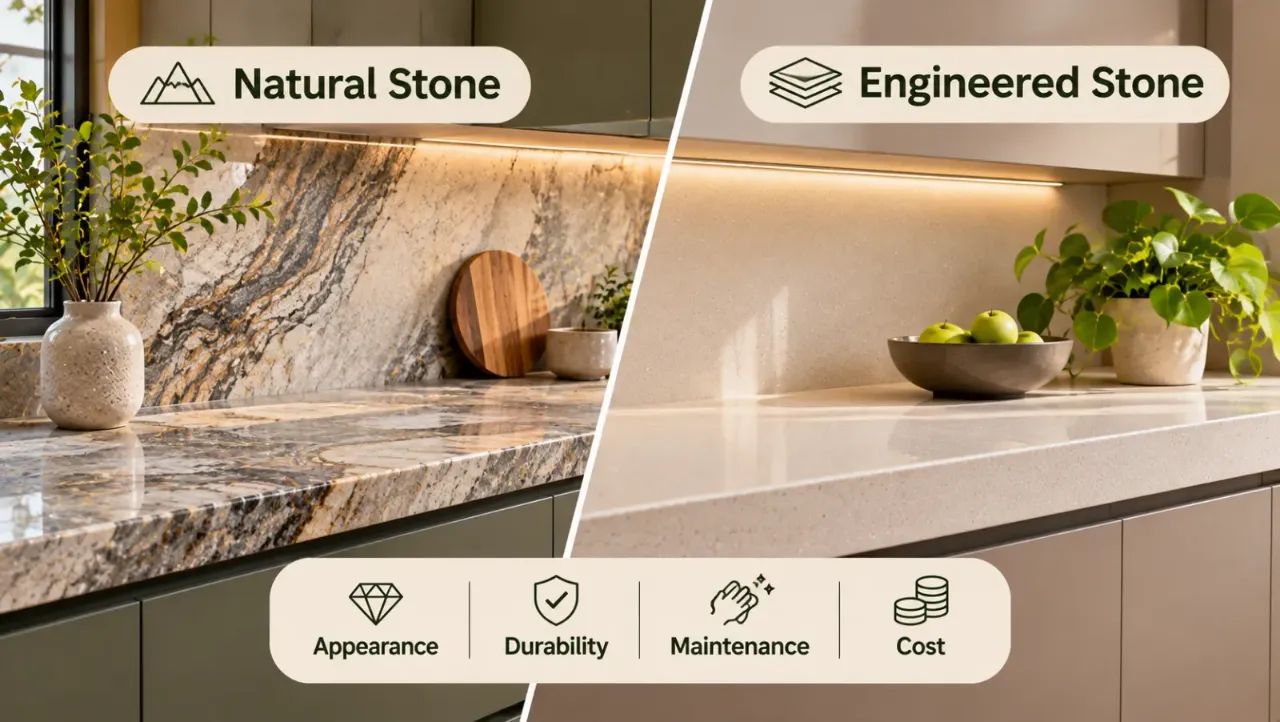
Natural Stone vs Engineered Stone: Which Should You Choose?
Stone surfaces can make a home feel refined, substantial and timeless. From kitchen countertops and bathroom vanities to flooring, wall cladding and dining tables, they bring texture and character that can be difficult to achieve with other materials.
But choosing stone involves more than selecting a colour or pattern. Natural stone and engineered stone may look similar at first, yet they differ in how they are made, how they respond to everyday use and how much maintenance they need.
Natural materials such as granite, marble, slate and travertine are quarried from the earth and processed into slabs or tiles. Engineered surfaces, such as quartz, are manufactured by combining mineral particles with binders and other components. Other manufactured surfaces, including porcelain and sintered stone, use different production processes and should not be treated as identical to engineered quartz.
Quick answer: Natural stone offers individual patterns and geological character, while engineered surfaces can provide more controlled designs and, depending on the product, simpler routine maintenance. The right choice depends on the room, daily use, maintenance expectations and budget.
1. What Is Natural Stone?
Natural stone is obtained from quarries and cut into slabs, tiles or smaller pieces for interior applications. Its appearance is created by geological processes over long periods, which means each piece can have its own colour variations, mineral patterns, veins and texture.
Common natural stones used in homes include:
- Granite: Known for its mineral patterns and generally good resistance to everyday wear. It is commonly used for kitchen countertops, flooring and work surfaces.
- Marble: Recognised for its distinctive veining and elegant appearance. It is popular for flooring, bathroom surfaces, wall cladding and decorative applications, but can be vulnerable to acids and staining.
- Slate: A fine-grained stone often used for flooring, wall cladding and textured surfaces. Its appearance can range from smooth and subtle to naturally layered.
- Travertine: A type of limestone with characteristic pores and natural patterns. It is used for flooring, walls and decorative surfaces, but often needs appropriate filling and sealing.
- Sandstone: Offers a softer, earthy appearance and is used for selected flooring, wall and architectural applications. Its suitability depends on its density, finish and intended exposure.
The main attraction of natural stone is its individuality. Even two slabs of the same stone may have different patterns, shades and markings.
2. What Is Engineered Stone?
Engineered stone is manufactured by combining selected minerals or stone particles with binders, pigments and other components. The mixture is processed into slabs to create a controlled surface appearance.
The term covers different product categories, so it is important to understand what a supplier is actually offering.
Engineered quartz is commonly made using quartz minerals combined with resin binders, pigments and other materials. It is popular for kitchen countertops, bathroom vanities and other interior surfaces because it offers a relatively consistent appearance and does not normally require periodic sealing.
Porcelain slabs are manufactured from refined mineral materials and fired at high temperatures. They are a separate category from engineered quartz and are available in a wide range of colours, patterns and finishes.
Sintered stone is produced by processing mineral materials under high heat and pressure. It is also distinct from engineered quartz, and its performance depends on the product specification and installation.
The important point is that engineered stone is not one single material. Its composition, heat performance, stain resistance, outdoor suitability and maintenance requirements vary by product.
3. Natural Stone vs Engineered Stone: Key Differences
| Factor | Natural Stone | Engineered Stone |
|---|---|---|
| Composition | Quarried natural rock | Manufactured mineral-based surface |
| Appearance | Naturally varied patterns and markings | Usually more controlled and consistent |
| Colour options | Depends on available stone varieties | Broad range of colours and designs |
| Pattern | Each slab may differ | More predictable across selected batches |
| Porosity | Varies by stone | Depends on product type |
| Staining | Some stones need sealing and careful cleaning | Many engineered quartz products resist everyday staining, but are not stain-proof |
| Heat | Depends on stone type and finish | Depends on the product; resin-based quartz needs care around high heat |
| Scratches | Varies by stone hardness | Varies by product composition and finish |
| Sealing | Often required for some stones | Engineered quartz generally does not need sealing |
| Repairs | May be repairable or refinished depending on damage | Repair options depend on the material and damage |
| Maintenance | Depends on stone and treatment | Often simpler for engineered quartz, but product-specific care still applies |
| Cost | Varies by stone, rarity, grade and installation | Varies by brand, composition, design and installation |
Neither category is automatically better. A well-selected natural stone can perform very well in the right application, while a suitable engineered surface can make everyday maintenance easier.
4. Appearance: Natural Variation or Consistent Design?
Appearance is often the first factor homeowners notice.
Natural stone has patterns formed by minerals, pressure and geological conditions. This creates veins, grains, colour changes and markings that cannot be reproduced exactly from one slab to another.
Marble, for example, may have dramatic veins or subtle cloud-like patterns. Granite can feature fine speckles, large mineral clusters or a more uniform appearance. Travertine and sandstone offer softer, earthy textures.
Engineered surfaces offer greater control over the final design. They can be manufactured in consistent colours, subtle patterns, bold veining and different surface finishes.
This can be useful when you want multiple countertops, vanity tops or wall panels to look closely coordinated.
Choose engineered stone if: You prefer a more predictable appearance and want to coordinate several surfaces with fewer visible differences.
Always inspect the actual slab or a sufficiently large sample before placing an order. A small sample may not show the full pattern, colour variation or veining of the finished surface.
5. Durability: Which Surface Handles Daily Use Better?
Durability depends on the specific stone, its finish, thickness, support, fabrication and installation. It is not accurate to assume that every natural stone is stronger than every engineered surface, or the other way around.
Granite is generally a strong option for frequently used kitchen counters. However, the exact variety and finish still matter.
Marble is often selected for its appearance, but it can scratch, stain or become etched when exposed to acidic substances such as lemon juice and vinegar. These marks may affect the surface even when it has been sealed.
Engineered quartz is designed for everyday indoor use and generally offers good resistance to routine staining and surface wear. However, it can be damaged by excessive heat, impact or harsh chemicals, depending on the product.
Porcelain and sintered stone have different performance characteristics from engineered quartz. Some products offer strong resistance to heat, UV exposure and staining, but edges can be vulnerable to chipping and fabrication requires appropriate expertise.
Before selecting a surface, ask the supplier for product-specific information about:
- Scratch and abrasion resistance
- Impact and edge-chipping resistance
- Heat tolerance
- Stain resistance
- UV exposure and outdoor suitability
- Recommended cleaning products
- Repair and warranty conditions
The best choice is the surface whose performance matches the way you intend to use it.
6. Staining and Sealing: What Should You Expect?
Porosity is an important consideration when selecting natural stone.
Some natural stones absorb liquids more readily than others. Marble, travertine and certain other stones may require sealing to reduce the absorption of spills. The frequency of resealing depends on the stone, its finish, the sealer used and how heavily the surface is used.
Granite also varies. Some varieties are relatively dense, while others may benefit from sealing.
Sealing does not make a stone completely stain-proof or waterproof. It provides an additional layer of protection, but spills should still be cleaned promptly.
Engineered quartz is generally non-porous and does not usually require periodic sealing. It can be convenient for homeowners who prefer a surface with fewer routine maintenance steps.
However, engineered quartz is not immune to staining. Certain substances, prolonged exposure, strong chemicals or unsuitable cleaning products can affect its appearance.
Porcelain and sintered stone have different absorption characteristics. Follow the manufacturer's care instructions rather than assuming that all engineered surfaces need the same treatment.
7. Heat Resistance: An Important Kitchen Consideration
Kitchen countertops are regularly exposed to hot cookware, appliances and cooking activity. Heat performance should therefore be checked before selecting a surface.
Granite generally handles heat well, but sudden temperature changes can still cause damage. Using trivets or heat-resistant mats is a sensible precaution.
Marble can tolerate some heat, but it is not advisable to place very hot cookware directly on it. Thermal shock, existing cracks and surface treatments can affect its performance.
Engineered quartz contains resin binders, which can be affected by high temperatures. Hot pans should not be placed directly on the surface.
Porcelain and some sintered stone products can offer better heat tolerance, but the exact product specification, thickness, support and installation details still matter.
8. Maintenance: Which One Is Easier to Live With?
Maintenance can make a significant difference over the life of a surface.
Natural stone requires care suited to its type. Use a soft cloth, suitable stone cleaner and prompt spill removal. Avoid acidic household cleaners on acid-sensitive stones such as marble and limestone.
If the stone has been sealed, check whether the protective treatment needs renewal. Avoid abrasive pads and harsh chemicals unless the supplier confirms they are suitable.
Engineered quartz is usually easier to maintain for everyday indoor use. Regular cleaning with a soft cloth and mild, manufacturer-approved cleaner is generally sufficient.
However, avoid assuming that all engineered surfaces can be cleaned in the same way. Porcelain, sintered stone and engineered quartz may have different recommendations, particularly for textured finishes and stubborn marks.
| Surface | Routine Care | Important Precaution |
|---|---|---|
| Granite | Wipe with a soft cloth and suitable cleaner | Check whether sealing is needed |
| Marble | Use a pH-neutral stone cleaner | Avoid acids and abrasive cleaners |
| Travertine | Use suitable stone cleaner | Protect pores and maintain sealing where specified |
| Engineered quartz | Mild cleaner and soft cloth | Avoid direct high heat and harsh chemicals |
| Porcelain | Follow the manufacturer's cleaning guidance | Check textured finishes and edge protection |
| Sintered stone | Use product-approved cleaning methods | Protect edges during handling and installation |
9. Where Should You Use Natural and Engineered Stone?
The right application matters as much as the material itself.
Kitchen Countertops
Granite is a popular natural-stone option for Indian kitchens because of its practical performance and variety of finishes.
Engineered quartz is worth considering if you prefer consistent colours, controlled patterns and relatively simple daily maintenance.
Marble can create a distinctive appearance, but it needs more careful handling around acidic food and spills.
Porcelain and sintered stone may also suit kitchen counters, depending on the product's specifications and the fabricator's experience.
Bathroom Vanities and Walls
Marble, granite, engineered quartz and porcelain can all be considered for bathroom applications.
Pay attention to water exposure, surface finish, cleaning access and edge detailing. For flooring, slip resistance is especially important. A polished surface should not be selected for a wet floor based on appearance alone.
Flooring
Natural stone such as granite, marble, slate and travertine can create a distinctive floor finish. However, the stone's hardness, porosity, finish and maintenance requirements should be considered.
Porcelain slabs and tiles offer a manufactured alternative with a wide range of appearances. Engineered quartz is not automatically suitable for every flooring application, so check the manufacturer's approved uses.
Feature Walls and Decorative Surfaces
Natural stone can add unique texture and variation to feature walls, niches and selected decorative elements.
Porcelain and sintered stone can provide large-format patterns and a more controlled visual finish. Check the panel size, weight, fixing system and installation requirements before finalising the design.
Dining Tables and Furniture
Stone tops can create a strong visual feature on dining tables, coffee tables and consoles.
Consider weight, edge profile, support structure, impact exposure and ease of cleaning. A material that works well as a wall finish may not be the best choice for a heavily used tabletop.
10. What Affects the Cost of Natural and Engineered Stone?
There is no universal rule that natural stone is always more expensive or that engineered stone is always more affordable.
The final price depends on several factors:
- Material type: Common granite varieties may cost less than rare marble, while premium engineered surfaces can also be expensive.
- Brand and origin: Imported materials and well-known engineered-surface brands may carry higher prices.
- Thickness: Slab thickness affects material use, weight and fabrication.
- Finish: Polished, honed, leathered and textured finishes may have different costs.
- Pattern and availability: Rare colours, distinctive veins and limited stock can increase prices.
- Fabrication: Cut-outs, curved edges, mitred joints and special profiles add labour.
- Wastage: Complex layouts and vein matching can require additional material.
- Installation: Transportation, handling, support structures, adhesives and site conditions influence the total.
Compare complete quotations rather than looking only at the price per square foot. Ask whether measurement, cutting, edge finishing, sink cut-outs, transportation, installation and sealing are included.
11. Common Mistakes to Avoid When Choosing Stone
A surface may look attractive in a showroom but prove inconvenient once it is installed. Avoid these common mistakes:
- Choosing only by appearance: Check performance and maintenance before finalising the colour or pattern.
- Assuming all natural stone behaves alike: Marble, granite, slate and travertine have different characteristics.
- Treating all engineered surfaces as the same: Engineered quartz, porcelain and sintered stone are different product categories.
- Believing sealing makes stone stain-proof: Sealing reduces absorption but does not eliminate every risk.
- Ignoring heat limitations: This is especially important for resin-based engineered quartz in kitchens.
- Selecting a slippery finish for wet floors: Check the product's slip-resistance information and suitability for the intended area.
- Approving a small sample without seeing the slab: Large patterns and natural variations may look very different across a full surface.
- Overlooking installation quality: Poor support, joints, edge finishing or handling can affect even a high-quality material.
12. Homeowner Checklist Before Buying
Before confirming your stone selection, use this checklist:
- Identify the exact material and product category.
- Check the intended application and manufacturer's approved uses.
- Inspect the full slab or a large sample.
- Ask about stain, scratch, impact and heat performance.
- Confirm whether sealing is required.
- Check cleaning and maintenance instructions.
- Review thickness, finish and edge options.
- Confirm the fabricator's experience with the material.
- Ask about joints, cut-outs, support and installation.
- Compare complete quotations and warranty conditions.
13. Final Thought: Choose for Your Lifestyle, Not Just the Look
Natural stone and engineered stone each have a place in modern homes. Natural stone offers geological character, individual patterns and a sense of authenticity. Engineered surfaces provide more controlled designs and, depending on the product, can simplify everyday care.
For a busy kitchen, compare granite, engineered quartz and suitable porcelain or sintered surfaces based on actual heat, stain and installation requirements. For a feature wall or decorative application, natural marble or travertine may offer the variation you want. For a bathroom, consider water exposure, cleaning and slip resistance alongside appearance.
There is no single winner. The right material is the one that suits the room, your daily routine, your maintenance expectations and your overall budget.
Frequently Asked Questions
1. Is natural stone better than engineered stone?
Neither is universally better. Natural stone offers unique patterns and variation, while engineered surfaces can provide more consistent designs and easier routine care. The right option depends on the material and its intended application.
2. Is engineered quartz the same as natural quartz?
No. Natural quartz is a mineral found in nature. Engineered quartz surfaces are manufactured products made using quartz minerals, resin binders, pigments and other components.
3. Is engineered stone more durable than natural stone?
It depends on the specific products being compared. Engineered quartz generally performs well against everyday staining, while granite is known for its practical durability. Marble can be more sensitive to acids and scratches. Compare product specifications rather than relying on broad category claims.
4. Does natural stone need sealing?
Some natural stones benefit from sealing, but the requirement depends on the stone, its porosity, finish and intended use. Ask the supplier whether sealing is needed and how often the treatment should be checked or renewed.
5. Can I place hot pans on engineered quartz?
It is not recommended. Engineered quartz contains resin binders that can be affected by high temperatures. Use trivets and follow the manufacturer's heat guidance.
6. Which is better for an Indian kitchen: granite or quartz?
Granite and engineered quartz are both popular choices. Granite generally handles kitchen heat well, while engineered quartz offers consistent designs and convenient routine maintenance. Your choice should account for cooking habits, heat exposure, budget, fabrication quality and product specifications.
7. Is natural marble suitable for kitchen countertops?
It can be used, but marble is more vulnerable to acid etching and staining than some alternatives. It is better suited to homeowners who appreciate its appearance and are comfortable with careful use and maintenance.
8. Is porcelain considered engineered stone?
Porcelain is a manufactured mineral-based surface, but it is not the same as engineered quartz. It is best treated as a separate category because its composition, manufacturing process and performance characteristics differ.
Plan Your Home Interiors with Walls to Wonder
Choosing the right surface is only one part of creating a home that looks good and works well. Explore Walls to Wonder's AI tools to visualise rooms, understand design costs and make more informed interior decisions.
- Whole Home Visualizer – Explore design ideas for your entire home.
- Design My Room – Experiment with different room styles and layouts.
- Interior Design Cost Estimate – Get an indicative estimate for your interior project.
- Interior Quotation Checker – Review and understand your interior quotation.
- Rate My Room Design – Get feedback on your room design.
- Interior Style Finder – Discover an interior style that suits your preferences.
Explore more ideas and tools at Walls to Wonder.
Turn this idea into a plan for your home
Visualise your space, understand the likely budget, or find a professional who can bring the idea to life.