
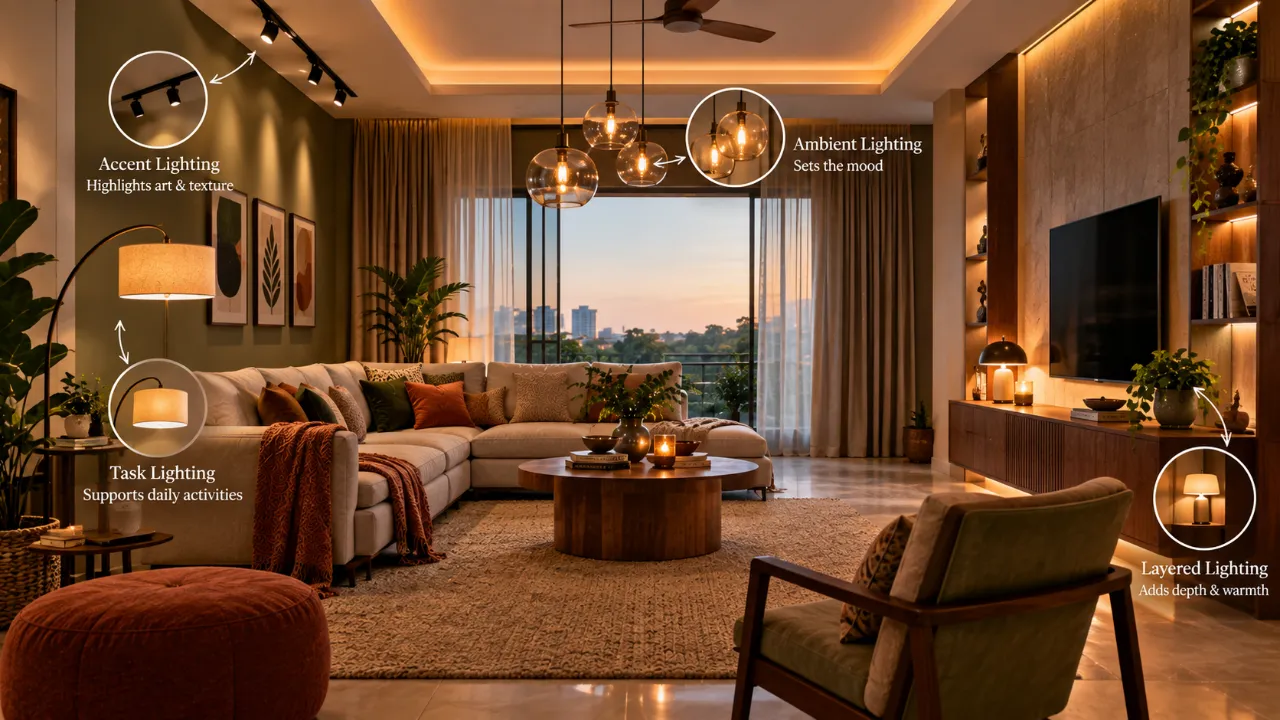
Lighting in Layers: How to Make a Living Room Glow
Lighting is one of the easiest ways to change how a living room feels — and one of the most commonly simplified.
A single ceiling light may make the room visible, but visibility is not the same as good lighting.
A well-designed living room usually needs different kinds of light for different reasons.
What Does “Layering Lighting” Actually Mean?
Layering lighting means using different sources of illumination to perform different jobs.
The three basic layers are:
Ambient Lighting
General illumination for the room.
Task Lighting
Focused light for specific activities.
Accent Lighting
Light used to highlight features, objects or architectural details.
These layers should overlap rather than operate as completely separate systems.
Layer 1: Start With Ambient Lighting
Ambient lighting is the foundation. Its job is to provide comfortable general illumination throughout the room.
Common sources include ceiling lights, recessed downlights, cove lighting, chandeliers, flush fixtures and diffused architectural lighting.
Ambient lighting should establish the overall brightness of the room, but that does not mean it should be extremely bright.
Think of ambient light as the base layer, not the entire lighting design.
Layer 2: Add Task Lighting Where People Actually Do Things
Task lighting is more focused. It supports activities such as reading, working on a laptop, writing or other focused tasks.
- Floor lamp beside an armchair
- Table lamp beside a sofa
- Directional wall light
- Adjustable reading lamp
- Floor lamp near a work surface
The important word is placement.
Identify the activity first, then position the light accordingly.
Layer 3: Use Accent Lighting to Give the Room Character
Accent lighting is what makes the room feel designed rather than simply illuminated.
It can draw attention to artwork, sculptural objects, textured walls, architectural niches, curtains, shelving, plants and feature materials.
Accent lighting can also create visual depth by giving the eye several points of interest.
Why One Ceiling Light Usually Feels Flat
Most of the illumination from a single ceiling fixture arrives from above. The room may be bright, but walls, decorative details and architectural features can feel comparatively dark.
Now add a floor lamp beside the sofa, a table lamp on the console and a light highlighting artwork.
The room has not necessarily become much brighter. It has become more visually layered.
Create a Lighting Hierarchy
Not every light should attract equal attention.
Your ambient lighting establishes the overall atmosphere. Task lighting supports the activity. Accent lighting creates emphasis.
When every fixture is equally bright and visually dominant, the hierarchy disappears.
Light the Walls, Not Just the Floor
Walls occupy a huge percentage of the visual field. Leaving them completely dark while flooding the centre of the room can make the space feel less balanced.
- Wall sconces
- Picture lights
- Adjustable spotlights
- Wall washers
- Cove lighting
- Shelving lights
You do not need to illuminate every wall equally. Choose the surfaces or features that deserve attention.
Use Floor Lamps to Add Height
Floor lamps introduce light at a different vertical level from ceiling fixtures and can fill visual gaps.
A tall floor lamp beside a sofa can create a vertical relationship between the seating area and the ceiling.
The lamp itself can also become part of the room's composition.
Table Lamps Create Smaller Lighting Islands
Table lamps are useful for creating intimate pockets of light.
- Side tables
- Consoles
- Sideboards
- Cabinets
- Open shelving
Instead of illuminating the whole room, they create smaller zones that can be used independently in the evening.
Do Not Forget the Ceiling
Cove lighting, concealed linear illumination or perimeter lighting can create softer ambient light and visually support the ceiling plane.
However, concealed lighting should still have a purpose. More hidden lights do not automatically create better lighting.
Think About Colour Temperature
The colour temperature of a light affects how the room appears and how its finishes are perceived.
For living spaces, warmer light is often preferred when the goal is a relaxed evening atmosphere. The exact choice should still work with the room's palette and materials.
Consistency matters. Noticeably different colour temperatures used together can make the room feel visually disconnected.
Choose Light Sources With the Room's Colours in Mind
Lighting interacts with materials. Wall colours, stone, wood, paint, fabric, artwork and metal finishes can all appear different under different light sources.
This is why lighting decisions should not be made separately from material decisions.
Test important materials under the lighting you actually plan to use.
Use Dimmers Wherever Possible
One of the biggest advantages of layered lighting is control.
A room might need brighter illumination for cleaning or rearranging furniture and softer light later for conversation or television.
Dimmers make this transition easier without requiring completely separate systems for every mood.
Do Not Make Every Light the Same Brightness
Trying to make every fixture equally strong can flatten the room.
Allow different lights to have different visual roles:
- Ambient light for general visibility
- Task light for focused activities
- Accent light for emphasis
The goal is contrast, not chaos.
Use Lighting to Define Zones
Open-plan living rooms especially benefit from layered lighting.
A single space may contain a television area, conversation area, reading corner and dining connection.
Use different lighting groups to reinforce these areas without physical walls.
| Zone | Possible Lighting |
|---|---|
| Seating Area | Ambient lighting + floor or table lamp |
| Reading Corner | Dedicated task light |
| Console | Table lamp or decorative light |
| Artwork | Focused accent lighting |
| Shelving | Integrated shelf lighting |
Light From Different Heights
A room becomes more interesting when light exists at multiple levels.
Not every room needs all four, but mixing heights can prevent the lighting from feeling as if everything is coming from above.
Lighting Can Make a Small Room Feel Better
Layering is especially valuable in smaller living rooms. A wall light can illuminate a vertical surface without taking floor space. A slim floor lamp can create a reading zone. A small table lamp can add warmth without adding much clutter.
Several controlled sources can create more visual depth than one powerful ceiling fixture.
Make Sure You Do Not Overuse Spotlights
Recessed downlights and spotlights can be useful, but covering the entire ceiling with them can produce a uniform, commercial feeling.
You do not need every object to have its own spotlight. Decide what genuinely deserves emphasis.
Be Careful With Glare
A beautiful light fixture is not successful if it constantly shines into someone's eyes or creates distracting reflections.
Check the lighting from the sofa, television, reading chair, main walking path and other common positions.
Screens are particularly sensitive to glare, so fixtures should be positioned carefully around television areas.
Television Areas Need Special Attention
The lighting should not compete with the screen.
Avoid strong accent lights that reflect directly on the television. Softer surrounding light can also prevent a very bright screen from sitting against a completely dark room.
Use Accent Lighting to Highlight Texture
Lighting can make materials much more expressive.
Textured stone, fluted panels, artwork and textured finishes can respond particularly well to directional or grazing light.
This is where lighting becomes part of the architecture rather than simply an electrical requirement.
Layer Natural Light During the Day
Lighting design does not start when the lamps are switched on.
Observe how the living room behaves in the morning, afternoon and evening. Notice where direct sunlight falls, where glare appears and which areas become visually dark.
Artificial lighting should complement these conditions rather than ignore them.
Plan the Switches by Activity
A layered lighting scheme becomes frustrating if every fixture is controlled by one switch.
| Control | Suggested Group |
|---|---|
| Switch 1 | General ambient lighting |
| Switch 2 | Secondary ambient or decorative lighting |
| Switch 3 | Accent lighting |
| Switch 4 | Specific task lighting |
This allows the room to change without turning everything on at once.
A Simple Lighting Plan for a Living Room
| Layer | Example | Purpose |
|---|---|---|
| Ambient | Ceiling or cove lighting | General illumination |
| Task | Floor lamp beside reading chair | Focused activity |
| Task | Table lamp near sofa | Reading or conversation |
| Accent | Artwork light | Focal emphasis |
| Accent | Shelf or niche lighting | Depth and detail |
| Decorative | Pendant or statement fixture | Visual character |
How to Layer Lighting Room by Room
Small Living Room
Keep the number of fixtures controlled. Prioritize vertical lighting and avoid using too much floor space.
Large Living Room
Use multiple lighting zones and several smaller lighting islands instead of one central source.
Reading Corner
Give the chair its own dedicated task light instead of depending on ceiling lighting.
Feature Wall
Use selective accent lighting to emphasize the wall without making the entire room equally bright.
Open-Plan Room
Use different lighting groups to establish subtle zones for seating, dining and circulation.
The Best Lighting Is the Lighting You Can Change
The living room should not have to look the same at 9 a.m., 3 p.m., 7 p.m. and 10 p.m.
Morning may need very little artificial light. Evening conversation may benefit from softer ambient and task lighting. A gathering may call for more overall brightness.
One lighting setting cannot serve all of these moments equally well. Multiple layers can.
A Quick Checklist Before Finalising Your Living Room Lighting
General Comfort
Is the whole room comfortably illuminated?
Task Support
Can someone read without turning on the brightest light?
Visual Emphasis
Are important features or artwork highlighted?
Multiple Heights
Is light available at more than one vertical level?
Flexibility
Can the lighting change with the activity?
Glare Control
Are screens and seating positions protected from uncomfortable reflections?
Design the Room, Then Layer the Light
Lighting works best when it is planned alongside the furniture, layout, colours and overall interior concept.
Explore Design My Room, estimate your Interior Design Cost, or explore Interior Designers.
The Final Takeaway
A well-lit living room is not necessarily the brightest one.
It is the one where different layers of light work together.
Ambient lighting establishes the base. Task lighting supports real activities. Accent lighting adds depth, emphasis and atmosphere.
Then dimming, switching, colour temperature, fixture placement and natural daylight bring the system together.
That change in thinking turns lighting from an electrical requirement into an actual interior-design tool.
Frequently Asked Questions
The three basic layers are ambient lighting for general illumination, task lighting for specific activities and accent lighting for highlighting features.
It can provide general visibility, but relying on one fixture often produces a flatter lighting effect. Additional task and accent lighting can make the room more flexible and visually layered.
Place task lighting where activities such as reading, working or detailed visual tasks actually happen. A floor or table lamp near a chair or sofa is a common solution.
Use suitable warm-toned light sources, introduce lamps at lower levels, reduce reliance on bright overhead lighting and layer several smaller sources.
Visible light sources generally work better when their colour appearance feels consistent. Noticeably different colour temperatures can make the room appear visually disconnected.
Dimmers are not mandatory, but they can make a layered lighting scheme much more flexible by allowing the intensity to change with the activity and time of day.
Turn this idea into a plan for your home
Visualise your space, understand the likely budget, or find a professional who can bring the idea to life.