
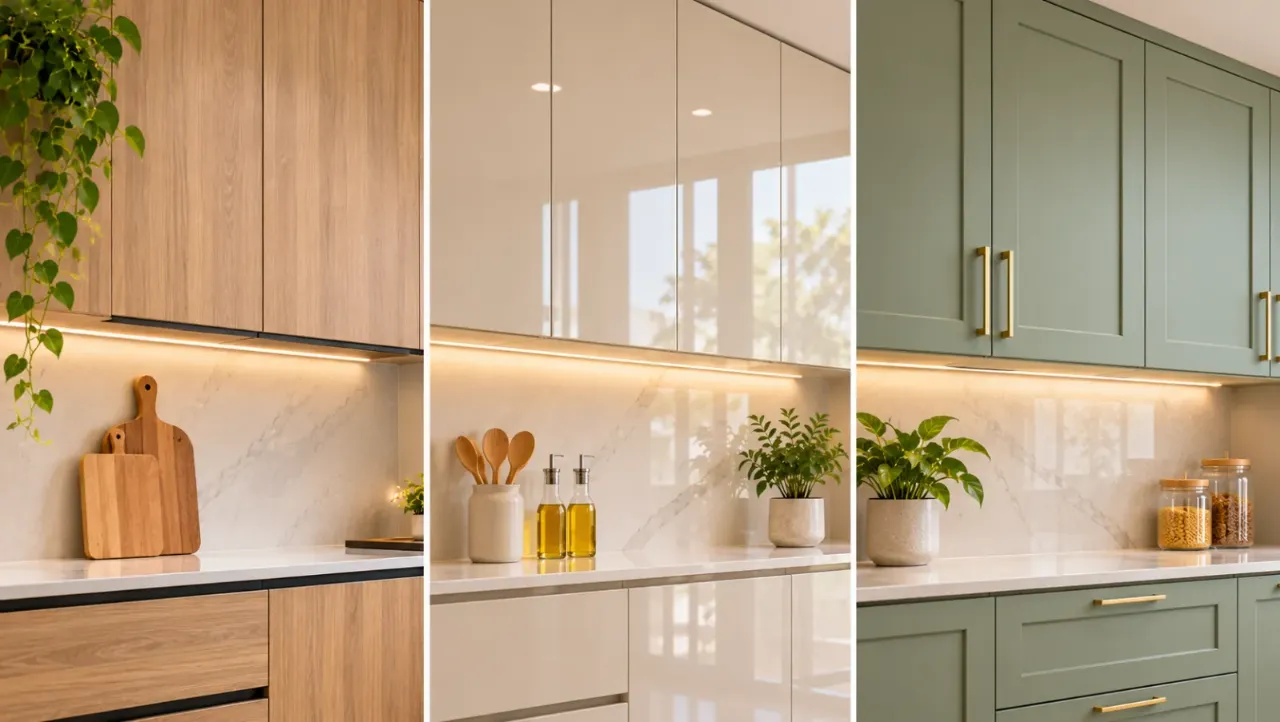
Laminate vs Acrylic vs Membrane: Choosing Kitchen Shutter Finishes
When planning a modular kitchen, choosing the cabinet layout is only part of the decision. The finish you select for the shutters affects how the kitchen looks, how it handles everyday use and how much attention it needs to stay presentable.
Laminate, acrylic and membrane are three commonly considered options. They can all create attractive kitchen cabinets, but they differ in construction, appearance, cost, maintenance and repair requirements.
A glossy acrylic kitchen may look bright and contemporary, while laminate offers a wider variety of colours and textures. Membrane shutters can create a smooth, continuous appearance, including on routed or profiled door designs.
So, which one should you choose?
The answer depends on your budget, preferred style, cooking habits, cabinet design and the quality of the material and workmanship. Here is how the three finishes compare.
1. Understanding the Three Kitchen Shutter Finishes
Before comparing their performance, it helps to understand how each finish is made.
Laminate finish
Laminate is a decorative sheet bonded to a substrate such as plywood, MDF or another suitable board. It is available in many colours, patterns and textures, including wood grains, stone-inspired designs, solid colours and matte or glossy finishes.
It is widely used for kitchen shutters because it offers design flexibility and a broad range of price points.
Acrylic finish
Acrylic kitchen shutters generally use an acrylic sheet bonded to a suitable substrate. The sheet creates a smooth, reflective surface, although matte acrylic options are also available.
High-gloss acrylic is popular in contemporary kitchens because it reflects light and gives cabinet fronts a sleek appearance. The quality of the sheet, adhesive and edge finishing influences the final result.
Membrane finish
Membrane shutters are typically made by applying a decorative PVC-based film over a prepared board, often MDF, using a vacuum-pressing process. The film wraps over the front and edges and can be formed around routed profiles.
This makes membrane useful for designs with grooves, curves, raised details and decorative shutter profiles. Its performance depends heavily on the film quality, substrate, bonding and exposure conditions.
2. Laminate vs Acrylic vs Membrane: Quick Comparison
| Feature | Laminate | Acrylic | Membrane |
|---|---|---|---|
| Appearance | Matte, glossy, textured and patterned | Smooth, reflective or matte | Smooth, often continuous and available in profiled designs |
| Design range | Very wide | Wide, especially solid colours | Wide, including routed and decorative profiles |
| Fingerprints | Depends on colour and texture | Often noticeable on high-gloss dark shades | Depends on film texture and colour |
| Scratch visibility | Depends on grade, colour and texture | Fine scratches may be visible on glossy surfaces | Film can be marked or damaged |
| Cleaning | Generally straightforward with suitable care | Smooth surface is easy to wipe | Usually easy to wipe if the film is intact |
| Moisture concerns | Edges and substrate need protection | Joints and substrate need protection | Edges and film bonding need particular attention |
| Repairability | Individual sheets or shutters may be replaceable; local repairs can be difficult to match | Surface damage can be difficult to repair invisibly | Peeling or damaged film may require shutter replacement or specialist repair |
| Relative cost | Often available across budget ranges | Generally higher than basic laminates | Varies by film quality and shutter construction |
These are general tendencies, not guarantees. Product specifications, board quality, installation and the manufacturer's warranty can change the result.
3. Laminate Kitchen Shutters: Versatile and Practical
Laminate is a popular choice for homeowners who want a large selection of finishes without committing to a single visual style.
Why homeowners choose laminate
- Available in matte, glossy, textured and wood-grain options.
- Offers a wide range of colours and patterns.
- Can suit both contemporary and traditional kitchens.
- Comes in different quality and price categories.
- Individual shutters can often be replaced without changing every cabinet, subject to matching availability.
What to consider
Not every laminate has the same scratch, stain or heat resistance. Low-quality sheets or poorly finished edges may deteriorate with regular use. Water entering through damaged joints can also affect the underlying board.
For kitchen use, ask about the laminate grade, thickness, intended application and edge-banding quality. The board underneath should be selected for the moisture conditions of the kitchen.
Best suited for
Homeowners looking for design flexibility, practical everyday use and a choice of price points.
4. Acrylic Kitchen Shutters: Smooth and Reflective
Acrylic is often selected for its polished appearance. High-gloss acrylic reflects light and can make a kitchen feel brighter, particularly when paired with light-coloured cabinetry and suitable lighting.
Why homeowners choose acrylic
- Creates a smooth, contemporary cabinet appearance.
- High-gloss options reflect light effectively.
- Available in several solid colours and some textured or matte variants.
- Smooth surfaces are generally easy to wipe.
- Works well with handleless or minimal cabinet designs.
What to consider
Fingerprints, dust and water marks can be noticeable on dark, reflective surfaces. Fine scratches may also show under direct lighting. Depending on the product, scratches can be difficult to remove without affecting the finish.
Acrylic sheets should be bonded and edge-finished properly. The quality of the substrate and adhesive matters just as much as the visible sheet.
Best suited for
Homeowners who prefer a sleek, modern kitchen and are comfortable with regular surface wiping to maintain a polished appearance.
5. Membrane Kitchen Shutters: Seamless and Decorative
Membrane finishes are useful when the kitchen design calls for more than a flat cabinet front. The PVC-based film can be pressed over prepared board surfaces and around selected profiles, creating a continuous-looking finish across the shutter face and edges.
Why homeowners choose membrane
- Can create a continuous finish over the front and edges.
- Suitable for selected routed, grooved and decorative shutter designs.
- Available in different colours, textures and wood-inspired patterns.
- Can create a softer, less reflective appearance.
- Offers design options for both contemporary and traditional kitchens.
What to consider
Membrane quality and bonding are critical. Prolonged exposure to high heat or steam can increase the risk of film damage or lifting, particularly around poorly protected edges and near heat-producing appliances.
The suitability of a membrane shutter near a hob, oven or other heat source must be checked against the manufacturer's specifications. Good ventilation, appropriate appliance clearances and correct installation are important.
If the film is damaged or begins to peel, a seamless local repair may be difficult. Depending on the damage, replacing the shutter may be the more practical solution.
Best suited for
Homeowners who want decorative, routed or continuous-looking shutters and can follow the product's heat and care limitations.
6. Which Finish Is Easier to Maintain?
Maintenance depends on the actual product, its colour, texture and location in the kitchen.
Laminate: A suitable smooth laminate is generally straightforward to clean with a soft cloth and mild cleaner. Textured finishes may collect dust or cooking residue in grooves.
Acrylic: Smooth acrylic is easy to wipe, but high-gloss surfaces can reveal fingerprints, fine scratches and streaks. Use a soft microfibre cloth and avoid abrasive cleaning materials.
Membrane: The smooth film surface is generally easy to wipe while intact. However, avoid excessive heat, steam and harsh chemicals, and pay attention to edges and areas around appliances.
For all three finishes, clean spills promptly and follow the manufacturer's instructions. Do not use strong solvents, scouring pads or abrasive powders unless the manufacturer specifically permits them.
7. How Much Do These Kitchen Shutter Finishes Cost?
The cost depends on more than the visible finish. It can vary with the brand, sheet or film quality, substrate, thickness, colour, surface texture, shutter size, edge treatment and installation.
- Laminate: Often offers the widest range of budget options, from basic decorative sheets to premium textures and finishes.
- Acrylic: Generally sits above basic laminate options, particularly for premium high-gloss sheets and specialised colours.
- Membrane: Pricing varies considerably with film quality, profile complexity and the board and pressing process.
Do not compare quotations only by the name of the finish. Ask for the brand, product specification, substrate, thickness, hardware, edge treatment and installation details.
A lower-priced shutter may use a different board or thinner surface material, which can affect its performance over time.
8. What Matters Beyond the Finish?
Even a premium finish cannot compensate for poor cabinet construction. Before approving your kitchen quotation, examine the complete shutter and cabinet specification.
Board quality
Ask whether the substrate is plywood, MDF, HDHMR or another board. Check its suitability for the kitchen's moisture conditions.
Edge treatment
Inspect how exposed edges, corners and joints are finished. Poorly sealed edges can allow moisture to reach the substrate.
Adhesive and bonding
Ask which adhesive or pressing method is used and whether it is suitable for the chosen finish.
Hardware
Hinges, drawer channels, handles and lift-up mechanisms affect everyday operation. Check the brand, load rating and warranty.
Installation
Poor alignment, uneven gaps and incorrect fixing can affect the appearance and functioning of shutters.
Warranty and replacement
Confirm what the warranty covers, how long it lasts and whether damaged shutters can be replaced individually.
9. Which Finish Should You Choose?
There is no single best option for every kitchen. Use your priorities to narrow down the choice.
| Your priority | Finish to consider |
|---|---|
| Wide choice of colours, textures and price points | Laminate |
| A sleek, reflective and contemporary appearance | Acrylic |
| Routed, grooved or decorative shutter designs | Membrane |
| A low-reflection, understated look | Matte laminate or suitable matte acrylic |
| A smooth surface that is straightforward to wipe | Suitable smooth laminate or acrylic |
| A specific wood-grain or stone-inspired look | Laminate or a suitable membrane design |
Treat this as a starting point, not a substitute for checking the exact product specifications and samples.
10. Kitchen Shutter Selection Checklist
Before finalising the finish, check:
- Have you compared physical samples rather than relying only on catalogue images?
- Does the finish suit your kitchen lighting and colour scheme?
- Have you checked how visible fingerprints and scratches are on the sample?
- Is the finish suitable for the intended location and exposure to heat or moisture?
- Have you confirmed the substrate and its moisture suitability?
- Are all edges and joints properly finished?
- Have you checked the manufacturer's cleaning instructions?
- Does the quotation specify the brand, product, thickness and finish?
- Are hardware, installation and warranty details clearly mentioned?
- Is individual shutter replacement possible if damage occurs?
Final Thought
Laminate, acrylic and membrane finishes each serve a different purpose in kitchen design. Laminate offers versatility and a wide choice of price points. Acrylic creates a smooth, reflective appearance, while membrane allows continuous-looking and decorative shutter profiles.
The right decision should consider more than the sample's appearance. Look at the board underneath, the quality of the surface material, edge finishing, heat exposure, hardware and installation.
A well-designed kitchen is not defined by the most expensive shutter finish. It is defined by choosing materials that suit the way the kitchen is used and ensuring that every part of the cabinet is built and installed properly.
Visualise your kitchen before finalising the finish
Use Design My Room to explore kitchen design ideas and the Whole Home Visualizer to coordinate the kitchen with the rest of your home. The Interior Style Finder can also help you explore a suitable design direction.
Frequently Asked Questions
1. Which is better for a modular kitchen: laminate, acrylic or membrane?
There is no universal winner. Laminate offers variety and different price points, acrylic suits reflective contemporary designs, and membrane is useful for selected decorative and routed shutters. Choose based on the product specification, kitchen conditions and maintenance expectations.
2. Is acrylic more expensive than laminate?
Premium acrylic options generally cost more than basic laminates. However, prices vary by brand, thickness, colour, substrate and installation, so compare complete specifications rather than finish names alone.
3. Do acrylic kitchen shutters scratch easily?
Acrylic surfaces can develop fine scratches, and these may be visible under direct light, especially on glossy finishes. Use suitable cleaning cloths and avoid abrasive materials.
4. Is membrane finish suitable near a kitchen hob?
Membrane shutters should only be used where the manufacturer's heat-exposure specifications allow. Heat and steam can affect the film and its bonding. Check appliance clearances, ventilation and the shutter manufacturer's recommendations before installation.
5. Which kitchen shutter finish is easiest to clean?
Smooth laminate and acrylic surfaces are generally straightforward to wipe. Membrane surfaces can also be easy to clean while the film remains intact. The exact texture, product quality and cleaning instructions matter.
6. Can membrane shutters peel over time?
Peeling or lifting can occur if bonding is poor or if the film is exposed to unsuitable heat, steam or moisture conditions. Proper substrate preparation, pressing and installation help reduce the risk.
7. Can damaged acrylic or membrane shutters be repaired?
Some minor marks may be treatable depending on the product, but repairs can be difficult to make invisible. Damaged sheets or films may require shutter replacement. Ask the supplier about repair and replacement support before ordering.
8. What should I check before approving a kitchen shutter quotation?
Check the finish brand and specification, substrate, thickness, edge treatment, adhesive or pressing method, hardware, installation scope, warranty and replacement terms. These details help you compare quotations fairly.
Plan Your Kitchen with Walls to Wonder
Explore kitchen concepts with Design My Room and coordinate ideas across your home using the Whole Home Visualizer.
Use the Interior Design Cost Estimate for indicative budget planning and the Interior Quotation Checker to review quotation details.
You can also use Rate My Room Design to get design feedback and the Interior Style Finder to explore styles that suit your preferences.
Discover more ideas and tools at Walls to Wonder.
Turn this idea into a plan for your home
Visualise your space, understand the likely budget, or find a professional who can bring the idea to life.