
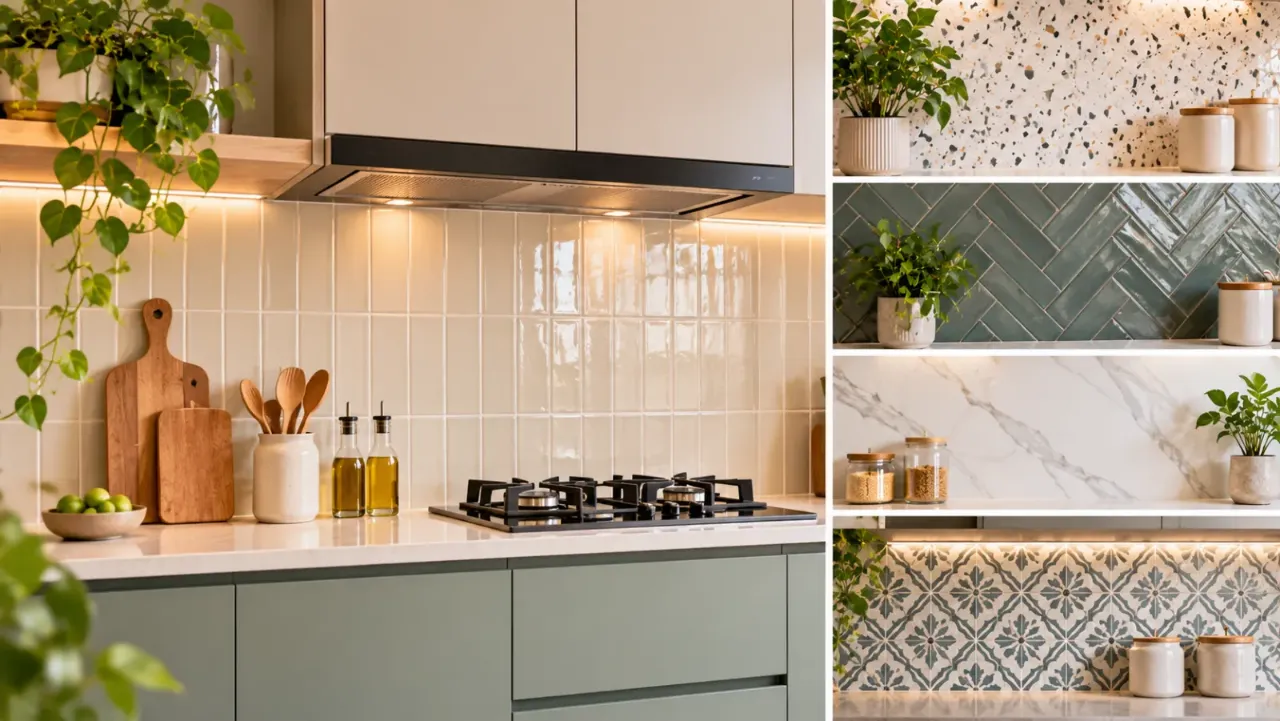
Kitchen Backsplash Ideas: Materials That Look Good and Clean Easily
The wall behind a kitchen countertop faces some of the toughest everyday conditions in a home. Oil splashes, food stains, steam, water and regular wiping can gradually affect its appearance. A backsplash protects this area, but it also plays an important role in how the kitchen looks.
Choosing one is not simply about finding an attractive tile or finish. The material should suit the way the kitchen is used, especially in Indian homes where frequent frying, tadka, boiling and heavy cooking can expose surfaces to grease and heat.
Some materials are easier to wipe but show fingerprints. Others look natural and luxurious but need periodic sealing. Even the grout, joints and installation method can affect how much effort cleaning requires.
Here is a practical comparison of kitchen backsplash materials, with ideas to help you choose a finish that balances appearance, durability and easy maintenance.
1. What Should You Consider Before Choosing a Kitchen Backsplash?
Before comparing materials, think about the conditions your backsplash will face.
- Grease and food splashes: The area behind the hob needs a surface that can be cleaned regularly without trapping grease in deep textures or porous joints.
- Heat exposure: Materials installed behind a cooking appliance must be suitable for the temperatures and clearances involved. Always follow the appliance and surface manufacturer's installation instructions.
- Water and moisture: The area behind the sink needs a finish that handles frequent splashes and can be cleaned without damage.
- Grout and joints: Small tiles may create a detailed appearance, but they also introduce more grout lines that need cleaning.
- Cleaning products: Some finishes tolerate everyday mild cleaners but can be damaged by abrasive pads, acidic products or strong chemicals.
- Visual compatibility: The backsplash should work with the countertop, cabinets, flooring, hardware and overall kitchen colour palette.
The best material is the one that suits both the kitchen's design and its daily cooking routine.
2. Ceramic Tiles: A Versatile and Practical Choice
Ceramic tiles are a popular backsplash option because they are available in many colours, patterns, sizes and finishes. They can create anything from a simple contemporary background to a decorative feature behind the cooking counter.
Why they work
- The glazed surface is generally easy to wipe.
- There are plenty of colours, patterns and tile formats.
- Individual damaged tiles can often be replaced.
- They are available at different price points.
What to consider
- Grout lines need regular attention.
- Deeply textured or uneven tiles can collect grease.
- Some decorative finishes may require more careful cleaning.
- Installation quality and joint finishing affect long-term performance.
Best suited for: Everyday kitchens that need a practical, flexible and visually varied backsplash.
For easier maintenance, consider glazed ceramic tiles with a smooth surface and a grout colour that does not show every small stain.
3. Porcelain Tiles: A Durable Option for Busy Kitchens
Porcelain tiles are made from a dense ceramic body and are available in a wide range of stone, concrete and plain finishes. They are particularly useful when you want the appearance of a natural material without using a natural stone surface.
Why they work
- Many porcelain options have low water absorption.
- They are available in durable finishes.
- Large formats can reduce the number of visible joints.
- Stone-look and concrete-look designs offer considerable visual variety.
What to consider
- The tile must be installed on a suitable, properly prepared surface.
- Cutting and installation can be more demanding, particularly for large formats.
- Textured finishes may be harder to wipe clean.
- Grout still requires suitable selection and maintenance.
Best suited for: Busy kitchens where durability, a clean appearance and fewer visible joints are priorities.
A large-format porcelain backsplash can create a more continuous appearance behind the countertop. Choose a smooth or lightly textured finish for easier everyday cleaning.
4. Glass Backsplash: A Smooth, Contemporary Finish
A glass backsplash creates a sleek, reflective surface with very few or no visible joints, depending on the installation. It can help a compact kitchen feel brighter by reflecting light.
Why it works
- Smooth glass is easy to wipe.
- There are fewer joints where dirt can collect.
- It can create a clean, uninterrupted look.
- Coloured or back-painted glass offers a range of design possibilities.
What to consider
- Fingerprints, water marks and dried splashes may be visible.
- It needs careful measurement and professional installation.
- The glass must be specifically suitable for the intended location and heat exposure.
- Cut-outs for sockets and fittings need to be planned in advance.
Best suited for: Contemporary kitchens where a seamless appearance and easy surface wiping are important.
Do not use ordinary glass behind a hob. Select a glass product specifically rated for the intended heat exposure and follow the manufacturer's installation requirements.
5. Natural Stone: A Distinctive and Premium Look
Natural stone can give a kitchen a rich, individual appearance. Marble, granite and other stones have natural variations in colour and veining, making each installation visually distinctive.
Why it works
- Natural patterns create depth and character.
- It can complement stone countertops.
- Different stone types offer varied colours and textures.
- Large stone pieces can reduce the number of visible joints.
What to consider
- Some natural stones are porous and need suitable sealing.
- Marble can be vulnerable to acids, including lemon juice and vinegar.
- Certain stones can stain if spills are not cleaned promptly.
- Sealer does not make every stone stain-proof or maintenance-free.
- Repairs and matching replacement pieces can be difficult.
Best suited for: Kitchens where natural material character is a priority and the homeowner is comfortable following the stone's care requirements.
Before selecting natural stone, ask about porosity, sealing, stain resistance and recommended cleaning products. Do not assume every stone performs in the same way.
6. Quartz and Other Engineered Slabs: A Seamless Appearance
Engineered quartz and other manufactured slab surfaces can provide a clean, continuous backsplash with fewer joints than small-format tiles.
Why they work
- Large panels create a streamlined look.
- There are many colours and patterns.
- Fewer joints can simplify routine wiping.
- The backsplash can visually match the countertop.
What to consider
- Engineered quartz contains resin and should not be assumed to tolerate direct high heat.
- Follow the manufacturer's restrictions around hobs and other heat sources.
- Large slabs need skilled handling and installation.
- Repairs and replacements may be more complicated than replacing individual tiles.
- The exact cleaning and maintenance requirements vary by product.
Best suited for: Kitchens where a coordinated countertop and backsplash or a minimal-joint appearance is desired.
An engineered slab may be a good choice for areas away from direct high heat. Behind a hob, confirm that the specific product is approved for the installation and exposure. A matching look does not automatically mean matching heat performance.
7. Stainless Steel: A Functional Choice for Heavy Cooking
Stainless steel is commonly associated with commercial kitchens, but it can also work in residential kitchens where cooking activity is frequent.
Why it works
- It offers a smooth, non-porous surface when properly finished.
- It can be wiped clean of everyday grease and food splashes.
- It creates a contemporary, functional appearance.
- It can be useful as a protective panel behind a cooking area when appropriately specified.
What to consider
- Fingerprints, water marks and scratches may be visible.
- The finish can influence how noticeable everyday marks become.
- It may look more industrial than other kitchen materials.
- Edges, joints and fixing details need proper finishing.
Best suited for: High-use cooking zones and kitchens where practicality is more important than a decorative feature.
A brushed finish can help make minor marks less noticeable than a highly polished surface. Use cleaning products recommended for the selected grade and finish.
8. Compare the Materials Before Making a Decision
| Material | Appearance | Everyday cleaning | Main consideration |
|---|---|---|---|
| Glazed ceramic | Colourful, classic or modern | Easy on smooth surfaces | Grout maintenance |
| Porcelain | Stone-look, concrete-look or plain | Generally easy on smooth surfaces | Installation and grout |
| Glass | Seamless and reflective | Easy to wipe; marks can show | Heat-rated product and professional fitting |
| Natural stone | Unique and premium | Varies by stone and finish | Porosity, sealing and staining |
| Engineered quartz | Consistent and coordinated | Generally easy to wipe | Resin and heat limitations |
| Stainless steel | Contemporary and functional | Easy to wipe; fingerprints may show | Scratches and water marks |
No material is completely maintenance-free. The finish, installation, grout, exposure and cleaning routine all influence how well it performs.
9. Choose the Backsplash According to the Kitchen Zone
Different parts of the kitchen experience different types of exposure. You do not necessarily need the same backsplash material everywhere.
Behind the hob
This area receives the most direct grease splashes and heat. Choose a smooth, cleanable surface specifically suitable for the appliance's heat exposure. Suitable glazed tiles, appropriately rated panels or stainless steel may be considered, depending on the installation.
Behind the sink
Water splashes and cleaning products are the main concerns. Choose a surface with suitable moisture resistance and properly sealed joints. Glazed tiles, porcelain and suitable glass can be practical options.
Behind the preparation counter
This area may receive food stains, chopping splashes and frequent wiping. Smooth tiles, porcelain and suitable slab surfaces can work well.
Along an open countertop
A backsplash may need to coordinate with the adjoining wall, cabinets and dining area. Consider how the finish looks from the rest of the home, not just from within the kitchen.
10. Design Ideas That Make a Kitchen Backsplash Look Better
A practical surface does not have to look plain. The layout, colour, pattern and finish can all contribute to the kitchen's character.
- Subway tiles: A classic rectangular format that works with contemporary and traditional kitchens.
- Large-format tiles: Reduce visible grout lines and create a quieter appearance.
- Herringbone patterns: Add movement and visual detail, though they introduce more joints and installation work.
- Vertical tile layouts: Can create a taller visual effect and give a familiar tile a different appearance.
- Stone-look finishes: Add texture and natural character without necessarily using natural stone.
- Full-height backsplash: Extends the surface from the countertop towards the cabinets or upper wall, creating a continuous backdrop.
- Matching countertop and backsplash: Creates a coordinated, minimal look when the selected material is suitable for both applications.
Keep the pattern in proportion to the kitchen. A heavily detailed backsplash may compete with patterned countertops, busy cabinet finishes or decorative flooring.
11. How to Make a Kitchen Backsplash Easier to Clean
Even a good material can become difficult to maintain if the wrong finish or installation details are selected.
- Choose smooth surfaces: Deep textures, open pores and uneven joints can hold grease and dirt.
- Pay attention to grout: Use a grout type suitable for the location and follow the manufacturer's sealing and maintenance instructions. Epoxy grout can offer lower absorption than conventional cement-based grout, but it still needs correct installation.
- Minimise unnecessary joints: Large-format tiles or slabs can reduce the number of grout lines.
- Clean splashes promptly: Fresh grease and food stains are generally easier to remove than deposits that have been left to build up.
- Use suitable cleaners: Follow the material manufacturer's recommendations. Avoid acidic cleaners on acid-sensitive stone and abrasive products on finishes that can scratch.
- Check edges and corners: Properly finished joints around countertops, sockets and corners help prevent water and dirt from collecting in gaps.
12. Common Kitchen Backsplash Mistakes to Avoid
| Mistake | Better approach |
|---|---|
| Choosing only by appearance | Compare cleaning, heat exposure and maintenance as well. |
| Using highly textured tiles behind the hob | Prefer a smoother, easier-to-wipe surface. |
| Ignoring grout colour and type | Choose grout suitable for the location and expected cleaning. |
| Using natural stone without checking care needs | Confirm sealing, stain resistance and cleaning requirements. |
| Assuming quartz can handle direct hob heat | Check product-specific heat restrictions and installation clearances. |
| Choosing glass without heat suitability | Specify glass designed for the intended location. |
| Installing too many small tiles | Consider larger formats to reduce joints. |
| Ignoring sockets and fittings | Plan cut-outs and finishing before installation. |
13. Kitchen Backsplash Planning Checklist
Before finalising your backsplash, check the following:
- Identify the areas behind the hob, sink and preparation counter.
- Decide whether one material will be used throughout or different surfaces are needed.
- Check heat suitability near the cooking appliance.
- Confirm moisture resistance behind the sink.
- Compare smooth and textured finishes.
- Consider the number of grout lines and the type of grout.
- Match the backsplash with the countertop and cabinets.
- Check cleaning product compatibility.
- Plan socket cut-outs, edges and countertop joints.
- Confirm installation instructions and maintenance requirements.
Conclusion
A good kitchen backsplash should protect the wall, complement the cabinets and countertop, and remain manageable to clean after everyday cooking. Ceramic and porcelain tiles offer flexibility, glass creates a smooth modern finish, natural stone adds character, engineered slabs provide visual continuity and stainless steel can be useful in hardworking cooking zones.
Instead of choosing a material only because it looks attractive in a display, consider where it will be installed and what it will experience every day. When heat suitability, grout, surface finish and maintenance are considered together, the backsplash can remain both practical and visually appealing.
Frequently Asked Questions
1. Which material is easiest to clean for a kitchen backsplash?
Smooth glazed ceramic, porcelain, suitable glass and stainless steel are generally straightforward to wipe. The best option depends on the finish, installation and cleaning instructions.
2. Are ceramic tiles good for an Indian kitchen backsplash?
Yes. Glazed ceramic tiles offer many design choices and are generally easy to clean. Pay attention to grout maintenance and choose a smooth finish around the cooking area.
3. Are large tiles better for kitchen backsplashes?
Large-format tiles can reduce the number of grout lines and create a more continuous appearance. However, they need accurate cutting and professional installation.
4. Is glass suitable behind a gas stove?
Only glass specifically designed and approved for the intended heat exposure should be considered. Follow the manufacturer's instructions and required clearances for the cooking appliance.
5. Does a natural stone backsplash need sealing?
Some natural stones require periodic sealing, while others may have different care requirements. Confirm the specific stone's porosity, finish and recommended maintenance.
6. Is quartz suitable for a kitchen backsplash?
Engineered quartz can work in many backsplash areas, but its resin content means direct high heat can be a concern. Check the manufacturer's heat restrictions before installing it behind a hob.
7. Which grout is best for a kitchen backsplash?
The choice depends on the tile, joint width and exposure. Epoxy grout generally absorbs less than cement-based grout, but both require correct installation and product-specific care.
8. Should the kitchen backsplash match the countertop?
It does not have to match exactly. A coordinated colour, similar undertone or complementary texture can create a balanced design. Matching materials can also produce a more continuous appearance if they are suitable for both applications.
Plan Your Kitchen with Walls to Wonder
Explore kitchen design possibilities, visualise finishes and make more informed interior design decisions with Walls to Wonder's AI-powered tools.
- Whole Home Visualizer – Visualise design ideas across your home.
- Design My Room – Experiment with kitchen colours, layouts and finishes.
- Interior Design Cost Estimate – Estimate your interior design budget.
- Interior Quotation Checker – Review and compare interior design quotations.
- Rate My Room Design – Get feedback on your kitchen design.
- Interior Style Finder – Discover an interior style that suits your preferences.
Visit Walls to Wonder for more home design ideas and tools.
Turn this idea into a plan for your home
Visualise your space, understand the likely budget, or find a professional who can bring the idea to life.