
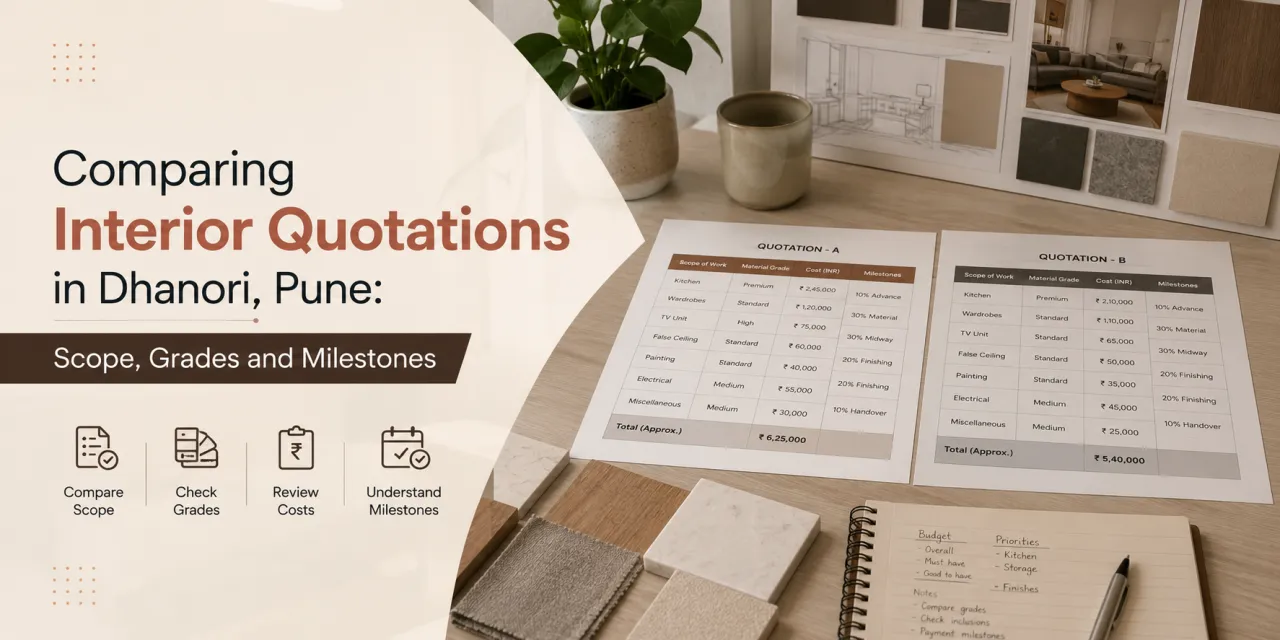
Comparing Interior Quotations in Dhanori, Pune: Scope, Grades and Milestones
A quotation is not a price tag. It is a proposed definition of what will be measured, purchased, installed and accepted. Two interior quotations for the same Dhanori apartment can look far apart while describing different jobs—or look almost identical while hiding very different material grades and exclusions.
If you are comparing designers and companies serving Dhanori, Pune, begin with the work rather than the total. This is particularly important for a new apartment handover, a resale flat needing coordinated repairs, or a partly furnished home where only the kitchen, wardrobes and lighting are being addressed. Nearby areas such as Lohegaon, Vishrantwadi, Charholi and Viman Nagar may appear in a company’s service area, but the useful comparison is still the same: can the quotation be understood, measured and managed?
The first trade-off: a lower headline total versus a complete scope
What you gain and give up
A compact quotation is quick to read and may preserve cash for appliances, loose furniture or later upgrades. The sacrifice is visibility. Phrases such as “modular kitchen,” “false ceiling” or “complete electrical” do not tell you how many cabinets, points, channels, shutters, finishes or site activities are included.
The safer comparison document is a BOQ—bill of quantities—with room-wise line items, dimensions or quantities, unit rates, finish descriptions and installation responsibility. Ask whether the kitchen includes carcass, shutters, skirting, filler panels, handles, baskets, hinges, channels, countertop, sink cut-out, plumbing changes and delivery. For a wardrobe, look for internal partitions, back panel, loft, edge banding, shutters, hardware and site fixing rather than only a square-foot figure.
Works when: the scope is genuinely limited and every excluded item is recorded. Becomes expensive when: omissions emerge after demolition or site measurement, when a “complete” item turns into a series of variation orders.
Compare the service boundary too. One firm may offer design, 3D views, procurement, civil work, electrical modifications, carpentry, installation and snag closure. Another may design and install cabinetry but leave painting, plumbing, debris removal, appliance connections or light fixtures to others. Neither approach is automatically wrong; it becomes risky when the homeowner assumes the wider service is included.
The second trade-off: material grade, finish and hardware
Specification is where the quotation earns its credibility
“Plywood,” “laminate” and “premium hardware” are categories, not complete specifications. A useful quotation names the board type and thickness where relevant, laminate or acrylic finish, edge treatment, moisture-resistant application, brand or approved equivalent, and the hardware series or performance level. It should also state where a different material is proposed—for example, a cabinet interior, back panel or loft.
Higher specification can improve appearance, resistance to daily wear, smoothness of operation and future repairability. It also narrows the allowance for substitutions and raises the initial outlay. A restrained specification may be sensible for a rental refresh, a low-use overhead cabinet or a home office that can be upgraded later. It is less sensible to accept vague grades in sink units, frequently used drawers or areas exposed to moisture.
Works when: the selected grade matches use, maintenance expectations and the room’s exposure. Becomes expensive when: the quotation uses a premium finish in the total but a basic grade in the detailed schedule, or when a cheaper substitute changes dimensions and forces rework.
Ask for a sample or written reference before approval. Confirm whether taxes, transport, unloading, installation consumables, edge profiles, polishing, glass, baskets and soft-close mechanisms are included. “Brand or equivalent” should have an approval process: who decides equivalence, and what happens if the specified product is unavailable?

Test the budget before comparing offers
Use the interior cost estimator to organise an early budget conversation. Treat its output as a planning reference, not a substitute for site measurement or a BOQ.

Run a second reading of the document
The quotation checker can help surface unclear line items and omissions. Confirm every flagged point directly with the designer before signing.
The third trade-off: coordination bundled into one contract versus separate specialists
Convenience has a management cost—and so does managing it yourself
A turnkey arrangement can give you one schedule, one escalation point and a clearer responsibility for coordination between carpentry, electrical, civil, painting and installation. The trade-off is that the bundled margin and project management charge may be less visible. You also need to understand whether the company is executing the work or coordinating subcontractors.
Separate specialists can offer more control over a particular kitchen, wardrobe system, renovation repair or loose furniture purchase. That approach may work for an organised homeowner with time to sequence trades. It becomes expensive when a civil change delays measurements, an appliance opening is missed, or one contractor says another owns the defect.
Works when: responsibility for drawings, procurement, site protection, quality checks and handover is written down. Becomes expensive when: “coordination” is promised verbally but no one owns interfaces such as plumbing behind a cabinet, electrical points inside a wardrobe or the final appliance fit.
Before paying an advance, ask for the design deliverables and approval stages: layout, elevation, electrical plan, finish schedule, hardware schedule and final BOQ. Ask who records site measurements, who approves substitutions, how drawings are revised and whether a change order is issued before extra work begins. A written change order should describe the change, quantity, rate, tax impact, schedule impact and approval—not arrive as a surprise in the final bill.
The fourth trade-off: a small advance now versus payment tied to evidence
Milestones should purchase progress, not merely time
An advance helps a company reserve design effort, order materials and plan labour. The homeowner gives up liquidity and leverage, so the amount, refund position and permitted use should be clear. A large early payment is especially difficult to evaluate if drawings, samples, site measurements and procurement have not yet been approved.
A more defensible schedule links instalments to visible deliverables: design and measurement approval; material and hardware approval; production or procurement; delivery and installation; testing, snag closure and handover. The exact percentages depend on the contract and procurement model. What matters is that the final payment is not due before defects, missing parts, cleaning responsibilities, warranty documents and agreed acceptance criteria are addressed.
Works when: each milestone has an evidence pack—approved drawings, delivery records, installation status or signed snag list. Becomes expensive when: payment dates are calendar-based, the quotation allows unilateral changes, or the warranty starts before the homeowner can reasonably inspect the work.
Clarify taxes and invoicing, transport and unloading, storage, protection of floors and lifts, debris removal, civil permissions where applicable, and the cost of work discovered after dismantling. Also ask how cancellations, delayed handover, unavailable materials and customer-supplied appliances are handled. These clauses are not pessimism; they prevent a commercial disagreement from becoming a site argument.
Put the competing quotations on one comparison page
Do not force every designer into the same package. Normalise the information first, then decide which trade-offs suit your home. A quotation that separates optional work may be more honest than one that quietly includes it in a broad “interiors” total.
| Compare this | Ask for | Why it changes the decision |
|---|---|---|
| Scope and quantity | Room-wise BOQ, dimensions, units and installation responsibility | Reveals missing storage, panels, points and site work |
| Materials | Board, finish, thickness, edge treatment, brand or approved equivalent | Prevents a low total based on an unspoken downgrade |
| Hardware | Make, series or specification for hinges, runners, lifts and baskets | Hardware affects use, replacement and long-term value |
| Commercials | Tax, transport, labour, civil exclusions, change-order rate and warranty | Shows the likely cost beyond the displayed total |
| Milestones | Deliverable, approval, payment trigger and retention or final acceptance | Keeps cash flow connected to measurable progress |
A short decision summary before you sign
- Match every room and service you expect to a BOQ line or a clearly marked exclusion.
- Record material grades, finishes, hardware and substitution rules in the quotation.
- Separate included work from optional upgrades, taxes, transport and civil or repair work.
- Approve drawings and samples before production; require written change orders for variations.
- Pay against defined milestones and reserve acceptance until testing, snags and handover documents are complete.
For a broader view of designers and companies serving the area, revisit the Dhanori directory. You can also browse design ideas, compare approaches in projects and expert stories, and use practical posts before requesting a revised quote. If the design direction is still uncertain, Design my room, Find my style and the AI interior assistant can help you prepare questions and preferences. WallsToWonder helps by bringing discovery, planning references and quotation-review tools together; the final scope, specification and contract still need confirmation with the chosen professional.
Questions Dhanori homeowners commonly ask
1. Should I choose the cheapest interior quotation?
Not on total alone. First compare scope, quantities, material grades, exclusions, taxes, warranty and payment triggers. A lower figure can simply move costs outside the quotation.
2. What does a proper BOQ include?
It should identify room-wise work, dimensions or quantities, units, materials, finishes, hardware, installation and exclusions. Ask for assumptions behind any square-foot rate.
3. How much advance is reasonable?
There is no universal amount. Tie the advance to defined design or procurement work, record cancellation terms and avoid paying for unapproved materials or undefined future work.
4. Are civil and electrical changes normally included?
They may be included, partly included or excluded depending on the project. Ask for separate line items covering points, chasing, plumbing, masonry, painting, debris and restoration.
5. How can I check a quotation without design expertise?
Ask for a room-wise BOQ, compare like-for-like specifications, request samples and use the quotation checker to identify questions for the designer. Do not approve unclear items.
Get a personalised estimate for your home
Choose your rooms, materials and preferences to understand a practical interior budget before you commit.