
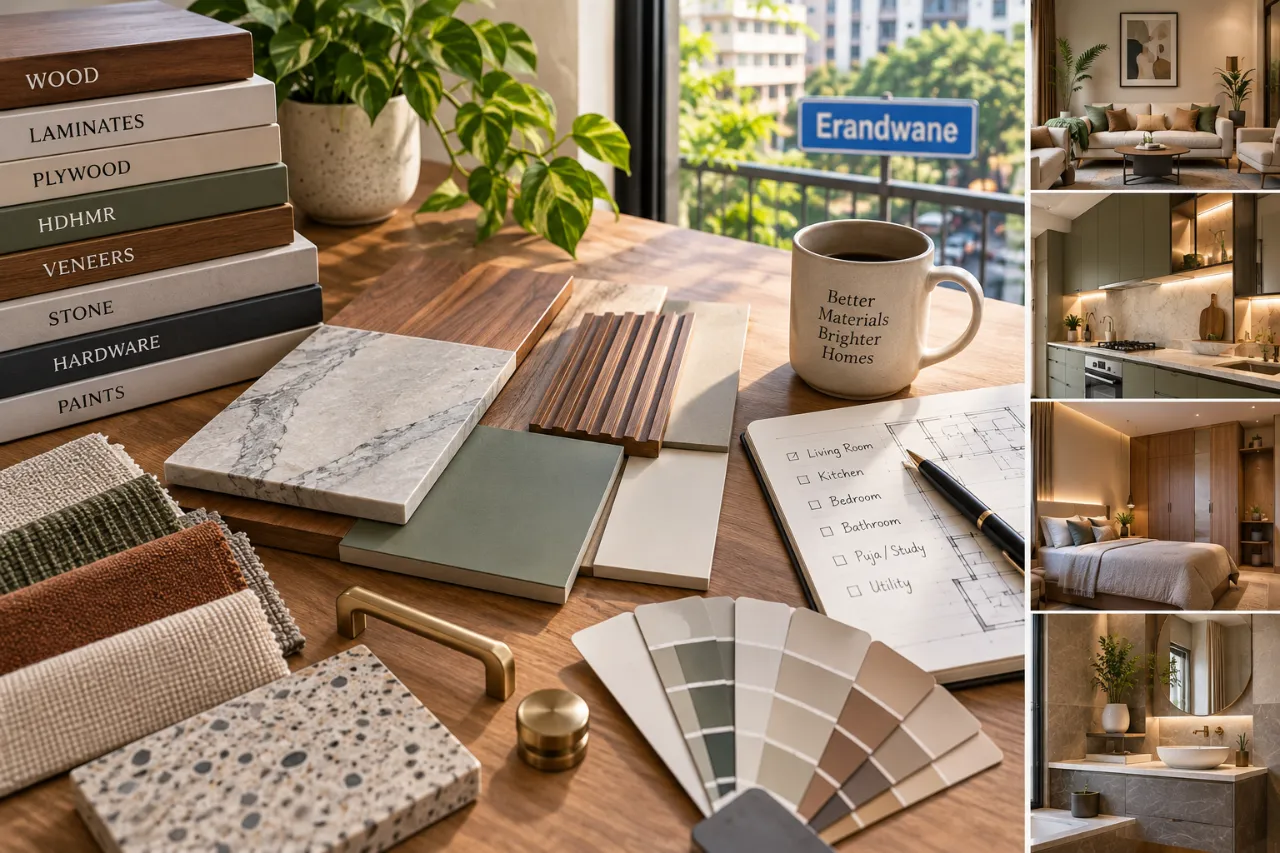
Choosing Interior Materials in Erandwane: A Room-by-Room Decision Guide
A wardrobe shutter can look flawless on handover day and still reveal the wrong material choice after one monsoon cycle, a plumbing repair or repeated daily use. In Erandwane, where homes may range from older apartments undergoing renovation to newer flats needing a complete interior package, material selection is less about choosing the most expensive board and more about matching each layer to its exposure and workload.
This interior materials guide for Erandwane, Pune treats plywood, HDHMR, laminates, edge bands, finishes and hardware as a decision system. Start by reviewing designers and companies serving Erandwane, but keep the material brief independent of any one quotation. That makes comparisons clearer across nearby service areas such as Kothrud, Karve Nagar, Deccan Gymkhana and Prabhat Road.
The material decision is a chain, not a board selection
“Plywood kitchen” or “laminate wardrobe” is not a complete specification. The result depends on the substrate, surface finish, adhesive, edge treatment, hinges, channels, installation quality and the way the unit meets a wall or floor. A good comparison asks five questions: how much moisture and impact the unit will face, how much maintenance it permits, how easily it can be repaired or altered, how many vendors must coordinate, and where cost can expand after work begins.
| Decision criterion | Plywood | HDHMR | Laminate finish | Paint, veneer or acrylic finish |
|---|---|---|---|---|
| Best understood as | A structural substrate with different grades and core qualities | A dense engineered board suited to many dry interior applications | A surface layer applied over a suitable substrate | A visual finish with different care and coordination demands |
| Moisture exposure | Grade, sealing and edge protection matter; no board should be treated as automatically waterproof | Needs careful detailing at cut edges and wet interfaces | Resists routine surface marks, but joints and exposed edges remain vulnerable | Performance varies; touch-ups and surface protection may be more demanding |
| Maintenance | Depends largely on the chosen finish and hardware | Usually practical for dry storage when edges are sealed | Generally easy to wipe; dark textures can show dust or fingerprints | Can require more careful cleaning and future touch-up planning |
| Coordination effort | Requires clear board grade, thickness and edge details | Requires accurate cutting and protection from site moisture | Requires shade, grain direction and joint planning | Requires stronger control of surface preparation, samples and application |
| Cost exposure | Can rise with grade, thickness, wastage and hardware | Often changes with density, thickness and application | Changes with brand, texture, thickness, edging and wastage | Changes with preparation, coats, detailing and repair allowance |
Read the home room by room
Kitchen: protect the vulnerable interfaces
The kitchen has the highest concentration of heat, water, cleaning activity and hardware movement. Focus less on a blanket promise of “waterproof material” and more on the sink cabinet, hob area, dishwasher or washing-machine adjacency, plinth, corner joints and cut-outs for plumbing.
Plywood may be a sensible substrate where the design has larger spans, frequent access or greater repair expectations, provided the grade and edge sealing are written into the quotation. HDHMR can suit selected dry or moderately exposed cabinet components when its cut edges are properly protected. Neither choice removes the need for a drip management plan.
For shutters, laminate is often the easier-to-maintain option when the priority is predictable cleaning and controlled cost exposure. Ask for the laminate code, thickness, texture direction and edge-band specification. Hardware should be compared separately: hinge overlay, drawer load rating, soft-close provision, tandem or regular channels, and access for future replacement.
Bedrooms: balance flexibility with visual calm
Bedroom wardrobes are usually exposed to less water but more repetitive opening, hanging loads and occasional relocation of shelves. A sound decision may combine a stable substrate with laminate shutters and robust edge bands rather than using the same board and finish throughout.
Look closely at tall shutter alignment, adjustable shelves, drawer bottoms, loft access and the gap between the wardrobe and wall. In a renovation, uneven walls can create filler strips and shadow gaps that affect both appearance and material consumption. A designer should show how those conditions are measured before the board is ordered.
For a dressing area, compare laminate with veneer or paint only after seeing full-size samples in the room’s light. Small samples can hide grain direction, reflection and the visibility of joints.
Living spaces: finish consistency matters more than maximum specification
TV units, crockery storage and display ledges are usually drier than kitchen cabinets, but they remain visible from several angles. Here, coordination becomes a major criterion. Matching laminate tones across shutters, open niches and side panels can be more valuable than specifying one premium substrate everywhere.
Check how the back panel is fixed, how ventilation is handled around electronics, and whether cable routes remain accessible. Veneer, acrylic, paint and textured laminates each create a different maintenance and repair expectation. A high-gloss surface may show fingerprints and scratches more readily than a textured or matte alternative; ask how a damaged panel would be replaced.
Storage, utility and pooja areas: small details carry the risk
Utility cabinets and shoe storage encounter dust, cleaning water and damp footwear. Prioritise sealed edges, a clean plinth detail, removable access panels and hardware that can be serviced. A storage unit near an entrance also benefits from a finish that does not make everyday marks conspicuous.
For a pooja unit, specify the heat source, ventilation, cable routing and cleaning method before finalising the finish. Avoid treating decorative backing panels as structural elements unless the quotation clearly says how they are supported.
Use tools before the quotation becomes a commitment
A material discussion becomes more useful when it is tied to scope. A designer may provide design development, site measurement, 3D views, modular manufacture, civil or electrical coordination, installation and post-handover support. These services should be separated from the material line items so that a lower-looking quote is not simply omitting preparation or installation work.
Test the budget structure
Use the interior design cost estimator to organise assumptions around rooms, scope and finish level. Treat the output as a planning aid, then confirm material grades and quantities with the designer.

Inspect the line items
Run the document through the interior quotation checker to identify missing descriptions or unclear allowances. Human review is still needed for samples, drawings, site conditions and contractual terms.
What a reviewable quotation should reveal
Every board-related item should identify substrate, thickness, finish, edge band, hardware and quantity or measurement basis. “Modular kitchen” is not enough. A useful schedule distinguishes carcass, shutters, backs, fillers, skirting, handles, baskets, channels, hinges, lights and installation. It also states what happens at corners, service cut-outs, wall irregularities and changes requested after approval.
Major pricing factors include the number of running units, tall storage, drawer count, hardware grade, finish complexity, site access, civil and electrical changes, demolition, protection of existing surfaces, and whether loose furniture or appliances are included. Material choice changes cost exposure through wastage, replacement difficulty and coordination—not only through the board’s per-sheet rate.
Questions worth asking before paying an advance
- Which substrate is specified for each room, and where does the specification change?
- What are the board thickness, finish code, edge-band thickness and adhesive or sealing assumptions?
- Which hinges, drawer channels, lift-ups and baskets are included, and what access is available for replacement?
- How are sink cabinets, plumbing cut-outs, plinths and exposed edges protected?
- Are demolition, levelling, electrical work, painting, delivery, installation and debris removal included?
- What is the process for approving full-size samples, drawings, substitutions and variations?
- What is excluded, and when does the payment schedule become due?
Red flags that deserve a pause
Be cautious when a proposal uses “premium,” “waterproof,” or “lifetime” without a measurable specification. A single material promise for every room may indicate that exposure and function have not been assessed. So can a quotation with no edge detail, no hardware schedule, no drawings, no exclusions, or a large advance requested before the scope is approved.
Other warning signs include substitutions allowed without written approval, samples that do not carry identifiable codes, verbal warranty claims, and a final total that cannot be reconciled with unit quantities. Compare local designers and companies serving the Erandwane area using the same written brief rather than comparing headline totals alone.
Make the comparison wider than materials
Material skill is only one part of a reliable interior service. Review a company’s relevant project stories, browse room and material design ideas, and use WallsToWonder posts to refine the questions you take to a consultation. For early visual direction, Design my room and Find my style can help clarify preferences, while the AI interior assistant can help organise questions and scope notes.
The strongest comparison is not the one with the longest material list. It is the one where every room has a reason for its substrate, finish, edge treatment and hardware—and where the quotation makes future maintenance and substitutions visible.
Frequently asked questions
Is plywood always better than HDHMR for an Erandwane home?
No. The suitable choice depends on exposure, span, hardware, edge protection, design and budget. Specify the application rather than assuming one board should be used everywhere.
Can laminate make a cabinet moisture-proof?
No. Laminate protects a surface, but joints, cut-outs, edges, backs and the underlying substrate still need correct detailing and sealing.
What should I compare first between two interior quotations?
Compare scope, quantities, substrate and finish specifications, hardware, installation, exclusions, taxes if applicable, payment stages and variation terms before comparing totals.
Which finish is easiest to maintain?
That depends on texture, colour, use and repair expectations. Many laminates are practical for routine wiping, while glossy or specially applied finishes may show marks or require more careful upkeep.
Where can I find designers serving Erandwane?
Start with the WallsToWonder Erandwane directory, then send shortlisted designers the same room list and material brief so their proposals can be compared fairly.
Turn this idea into a plan for your home
Visualise your space, understand the likely budget, or find a professional who can bring the idea to life.