
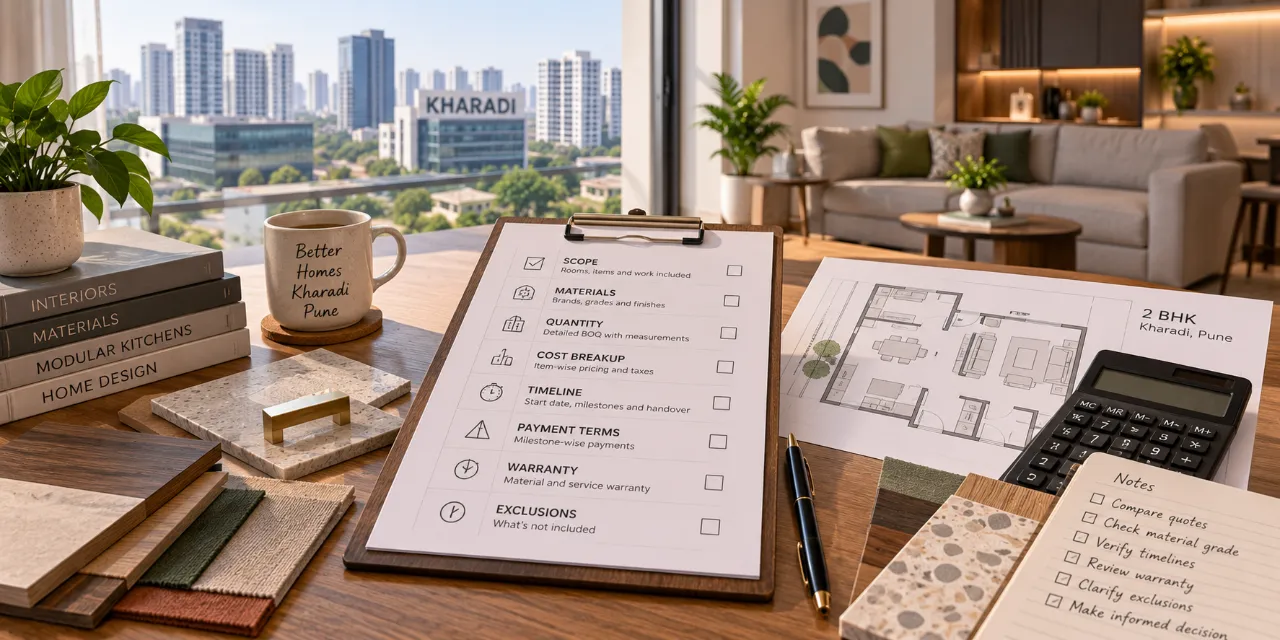
Interior Design Quotation Checklist for Kharadi, Pune Homes
A quotation is more than a final number. It is the working description of your home: what will be designed, which materials will be used, what the company will execute, and what you may still need to arrange separately. This interior design quotation checklist for Kharadi, Pune homeowners is designed to help you compare proposals without getting distracted by a low headline figure.
Start by browsing designers and companies serving Kharadi, then request comparable quotations from a shortlist. The most useful comparison is made only after each designer has received the same brief, drawings and expected scope.
What to decide before requesting a quotation
Quotations become vague when the brief is vague. Before your first meeting, write down the decisions that affect design effort and execution:
1Define the home
Note the property type, carpet area if available, number of bedrooms, possession or handover status, and whether the home is a new fit-out or a renovation. A compact apartment, a larger family home and a rented property will need different scopes.
2Set priorities
Separate essentials from nice-to-haves. A functional modular kitchen, wardrobes and electrical changes may come before a display unit, false ceiling or extensive décor. This makes value engineering easier later.
3Agree on involvement
Decide whether you want design-only advice, design plus supply, turnkey execution, or limited work such as a kitchen and storage. Ask if site supervision and coordination with other vendors are included.
4Record constraints
List society rules, permitted working hours, lift access, loading restrictions, existing plumbing points, electrical capacity and any items you will retain. These practical details can affect both time and cost in an occupied or recently handed-over apartment.
Services that may appear in a designer’s proposal
Do not assume that “interiors” means the same thing across companies. A proposal may cover one or several of the following:
- Space planning, concept development, mood boards and 3D views.
- Modular kitchen planning, wardrobes, loft storage and other factory-made furniture.
- Carpentry, civil modifications, partitions, painting, false ceiling and flooring work.
- Electrical points, lighting layouts, plumbing alterations and hardware installation.
- Loose furniture, curtains, furnishings, appliances or décor, if specifically listed.
- Site measurement, drawings, procurement, delivery, installation, supervision and handover.
Ask the designer to label each item as included, excluded, optional or provisional. “As per discussion” is not a useful scope description.
How to compare two quotations fairly
Read proposals side by side, not one after another. Check whether a lower total simply excludes painting, electrical work, installation, hardware, delivery or taxes. A designer who appears more expensive may have included a fuller execution scope; the reverse can also be true.
| Quotation area | What to compare | Question to ask |
|---|---|---|
| Design service | Drawings, revisions, 3D views and site visits | How many revision rounds and visits are included? |
| Furniture | Unit dimensions, internal layout, finish and hardware | Is the rate based on actual measurements or an estimate? |
| Execution | Labour, installation, protection and clean-up | Who coordinates separate civil, electrical or plumbing work? |
| Materials | Board grade, thickness, laminate, paint, fittings and brands | What approved alternatives apply if a product is unavailable? |
| Commercial terms | Taxes, transport, payment stages and variation process | What triggers an extra charge and how is it approved? |
Use a simple comparison sheet with one row per work item. If one proposal uses square feet and another uses running feet or a lump sum, request the underlying quantities before comparing.
Material details that should never be missing
“Premium finish” is not a material specification. The quotation should identify the board or substrate, thickness where relevant, surface finish, edge treatment, hardware range and warranty terms. For kitchens and utility areas, ask how moisture-prone zones will be handled. For wardrobes and storage, check the back panel, shelves, shutters and internal accessories rather than comparing only the outside finish.
Hardware can materially change usability and cost. Look for the type and quantity of hinges, drawer channels, lift-up fittings, baskets, handles and soft-close mechanisms. If a brand is mentioned, confirm the exact series or an agreed equivalent. Samples should be checked in your home’s lighting, since a laminate or paint colour can look different from a small catalogue image.
A useful material note
Ask for a small “material schedule” attached to the quotation. It can list item, location, specification, quantity, selected finish, brand or acceptable equivalent, and warranty. This reduces misunderstandings when the project moves from design approval to production.
Cost factors specific to the project, not just the locality
There is no responsible single rate for every Kharadi home. The final amount depends on scope, size, design complexity, material selection, site conditions and the level of supervision required. A quotation may change when measurements are confirmed or when you add civil and electrical work.
- Property readiness: fresh possession, an occupied home, demolition and protection requirements affect preparation.
- Extent of work: a kitchen and wardrobes are different from a complete home with ceilings, lighting, paint and loose furniture.
- Storage density: full-height wardrobes, lofts, utility units and specialised accessories add material and installation work.
- Finish and hardware: laminate, acrylic, veneer, paint systems and hardware levels carry different costs.
- Design changes: moved plumbing points, additional electrical circuits, partitions and custom details need separate allowances.
- Logistics: transport, floor access, parking, society permissions and working-hour limitations should be clarified early.
For an early budget sense, you can use the interior design cost estimator. Treat its output as a planning aid, not a binding offer; the designer’s measured scope and material schedule remain decisive.
Two useful checks before you negotiate

Estimate the budget range
Use your rooms, scope and preferences to frame a sensible starting discussion before reviewing proposals.
Try the cost estimator
Scan the quotation structure
Use a second review to spot missing scope, unclear allowances and terms that deserve a direct question.
Check a quotationWarning signs in a quotation
- A large advance is requested before the scope, drawings, materials and payment milestones are documented.
- The total is attractive, but quantities, unit rates or exclusions are absent.
- Material descriptions rely on words such as “best”, “premium” or “branded” without a schedule.
- There is no written process for design changes, cancellations, delays, defects or damaged material.
- Taxes, transport, installation, site protection or society-related costs appear only in conversation.
- The designer avoids a site measurement or will not explain who is responsible for coordination.
One unclear line is not proof of poor work. It is a prompt to ask for clarification. Repeated reluctance to document important commitments is a stronger reason to pause.
Questions to ask before paying an advance
- What exactly will be delivered before production begins: plans, elevations, 3D views, samples or a final bill of quantities?
- Which person is responsible for site coordination, and how will updates and approvals be recorded?
- What are the payment stages, and what work or material delivery does each stage correspond to?
- How are changes priced after approval? Will you receive a revised quotation before the work proceeds?
- What is the expected sequence of work, and which dependencies could delay installation?
- What warranty or defect-resolution process applies to modular units, hardware and site work?
- Which items must you pay for directly, such as appliances, society deposits or utility changes?
Pay only after you understand the scope and commercial terms. Keep the approved quotation, drawings, material schedule, payment receipts and change approvals together.
Final quotation checklist
- Room-wise scope and measurable quantities are listed.
- Included, excluded, optional and provisional items are separated.
- Materials, finishes, hardware and acceptable alternatives are described.
- Design revisions, site visits, drawings and supervision are defined.
- Taxes, delivery, installation, protection, debris removal and clean-up are addressed.
- Payment milestones match progress, not only calendar dates.
- Change orders, delays, defects, warranty and cancellation terms are written.
- Final measurements and approvals will be recorded before production.
Make your shortlist easier to assess
Compare designers and companies serving the area through the WallsToWonder designer directory. You can also explore practical design ideas to clarify the look and storage you want before requesting a revised quotation.
Frequently asked questions
1. How many quotations should a Kharadi homeowner compare?
Compare enough proposals to see differences in scope and materials, usually from a small shortlist. Consistency of the brief matters more than collecting many numbers.
2. Should a quotation include GST and delivery?
It should clearly state whether taxes, transport, unloading and installation are included or extra. Ask for the applicable treatment in writing before approving the total.
3. Is a square-foot rate enough to approve an interior project?
No. A square-foot figure can be useful for an early comparison, but room-wise quantities, materials, hardware, exclusions and execution responsibilities are needed for approval.
4. What if I want to change a laminate or cabinet after approval?
Ask for a written change order showing the revised specification, cost and effect on timing. Do not rely on an informal message or verbal assurance alone.
5. Where can I find designers serving Kharadi?
Use the WallsToWonder designer directory to begin a shortlist, then independently compare each proposal’s scope, materials, terms and communication.
Get a personalised estimate for your home
Choose your rooms, materials and preferences to understand a practical interior budget before you commit.