

Interior Design Quotation Checklist for Hinjewadi, Pune Homes
Comparing interior design quotations can feel harder than choosing a colour palette. One designer may quote for a complete turnkey service, while another may show only modular work. A lower total may exclude civil work, hardware, site supervision or taxes. This interior design quotation checklist for Hinjewadi, Pune homeowners is meant to help you compare like with like before paying an advance.
Start by browsing designers and companies serving Hinjewadi, then request written quotations based on the same brief. Keep your own copy of the scope, drawings, material specifications and payment schedule. The document should remain useful even if you eventually decide to manage parts of the project yourself.
1. Understand what your home actually needs
Hinjewadi has a mix of apartment homes, rented residences, newly handed-over flats and resale properties. Your quotation will change substantially depending on whether you need a full-home fit-out, a few storage units or a renovation with repairs. Note the handover condition before inviting proposals.
Write a one-page project brief
- Home configuration and approximate carpet area, if available.
- Rooms to be designed: kitchen, bedrooms, living room, study, foyer, balcony or utility.
- Must-haves such as loft storage, crockery unit, work-from-home desk, pooja storage or child-safe furniture.
- Expected move-in date and any society working-hour restrictions already communicated.
- Items you will retain, including appliances, beds, loose furniture, lights and curtains.
Photographs, a builder floor plan and measurements reduce assumptions. Ask the designer to identify what still needs a site measurement. Do not treat a preliminary estimate as a final commitment.
2. Compare designers on process, not just presentation
A polished 3D view is useful, but it does not tell you who will measure the site, coordinate vendors or resolve a damaged panel. Shortlist designers serving the area by checking their relevant residential experience, communication process and scope of responsibility.
Questions about capability
- Have they handled apartments with similar room sizes and handover conditions?
- Who prepares drawings and approves revisions?
- Who is your day-to-day contact after the design is accepted?
Questions about delivery
- Is manufacturing done in-house, through partners or at a third-party facility?
- Who coordinates electrical, plumbing, painting and installation work?
- How are snags, replacements and touch-ups recorded?
Request two or three comparable quotations where possible. Give each designer the same brief and ask them to separate included, excluded and optional work. That is a fairer comparison than collecting informal totals over messages.
3. Set a working budget before comparing totals
There is no dependable single interior price for every home in Hinjewadi. The final amount depends on the number of rooms, design complexity, material grades, hardware, civil changes, site access, labour and the level of project management. A compact apartment with selected storage is not comparable to a full-home turnkey execution.
Use the WallsToWonder interior cost estimator to create an initial planning range, then validate it against a detailed quotation. Keep a separate allowance for choices made after the first estimate, such as upgraded handles, additional lofts, mirrors, lights, curtains or appliance changes.
4. Inspect the material and hardware specifications
“Premium finish” is not a sufficient material description. The quotation should identify the board or substrate, finish, thickness where relevant, edge treatment, hardware range and warranty terms. Ask what is proposed for areas exposed to moisture, heat and daily abrasion.
| Quotation item | What to look for | Question to ask |
|---|---|---|
| Kitchen cabinets | Carcass and shutter material, finish, edge banding, internal shelves | What is suitable for the sink and hob zones? |
| Hardware | Hinges, channels, lifts, baskets and soft-close inclusion | Which items are included in the stated quantity? |
| Wardrobes | Internal layout, shutters, handles, locks and lofts | Are drawers, mirrors and loft storage priced separately? |
| Electrical work | Point quantities, wiring responsibility, fixtures and changes | Does the scope include only points or also light fittings? |
| Surface finishes | Paint system, laminate, veneer, glass, stone or tile details | How will shade variation, repairs and touch-ups be handled? |
Ask to see physical samples for frequently touched finishes. A sample can reveal texture and colour more accurately than a screen. Also confirm who supplies appliances, sinks, chimneys, lights and other items that interface with the cabinetry.
5. Read the quotation line by line
A clear quotation should connect every amount to a measurable scope. Look for dimensions, quantities, unit rates or a transparent basis of calculation. “Complete kitchen” can mean very different things between companies.
- Scope: room-wise list of furniture, civil work, painting, electrical, plumbing, false ceiling and soft furnishings.
- Drawings: design stages, number of revisions, detailed working drawings and approval method.
- Commercial terms: taxes, transport, installation, site measurement, design fees and payment milestones.
- Timeline: design approval, production, delivery, installation and dependencies such as handover or appliance arrival.
- Change control: how additions, deletions and revised specifications are priced and approved.
- After-sales: snag resolution, warranty coverage, exclusions and the correct contact for service requests.
Check whether the quotation is a fixed amount, an estimate or subject to measurement. “As per actuals” should be explained, not left as a broad blank cheque. If quantities are missing, ask for them before comparing the total with another proposal.
Use two simple tools before you negotiate

Plan a starting budget
Use the cost estimator to organise your requirements and identify areas that need a designer’s detailed validation.
Review the document
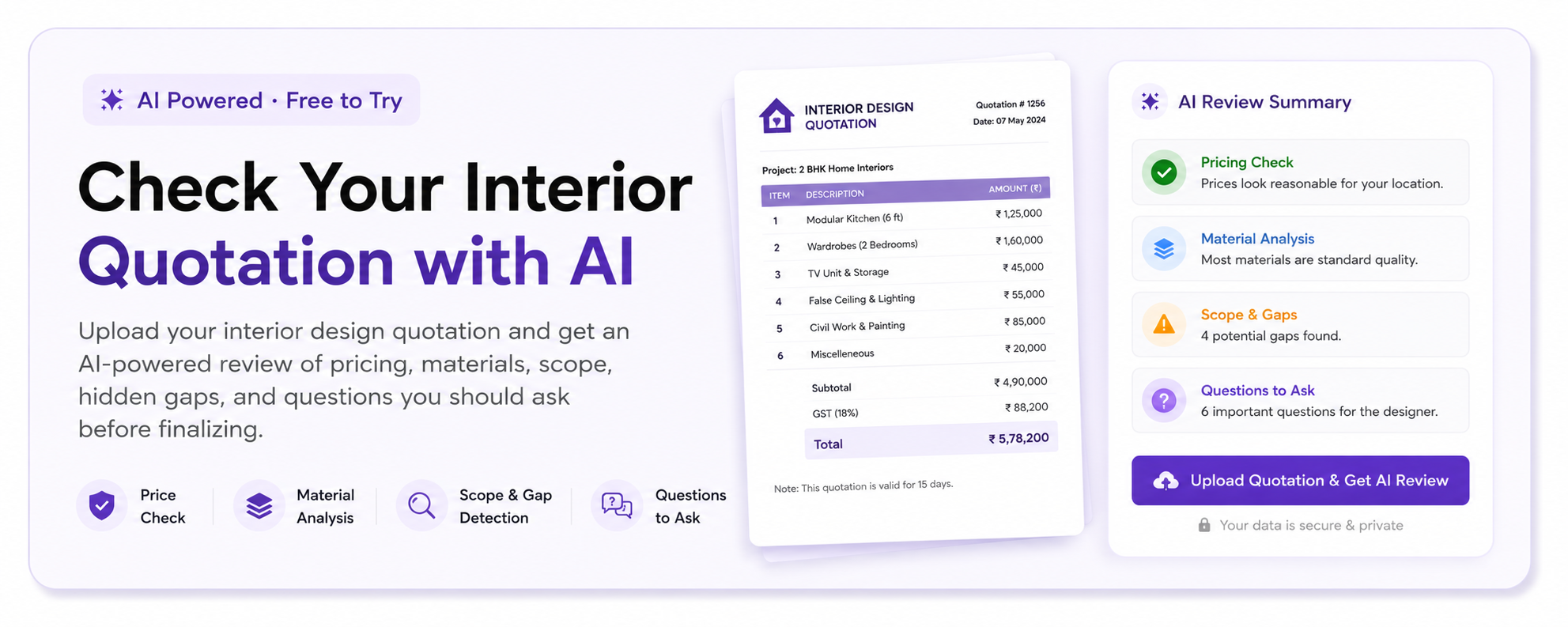
Run the proposal through the quotation checker to spot missing fields and prepare better follow-up questions.
6. Prepare for execution in an apartment community
Before work begins, confirm practical details with the designer and your society or building management. The exact process varies by property, so rely on the rules issued for your home rather than assumptions.
- Who applies for work permissions and books the service lift?
- Where can materials be unloaded and temporarily stored?
- What are the permitted working hours and restrictions on drilling or debris?
- Who protects flooring, lifts and common areas during movement of materials?
- How will dust, packaging and construction waste be removed?
- What happens if the handover date, appliance delivery or civil repair is delayed?
Ask for a written execution sequence. Modular production, on-site civil work and installation may overlap, but the dependency between them should be understandable. Take dated photographs of the home before work starts and maintain a simple decisions register.
7. Know the red flags before paying an advance
Pause and clarify
- Large advance requested before a written scope or design agreement.
- One unexplained lump sum for several rooms.
- Material descriptions based only on words such as “best” or “premium”.
- Pressure to approve immediately because the offer is “valid today”.
Ask for evidence in writing
- Promised completion dates that have no milestones.
- Verbal assurances about warranty or free additions.
- Unclear responsibility for appliances, electrical fixtures or civil repairs.
- No process for design changes, delays, defects or cancellations.
A low quote is not automatically a problem, and a high quote is not automatically safer. The concern is an inability to explain the difference. Ask each designer to revise the document until you can identify what you are paying for.
Questions to ask before paying an advance
- What exact deliverables does this payment cover?
- Is the advance adjustable against the final bill, and under what conditions?
- When will site measurements, drawings and material samples be provided?
- Which decisions must be finalised before manufacturing starts?
- How are additional work and client-requested changes approved?
- What are the payment milestones, and what work is linked to each one?
- Who owns the drawings and what happens if the project does not proceed?
- How will defects, missing parts and post-installation service be handled?
Make your comparison easier
Save each proposal with its drawings, sample list and revisions. You can also explore design ideas to refine your brief before requesting changes. When you are ready to compare options, use the designer directory to continue your search among companies serving Hinjewadi and Pune.
Frequently asked questions
1. How many interior quotations should I compare?
Two or three comparable, written quotations are usually more useful than many informal estimates. Give each designer the same brief and ask for exclusions.
2. Should I choose the lowest quotation?
Not without checking scope, material specifications, hardware, taxes, timeline and after-sales support. A cheaper total may simply leave out important work.
3. Does a quotation include appliances and loose furniture?
Only if stated. Confirm responsibility for appliances, lights, curtains, mattresses, dining furniture and other movable items separately.
4. What should be written about changes?
The document should explain how additions, deletions and specification changes are requested, priced and approved before execution.
5. Can I use a cost estimate instead of a designer quotation?
A cost estimate is useful for early planning, but it cannot replace site measurements, drawings, material selections and a project-specific commercial proposal.
Get a personalised estimate for your home
Choose your rooms, materials and preferences to understand a practical interior budget before you commit.